


 本文详细解析了NioSocketAcceptor的工作流程,包括初始化、绑定、接收连接及数据处理等关键步骤,并深入探讨了其内部实现机制。

1 NioSocketAcceptor类关系图
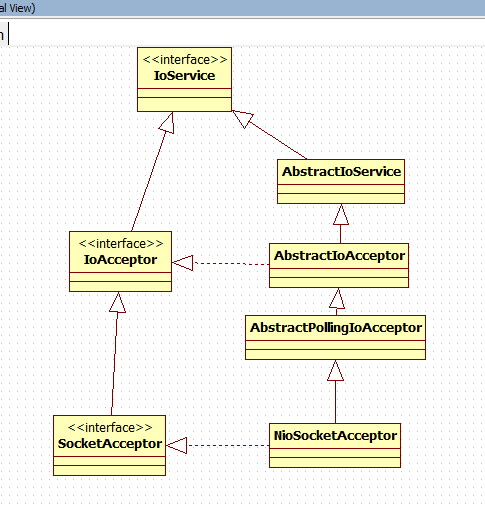
1.1 NioSocketAcceptor acceptor = new NioSocketAcceptor(5);
NioSocketAcceptor 初始化顺序
AbstractIoService构造函数
protected AbstractIoService(IoSessionConfig sessionConfig, Executor executor) {
        if (sessionConfig == null) {
            throw new IllegalArgumentException("sessionConfig");
        }

        if (getTransportMetadata() == null) {
            throw new IllegalArgumentException("TransportMetadata");
        }

        if (!getTransportMetadata().getSessionConfigType().isAssignableFrom(
                sessionConfig.getClass())) {
            throw new IllegalArgumentException("sessionConfig type: "
                    + sessionConfig.getClass() + " (expected: "
                    + getTransportMetadata().getSessionConfigType() + ")");
        }

        // Create the listeners, and add a first listener : a activation listener
        // for this service, which will give information on the service state.
        listeners = new IoServiceListenerSupport(this);
        listeners.add(serviceActivationListener);

        // Stores the given session configuration
        this.sessionConfig = sessionConfig;

        // Make JVM load the exception monitor before some transports
        // change the thread context class loader.
        ExceptionMonitor.getInstance();

        if (executor == null) {
            this.executor = Executors.newCachedThreadPool();
            createdExecutor = true;
        } else {
            this.executor = executor;
            createdExecutor = false;
        }

        threadName = getClass().getSimpleName() + '-' + id.incrementAndGet();
    }
protected AbstractIoAcceptor(IoSessionConfig sessionConfig, Executor executor) {
super(sessionConfig, executor);
defaultLocalAddresses.add(null);
}AbstractPollingIoAcceptor 构造函数
private AbstractPollingIoAcceptor(IoSessionConfig sessionConfig,
            Executor executor, IoProcessor<S> processor,
            boolean createdProcessor) {
        super(sessionConfig, executor);

        if (processor == null) {
            throw new IllegalArgumentException("processor");
        }

        this.processor = processor;
        this.createdProcessor = createdProcessor;

        try {
            // Initialize the selector
            init();

            // The selector is now ready, we can switch the
            // flag to true so that incoming connection can be accepted
            selectable = true;
        } catch (RuntimeException e) {
            throw e;
        } catch (Exception e) {
            throw new RuntimeIoException("Failed to initialize.", e);
        } finally {
            if (!selectable) {
                try {
                    destroy();
                } catch (Exception e) {
                    ExceptionMonitor.getInstance().exceptionCaught(e);
                }
            }
        }
    }
NioSocketAcceptor 构造函数
public NioSocketAcceptor(int processorCount) {
        super(new DefaultSocketSessionConfig(), NioProcessor.class, processorCount);
        ((DefaultSocketSessionConfig) getSessionConfig()).init(this);
    }
1.2 IoFilterChain 过滤链
acceptor.getFilterChain().addLast("logger", new LoggingFilter());
/**  AbstractIoService
     * {@inheritDoc}
     */
    public final DefaultIoFilterChainBuilder getFilterChain() {
        if (filterChainBuilder instanceof DefaultIoFilterChainBuilder) {
            return (DefaultIoFilterChainBuilder) filterChainBuilder;
        }


        throw new IllegalStateException(
                    "Current filter chain builder is not a DefaultIoFilterChainBuilder.");
    }
源代码:
public class DefaultIoFilterChainBuilder implements IoFilterChainBuilder {

    private final static Logger LOGGER =
        LoggerFactory.getLogger(DefaultIoFilterChainBuilder.class);
    private final List<Entry> entries;

    /**
     * Creates a new instance with an empty filter list.
     */
    public DefaultIoFilterChainBuilder() {
        entries = new CopyOnWriteArrayList<Entry>();
    }

    /**
     * Creates a new copy of the specified {@link DefaultIoFilterChainBuilder}.
     */
    public DefaultIoFilterChainBuilder(DefaultIoFilterChainBuilder filterChain) {
        if (filterChain == null) {
            throw new IllegalArgumentException("filterChain");
        }
        entries = new CopyOnWriteArrayList<Entry>(filterChain.entries);
    }
addLast
/**
     * @see IoFilterChain#addLast(String, IoFilter)
     */
    public synchronized void addLast(String name, IoFilter filter) {
        register(entries.size(), new EntryImpl(name, filter));
    }
   private void register(int index, Entry e) {
        if (contains(e.getName())) {
            throw new IllegalArgumentException(
                    "Other filter is using the same name: " + e.getName());
        }

        entries.add(index, e);
    }
1.3 IoFilter
1.4 IoSessionConfig
1.4 IoProcess
1.5 acceptor.bind(new InetSocketAddress(this.serverAddr, this.serverPort));
最终会运行AbstractPollingIoAcceptor.bindInternal
AbstractPollingIoAcceptor
protected final Set<SocketAddress> bindInternal(
            List<? extends SocketAddress> localAddresses) throws Exception {
        // Create a bind request as a Future operation. When the selector
        // have handled the registration, it will signal this future.
        AcceptorOperationFuture request = new AcceptorOperationFuture(
                localAddresses);

        // adds the Registration request to the queue for the Workers
        // to handle
        registerQueue.add(request);

        // creates the Acceptor instance and has the local
        // executor kick it off.
        startupAcceptor();

        // As we just started the acceptor, we have to unblock the select()
        // in order to process the bind request we just have added to the
        // registerQueue.
        wakeup();

        // Now, we wait until this request is completed.
        request.awaitUninterruptibly();

        if (request.getException() != null) {
            throw request.getException();
        }

        // Update the local addresses.
        // setLocalAddresses() shouldn't be called from the worker thread
        // because of deadlock.
        Set<SocketAddress> newLocalAddresses = new HashSet<SocketAddress>();

        for (H handle:boundHandles.values()) {
            newLocalAddresses.add(localAddress(handle));
        }

        return newLocalAddresses;
    }
1.5.1 startupAcceptor() 使用线程池执行Acceptor
/**
     * This method is called by the doBind() and doUnbind()
     * methods.  If the acceptor is null, the acceptor object will
     * be created and kicked off by the executor.  If the acceptor
     * object is null, probably already created and this class
     * is now working, then nothing will happen and the method
     * will just return.
     */
    private void startupAcceptor() {
        // If the acceptor is not ready, clear the queues
        // TODO : they should already be clean : do we have to do that ?
        if (!selectable) {
            registerQueue.clear();
            cancelQueue.clear();
        }

        // start the acceptor if not already started
        Acceptor acceptor = acceptorRef.get();

        if (acceptor == null) {
            acceptor = new Acceptor();

            if (acceptorRef.compareAndSet(null, acceptor)) {
                executeWorker(acceptor);
            }
        }
    }
Acceptor() 实现了Runnable接口 不停的执行
/**
     * This class is called by the startupAcceptor() method and is
     * placed into a NamePreservingRunnable class.
     * It's a thread accepting incoming connections from clients.
     * The loop is stopped when all the bound handlers are unbound.
     */
    private class Acceptor implements Runnable {
        public void run() {
            assert (acceptorRef.get() == this);

            int nHandles = 0;

            while (selectable) {
                try {
                    // Detect if we have some keys ready to be processed
                    // The select() will be woke up if some new connection
                    // have occurred, or if the selector has been explicitly
                    // woke up
                    int selected = select();

                    // this actually sets the selector to OP_ACCEPT,
                    // and binds to the port on which this class will
                    // listen on
                    nHandles += registerHandles();

                    // Now, if the number of registred handles is 0, we can
                    // quit the loop: we don't have any socket listening
                    // for incoming connection.
                    if (nHandles == 0) {
                        acceptorRef.set(null);

                        if (registerQueue.isEmpty() && cancelQueue.isEmpty()) {
                            assert (acceptorRef.get() != this);
                            break;
                        }

                        if (!acceptorRef.compareAndSet(null, this)) {
                            assert (acceptorRef.get() != this);
                            break;
                        }

                        assert (acceptorRef.get() == this);
                    }

                    if (selected > 0) {
                        // We have some connection request, let's process
                        // them here.
                        processHandles(selectedHandles());
                    }

                    // check to see if any cancellation request has been made.
                    nHandles -= unregisterHandles();
                } catch (ClosedSelectorException cse) {
                    // If the selector has been closed, we can exit the loop
                    break;
                } catch (Throwable e) {
                    ExceptionMonitor.getInstance().exceptionCaught(e);

                    try {
                        Thread.sleep(1000);
                    } catch (InterruptedException e1) {
                        ExceptionMonitor.getInstance().exceptionCaught(e1);
                    }
                }
            }

            // Cleanup all the processors, and shutdown the acceptor.
            if (selectable && isDisposing()) {
                selectable = false;
                try {
                    if (createdProcessor) {
                        processor.dispose();
                    }
                } finally {
                    try {
                        synchronized (disposalLock) {
                            if (isDisposing()) {
                                destroy();
                            }
                        }
                    } catch (Exception e) {
                        ExceptionMonitor.getInstance().exceptionCaught(e);
                    } finally {
                        disposalFuture.setDone();
                    }
                }
            }
        }
NioSocketAcceptor
/**
* Check if we have at least one key whose corresponding channels is
* ready for I/O operations.
*
* This method performs a blocking selection operation.
* It returns only after at least one channel is selected,
* this selector's wakeup method is invoked, or the current thread
* is interrupted, whichever comes first.
*
* @return The number of keys having their ready-operation set updated
* @throws IOException If an I/O error occurs
* @throws ClosedSelectorException If this selector is closed
*/
@Override
protected int select() throws Exception {
return selector.select();
}请问
/**
     * Sets up the socket communications.  Sets items such as:
     * <p/>
     * Blocking
     * Reuse address
     * Receive buffer size
     * Bind to listen port
     * Registers OP_ACCEPT for selector
     */
    private int registerHandles() {
        for (;;) {
            // The register queue contains the list of services to manage
            // in this acceptor.
            AcceptorOperationFuture future = registerQueue.poll();

            if (future == null) {
                return 0;
            }

            // We create a temporary map to store the bound handles,
            // as we may have to remove them all if there is an exception
            // during the sockets opening.
            Map<SocketAddress, H> newHandles = new ConcurrentHashMap<SocketAddress, H>();
            List<SocketAddress> localAddresses = future.getLocalAddresses();

            try {
                // Process all the addresses
                for (SocketAddress a : localAddresses) {
                    H handle = open(a);
                    newHandles.put(localAddress(handle), handle);
                }

                // Everything went ok, we can now update the map storing
                // all the bound sockets.
                boundHandles.putAll(newHandles);

                // and notify.
                future.setDone();
                return newHandles.size();
            } catch (Exception e) {
                // We store the exception in the future
                future.setException(e);
            } finally {
                // Roll back if failed to bind all addresses.
                if (future.getException() != null) {
                    for (H handle : newHandles.values()) {
                        try {
                            close(handle);
                        } catch (Exception e) {
                            ExceptionMonitor.getInstance().exceptionCaught(e);
                        }
                    }

                    // TODO : add some comment : what is the wakeup() waking up ?
                    wakeup();
                }
            }
        }
    }
接上图open方法 jdk自带的NIO
/**
     * {@inheritDoc}
     */
    @Override
    protected ServerSocketChannel open(SocketAddress localAddress)
            throws Exception {
        // Creates the listening ServerSocket
        ServerSocketChannel channel = ServerSocketChannel.open();

        boolean success = false;

        try {
            // This is a non blocking socket channel
            channel.configureBlocking(false);

            // Configure the server socket,
            ServerSocket socket = channel.socket();

            // Set the reuseAddress flag accordingly with the setting
            socket.setReuseAddress(isReuseAddress());

            // and bind.
            socket.bind(localAddress, getBacklog());

            // Register the channel within the selector for ACCEPT event
            channel.register(selector, SelectionKey.OP_ACCEPT);
            success = true;
        } finally {
            if (!success) {
                close(channel);
            }
        }
        return channel;
    }
Acceptor接收数据
if (selected > 0) {
                        // We have some connection request, let's process
                        // them here.
                        processHandles(selectedHandles());
                    }
/**
* This method will process new sessions for the Worker class. All
* keys that have had their status updates as per the Selector.selectedKeys()
* method will be processed here. Only keys that are ready to accept
* connections are handled here.
* <p/>
* Session objects are created by making new instances of SocketSessionImpl
* and passing the session object to the SocketIoProcessor class.
*/
@SuppressWarnings("unchecked")
private void processHandles(Iterator<H> handles) throws Exception {
while (handles.hasNext()) {
H handle = handles.next();
handles.remove();
// Associates a new created connection to a processor,
// and get back a session
S session = accept(processor, handle);
if (session == null) {
break;
}
//初始化session
initSession(session, null, null);
// add the session to the SocketIoProcessor 过滤链处理数据入口
session.getProcessor().add(session);
}
}processHandles 的accept 获取SocketChannel 封装成NioSocketSessionprotected NioSession accept(IoProcessor<NioSession> processor,
ServerSocketChannel handle) throws Exception {
SelectionKey key = handle.keyFor(selector);
if ((key == null) || (!key.isValid()) || (!key.isAcceptable()) ) {
return null;
}
// accept the connection from the client
SocketChannel ch = handle.accept();
if (ch == null) {
return null;
}
return new NioSocketSession(this, processor, ch);
}processor
/**
     * {@inheritDoc}
     */
    public final void add(S session) {
        if (disposed || disposing) {
            throw new IllegalStateException("Already disposed.");
        }

        // Adds the session to the newSession queue and starts the worker
        newSessions.add(session);
        startupProcessor();
    }
    /**
     * Starts the inner Processor, asking the executor to pick a thread in its
     * pool. The Runnable will be renamed
     */
    private void startupProcessor() {
        Processor processor = processorRef.get();

        if (processor == null) {
            processor = new Processor();

            if (processorRef.compareAndSet(null, processor)) {
                executor.execute(new NamePreservingRunnable(processor, threadName));
            }
        }

        // Just stop the select() and start it again, so that the processor
        // can be activated immediately.
        wakeup();
    }
主要接收数据处理代码逻辑
/**
     * The main loop. This is the place in charge to poll the Selector, and to
     * process the active sessions. It's done in
     * - handle the newly created sessions
     * -
     */
    private class Processor implements Runnable {
        public void run() {
            assert (processorRef.get() == this);

            int nSessions = 0;
            lastIdleCheckTime = System.currentTimeMillis();

            for (;;) {
                try {
                    // This select has a timeout so that we can manage
                    // idle session when we get out of the select every
                    // second. (note : this is a hack to avoid creating
                    // a dedicated thread).
                    long t0 = System.currentTimeMillis();
                    int selected = select(SELECT_TIMEOUT);
                    long t1 = System.currentTimeMillis();
                    long delta = (t1 - t0);

                    if ((selected == 0) && !wakeupCalled.get() && (delta < 100)) {
                        // Last chance : the select() may have been
                        // interrupted because we have had an closed channel.
                        if (isBrokenConnection()) {
                            LOG.warn("Broken connection");

                            // we can reselect immediately
                            // set back the flag to false
                            wakeupCalled.getAndSet(false);

                            continue;
                        } else {
                            LOG.warn("Create a new selector. Selected is 0, delta = "
                                            + (t1 - t0));
                            // Ok, we are hit by the nasty epoll
                            // spinning.
                            // Basically, there is a race condition
                            // which causes a closing file descriptor not to be
                            // considered as available as a selected channel, but
                            // it stopped the select. The next time we will
                            // call select(), it will exit immediately for the same
                            // reason, and do so forever, consuming 100%
                            // CPU.
                            // We have to destroy the selector, and
                            // register all the socket on a new one.
                            registerNewSelector();
                        }

                        // Set back the flag to false
                        wakeupCalled.getAndSet(false);

                        // and continue the loop
                        continue;
                    }

                    // Manage newly created session first
                    nSessions += handleNewSessions();

                    updateTrafficMask();

                    // Now, if we have had some incoming or outgoing events,
                    // deal with them
                    if (selected > 0) {
                        //LOG.debug("Processing ..."); // This log hurts one of the MDCFilter test...
                        process();
                    }

                    // Write the pending requests
                    long currentTime = System.currentTimeMillis();
                    flush(currentTime);

                    // And manage removed sessions
                    nSessions -= removeSessions();

                    // Last, not least, send Idle events to the idle sessions
                    notifyIdleSessions(currentTime);

                    // Get a chance to exit the infinite loop if there are no
                    // more sessions on this Processor
                    if (nSessions == 0) {
                        processorRef.set(null);

                        if (newSessions.isEmpty() && isSelectorEmpty()) {
                            // newSessions.add() precedes startupProcessor
                            assert (processorRef.get() != this);
                            break;
                        }

                        assert (processorRef.get() != this);

                        if (!processorRef.compareAndSet(null, this)) {
                            // startupProcessor won race, so must exit processor
                            assert (processorRef.get() != this);
                            break;
                        }

                        assert (processorRef.get() == this);
                    }

                    // Disconnect all sessions immediately if disposal has been
                    // requested so that we exit this loop eventually.
                    if (isDisposing()) {
                        for (Iterator<S> i = allSessions(); i.hasNext();) {
                            scheduleRemove(i.next());
                        }

                        wakeup();
                    }
                } catch (ClosedSelectorException cse) {
                    // If the selector has been closed, we can exit the loop
                    break;
                } catch (Throwable t) {
                    ExceptionMonitor.getInstance().exceptionCaught(t);

                    try {
                        Thread.sleep(1000);
                    } catch (InterruptedException e1) {
                        ExceptionMonitor.getInstance().exceptionCaught(e1);
                    }
                }
            }

            try {
                synchronized (disposalLock) {
                    if (disposing) {
                        doDispose();
                    }
                }
            } catch (Throwable t) {
                ExceptionMonitor.getInstance().exceptionCaught(t);
            } finally {
                disposalFuture.setValue(true);
            }
        }
    }
过滤链:
private void process() throws Exception {
        for (Iterator<S> i = selectedSessions(); i.hasNext();) {
            S session = i.next();
            process(session);
            i.remove();
        }
    }

    /**
     * Deal with session ready for the read or write operations, or both.
     */
    private void process(S session) {
        // Process Reads
        if (isReadable(session) && !session.isReadSuspended()) {
            read(session);
        }

        // Process writes
        if (isWritable(session) && !session.isWriteSuspended()) {
            // add the session to the queue, if it's not already there
            if (session.setScheduledForFlush(true)) {
                flushingSessions.add(session);
            }
        }
    }

  private void read(S session) {
        IoSessionConfig config = session.getConfig();
        int bufferSize = config.getReadBufferSize();
        IoBuffer buf = IoBuffer.allocate(bufferSize);

        final boolean hasFragmentation = session.getTransportMetadata()
                .hasFragmentation();

        try {
            int readBytes = 0;
            int ret;

            try {
                if (hasFragmentation) {

                    while ((ret = read(session, buf)) > 0) {
                        readBytes += ret;

                        if (!buf.hasRemaining()) {
                            break;
                        }
                    }
                } else {
                    ret = read(session, buf);

                    if (ret > 0) {
                        readBytes = ret;
                    }
                }
            } finally {
                buf.flip();
            }

            if (readBytes > 0) {
//处理逻辑
                IoFilterChain filterChain = session.getFilterChain();
                filterChain.fireMessageReceived(buf);
                buf = null;

                if (hasFragmentation) {
                    if (readBytes << 1 < config.getReadBufferSize()) {
                        session.decreaseReadBufferSize();
                    } else if (readBytes == config.getReadBufferSize()) {
                        session.increaseReadBufferSize();
                    }
                }
            }

            if (ret < 0) {
                scheduleRemove(session);
            }
        } catch (Throwable e) {
            if (e instanceof IOException) {
                if (!(e instanceof PortUnreachableException)
                        || !AbstractDatagramSessionConfig.class.isAssignableFrom(config.getClass())
                        || ((AbstractDatagramSessionConfig) config).isCloseOnPortUnreachable()) {
                    scheduleRemove(session);
                }
            }

            IoFilterChain filterChain = session.getFilterChain();
            filterChain.fireExceptionCaught(e);
        }
    }
调用过滤连: DefaultIoFilterChain
public void fireMessageReceived(Object message) {
        if (message instanceof IoBuffer) {
            session.increaseReadBytes(((IoBuffer) message).remaining(), System
                    .currentTimeMillis());
        }

        Entry head = this.head;
        callNextMessageReceived(head, session, message);
    }

    private void callNextMessageReceived(Entry entry, IoSession session,
            Object message) {
        try {
            IoFilter filter = entry.getFilter();
            NextFilter nextFilter = entry.getNextFilter();
            filter.messageReceived(nextFilter, session,
                    message);
        } catch (Throwable e) {
            fireExceptionCaught(e);
        }
    }
业务处理handler总是最后处理





 扫一扫
扫一扫


 415
415

 被折叠的 条评论
为什么被折叠?
被折叠的 条评论
为什么被折叠?
 到【灌水乐园】发言





