


 本文介绍了如何导入葡萄酒数据集并进行预处理,包括划分训练集和测试集、特征缩放等步骤,提供了完整的Python代码实现。
导入葡萄酒数据:
 1 import numpy as np
 2 import pandas as pd
 3
 4 df_wine = pd.read_csv("https://archive.ics.uci.edu/ml/machine-learning-databases/wine/wine.data", header=None)
 5 df_wine.columns = ["class label", "alcohol",
 6                    "malic acid", "ash",
 7                    "alcalinity of ash", "magnesium",
 8                    "total phenols", "flavanoids",
 9                    "nonflavaniod phenols", "proanthocyanins",
10                    "color intensity", "hue",
11                    "OD280/OD315 of diluted wines", "proline"]
12 # 查看类标
13 print("class label:", np.unique(df_wine["class label"]))
14 print(df_wine.head())
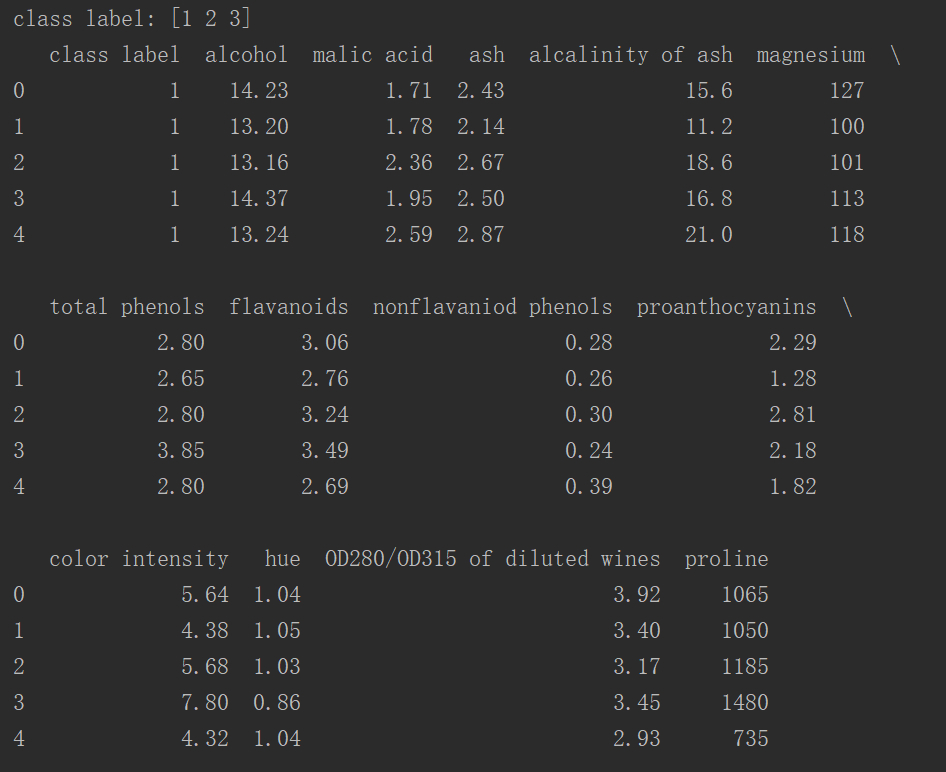
运行结果:
划分训练集和测试集:
我们可以使用 sklearn.model_selection 中的 train_test_split 划分数据,test_size用来设置测试数据的比例,random_state用来
设置随机数是否保持一致。
1 from sklearn.model_selection import train_test_split
2 # import warnings
3 # warnings.filterwarnings('ignore')
4 x, y = df_wine.iloc[:, 1:].values, df_wine.iloc[:, 0].values
5 x_train, x_test, y_train, y_test = train_test_split(x, y, test_size=0.3, random_state=0)
这里如果你用的是 sklearn.cross_validation 的 train_test_split ,那么代码是会报警告的,由于版本的更新,推荐使用上面的代码。
特征缩放:
特征缩放我们可以采用归一化和标准化两者方法
 1 # 特征缩放:归一化
 2 from sklearn.preprocessing import MinMaxScaler
 3 mms = MinMaxScaler()
 4 x_train_norm = mms.fit_transform(x_train)
 5 x_test_norm = mms.transform(x_test)
 6 print(x_test_norm, "\n")
 7
 8 # 特征缩放:标准化
 9 from sklearn.preprocessing import StandardScaler
10 stdsc = StandardScaler()
11 x_train_std = stdsc.fit_transform(x_train)
12 x_test_std = stdsc.transform(x_test)
13 print(x_test_std)





 扫一扫
扫一扫


 被折叠的 条评论
为什么被折叠?
被折叠的 条评论
为什么被折叠?
 到【灌水乐园】发言





