



1、BeanFactoryPostProcessor
BeanFactoryPostProcessor是spring BeanFactory加载Bean后调用
AbstractApplicationContext#refresh调用方法invokeBeanFactoryPostProcessors(beanFactory);
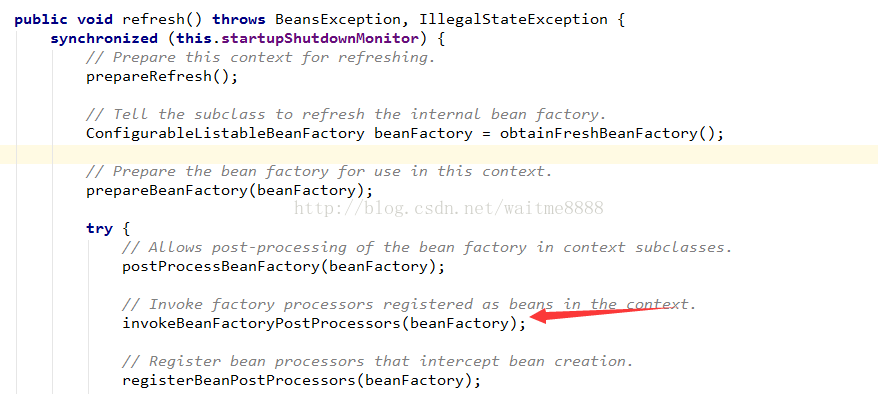


这里需要注意BeanDefinitionRegistryPostProcessor类,他继承BeanFactoryPostProcessor,先执行postProcessBeanDefinitionRegistry方法
public interface BeanDefinitionRegistryPostProcessor extends BeanFactoryPostProcessor {

	/**
	 * Modify the application context's internal bean definition registry after its
	 * standard initialization. All regular bean definitions will have been loaded,
	 * but no beans will have been instantiated yet. This allows for adding further
	 * bean definitions before the next post-processing phase kicks in.
	 * @param registry the bean definition registry used by the application context
	 * @throws org.springframework.beans.BeansException in case of errors
	 */
	void postProcessBeanDefinitionRegistry(BeanDefinitionRegistry registry) throws BeansException;

}
2、BeanPostProcessor
BeanPostProcessor是Bean初始化前后调用

BeanPostProcessor接口如下
public interface BeanPostProcessor {

	/**
	 * Apply this BeanPostProcessor to the given new bean instance <i>before</i> any bean
	 * initialization callbacks (like InitializingBean's {@code afterPropertiesSet}
	 * or a custom init-method). The bean will already be populated with property values.
	 * The returned bean instance may be a wrapper around the original.
	 * @param bean the new bean instance
	 * @param beanName the name of the bean
	 * @return the bean instance to use, either the original or a wrapped one; if
	 * {@code null}, no subsequent BeanPostProcessors will be invoked
	 * @throws org.springframework.beans.BeansException in case of errors
	 * @see org.springframework.beans.factory.InitializingBean#afterPropertiesSet
	 */
	Object postProcessBeforeInitialization(Object bean, String beanName) throws BeansException;

	/**
	 * Apply this BeanPostProcessor to the given new bean instance <i>after</i> any bean
	 * initialization callbacks (like InitializingBean's {@code afterPropertiesSet}
	 * or a custom init-method). The bean will already be populated with property values.
	 * The returned bean instance may be a wrapper around the original.
	 * <p>In case of a FactoryBean, this callback will be invoked for both the FactoryBean
	 * instance and the objects created by the FactoryBean (as of Spring 2.0). The
	 * post-processor can decide whether to apply to either the FactoryBean or created
	 * objects or both through corresponding {@code bean instanceof FactoryBean} checks.
	 * <p>This callback will also be invoked after a short-circuiting triggered by a
	 * {@link InstantiationAwareBeanPostProcessor#postProcessBeforeInstantiation} method,
	 * in contrast to all other BeanPostProcessor callbacks.
	 * @param bean the new bean instance
	 * @param beanName the name of the bean
	 * @return the bean instance to use, either the original or a wrapped one; if
	 * {@code null}, no subsequent BeanPostProcessors will be invoked
	 * @throws org.springframework.beans.BeansException in case of errors
	 * @see org.springframework.beans.factory.InitializingBean#afterPropertiesSet
	 * @see org.springframework.beans.factory.FactoryBean
	 */
	Object postProcessAfterInitialization(Object bean, String beanName) throws BeansException;

}
ben初始化执行顺序详见《
Spring源码分析(二)》





 扫一扫
扫一扫


 1081
1081

 被折叠的 条评论
为什么被折叠?
被折叠的 条评论
为什么被折叠?
 到【灌水乐园】发言





