



Spring事务的本质其实就是数据库对事务的支持
一:数据库事务
事务的特性(ACID)
- 原子性(Atomicity):原子性是指事务是一个不可分割的工作单位,事务中的操作要么都发生,要么都不发生。
- 一致性(Consistency):事务前后数据的完整性必须保持一致。
- 隔离性(Isolation):事务的隔离性是指多个用户并发访问数据库时,一个用户的事务不能被其它用户的事务所干扰,多个并发事务之间数据要相互隔离。
- 持久性(Durability):持久性是指一个事务一旦被提交,它对数据库中数据的改变就是永久性的,接下来即使数据库发生故障也不应该对其有任何影响
概念说明:
- 脏读:指当一个事务正在访问数据,并且对数据进行了修改,而这种数据还没有提交到数据库中,这时,另外一个事务也访问这个数据,然后使用了这个数据。因为这个数据还没有提交那么另外一个事务读取到的这个数据我们称之为脏数据。依据脏数据所做的操作肯能是不正确的。
- 不可重复读:指在一个事务内,多次读同一数据。在这个事务还没有执行结束,另外一个事务也访问该同一数据,那么在第一个事务中的两次读取数据之间,由于第二个事务的修改第一个事务两次读到的数据可能是不一样的,这样就发生了在一个事物内两次连续读到的数据是不一样的,这种情况被称为是不可重复读。
- 幻读:一个事务先后读取一个范围的记录,但两次读取的纪录数不同,我们称之为幻读(两次执行同一条 select 语句会出现不同的结果,第二次读会增加一数据行,并没有说这两次执行是在同一个事务中)
- 丢失更新:如果两个事务都在对同一数据同时进行修改操作,那么其中一个必然会覆盖另一个的操作
事务的四种隔离级别:
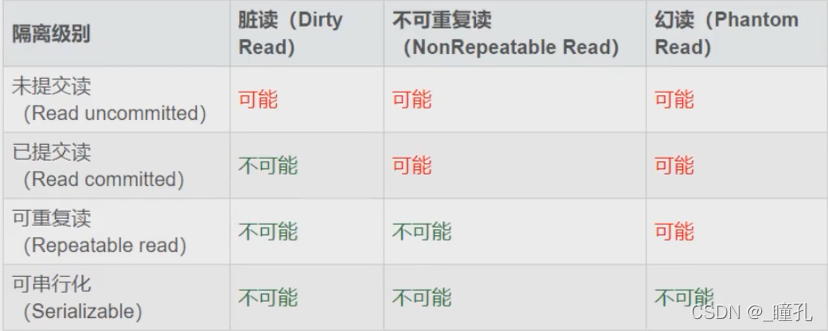
隔离级别概念说明:
读未提交 (Read uncommitted):就是一个事务可以读取另一个未提交事务的数据。
示例:老板要给程序员发工资,程序员的工资是3.6万/月。但是发工资时老板不小心按错了数字,按成3.9万/月,该钱已经打到程序员的户口,但是事务还没有提交,就在这时,程序员去查看自己这个月的工资,发现比往常多了3千元,以为涨工资了非常高兴。但是老板及时发现了不对,马上回滚差点就提交了的事务,将数字改成3.6万再提交。
分析:实际程序员这个月的工资还是3.6万,但是程序员看到的是3.9万。他看到的是老板还没提交事务时的数据。这就是脏读。因此,在这种隔离级别下,查询是不会加锁的,也由于查询的不加锁,所以这种隔离级别的一致性是最差的,可能会产生“脏读”、“不可重复读”、“幻读”。如无特殊情况,基本是不会使用这种隔离级别的。
读提交(Read Committed):就是只能读到已经提交了的内容。
示例:程序员拿着信用卡去享受生活(卡里当然是只有3.6万),当他埋单时(程序员事务开启),收费系统事先检测到他的卡里有3.6万,就在这个时候!!程序员的妻子要把钱全部转出充当家用,并提交。当收费系统准备扣款时,再检测卡里的金额,发现已经没钱了(第二次检测金额当然要等待妻子转出金额事务提交完)。程序员就会很郁闷,明明卡里是有钱的…
分析:这就是读提交,若有事务对数据进行更新(UPDATE)操作时,读操作事务要等待这个更新操作事务提交后才能读取数据,可以解决脏读问题。但在这个事例中,出现了一个事务范围内两个相同的查询却返回了不同数据,这就是不可重复读。
这是各种系统中最常用的一种隔离级别,也是SQL Server和Oracle的默认隔离级别。这种隔离级别能够有效的避免脏读,但除非在查询中显示的加锁,如:
select * from T where ID=2 lock in share mode;
select * from T where ID=2 for update;
不然,普通的查询是不会加锁的。那为什么“读提交”同“读未提交”一样,都没有查询加锁,但是却能够避免脏读呢?这就要说道另一个机制“快照(snapshot)”,而这种既能保证一致性又不加锁的读也被称为“快照读(Snapshot Read)”。假设没有“快照读”,那么当一个更新的事务没有提交时,另一个对更新数据进行查询的事务会因为无法查询而被阻塞(因为上了X锁,即写锁,所以不能得到S锁,即读锁),这种情况下,并发能力就相当的差。而“快照读”就可以完成高并发的查询,不过,“读提交”只能避免“脏读”,并不能避免“不可重复读”和“幻读”。
可重复读(Repeated Read):就是专门针对“不可重复读”这种情况而制定的隔离级别,自然,它就可以有效的避免“不可重复读”。而它也是MySql的默认隔离级别。
示例:程序员拿着信用卡去享受生活(卡里当然是只有3.6万),当他埋单时(事务开启,不允许其他事务的UPDATE修改操作),收费系统事先检测到他的卡里有3.6万。这个时候他的妻子不能转出金额了。接下来收费系统就可以扣款了。
分析:重复读可以解决不可重复读问题。写到这里,应该明白的一点就是,不可重复读对应的是修改,即UPDATE操作。但是可能还会有幻读问题。因为幻读问题对应的是插入INSERT操作,而不是UPDATE操作。
什么时候会出现幻读?
示例:程序员某一天去消费,花了2千元,然后他的妻子去查看他今天的消费记录(全表扫描FTS,妻子事务开启),看到确实是花了2千元,就在这个时候,程序员花了1万买了一部电脑,即新增INSERT了一条消费记录,并提交。当妻子打印程序员的消费记录清单时(妻子事务提交),发现花了1.2万元,似乎出现了幻觉,这就是幻读。
在这个级别下,普通的查询同样是使用的“快照读”,但是,和“读提交”不同的是,当事务启动时,就不允许进行“修改操作(Update)”了,而“不可重复读”恰恰是因为两次读取之间进行了数据的修改,因此,“可重复读”能够有效的避免“不可重复读”,但却避免不了“幻读”,因为幻读是由于“插入或者删除操作(Insert or Delete)”而产生的。
序列化 Serializable
这是数据库最高的隔离级别,这种级别下,事务“串行化顺序执行”,也就是一个一个排队执行。这种级别下,“脏读”、“不可重复读”、“幻读”都可以被避免,但是执行效率奇差,性能开销也最大,所以基本没人会用。
以上内容参考链接:数据库的四种隔离级别
查看隔离级别:
# 全局隔离级别
SELECT @@GLOBAL.transaction_isolation;
# 会话隔离级别
SELECT @@SESSION.transaction_isolation;
以下命令均为mysql8
设置隔离级别:
# 设置全局隔离级别
set global transaction isolation level READ UNCOMMITTED;
set global transaction isolation level READ COMMITTED;
set global transaction isolation level REPEATABLE READ;
set global transaction isolation level SERIALIZABLE;

#设置会话隔离级别
set session transaction isolation level READ UNCOMMITTED;
set session transaction isolation level READ COMMITTED;
set session transaction isolation level REPEATABLE READ;
set session transaction isolation level SERIALIZABLE;
二:Spring事务
Spring事务的本质其实就是数据库对事务的支持,使用JDBC的事务管理机制,就是利用java.sql.Connection对象完成对事务的提交,那在没有Spring帮我们管理事务之前,我们要怎么做。
Connection conn = DriverManager.getConnection();
try {
    conn.setAutoCommit(false);  //将自动提交设置为false
    执行CRUD操作
    conn.commit();      //当两个操作成功后手动提交
} catch (Exception e) {
    conn.rollback();    //一旦其中一个操作出错都将回滚,所有操作都不成功
    e.printStackTrace();
} finally {
    conn.colse();
}
我们可以在java.sql.Connection中看到JDBC定义了五种事务隔离级别来解决这些并发导致的问题:
 /**
     * A constant indicating that transactions are not supported.
     */
    int TRANSACTION_NONE             = 0;

    /**
     * A constant indicating that
     * dirty reads, non-repeatable reads and phantom reads can occur.
     * This level allows a row changed by one transaction to be read
     * by another transaction before any changes in that row have been
     * committed (a "dirty read").  If any of the changes are rolled back,
     * the second transaction will have retrieved an invalid row.
     */
    int TRANSACTION_READ_UNCOMMITTED = 1;

    /**
     * A constant indicating that
     * dirty reads are prevented; non-repeatable reads and phantom
     * reads can occur.  This level only prohibits a transaction
     * from reading a row with uncommitted changes in it.
     */
    int TRANSACTION_READ_COMMITTED   = 2;

    /**
     * A constant indicating that
     * dirty reads and non-repeatable reads are prevented; phantom
     * reads can occur.  This level prohibits a transaction from
     * reading a row with uncommitted changes in it, and it also
     * prohibits the situation where one transaction reads a row,
     * a second transaction alters the row, and the first transaction
     * rereads the row, getting different values the second time
     * (a "non-repeatable read").
     */
    int TRANSACTION_REPEATABLE_READ  = 4;

    /**
     * A constant indicating that
     * dirty reads, non-repeatable reads and phantom reads are prevented.
     * This level includes the prohibitions in
     * <code>TRANSACTION_REPEATABLE_READ</code> and further prohibits the
     * situation where one transaction reads all rows that satisfy
     * a <code>WHERE</code> condition, a second transaction inserts a row that
     * satisfies that <code>WHERE</code> condition, and the first transaction
     * rereads for the same condition, retrieving the additional
     * "phantom" row in the second read.
     */
    int TRANSACTION_SERIALIZABLE     = 8;
翻译过来这几个常量就是
TRANSACTION_NONEJDBC 驱动不支持事务TRANSACTION_READ_UNCOMMITTED允许脏读、不可重复读和幻读。TRANSACTION_READ_COMMITTED禁止脏读,但允许不可重复读和幻读。TRANSACTION_REPEATABLE_READ禁止脏读和不可重复读,单运行幻读。TRANSACTION_SERIALIZABLE禁止脏读、不可重复读和幻读。
JDBC规范虽然定义了事务的以上支持行为,但是各个JDBC驱动,数据库厂商对事务的支持程度可能各不相同。出于性能的考虑我们一般设置TRANSACTION_READ_COMMITTED就差不多了,剩下的通过使用数据库的锁来帮我们处理别的。
了解了基本的JDBC事务,那有了Spring,在事务管理上会有什么新的改变呢?
有了Spring,我们再也无需要去处理获得连接、关闭连接、事务提交和回滚等这些操作,使得我们把更多的精力放在处理业务上。事实上Spring并不直接管理事务,而是提供了多种事务管理器。他们将事务管理的职责委托给Hibernate或者JTA等持久化机制所提供的相关平台框架的事务来实现。
Spring事务管理的核心接口是PlatformTransactionManager
public interface PlatformTransactionManager {

	/**
	 * Return a currently active transaction or create a new one, according to
	 * the specified propagation behavior.
	 * <p>Note that parameters like isolation level or timeout will only be applied
	 * to new transactions, and thus be ignored when participating in active ones.
	 * <p>Furthermore, not all transaction definition settings will be supported
	 * by every transaction manager: A proper transaction manager implementation
	 * should throw an exception when unsupported settings are encountered.
	 * <p>An exception to the above rule is the read-only flag, which should be
	 * ignored if no explicit read-only mode is supported. Essentially, the
	 * read-only flag is just a hint for potential optimization.
	 * @param definition TransactionDefinition instance (can be {@code null} for defaults),
	 * describing propagation behavior, isolation level, timeout etc.
	 * @return transaction status object representing the new or current transaction
	 * @throws TransactionException in case of lookup, creation, or system errors
	 * @throws IllegalTransactionStateException if the given transaction definition
	 * cannot be executed (for example, if a currently active transaction is in
	 * conflict with the specified propagation behavior)
	 * @see TransactionDefinition#getPropagationBehavior
	 * @see TransactionDefinition#getIsolationLevel
	 * @see TransactionDefinition#getTimeout
	 * @see TransactionDefinition#isReadOnly
	 */
	TransactionStatus getTransaction(@Nullable TransactionDefinition definition) throws TransactionException;

	/**
	 * Commit the given transaction, with regard to its status. If the transaction
	 * has been marked rollback-only programmatically, perform a rollback.
	 * <p>If the transaction wasn't a new one, omit the commit for proper
	 * participation in the surrounding transaction. If a previous transaction
	 * has been suspended to be able to create a new one, resume the previous
	 * transaction after committing the new one.
	 * <p>Note that when the commit call completes, no matter if normally or
	 * throwing an exception, the transaction must be fully completed and
	 * cleaned up. No rollback call should be expected in such a case.
	 * <p>If this method throws an exception other than a TransactionException,
	 * then some before-commit error caused the commit attempt to fail. For
	 * example, an O/R Mapping tool might have tried to flush changes to the
	 * database right before commit, with the resulting DataAccessException
	 * causing the transaction to fail. The original exception will be
	 * propagated to the caller of this commit method in such a case.
	 * @param status object returned by the {@code getTransaction} method
	 * @throws UnexpectedRollbackException in case of an unexpected rollback
	 * that the transaction coordinator initiated
	 * @throws HeuristicCompletionException in case of a transaction failure
	 * caused by a heuristic decision on the side of the transaction coordinator
	 * @throws TransactionSystemException in case of commit or system errors
	 * (typically caused by fundamental resource failures)
	 * @throws IllegalTransactionStateException if the given transaction
	 * is already completed (that is, committed or rolled back)
	 * @see TransactionStatus#setRollbackOnly
	 */
	void commit(TransactionStatus status) throws TransactionException;

	/**
	 * Perform a rollback of the given transaction.
	 * <p>If the transaction wasn't a new one, just set it rollback-only for proper
	 * participation in the surrounding transaction. If a previous transaction
	 * has been suspended to be able to create a new one, resume the previous
	 * transaction after rolling back the new one.
	 * <p><b>Do not call rollback on a transaction if commit threw an exception.</b>
	 * The transaction will already have been completed and cleaned up when commit
	 * returns, even in case of a commit exception. Consequently, a rollback call
	 * after commit failure will lead to an IllegalTransactionStateException.
	 * @param status object returned by the {@code getTransaction} method
	 * @throws TransactionSystemException in case of rollback or system errors
	 * (typically caused by fundamental resource failures)
	 * @throws IllegalTransactionStateException if the given transaction
	 * is already completed (that is, committed or rolled back)
	 */
	void rollback(TransactionStatus status) throws TransactionException;

}
PlatformTransactionManager 接口是 spring 的事务管理器,它里面提供了我们常用的操作事务的方法
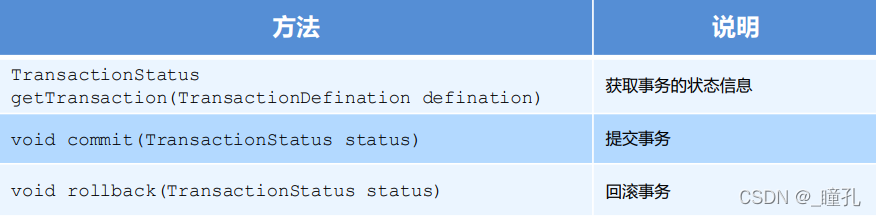
PlatformTransactionManager 是接口类型,不同的 Dao 层技术则有不同的实现类:
- jdbc 或 mybatis:org.springframework.jdbc.datasource.DataSourceTransactionManager
- hibernate:org.springframework.orm.hibernate5.HibernateTransactionManager
getTransaction方法里面的参数是TransactionDefinition类,这个类就定义了一些基本的事务属性,是事务的定义信息对象。
public interface TransactionDefinition {

	/**
	 * Support a current transaction; create a new one if none exists.
	 * Analogous to the EJB transaction attribute of the same name.
	 * <p>This is typically the default setting of a transaction definition,
	 * and typically defines a transaction synchronization scope.
	 */
	int PROPAGATION_REQUIRED = 0;

	/**
	 * Support a current transaction; execute non-transactionally if none exists.
	 * Analogous to the EJB transaction attribute of the same name.
	 * <p><b>NOTE:</b> For transaction managers with transaction synchronization,
	 * {@code PROPAGATION_SUPPORTS} is slightly different from no transaction
	 * at all, as it defines a transaction scope that synchronization might apply to.
	 * As a consequence, the same resources (a JDBC {@code Connection}, a
	 * Hibernate {@code Session}, etc) will be shared for the entire specified
	 * scope. Note that the exact behavior depends on the actual synchronization
	 * configuration of the transaction manager!
	 * <p>In general, use {@code PROPAGATION_SUPPORTS} with care! In particular, do
	 * not rely on {@code PROPAGATION_REQUIRED} or {@code PROPAGATION_REQUIRES_NEW}
	 * <i>within</i> a {@code PROPAGATION_SUPPORTS} scope (which may lead to
	 * synchronization conflicts at runtime). If such nesting is unavoidable, make sure
	 * to configure your transaction manager appropriately (typically switching to
	 * "synchronization on actual transaction").
	 * @see org.springframework.transaction.support.AbstractPlatformTransactionManager#setTransactionSynchronization
	 * @see org.springframework.transaction.support.AbstractPlatformTransactionManager#SYNCHRONIZATION_ON_ACTUAL_TRANSACTION
	 */
	int PROPAGATION_SUPPORTS = 1;

	/**
	 * Support a current transaction; throw an exception if no current transaction
	 * exists. Analogous to the EJB transaction attribute of the same name.
	 * <p>Note that transaction synchronization within a {@code PROPAGATION_MANDATORY}
	 * scope will always be driven by the surrounding transaction.
	 */
	int PROPAGATION_MANDATORY = 2;

	/**
	 * Create a new transaction, suspending the current transaction if one exists.
	 * Analogous to the EJB transaction attribute of the same name.
	 * <p><b>NOTE:</b> Actual transaction suspension will not work out-of-the-box
	 * on all transaction managers. This in particular applies to
	 * {@link org.springframework.transaction.jta.JtaTransactionManager},
	 * which requires the {@code javax.transaction.TransactionManager} to be
	 * made available it to it (which is server-specific in standard Java EE).
	 * <p>A {@code PROPAGATION_REQUIRES_NEW} scope always defines its own
	 * transaction synchronizations. Existing synchronizations will be suspended
	 * and resumed appropriately.
	 * @see org.springframework.transaction.jta.JtaTransactionManager#setTransactionManager
	 */
	int PROPAGATION_REQUIRES_NEW = 3;

	/**
	 * Do not support a current transaction; rather always execute non-transactionally.
	 * Analogous to the EJB transaction attribute of the same name.
	 * <p><b>NOTE:</b> Actual transaction suspension will not work out-of-the-box
	 * on all transaction managers. This in particular applies to
	 * {@link org.springframework.transaction.jta.JtaTransactionManager},
	 * which requires the {@code javax.transaction.TransactionManager} to be
	 * made available it to it (which is server-specific in standard Java EE).
	 * <p>Note that transaction synchronization is <i>not</i> available within a
	 * {@code PROPAGATION_NOT_SUPPORTED} scope. Existing synchronizations
	 * will be suspended and resumed appropriately.
	 * @see org.springframework.transaction.jta.JtaTransactionManager#setTransactionManager
	 */
	int PROPAGATION_NOT_SUPPORTED = 4;

	/**
	 * Do not support a current transaction; throw an exception if a current transaction
	 * exists. Analogous to the EJB transaction attribute of the same name.
	 * <p>Note that transaction synchronization is <i>not</i> available within a
	 * {@code PROPAGATION_NEVER} scope.
	 */
	int PROPAGATION_NEVER = 5;

	/**
	 * Execute within a nested transaction if a current transaction exists,
	 * behave like {@link #PROPAGATION_REQUIRED} else. There is no analogous
	 * feature in EJB.
	 * <p><b>NOTE:</b> Actual creation of a nested transaction will only work on
	 * specific transaction managers. Out of the box, this only applies to the JDBC
	 * {@link org.springframework.jdbc.datasource.DataSourceTransactionManager}
	 * when working on a JDBC 3.0 driver. Some JTA providers might support
	 * nested transactions as well.
	 * @see org.springframework.jdbc.datasource.DataSourceTransactionManager
	 */
	int PROPAGATION_NESTED = 6;


	/**
	 * Use the default isolation level of the underlying datastore.
	 * All other levels correspond to the JDBC isolation levels.
	 * @see java.sql.Connection
	 */
	int ISOLATION_DEFAULT = -1;

	/**
	 * Indicates that dirty reads, non-repeatable reads and phantom reads
	 * can occur.
	 * <p>This level allows a row changed by one transaction to be read by another
	 * transaction before any changes in that row have been committed (a "dirty read").
	 * If any of the changes are rolled back, the second transaction will have
	 * retrieved an invalid row.
	 * @see java.sql.Connection#TRANSACTION_READ_UNCOMMITTED
	 */
	int ISOLATION_READ_UNCOMMITTED = Connection.TRANSACTION_READ_UNCOMMITTED;

	/**
	 * Indicates that dirty reads are prevented; non-repeatable reads and
	 * phantom reads can occur.
	 * <p>This level only prohibits a transaction from reading a row
	 * with uncommitted changes in it.
	 * @see java.sql.Connection#TRANSACTION_READ_COMMITTED
	 */
	int ISOLATION_READ_COMMITTED = Connection.TRANSACTION_READ_COMMITTED;

	/**
	 * Indicates that dirty reads and non-repeatable reads are prevented;
	 * phantom reads can occur.
	 * <p>This level prohibits a transaction from reading a row with uncommitted changes
	 * in it, and it also prohibits the situation where one transaction reads a row,
	 * a second transaction alters the row, and the first transaction re-reads the row,
	 * getting different values the second time (a "non-repeatable read").
	 * @see java.sql.Connection#TRANSACTION_REPEATABLE_READ
	 */
	int ISOLATION_REPEATABLE_READ = Connection.TRANSACTION_REPEATABLE_READ;

	/**
	 * Indicates that dirty reads, non-repeatable reads and phantom reads
	 * are prevented.
	 * <p>This level includes the prohibitions in {@link #ISOLATION_REPEATABLE_READ}
	 * and further prohibits the situation where one transaction reads all rows that
	 * satisfy a {@code WHERE} condition, a second transaction inserts a row
	 * that satisfies that {@code WHERE} condition, and the first transaction
	 * re-reads for the same condition, retrieving the additional "phantom" row
	 * in the second read.
	 * @see java.sql.Connection#TRANSACTION_SERIALIZABLE
	 */
	int ISOLATION_SERIALIZABLE = Connection.TRANSACTION_SERIALIZABLE;


	/**
	 * Use the default timeout of the underlying transaction system,
	 * or none if timeouts are not supported.
	 */
	int TIMEOUT_DEFAULT = -1;


	/**
	 * Return the propagation behavior.
	 * <p>Must return one of the {@code PROPAGATION_XXX} constants
	 * defined on {@link TransactionDefinition this interface}.
	 * @return the propagation behavior
	 * @see #PROPAGATION_REQUIRED
	 * @see org.springframework.transaction.support.TransactionSynchronizationManager#isActualTransactionActive()
	 */
	int getPropagationBehavior();

	/**
	 * Return the isolation level.
	 * <p>Must return one of the {@code ISOLATION_XXX} constants defined on
	 * {@link TransactionDefinition this interface}. Those constants are designed
	 * to match the values of the same constants on {@link java.sql.Connection}.
	 * <p>Exclusively designed for use with {@link #PROPAGATION_REQUIRED} or
	 * {@link #PROPAGATION_REQUIRES_NEW} since it only applies to newly started
	 * transactions. Consider switching the "validateExistingTransactions" flag to
	 * "true" on your transaction manager if you'd like isolation level declarations
	 * to get rejected when participating in an existing transaction with a different
	 * isolation level.
	 * <p>Note that a transaction manager that does not support custom isolation levels
	 * will throw an exception when given any other level than {@link #ISOLATION_DEFAULT}.
	 * @return the isolation level
	 * @see #ISOLATION_DEFAULT
	 * @see org.springframework.transaction.support.AbstractPlatformTransactionManager#setValidateExistingTransaction
	 */
	int getIsolationLevel();

	/**
	 * Return the transaction timeout.
	 * <p>Must return a number of seconds, or {@link #TIMEOUT_DEFAULT}.
	 * <p>Exclusively designed for use with {@link #PROPAGATION_REQUIRED} or
	 * {@link #PROPAGATION_REQUIRES_NEW} since it only applies to newly started
	 * transactions.
	 * <p>Note that a transaction manager that does not support timeouts will throw
	 * an exception when given any other timeout than {@link #TIMEOUT_DEFAULT}.
	 * @return the transaction timeout
	 */
	int getTimeout();

	/**
	 * Return whether to optimize as a read-only transaction.
	 * <p>The read-only flag applies to any transaction context, whether backed
	 * by an actual resource transaction ({@link #PROPAGATION_REQUIRED}/
	 * {@link #PROPAGATION_REQUIRES_NEW}) or operating non-transactionally at
	 * the resource level ({@link #PROPAGATION_SUPPORTS}). In the latter case,
	 * the flag will only apply to managed resources within the application,
	 * such as a Hibernate {@code Session}.
	 * <p>This just serves as a hint for the actual transaction subsystem;
	 * it will <i>not necessarily</i> cause failure of write access attempts.
	 * A transaction manager which cannot interpret the read-only hint will
	 * <i>not</i> throw an exception when asked for a read-only transaction.
	 * @return {@code true} if the transaction is to be optimized as read-only
	 * @see org.springframework.transaction.support.TransactionSynchronization#beforeCommit(boolean)
	 * @see org.springframework.transaction.support.TransactionSynchronizationManager#isCurrentTransactionReadOnly()
	 */
	boolean isReadOnly();

	/**
	 * Return the name of this transaction. Can be {@code null}.
	 * <p>This will be used as the transaction name to be shown in a
	 * transaction monitor, if applicable (for example, WebLogic's).
	 * <p>In case of Spring's declarative transactions, the exposed name will be
	 * the {@code fully-qualified class name + "." + method name} (by default).
	 * @return the name of this transaction
	 * @see org.springframework.transaction.interceptor.TransactionAspectSupport
	 * @see org.springframework.transaction.support.TransactionSynchronizationManager#getCurrentTransactionName()
	 */
	@Nullable
	String getName();

}
除去常量,主要的方法有:
- int getPropagationBehavior(); // 返回事务的传播行为
- int getIsolationLevel(); // 返回事务的隔离级别
- int getTimeout(); // 返回事务必须在多少秒内完成
- boolean isReadOnly(); // 事务是否只读,事务管理器能够根据这个返回值进行优化,确保事务是只读的
- String getName(); // 返回事务的名称
其中常量分别是7种传播属性和5种隔离级别
事务传播属性:
| 名称 | 值 | 解释 |
|---|---|---|
| PROPAGATION_REQUIRED | 0 | 支持当前事务,如果当前没有事务,就新建一个事务。这是最常见的选择,也是Spring默认的事务的传播。 |
| PROPAGATION_SUPPORTS | 1 | 支持当前事务,如果当前没有事务,就以非事务方式执行。 |
| PROPAGATION_MANDATORY | 2 | 支持当前事务,如果当前没有事务,就抛出异常。 |
| PROPAGATION_REQUIRES_NEW | 3 | 新建事务,如果当前存在事务,把当前事务挂起。 |
| PROPAGATION_NOT_SUPPORTED | 4 | 以非事务方式执行操作,如果当前存在事务,就把当前事务挂起。 |
| PROPAGATION_NEVER | 5 | 以非事务方式执行,如果当前存在事务,则抛出异常。 |
| PROPAGATION_NESTED | 6 | 如果当前存在事务,则在嵌套事务内执行。如果当前没有事务,则进行与PROPAGATION_REQUIRED类似的操作。 |
隔离级别:
| 名称 | 值 | 解释 |
|---|---|---|
| ISOLATION_DEFAULT | -1 | 这是一个PlatfromTransactionManager默认的隔离级别,使用数据库默认的事务隔离级别。另外四个与JDBC的隔离级别相对应 |
| ISOLATION_READ_UNCOMMITTED | 1 | 这是事务最低的隔离级别,它充许另外一个事务可以看到这个事务未提交的数据。这种隔离级别会产生脏读,不可重复读和幻读。 |
| ISOLATION_READ_COMMITTED | 2 | 保证一个事务修改的数据提交后才能被另外一个事务读取。另外一个事务不能读取该事务未提交的数据。 |
| ISOLATION_REPEATABLE_READ | 4 | 这种事务隔离级别可以防止脏读,不可重复读。但是可能出现幻读。 |
| ISOLATION_SERIALIZABLE | 8 | 这是花费最高代价但是最可靠的事务隔离级别。事务被处理为顺序执行。除了防止脏读,不可重复读外,还避免了幻读。 |
调用PlatformTransactionManager接口的getTransaction()的方法得到的是TransactionStatus接口的一个实现类
public interface TransactionDefinition {

	/**
	 * Support a current transaction; create a new one if none exists.
	 * Analogous to the EJB transaction attribute of the same name.
	 * <p>This is typically the default setting of a transaction definition,
	 * and typically defines a transaction synchronization scope.
	 */
	int PROPAGATION_REQUIRED = 0;

	/**
	 * Support a current transaction; execute non-transactionally if none exists.
	 * Analogous to the EJB transaction attribute of the same name.
	 * <p><b>NOTE:</b> For transaction managers with transaction synchronization,
	 * {@code PROPAGATION_SUPPORTS} is slightly different from no transaction
	 * at all, as it defines a transaction scope that synchronization might apply to.
	 * As a consequence, the same resources (a JDBC {@code Connection}, a
	 * Hibernate {@code Session}, etc) will be shared for the entire specified
	 * scope. Note that the exact behavior depends on the actual synchronization
	 * configuration of the transaction manager!
	 * <p>In general, use {@code PROPAGATION_SUPPORTS} with care! In particular, do
	 * not rely on {@code PROPAGATION_REQUIRED} or {@code PROPAGATION_REQUIRES_NEW}
	 * <i>within</i> a {@code PROPAGATION_SUPPORTS} scope (which may lead to
	 * synchronization conflicts at runtime). If such nesting is unavoidable, make sure
	 * to configure your transaction manager appropriately (typically switching to
	 * "synchronization on actual transaction").
	 * @see org.springframework.transaction.support.AbstractPlatformTransactionManager#setTransactionSynchronization
	 * @see org.springframework.transaction.support.AbstractPlatformTransactionManager#SYNCHRONIZATION_ON_ACTUAL_TRANSACTION
	 */
	int PROPAGATION_SUPPORTS = 1;

	/**
	 * Support a current transaction; throw an exception if no current transaction
	 * exists. Analogous to the EJB transaction attribute of the same name.
	 * <p>Note that transaction synchronization within a {@code PROPAGATION_MANDATORY}
	 * scope will always be driven by the surrounding transaction.
	 */
	int PROPAGATION_MANDATORY = 2;

	/**
	 * Create a new transaction, suspending the current transaction if one exists.
	 * Analogous to the EJB transaction attribute of the same name.
	 * <p><b>NOTE:</b> Actual transaction suspension will not work out-of-the-box
	 * on all transaction managers. This in particular applies to
	 * {@link org.springframework.transaction.jta.JtaTransactionManager},
	 * which requires the {@code javax.transaction.TransactionManager} to be
	 * made available it to it (which is server-specific in standard Java EE).
	 * <p>A {@code PROPAGATION_REQUIRES_NEW} scope always defines its own
	 * transaction synchronizations. Existing synchronizations will be suspended
	 * and resumed appropriately.
	 * @see org.springframework.transaction.jta.JtaTransactionManager#setTransactionManager
	 */
	int PROPAGATION_REQUIRES_NEW = 3;

	/**
	 * Do not support a current transaction; rather always execute non-transactionally.
	 * Analogous to the EJB transaction attribute of the same name.
	 * <p><b>NOTE:</b> Actual transaction suspension will not work out-of-the-box
	 * on all transaction managers. This in particular applies to
	 * {@link org.springframework.transaction.jta.JtaTransactionManager},
	 * which requires the {@code javax.transaction.TransactionManager} to be
	 * made available it to it (which is server-specific in standard Java EE).
	 * <p>Note that transaction synchronization is <i>not</i> available within a
	 * {@code PROPAGATION_NOT_SUPPORTED} scope. Existing synchronizations
	 * will be suspended and resumed appropriately.
	 * @see org.springframework.transaction.jta.JtaTransactionManager#setTransactionManager
	 */
	int PROPAGATION_NOT_SUPPORTED = 4;

	/**
	 * Do not support a current transaction; throw an exception if a current transaction
	 * exists. Analogous to the EJB transaction attribute of the same name.
	 * <p>Note that transaction synchronization is <i>not</i> available within a
	 * {@code PROPAGATION_NEVER} scope.
	 */
	int PROPAGATION_NEVER = 5;

	/**
	 * Execute within a nested transaction if a current transaction exists,
	 * behave like {@link #PROPAGATION_REQUIRED} else. There is no analogous
	 * feature in EJB.
	 * <p><b>NOTE:</b> Actual creation of a nested transaction will only work on
	 * specific transaction managers. Out of the box, this only applies to the JDBC
	 * {@link org.springframework.jdbc.datasource.DataSourceTransactionManager}
	 * when working on a JDBC 3.0 driver. Some JTA providers might support
	 * nested transactions as well.
	 * @see org.springframework.jdbc.datasource.DataSourceTransactionManager
	 */
	int PROPAGATION_NESTED = 6;


	/**
	 * Use the default isolation level of the underlying datastore.
	 * All other levels correspond to the JDBC isolation levels.
	 * @see java.sql.Connection
	 */
	int ISOLATION_DEFAULT = -1;

	/**
	 * Indicates that dirty reads, non-repeatable reads and phantom reads
	 * can occur.
	 * <p>This level allows a row changed by one transaction to be read by another
	 * transaction before any changes in that row have been committed (a "dirty read").
	 * If any of the changes are rolled back, the second transaction will have
	 * retrieved an invalid row.
	 * @see java.sql.Connection#TRANSACTION_READ_UNCOMMITTED
	 */
	int ISOLATION_READ_UNCOMMITTED = Connection.TRANSACTION_READ_UNCOMMITTED;

	/**
	 * Indicates that dirty reads are prevented; non-repeatable reads and
	 * phantom reads can occur.
	 * <p>This level only prohibits a transaction from reading a row
	 * with uncommitted changes in it.
	 * @see java.sql.Connection#TRANSACTION_READ_COMMITTED
	 */
	int ISOLATION_READ_COMMITTED = Connection.TRANSACTION_READ_COMMITTED;

	/**
	 * Indicates that dirty reads and non-repeatable reads are prevented;
	 * phantom reads can occur.
	 * <p>This level prohibits a transaction from reading a row with uncommitted changes
	 * in it, and it also prohibits the situation where one transaction reads a row,
	 * a second transaction alters the row, and the first transaction re-reads the row,
	 * getting different values the second time (a "non-repeatable read").
	 * @see java.sql.Connection#TRANSACTION_REPEATABLE_READ
	 */
	int ISOLATION_REPEATABLE_READ = Connection.TRANSACTION_REPEATABLE_READ;

	/**
	 * Indicates that dirty reads, non-repeatable reads and phantom reads
	 * are prevented.
	 * <p>This level includes the prohibitions in {@link #ISOLATION_REPEATABLE_READ}
	 * and further prohibits the situation where one transaction reads all rows that
	 * satisfy a {@code WHERE} condition, a second transaction inserts a row
	 * that satisfies that {@code WHERE} condition, and the first transaction
	 * re-reads for the same condition, retrieving the additional "phantom" row
	 * in the second read.
	 * @see java.sql.Connection#TRANSACTION_SERIALIZABLE
	 */
	int ISOLATION_SERIALIZABLE = Connection.TRANSACTION_SERIALIZABLE;


	/**
	 * Use the default timeout of the underlying transaction system,
	 * or none if timeouts are not supported.
	 */
	int TIMEOUT_DEFAULT = -1;


	/**
	 * Return the propagation behavior.
	 * <p>Must return one of the {@code PROPAGATION_XXX} constants
	 * defined on {@link TransactionDefinition this interface}.
	 * @return the propagation behavior
	 * @see #PROPAGATION_REQUIRED
	 * @see org.springframework.transaction.support.TransactionSynchronizationManager#isActualTransactionActive()
	 */
	int getPropagationBehavior();

	/**
	 * Return the isolation level.
	 * <p>Must return one of the {@code ISOLATION_XXX} constants defined on
	 * {@link TransactionDefinition this interface}. Those constants are designed
	 * to match the values of the same constants on {@link java.sql.Connection}.
	 * <p>Exclusively designed for use with {@link #PROPAGATION_REQUIRED} or
	 * {@link #PROPAGATION_REQUIRES_NEW} since it only applies to newly started
	 * transactions. Consider switching the "validateExistingTransactions" flag to
	 * "true" on your transaction manager if you'd like isolation level declarations
	 * to get rejected when participating in an existing transaction with a different
	 * isolation level.
	 * <p>Note that a transaction manager that does not support custom isolation levels
	 * will throw an exception when given any other level than {@link #ISOLATION_DEFAULT}.
	 * @return the isolation level
	 * @see #ISOLATION_DEFAULT
	 * @see org.springframework.transaction.support.AbstractPlatformTransactionManager#setValidateExistingTransaction
	 */
	int getIsolationLevel();

	/**
	 * Return the transaction timeout.
	 * <p>Must return a number of seconds, or {@link #TIMEOUT_DEFAULT}.
	 * <p>Exclusively designed for use with {@link #PROPAGATION_REQUIRED} or
	 * {@link #PROPAGATION_REQUIRES_NEW} since it only applies to newly started
	 * transactions.
	 * <p>Note that a transaction manager that does not support timeouts will throw
	 * an exception when given any other timeout than {@link #TIMEOUT_DEFAULT}.
	 * @return the transaction timeout
	 */
	int getTimeout();

	/**
	 * Return whether to optimize as a read-only transaction.
	 * <p>The read-only flag applies to any transaction context, whether backed
	 * by an actual resource transaction ({@link #PROPAGATION_REQUIRED}/
	 * {@link #PROPAGATION_REQUIRES_NEW}) or operating non-transactionally at
	 * the resource level ({@link #PROPAGATION_SUPPORTS}). In the latter case,
	 * the flag will only apply to managed resources within the application,
	 * such as a Hibernate {@code Session}.
	 * <p>This just serves as a hint for the actual transaction subsystem;
	 * it will <i>not necessarily</i> cause failure of write access attempts.
	 * A transaction manager which cannot interpret the read-only hint will
	 * <i>not</i> throw an exception when asked for a read-only transaction.
	 * @return {@code true} if the transaction is to be optimized as read-only
	 * @see org.springframework.transaction.support.TransactionSynchronization#beforeCommit(boolean)
	 * @see org.springframework.transaction.support.TransactionSynchronizationManager#isCurrentTransactionReadOnly()
	 */
	boolean isReadOnly();

	/**
	 * Return the name of this transaction. Can be {@code null}.
	 * <p>This will be used as the transaction name to be shown in a
	 * transaction monitor, if applicable (for example, WebLogic's).
	 * <p>In case of Spring's declarative transactions, the exposed name will be
	 * the {@code fully-qualified class name + "." + method name} (by default).
	 * @return the name of this transaction
	 * @see org.springframework.transaction.interceptor.TransactionAspectSupport
	 * @see org.springframework.transaction.support.TransactionSynchronizationManager#getCurrentTransactionName()
	 */
	@Nullable
	String getName();
}
TransactionStatus 接口提供的是事务具体的运行状态,具体如下:
void flush();//如果适用的话,这个方法用于刷新底层会话中的修改到数据库,例如,所有受影响的Hibernate/JPA会话。
boolean hasSavepoint(); // 是否有恢复点
boolean isCompleted();// 是否已完成
boolean isNewTransaction(); // 是否是新的事务
boolean isRollbackOnly(); // 是否为只回滚
void setRollbackOnly();  // 设置为只回滚
可以看出返回的结果是一些事务的状态,可用来检索事务的状态信息。
未完待续…
如果有兴趣了解更多相关内容,欢迎来我的个人网站看看:瞳孔的个人空间





 扫一扫
扫一扫


 916
916

 被折叠的 条评论
为什么被折叠?
被折叠的 条评论
为什么被折叠?
 到【灌水乐园】发言





