


 本文详细解析了Java ArrayList在JDK 12中的源码,对比了JDK 8的部分内容,涵盖了初始化、增加、删除、查找和修改等方法。特别讨论了`System.arraycopy`和`Arrays.copyOf`的浅拷贝原理,并通过实例演示了ArrayList的操作流程。
Java ArrayList源码解析(基于JDK 12,对比JDK 8)
自从接触到ArrayList以来,一直觉得很方便,但是从来没有系统、全面的学习了解过ArraryList的实现原理。最近学习了一下ArrayList的源码学习一下,顺便记录一下,防止后面遗忘太快。现在的jdk版本更新比以前快了很多,截止发文已经更新到了JDK 15了,本文查看的源码是JDK 12的,native 方法阅读的是jdk 8的,也有对比jdk 12 与jdk 8的部分源码.
重要的事情说三遍,
本文查看的源码的jdk 12,部分源码对比jdk 8!!!
本文查看的源码的jdk 12,部分源码对比jdk 8!!!
本文查看的源码的jdk 12,部分源码对比jdk 8!!!
阅读前须知:
源码中使用的 System.arraycopy(elementData, index, elementData, index + 1, s - index)与 Arrays.copyOf(elementData, size, Object[].class)这两个方法是属于浅拷贝,关于浅拷贝以及System.arraycopy方法的底层C/C++方法可以看这两篇文章:
1、浅拷贝与深拷贝:https://www.cnblogs.com/shakinghead/p/7651502.html
2、System.arraycopy方法的底层C/C++方法:https://blog.youkuaiyun.com/fu_zhongyuan/article/details/88663818
我在网上找了一下该方法浅拷贝的指向原理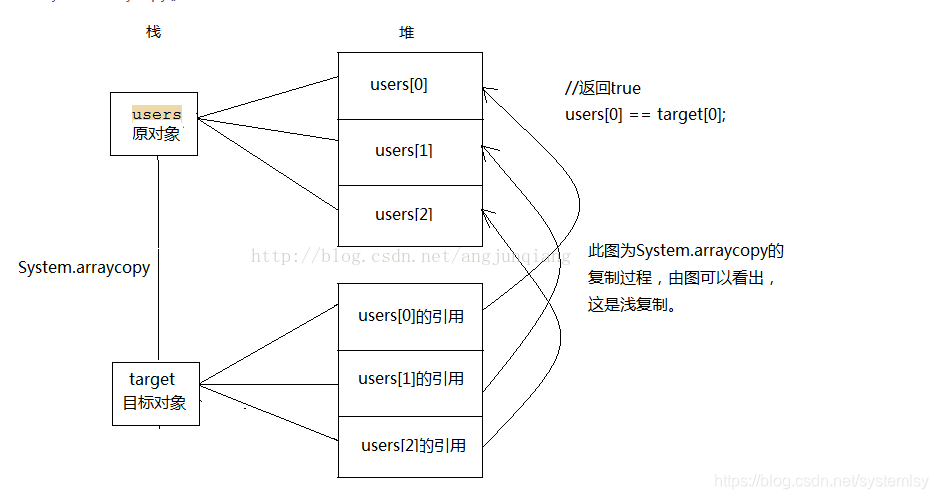
一、 ArrayList初始化
ArrayList有三种初始化方法:
1、初始化一种指定集合大小的空ArrayList;
2、初始化一个空的ArrayList;
3、初始化一个含有指定元素的ArrayLsit。
具体源码与注释一起放在下面了
 private static final Object[] DEFAULTCAPACITY_EMPTY_ELEMENTDATA = {

   };
 private static final Object[] EMPTY_ELEMENTDATA = {

   };
 transient Object[] elementData; // non-private to simplify nested class access

/**
     * Constructs an empty list with the specified initial capacity.
     *
     * @param  initialCapacity  the initial capacity of the list
     * @throws IllegalArgumentException if the specified initial capacity
     *         is negative
     */
    public ArrayList(int initialCapacity) {


        if (initialCapacity > 0) {


            this.elementData = new Object[initialCapacity];
        } else if (initialCapacity == 0) {


            this.elementData = EMPTY_ELEMENTDATA;
        } else {


            throw new IllegalArgumentException("Illegal Capacity: "+
                                               initialCapacity);
        }
    }
 /**
     * Constructs an empty list with an initial capacity of ten.
     */
    public ArrayList() {


        this.elementData = DEFAULTCAPACITY_EMPTY_ELEMENTDATA;
    }
 /**
     * Constructs a list containing the elements of the specified
     * collection, in the order they are returned by the collection's
     * iterator.
     *
     * @param c the collection whose elements are to be placed into this list
     * @throws NullPointerException if the specified collection is null
     */
    public ArrayList(Collection<? extends E> c) {


        elementData = c.toArray();
        if ((size = elementData.length) != 0) {


            // defend against c.toArray (incorrectly) not returning Object[]
            // (see e.g. https://bugs.openjdk.java.net/browse/JDK-6260652)
            if (elementData.getClass() != Object[].class)
                elementData = Arrays.copyOf(elementData, size, Object[].class);
        } else {


            // replace with empty array.
            this.elementData = EMPTY_ELEMENTDATA;
        }
    }
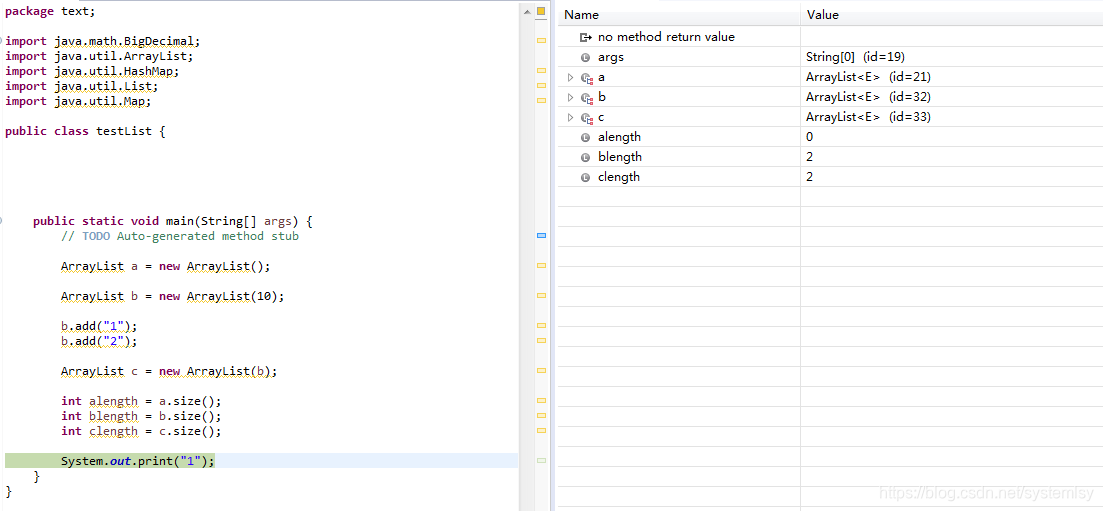
然后自己写了一个测试demo,试了一下这三个初始化方法,发现挺好用的
ArrayList常用方法
常用的方法无非就是增删改查
get( )与set()
改查这两个方法就很简单了,简单的先放在前面说
/**
     * Returns the element at the specified position in this list.
     *
     * @param  index index of the element to return
     * @return the element at the specified position in this list
     * @throws IndexOutOfBoundsException {@inheritDoc}
     */
    public E get(int index) {


        rangeCheck(index);

        return elementData(index);
    }

    /**
     * Replaces the element at the specified position in this list with
     * the specified element.
     *
     * @param index index of the element to replace
     * @param element element to be stored at the specified position
     * @return the element previously at the specified position
     * @throws IndexOutOfBoundsException {@inheritDoc}
     */
    public E set(int index, E element) {


        rangeCheck(index);

        E oldValue = elementData(index);
        elementData[index] = element;
        return oldValue;
    }
ArrayList新增
从下面源码可以看出,我们平时喜欢的使用的add(E e)其实调用的是上面的实现方法add(E e, Object[] elementData, int s),这里需要提的一点事add(int index, E element)这种指定元素、数组下标的新增方法。在这个方法里面使用了两个方法:grow()方法和arraycopy(Object src, int srcPos, Object dest, int destPos, int length),前者将数组容量扩大了一位,后者调用本地的native方法。
相关源码附在下面了:
/**
     * This helper method split out from add(E) to keep method
     * bytecode size under 35 (the -XX:MaxInlineSize default value),
     * which helps when add(E) is called in a C1-compiled loop.
     */
    private void add(E e, Object[] elementData, int s) {


        if (s == elementData.length)
            elementData = grow();
        elementData[s] = e;
        size = s + 1;
    }

    /**
     * Appends the specified element to the end of this list.
     *
     * @param e element to be appended to this list
     * @return {@code true} (as specified by {@link Collection#add})
     */
    public boolean add(E e) {


        modCount++;
        add(e, elementData, size);
        return true;
    }

    /**
     * Inserts the specified element at the specified position in this
     * list. Shifts the element currently at that position (if any) and
     * any subsequent elements to the right (adds one to their indices).
     *
     * @param index index at which the specified element is to be inserted
     * @param element element to be inserted
     * @throws IndexOutOfBoundsException {@inheritDoc}
     */
    public void add(int index, E element) {


        rangeCheckForAdd(index);
        modCount++;
        final int s;
        Object[] elementData;
        if ((s = size) == (elementData = this.elementData).length)
            elementData = grow();
        System.arraycopy(elementData, index,
                         elementData, index + 1,
                         s - index);
        elementData[index] = element;
        size = s + 1;
    }
 /**
     * Increases the capacity to ensure that it can hold at least the
     * number of elements specified by the minimum capacity argument.
     *
     * @param minCapacity the desired minimum capacity
     * @throws OutOfMemoryError if minCapacity is less than zero
     */
    private Object[] grow(int minCapacity) {


        return elementData = Arrays.copyOf(elementData,
                                           newCapacity(minCapacity));
    }

    private Object[] grow() {


        return grow(size + 1);
    }
 @HotSpotIntrinsicCandidate
    public static native void arraycopy(Object src,  int  srcPos,
                                        Object dest, int destPos,
                                        int length);
addAll(int index, Collection<? extends E> c)与 addAll(Collection<? extends E> c) 方法
这两个方法都是可以直接添加集合的方法,不同的是一个是尾部添加,一个是从索引处开始添加,源码贴在下面了。对比了JDK12 与JDK 8发现这两个方法没有做修改。
/**
* Appends all of the elements in the specified collection to the end of
* this list, in the order that they are returned by the
* specified collection's Iterator. The behavior of this operation is
* undefined if the specified collection is modified while the operation
* is in progress. (This implies that the behavior of this call is
* undefined if the specified collection is this list, and this
* list is nonempty.)
*
* @param c collection containing elements to be added to this list
* @return {@code true} if this list changed as a result of the call
* @throws NullPointerException if the specified collection is null
*/
public boolean addAll(Collection<? extends E> c) {
Object[] a = c.toArray();
modCount++;
int numNew = a.length;
if (numNew == 0)
return false;
Object[] elementData;
final int s;
if (numNew > (elementData = this.elementData).length - (s = size))
elementData = grow(s + numNew);
System.arraycopy(a,  最低0.47元/天 解锁文章






 扫一扫
扫一扫


 被折叠的 条评论
为什么被折叠?
被折叠的 条评论
为什么被折叠?
 到【灌水乐园】发言





