


测试函数ce🍨 本文为🔗365天深度学习训练营中的学习记录博客
●🍖 原作者:K同学啊
0.前期准备
开发及运行环境
● 语言环境:Python3.9.13
● 编译器:Jupyter Lab
● torch-1.9.1 Cuda 11.2 torchvision-0.10.1
● 涉及的库包括:torch、torch.nn、matplotlib.pyplot 、torchvision、numpy、torch.nn.functional
————————————————
版权声明:本文为优快云博主「swtee」的原创文章,遵循CC 4.0 BY-SA版权协议,转载请附上原文出处链接及本声明。
原文链接:https://blog.youkuaiyun.com/swtee/article/details/149547849
数据依旧来自K同学
————————————————
版权声明:本文为优快云博主「swtee」的原创文章,遵循CC 4.0 BY-SA版权协议,转载请附上原文出处链接及本声明。
原文链接:https://blog.youkuaiyun.com/swtee/article/details/149814018
VGG-16(Visual Geometry Group-16)是由牛津大学视觉几何组(Visual Geometry Group)提出的一种深度卷积神经网络架构,用于图像分类和对象识别任务。VGG-16在2014年被提出,是VGG系列中的一种。VGG-16之所以备受关注,是因为它在ImageNet图像识别竞赛中取得了很好的成绩,展示了其在大规模图像识别任务中的有效性。
from torchvision.models import vgg16


model = vgg16(pretrained = True).to(device) # 加载预训练的vgg16模型

for param in model.parameters():
    param.requires_grad = False # 冻结模型的参数,这样子在训练的时候只训练最后一层的参数


model.classifier._modules['6'] = nn.Linear(4096,len(classeNames)) # 修改vgg16模型中最后一层
def train(dataloader, model, loss_fn, optimizer):
    size = len(dataloader.dataset)  # 训练集的大小
    num_batches = len(dataloader)   # 批次数目, (size/batch_size,向上取整)

    train_loss, train_acc = 0, 0  # 初始化训练损失和正确率

    for X, y in dataloader:  # 获取图片及其标签
        X, y = X.to(device), y.to(device)

        # 计算预测误差
        pred = model(X)          # 网络输出
        loss = loss_fn(pred, y)  # 计算网络输出和真实值之间的差距,targets为真实值,计算二者差值即为损失

        # 反向传播
        optimizer.zero_grad()  # grad属性归零
        loss.backward()        # 反向传播
        optimizer.step()       # 每一步自动更新

        # 记录acc与loss
        train_acc  += (pred.argmax(1) == y).type(torch.float).sum().item()
        train_loss += loss.item()

    train_acc  /= size
    train_loss /= num_batches

    return train_acc, train_loss
测试函数
def test (dataloader, model, loss_fn):
    size        = len(dataloader.dataset)  # 测试集的大小
    num_batches = len(dataloader)          # 批次数目, (size/batch_size,向上取整)
    test_loss, test_acc = 0, 0

    # 当不进行训练时,停止梯度更新,节省计算内存消耗
    with torch.no_grad():
        for imgs, target in dataloader:
            imgs, target = imgs.to(device), target.to(device)

            # 计算loss
            target_pred = model(imgs)
            loss        = loss_fn(target_pred, target)

            test_loss += loss.item()
            test_acc  += (target_pred.argmax(1) == target).type(torch.float).sum().item()

    test_acc  /= size
    test_loss /= num_batches

    return test_acc, test_loss
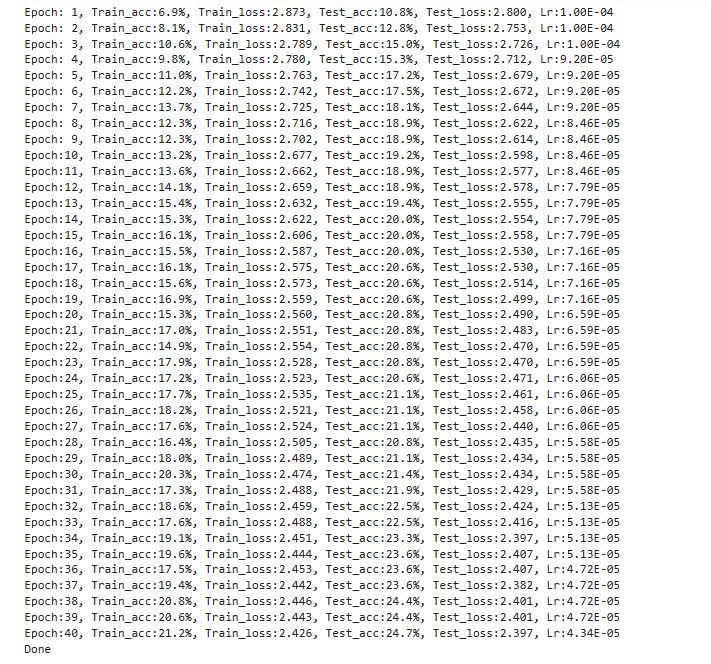
结果:
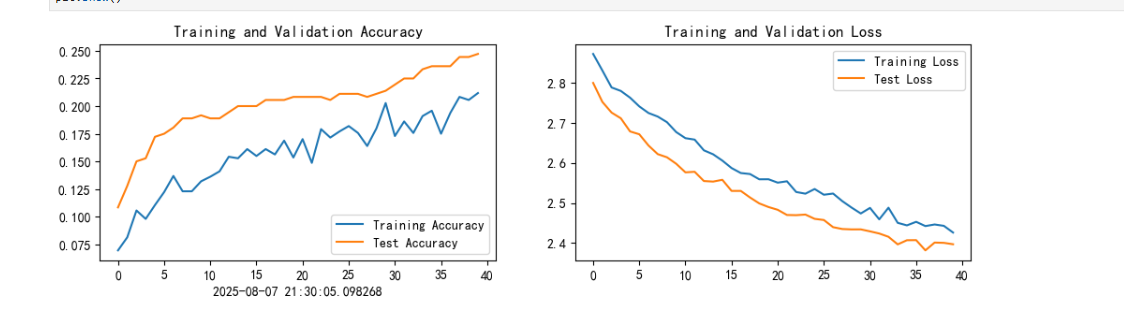
可视化输出:
调参:
待续
本次使用pytorch深度学习环境对官方的VGG-16模型进行调用,并且保存最佳模型权重。VGG-16模型的最大特点是深度。除此之外,其卷积层都采用3x3的卷积核和步长为1的卷积操作,同时卷积层后都有ReLU激活函数,从而降低过拟合风险。
2.训练过程中发现训练和测试的acc都过低(约为20%),通过调整动态学习率予以调整,初始学习率增大一个数量级之后,此问题得到一定的解决。






 扫一扫
扫一扫


 1572
1572

 被折叠的 条评论
为什么被折叠?
被折叠的 条评论
为什么被折叠?
 到【灌水乐园】发言





