



Java Number & Math 类:
一般地,当需要使用数字的时候,我们通常使用内置数据类型,如:byte、int、long、double 等。
int a = 5000;
float b = 13.65f;
byte c = 0x4a;
然而,在实际开发过程中,我们经常会遇到需要使用对象,而不是内置数据类型的情形。为了解决这个问题,Java 语言为每一个内置数据类型提供了对应的包装类。
所有的包装类(Integer、Long、Byte、Double、Float、Short)都是抽象类 Number 的子类。
包装类 基本数据类型
Boolean boolean
Byte byte
Short short
Integer int
Long long
Character char
Float float
Double double
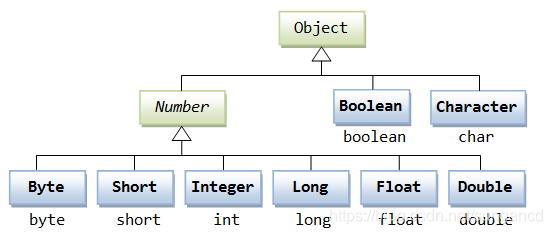
这种由编译器特别支持的包装称为装箱,所以当内置数据类型被当作对象使用的时候,编译器会把内置类型装箱为包装类。相似的,编译器也可以把一个对象拆箱为内置类型。Number 类属于 java.lang 包。
下面是一个使用 Integer 对象的实例
装箱和拆箱:
public class Test{

   public static void main(String args[]){
      //Integer x = new Integer(5);装箱
      Integer x=Integer.valueOf(5);//装箱
      int x1=x.intValue()+10;//拆箱
      System.out.println(x1);
   }
}
自动装箱和自动拆箱:
public class Test{

   public static void main(String args[]){
      Integer x = 5;//自动装箱
      x =  x + 10;//自动拆箱
      System.out.println(x);
   }
}
以上实例编译运行结果如下:
15
当 x 被赋为整型值时,由于x是一个对象,所以编译器要对x进行装箱。然后,为了使x能进行加运算,所以要对x进行拆箱。
Java Math 类
Java 的 Math 包含了用于执行基本数学运算的属性和方法,如初等指数、对数、平方根和三角函数。
Math 的方法都被定义为 static 形式,通过 Math 类可以在主函数中直接调用。
public class Test {
    public static void main (String []args)
    {
        System.out.println("90 度的正弦值:" + Math.sin(Math.PI/2));
        System.out.println("0度的余弦值:" + Math.cos(0));
        System.out.println("60度的正切值:" + Math.tan(Math.PI/3));
        System.out.println("1的反正切值: " + Math.atan(1));
        System.out.println("π/2的角度值:" + Math.toDegrees(Math.PI/2));
        System.out.println(Math.PI);
    }
}
以上实例编译运行结果如下:
90 度的正弦值:1.0
0度的余弦值:1.0
60度的正切值:1.7320508075688767
1的反正切值: 0.7853981633974483
π/2的角度值:90.0
3.141592653589793
序号 方法与描述
1 xxxValue()
将 Number 对象转换为xxx数据类型的值并返回。
2 compareTo()
将number对象与参数比较。
3 equals()
判断number对象是否与参数相等。
4 valueOf()
返回一个 Number 对象指定的内置数据类型
5 toString()
以字符串形式返回值。
6 parseInt()
将字符串解析为int类型。
7 abs()
返回参数的绝对值。
8 ceil()
返回大于等于( >= )给定参数的的最小整数,类型为双精度浮点型。
9 floor()
返回小于等于(<=)给定参数的最大整数 。
10 rint()
返回与参数最接近的整数。返回类型为double。
11 round()
它表示四舍五入,算法为 Math.floor(x+0.5),即将原来的数字加上 0.5 后再向下取整,所以,Math.round(11.5) 的结果为12,Math.round(-11.5) 的结果为-11。
12 min()
返回两个参数中的最小值。
13 max()
返回两个参数中的最大值。
14 exp()
返回自然数底数e的参数次方。
15 log()
返回参数的自然数底数的对数值。
16 pow()
返回第一个参数的第二个参数次方。
17 sqrt()
求参数的算术平方根。
18 sin()
求指定double类型参数的正弦值。
19 cos()
求指定double类型参数的余弦值。
20 tan()
求指定double类型参数的正切值。
21 asin()
求指定double类型参数的反正弦值。
22 acos()
求指定double类型参数的反余弦值。
23 atan()
求指定double类型参数的反正切值。
24 atan()
将笛卡尔坐标转换为极坐标,并返回极坐标的角度值。
25 random()
返回一个随机数。
Math 的 floor,round 和 ceil 方法实例比较
floor 返回不大于的最大整数
round方法,它表示“四舍五入”,算法为Math.floor(x+0.5),即将原来的数字加上0.5后再向下取整,所以,Math.round(11.5)的结果为12,Math.round(-11.5)的结果为-11。
ceil 则是不小于他的最小整数
| 参数 | Math.floor | Math.round | Math.ceil |
|---|---|---|---|
| 1.4 | 1 | 1 | 2 |
| 1.5 | 1 | 2 | 2 |
| 1.6 | 1 | 2 | 2 |
| -1.4 | -2 | -1 | -1 |
| -1.5 | -2 | -2 | -1 |
| -1.6 | -2 | -2 | -1 |
public class Main {
  public static void main(String[] args) {
    double[] nums = { 1.4, 1.5, 1.6, -1.4, -1.5, -1.6 };
    for (double num : nums) {
      test(num);
    }
  }

  private static void test(double num) {
    System.out.println("Math.floor(" + num + ")=" + Math.floor(num));
    System.out.println("Math.round(" + num + ")=" + Math.round(num));
    System.out.println("Math.ceil(" + num + ")=" + Math.ceil(num));
  }
}
以上实例执行输出结果为:
Math.floor(1.4)=1.0
Math.round(1.4)=1
Math.ceil(1.4)=2.0
Math.floor(1.5)=1.0
Math.round(1.5)=2
Math.ceil(1.5)=2.0
Math.floor(1.6)=1.0
Math.round(1.6)=2
Math.ceil(1.6)=2.0
Math.floor(-1.4)=-2.0
Math.round(-1.4)=-1
Math.ceil(-1.4)=-1.0
Math.floor(-1.5)=-2.0
Math.round(-1.5)=-2
Math.ceil(-1.5)=-1.0
Math.floor(-1.6)=-2.0
Math.round(-1.6)=-2
Math.ceil(-1.6)=-1.0





 扫一扫
扫一扫


 345
345

 被折叠的 条评论
为什么被折叠?
被折叠的 条评论
为什么被折叠?
 到【灌水乐园】发言





