


目录
1.let
(一)变量不能重复声明
let a = '熊大';
let a = '熊二';
//会报错
(二)块级作用域
只在{ } 里面起作用
{
    let a = '熊大'
}
console.log(a) //报错
(三)不存在变量提升
console.log(a);  // 报错而不是undefined
let a = 'xiong';
(四) 不影响作用域链
{
    let a = 'xiong';
    function fn(){
        console.log(a) //xiong
    }
}
2.const
(一)一一定要赋初始值
(二)声明常量一般用大写-------潜规则
(三)常量的值不能修改
(四)块级作用域
(五)对于数组和对象的元素修改,不算做对常量的修改,不会报错
3.解构赋值
按照一定模式从数组和对象中提取值,对变量进行赋值
(一)数组的解构
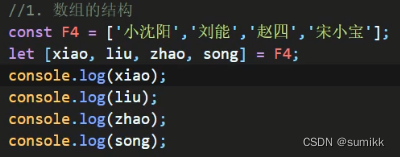
(二)对象的结构
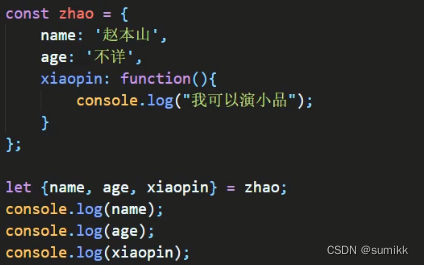
4.ES6引入新的声明字符串的方式——``
(一)声明
let str = `我是字符串`;
(二)内容中可以直接出现换行符
(三)变量拼接
let name = 'xionger'
let he = `${name}是老二`
console。log(he)  //xionger是老二
5.变量和函数的简洁写法
{
    name: name,
    //简化为
    name,
}

{
    fn:function(){
        console.log()
    }
    //可以简写为
    fn(){
        console.log()
    }
}
6.箭头函数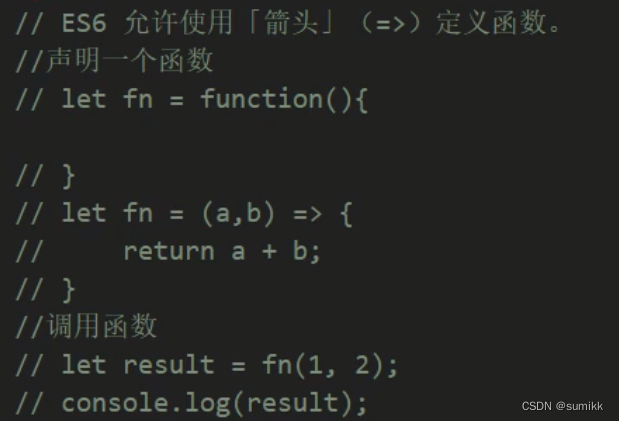
(一)this是静态的。this始终指向函数声明时所在作用域下的this的值
function fn() {
    console.log(this.name)
}
let fn2 = () => {
    console.log(this.name)
}

// 设置window对象的name属性
window.name = 'xiong';
const chan = {
    name: "dog"
}

//直接调用
fn()   //xiong
fn2()  //xiong

//call方法调用
fn().call(chan);  //dog
fn1().call(chan); //dog
(二)不能作为构造实例化对象
let fn = (name) => {
    this.name = name
}
let me = new fn('xiong')  //报错
console.log(me);
(三) 不能使用arguments变量
(四)简写
当形参只有一个时可以省略括号
当代码体只有一条语句时,return必须省略。而且执行结果就是函数的返回值
7.允许函数参数赋值初始值
function add(a, b, c = 5) {
    return a + b + c;
}
let result = add(1, 2) //8
let result2 = add(1, 2, 3)  //6
(一)有默认值的参数一般放后
(二)与解构赋值结合
8.rest参数,代替arguments
function fn(...a){
    console.log(a) //a打印出来是一个数组,可以使用数组的方法  filter some every map
}

fn(1,2,3,4)
rest参数必须放在所有形参最后面
9.扩展运算符(...)
能将数组转化为逗号分隔的参数序列
arr = [1,2,3,4]
function fn(){
    console.log(arguments)
}

fn(arr)
fn(...arr)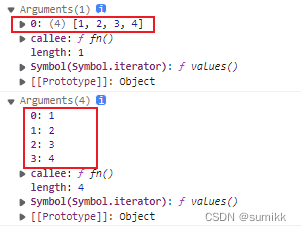
运用
(一)数组合并
const arr1 = [1,2]
const arr2 = [3,4]
const newarr = [...arr1 , ...arr2]
console.log(newarr) // 1,2,3,4
(二)数组克隆
const arr1 = [1,2]
const arr2 = [...arr1]
(三)将为数组转化为真正的数组
<div></div>
<div></div>
<div></div>

var divs = document.querySelectorAll('div')
var arr = [...divs]
console.log(divs)
console.log(arr)
10.新数据类型Symbol
特点:
- Symbol的值是唯一的,用来解决命名冲突的问题
- Symbol值不能与其他数据类型进行运算
- Symbol定义的对象属性不能使用for...in 循环遍历,但是可以使用Reflect.ownKeys来获取对象的所有键名
//创建 Symbol
let s = Symbol();

let s1 = Symbol('张三');
let s2 = Symbol('张三');
console.log(s1 == s2)  //false

// Symbol.for 创建
let s3 = Symbol.for('李四')
let s4 = Symbol.for('李四')
console.log(s3 == s4)  //true
给对象添加Symbol属性
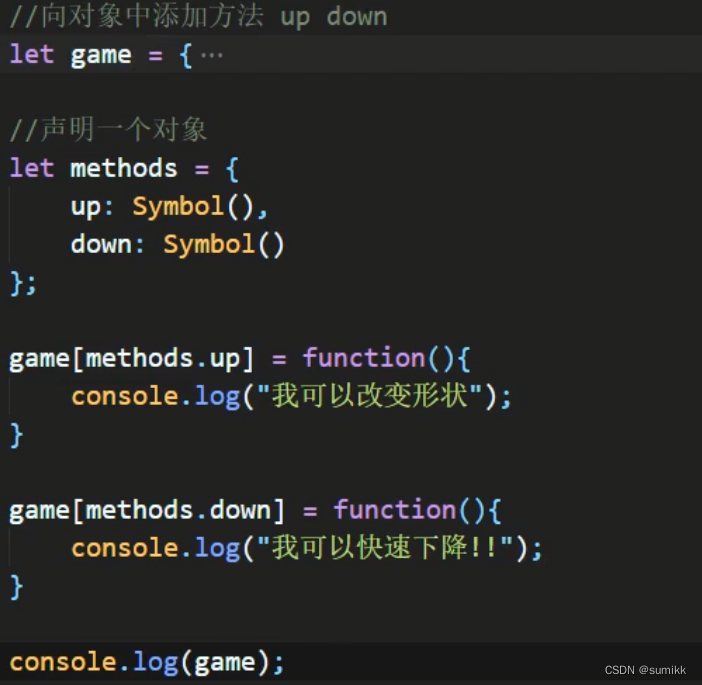
Symbol自己有11个内置属性
11.迭代器
迭代器(Iterator)是一种接口,为各种不同的数据结构提供统一的访问机制。任何数据结构只要部署Iterator接口,就可以完成遍历操作。
ES6创造了一种新的遍历命令for…of循环,Iterator接口主要供for…of消费
const arr = ['a', 'b', 'c', 'd']
for (let v of arr) {
    console.log(v) //a,b,c,d
}
for (let v in arr) {
    console.log(v) //0,1,2,3
}
工作原理:
a)创建一个指针对象,指向当前数据结构的起始位置
b)第一次调用对象的next方法,指针自动指向数据结构的第一个成员
c)接下来不断调用next方法,指针一直往后移动,知道指向最后一个成员
d)每次调用next方法返回一个包含value和done属性的对象
迭代器自定义遍历对象
//声明一个对象
const names = {
    stus: [
        'xiaoming',
        'xiaotian',
        'xiaoning',
        'xiaohong'
    ],
    [Symbol.iterator]() {
        let index = 0;
        let _this = this
        return {
            next: function () {
                if (index < _this.stus.length) {
                    const result = {
                        value: _this.stus[index],
                        done: false
                    }
                    index++;
                    return result;
                }
                else {
                    return { value: undefined, done: true };
                }
            }
        }
    }
}

//遍历对象
for (let v of names) {
    console.log(v)
}
12.生成器
生成器其实就是一个含函数
(一)函数的声明
function * fun() {
    console.log('xiong')
}
与普通函数不同的是:声明的时候需要加“ * ”
(二)函数调用是一个迭代器对象,需要用next方法执行,也可以用for...of遍历
function* fun() {
    console.log('aa')
}

let gofun = fun()
gofun.next()
如果调用next方法时传入参数,则传入的参数将作为那一段yield的返回结果。第n次调用next传参数,等于第n-1次yield返回的结果。
function* fun() {
    let one = yield 111;
    console.log(one);
    let two = yield 222;
    console.log(two);
}

let gofun = fun()
console.log(gofun.next());
console.log(gofun.next(1));
console.log(gofun.next(2));
(三)yield分割符
作用是将函数分隔成几段,以yield结束
function* fun() {
    console.log('第一段')
    yield 'aa'
    console.log('第二段')
    yield 'bb'
    console.log('第三段')
}
13.Promise
const p = new Promise(function (resolve, reject) {
    setTimeout(function{
        let data = '成功'
        resolve(data);
        let eer = '失败';
        reject(eer);
    }, 1000)
})
//调用Promise 对象的then方法
p.then(function (res) {
    console.log(res)
}), function (eer) {
    console.log(eer)
}
未完
14.集合和API
set
let s = new Set();
let s2 = new Set(['大事儿', '小事儿','好事儿','坏事儿','小事儿']);

//元素个数
console.log(s2.size)
//添加新的元素
s2.add('喜事儿');
//删除元素
s2.delete('坏事儿');
//检测
console.log(s2.has('糟心事'));
//清空
s2.clear()
15.Map
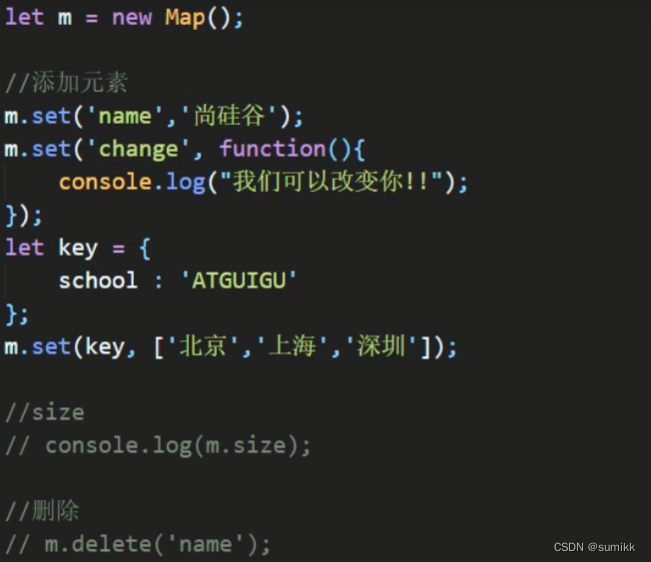
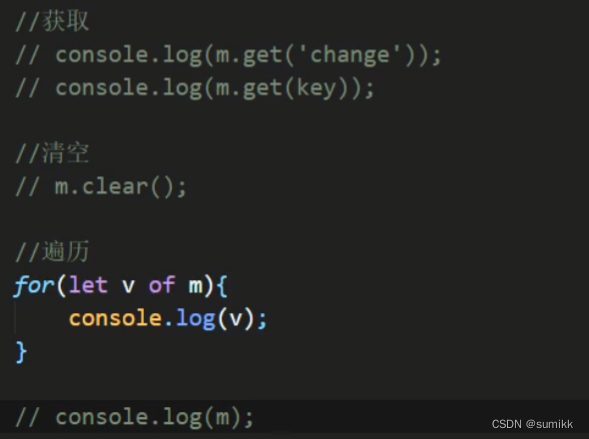
类似于对象,也是键值对的集合。但是“键”的范围不限于字符串,各种类型的值(包括对象)都可以当作键。Map也可以实现iterator接口,所以可以使用扩展运算符和for...of进行遍历。
Map的属性和方法:
1)size 返回Map的元素个数
2)set 增加一个新元素,返回当前Map
3)get 返回个键名对象的键值
4)has 检测Map中是否包含某个元素,返回boolean值
5)clear 清空集合,返回underfined
参考例子:
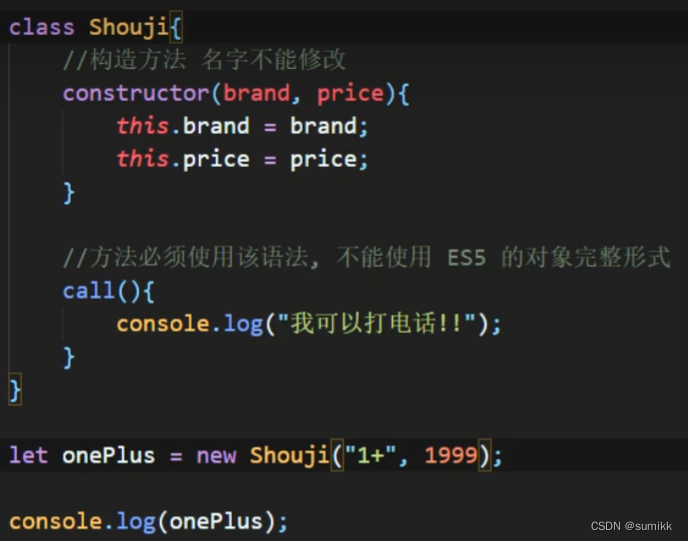
16.class类
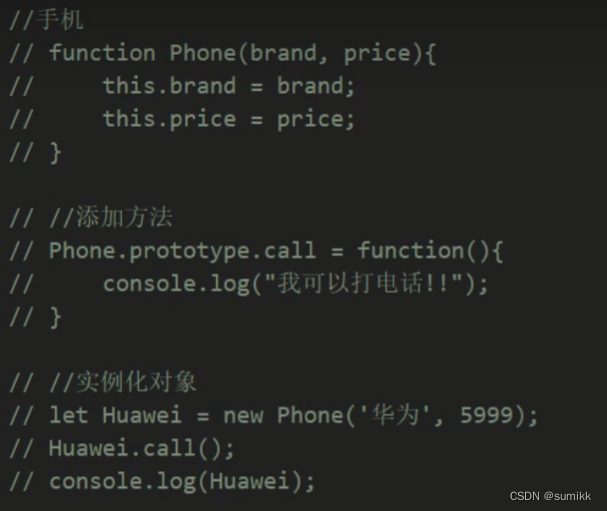
class作为对象的模板。通过class关键字,可以定义类。基本上,ES6的class可以只是一个语法糖,它的绝大部分功能,ES5都可以做到,新的class写法只是让对象原型的写法更加清晰、更像面向对象编程的语法而已
ES5
用class
类的静态成员
 class Phone {
     //静态属性
     static name = '手机';
     static change() {
         console.log('我可以改变世界')
     }
 }
 let nokia = new Phone();
 console.log(nokia.name) //undefined
 console.log(Phone.name) //手机
未完待续





 扫一扫
扫一扫


 2057
2057

 被折叠的 条评论
为什么被折叠?
被折叠的 条评论
为什么被折叠?
 到【灌水乐园】发言





