


JavaSE-多线程(5.2)- ReentrantLock (源码解析,公平模式)
ReentrantLock 解释
ReentrantLock 是 java JUC 包(java.util.concurrent)下的可重入锁工具类,具体功能实现依赖AbstractQueuedSynchronizer(AQS,抽象队列同步器),AQS 内部维护了一个变量 private volatile int state; 默认为 0,当线程上锁以后值变成 1 (state 值改变通过 CAS 实现),没有获取到锁的线程会加入等待对列。
ReentrantLock 使用举例
通过一个例子来分析 ReentrantLock 的执行原理:
public class FairLockAndNonFairLockTest {

    static class Task implements Runnable {
        private final ReentrantLock lock;
        private volatile int count = 0;

        public Task(boolean fair) {
            this.lock = new ReentrantLock(fair);
        }

        @Override
        public void run() {
            for (int i = 0; i < 3; i++) {
                doTask();
            }
        }

        private void doTask() {
            lock.lock();
            try {
                System.out.println("任务开始。。。, 线程:" + Thread.currentThread().getName() + " , count=" + count);
                count++;
                sleep(500);
                System.out.println("任务结束。。。, 线程:" + Thread.currentThread().getName() + " , count=" + count);
                printQueuedThreads(lock);
            } finally {
                lock.unlock();
            }
        }
    }

    public static void sleep(long millis) {
        try {
            Thread.sleep(millis);
        } catch (InterruptedException e) {
            throw new RuntimeException(e);
        }
    }

    public static void printQueuedThreads(ReentrantLock lock) {
        Class<ReentrantLock> reentrantLockClass = (Class<ReentrantLock>) lock.getClass();
        try {
            // getQueuedThreads 方法访问权限是 protected ,所以通过反射方式访问
            Method getQueuedThreads = reentrantLockClass.getDeclaredMethod("getQueuedThreads");
            getQueuedThreads.setAccessible(true);
            // 获取 aqs 中的线程队列
            List<Thread> list = (List<Thread>) getQueuedThreads.invoke(lock);
            // 看 getQueuedThreads 方法源码可知,它的顺序是从tail开始 加入list的,这里给它倒过来,从 head 开始
            Collections.reverse(list);
            System.out.println(list);
        } catch (NoSuchMethodException e) {
            throw new RuntimeException(e);
        } catch (InvocationTargetException e) {
            throw new RuntimeException(e);
        } catch (IllegalAccessException e) {
            throw new RuntimeException(e);
        }
    }

    public static void main(String[] args) {
        Task task = new Task(true);
        for (int i = 0; i < 5; i++) {
            new Thread(task, "t" + (i + 1)).start();

            // 稍微延迟启动,让线程按顺序创建和启动
            sleep(10);
        }
    }
}
以上代码中启动了5个线程,它们各自都会执行task任务,每个task任务会循环3次调用 doTask 方法,doTask方法有加锁操作,每执行一次 count 加1,并且在doTask方法中会打印当前等待队列中的线程。
查看运行结果(是否和你预期一致?):
任务开始。。。, 线程:t1 , count=0
任务结束。。。, 线程:t1 , count=1
[Thread[t2,5,main], Thread[t3,5,main], Thread[t4,5,main], Thread[t5,5,main]]
任务开始。。。, 线程:t2 , count=1
任务结束。。。, 线程:t2 , count=2
[Thread[t3,5,main], Thread[t4,5,main], Thread[t5,5,main], Thread[t1,5,main]]
任务开始。。。, 线程:t3 , count=2
任务结束。。。, 线程:t3 , count=3
[Thread[t4,5,main], Thread[t5,5,main], Thread[t1,5,main], Thread[t2,5,main]]
任务开始。。。, 线程:t4 , count=3
任务结束。。。, 线程:t4 , count=4
[Thread[t5,5,main], Thread[t1,5,main], Thread[t2,5,main], Thread[t3,5,main]]
任务开始。。。, 线程:t5 , count=4
任务结束。。。, 线程:t5 , count=5
[Thread[t1,5,main], Thread[t2,5,main], Thread[t3,5,main], Thread[t4,5,main]]
任务开始。。。, 线程:t1 , count=5
任务结束。。。, 线程:t1 , count=6
[Thread[t2,5,main], Thread[t3,5,main], Thread[t4,5,main], Thread[t5,5,main]]
任务开始。。。, 线程:t2 , count=6
任务结束。。。, 线程:t2 , count=7
[Thread[t3,5,main], Thread[t4,5,main], Thread[t5,5,main], Thread[t1,5,main]]
任务开始。。。, 线程:t3 , count=7
任务结束。。。, 线程:t3 , count=8
[Thread[t4,5,main], Thread[t5,5,main], Thread[t1,5,main], Thread[t2,5,main]]
任务开始。。。, 线程:t4 , count=8
任务结束。。。, 线程:t4 , count=9
[Thread[t5,5,main], Thread[t1,5,main], Thread[t2,5,main], Thread[t3,5,main]]
任务开始。。。, 线程:t5 , count=9
任务结束。。。, 线程:t5 , count=10
[Thread[t1,5,main], Thread[t2,5,main], Thread[t3,5,main], Thread[t4,5,main]]
任务开始。。。, 线程:t1 , count=10
任务结束。。。, 线程:t1 , count=11
[Thread[t2,5,main], Thread[t3,5,main], Thread[t4,5,main], Thread[t5,5,main]]
任务开始。。。, 线程:t2 , count=11
任务结束。。。, 线程:t2 , count=12
[Thread[t3,5,main], Thread[t4,5,main], Thread[t5,5,main]]
任务开始。。。, 线程:t3 , count=12
任务结束。。。, 线程:t3 , count=13
[Thread[t4,5,main], Thread[t5,5,main]]
任务开始。。。, 线程:t4 , count=13
任务结束。。。, 线程:t4 , count=14
[Thread[t5,5,main]]
任务开始。。。, 线程:t5 , count=14
任务结束。。。, 线程:t5 , count=15
[]
以上,由于线程启动后 sleep(10); 所以总是线程 t1 先执行,其他线程由于竞争不到锁会依次加入到等待队列中,当线程 t1 执行完 1 次后,t1释放锁,t1 会继续循环,但是由于是公平模式,所以 t1 会加入到等待队列,t2 成功获取锁继续执行,依次交替执行。
ReentrantLock 源码解析
ReentrantLock 源码如下:
package java.util.concurrent.locks;
import java.util.concurrent.TimeUnit;
import java.util.Collection;
/**
* @since 1.5
* @author Doug Lea
*/
public class ReentrantLock implements Lock, java.io.Serializable {
private static final long serialVersionUID = 7373984872572414699L;
/** Synchronizer providing all implementation mechanics */
private final Sync sync;
/**
* Base of synchronization control for this lock. Subclassed
* into fair and nonfair versions below. Uses AQS state to
* represent the number of holds on the lock.
*/
abstract static class Sync extends AbstractQueuedSynchronizer {
private static final long serialVersionUID = -5179523762034025860L;
/**
* Performs {@link Lock#lock}. The main reason for subclassing
* is to allow fast path for nonfair version.
*/
abstract void lock();
/**
* Performs non-fair tryLock. tryAcquire is implemented in
* subclasses, but both need nonfair try for trylock method.
*/
final boolean nonfairTryAcquire(int acquires) {
final Thread current = Thread.currentThread();
int c = getState();
if (c == 0) {
if (compareAndSetState(0, acquires)) {
setExclusiveOwnerThread(current);
return true;
}
}
else if (current == getExclusiveOwnerThread()) {
int nextc = c + acquires;
if (nextc < 0) // overflow
throw new Error("Maximum lock count exceeded");
setState(nextc);
return true;
}
return false;
}
protected final boolean tryRelease(int releases) {
int c = getState() - releases;
if (Thread.currentThread() != getExclusiveOwnerThread())
throw new IllegalMonitorStateException();
boolean free = false;
if (c == 0) {
free = true;
setExclusiveOwnerThread(null);
}
setState(c);
return free;
}
protected final boolean isHeldExclusively() {
// While we must in general read state before owner,
// we don't need to do so to check if current thread is owner
return getExclusiveOwnerThread() == Thread.currentThread();
}
final ConditionObject newCondition() {
return new ConditionObject();
}
// Methods relayed from outer class
final Thread getOwner() {
return getState() == 0 ? null : getExclusiveOwnerThread();
}
final int getHoldCount() {
return isHeldExclusively() ? getState() : 0;
}
final boolean isLocked() {
return getState() != 0;
}
/**
* Reconstitutes the instance from a stream (that is, deserializes it).
*/
private void readObject(java.io.ObjectInputStream s)
throws java.io.IOException, ClassNotFoundException {
s.defaultReadObject();
setState(0); // reset to unlocked state
}
}
/**
* Sync object for non-fair locks
*/
static final class NonfairSync extends Sync {
private static final long serialVersionUID = 7316153563782823691L;
/**
* Performs lock. Try immediate barge, backing up to normal
* acquire on failure.
*/
final void lock() {
if (compareAndSetState(0, 1))
setExclusiveOwnerThread(Thread.currentThread());
else
acquire(1);
}
protected final boolean tryAcquire(int acquires) {
return nonfairTryAcquire(acquires);
}
}
/**
* Sync object for fair locks
*/
static final class FairSync extends Sync {
    private static final long serialVersionUID = -3000897897090466540L;

    final void lock() {
        acquire(1);
    }

    /**
     * Fair version of tryAcquire.  Don't grant access unless
     * recursive call or no waiters or is first.
     */
    protected final boolean tryAcquire(int acquires) {
        final Thread current = Thread.currentThread();
        int c = getState();
        if (c == 0) {
            if (!hasQueuedPredecessors() &&
                compareAndSetState(0, acquires)) {
                setExclusiveOwnerThread(current);
                return true;
            }
        }
        else if (current == getExclusiveOwnerThread()) {
            int nextc = c + acquires;
            if (nextc < 0)
                throw new Error("Maximum lock count exceeded");
            setState(nextc);
            return true;
        }
        return false;
    }
}
/**
* Creates an instance of {@code ReentrantLock}.
* This is equivalent to using {@code ReentrantLock(false)}.
*/
public ReentrantLock() {
sync = new NonfairSync();
}
/**
* Creates an instance of {@code ReentrantLock} with the
* given fairness policy.
*
* @param fair {@code true} if this lock should use a fair ordering policy
*/
public ReentrantLock(boolean fair) {
    sync = fair ? new FairSync() : new NonfairSync();
}
/**
* Acquires the lock.
*
* <p>Acquires the lock if it is not held by another thread and returns
* immediately, setting the lock hold count to one.
*
* <p>If the current thread already holds the lock then the hold
* count is incremented by one and the method returns immediately.
*
* <p>If the lock is held by another thread then the
* current thread becomes disabled for thread scheduling
* purposes and lies dormant until the lock has been acquired,
* at which time the lock hold count is set to one.
*/
public void lock() {
sync.lock();
}
/**
* Acquires the lock unless the current thread is
* {@linkplain Thread#interrupt interrupted}.
*
* <p>Acquires the lock if it is not held by another thread and returns
* immediately, setting the lock hold count to one.
*
* <p>If the current thread already holds this lock then the hold count
* is incremented by one and the method returns immediately.
*
* <p>If the lock is held by another thread then the
* current thread becomes disabled for thread scheduling
* purposes and lies dormant until one of two things happens:
*
* <ul>
*
* <li>The lock is acquired by the current thread; or
*
* <li>Some other thread {@linkplain Thread#interrupt interrupts} the
* current thread.
*
* </ul>
*
* <p>If the lock is acquired by the current thread then the lock hold
* count is set to one.
*
* <p>If the current thread:
*
* <ul>
*
* <li>has its interrupted status set on entry to this method; or
*
* <li>is {@linkplain Thread#interrupt interrupted} while acquiring
* the lock,
*
* </ul>
*
* then {@link InterruptedException} is thrown and the current thread's
* interrupted status is cleared.
*
* <p>In this implementation, as this method is an explicit
* interruption point, preference is given to responding to the
* interrupt over normal or reentrant acquisition of the lock.
*
* @throws InterruptedException if the current thread is interrupted
*/
public void lockInterruptibly() throws InterruptedException {
sync.acquireInterruptibly(1);
}
/**
* Acquires the lock only if it is not held by another thread at the time
* of invocation.
*
* <p>Acquires the lock if it is not held by another thread and
* returns immediately with the value {@code true}, setting the
* lock hold count to one. Even when this lock has been set to use a
* fair ordering policy, a call to {@code tryLock()} <em>will</em>
* immediately acquire the lock if it is available, whether or not
* other threads are currently waiting for the lock.
* This "barging" behavior can be useful in certain
* circumstances, even though it breaks fairness. If you want to honor
* the fairness setting for this lock, then use
* {@link #tryLock(long, TimeUnit) tryLock(0, TimeUnit.SECONDS) }
* which is almost equivalent (it also detects interruption).
*
* <p>If the current thread already holds this lock then the hold
* count is incremented by one and the method returns {@code true}.
*
* <p>If the lock is held by another thread then this method will return
* immediately with the value {@code false}.
*
* @return {@code true} if the lock was free and was acquired by the
* current thread, or the lock was already held by the current
* thread; and {@code false} otherwise
*/
public boolean tryLock() {
return sync.nonfairTryAcquire(1);
}
/**
* Acquires the lock if it is not held by another thread within the given
* waiting time and the current thread has not been
* {@linkplain Thread#interrupt interrupted}.
*
* <p>Acquires the lock if it is not held by another thread and returns
* immediately with the value {@code true}, setting the lock hold count
* to one. If this lock has been set to use a fair ordering policy then
* an available lock <em>will not</em> be acquired if any other threads
* are waiting for the lock. This is in contrast to the {@link #tryLock()}
* method. If you want a timed {@code tryLock} that does permit barging on
* a fair lock then combine the timed and un-timed forms together:
*
* <pre> {@code
* if (lock.tryLock() ||
* lock.tryLock(timeout, unit)) {
* ...
* }}</pre>
*
* <p>If the current thread
* already holds this lock then the hold count is incremented by one and
* the method returns {@code true}.
*
* <p>If the lock is held by another thread then the
* current thread becomes disabled for thread scheduling
* purposes and lies dormant until one of three things happens:
*
* <ul>
*
* <li>The lock is acquired by the current thread; or
*
* <li>Some other thread {@linkplain Thread#interrupt interrupts}
* the current thread; or
*
* <li>The specified waiting time elapses
*
* </ul>
*
* <p>If the lock is acquired then the value {@code true} is returned and
* the lock hold count is set to one.
*
* <p>If the current thread:
*
* <ul>
*
* <li>has its interrupted status set on entry to this method; or
*
* <li>is {@linkplain Thread#interrupt interrupted} while
* acquiring the lock,
*
* </ul>
* then {@link InterruptedException} is thrown and the current thread's
* interrupted status is cleared.
*
* <p>If the specified waiting time elapses then the value {@code false}
* is returned. If the time is less than or equal to zero, the method
* will not wait at all.
*
* <p>In this implementation, as this method is an explicit
* interruption point, preference is given to responding to the
* interrupt over normal or reentrant acquisition of the lock, and
* over reporting the elapse of the waiting time.
*
* @param timeout the time to wait for the lock
* @param unit the time unit of the timeout argument
* @return {@code true} if the lock was free and was acquired by the
* current thread, or the lock was already held by the current
* thread; and {@code false} if the waiting time elapsed before
* the lock could be acquired
* @throws InterruptedException if the current thread is interrupted
* @throws NullPointerException if the time unit is null
*/
public boolean tryLock(long timeout, TimeUnit unit)
throws InterruptedException {
return sync.tryAcquireNanos(1, unit.toNanos(timeout));
}
/**
* Attempts to release this lock.
*
* <p>If the current thread is the holder of this lock then the hold
* count is decremented. If the hold count is now zero then the lock
* is released. If the current thread is not the holder of this
* lock then {@link IllegalMonitorStateException} is thrown.
*
* @throws IllegalMonitorStateException if the current thread does not
* hold this lock
*/
public void unlock() {
sync.release(1);
}
/**
* Returns a {@link Condition} instance for use with this
* {@link Lock} instance.
*
* <p>The returned {@link Condition} instance supports the same
* usages as do the {@link Object} monitor methods ({@link
* Object#wait() wait}, {@link Object#notify notify}, and {@link
* Object#notifyAll notifyAll}) when used with the built-in
* monitor lock.
*
* <ul>
*
* <li>If this lock is not held when any of the {@link Condition}
* {@linkplain Condition#await() waiting} or {@linkplain
* Condition#signal signalling} methods are called, then an {@link
* IllegalMonitorStateException} is thrown.
*
* <li>When the condition {@linkplain Condition#await() waiting}
* methods are called the lock is released and, before they
* return, the lock is reacquired and the lock hold count restored
* to what it was when the method was called.
*
* <li>If a thread is {@linkplain Thread#interrupt interrupted}
* while waiting then the wait will terminate, an {@link
* InterruptedException} will be thrown, and the thread's
* interrupted status will be cleared.
*
* <li> Waiting threads are signalled in FIFO order.
*
* <li>The ordering of lock reacquisition for threads returning
* from waiting methods is the same as for threads initially
* acquiring the lock, which is in the default case not specified,
* but for <em>fair</em> locks favors those threads that have been
* waiting the longest.
*
* </ul>
*
* @return the Condition object
*/
public Condition newCondition() {
return sync.newCondition();
}
/**
* Queries the number of holds on this lock by the current thread.
*
* <p>A thread has a hold on a lock for each lock action that is not
* matched by an unlock action.
*
* <p>The hold count information is typically only used for testing and
* debugging purposes. For example, if a certain section of code should
* not be entered with the lock already held then we can assert that
* fact:
*
* <pre> {@code
* class X {
* ReentrantLock lock = new ReentrantLock();
* // ...
* public void m() {
* assert lock.getHoldCount() == 0;
* lock.lock();
* try {
* // ... method body
* } finally {
* lock.unlock();
* }
* }
* }}</pre>
*
* @return the number of holds on this lock by the current thread,
* or zero if this lock is not held by the current thread
*/
public int getHoldCount() {
return sync.getHoldCount();
}
/**
* Queries if this lock is held by the current thread.
*
* <p>Analogous to the {@link Thread#holdsLock(Object)} method for
* built-in monitor locks, this method is typically used for
* debugging and testing. For example, a method that should only be
* called while a lock is held can assert that this is the case:
*
* <pre> {@code
* class X {
* ReentrantLock lock = new ReentrantLock();
* // ...
*
* public void m() {
* assert lock.isHeldByCurrentThread();
* // ... method body
* }
* }}</pre>
*
* <p>It can also be used to ensure that a reentrant lock is used
* in a non-reentrant manner, for example:
*
* <pre> {@code
* class X {
* ReentrantLock lock = new ReentrantLock();
* // ...
*
* public void m() {
* assert !lock.isHeldByCurrentThread();
* lock.lock();
* try {
* // ... method body
* } finally {
* lock.unlock();
* }
* }
* }}</pre>
*
* @return {@code true} if current thread holds this lock and
* {@code false} otherwise
*/
public boolean isHeldByCurrentThread() {
return sync.isHeldExclusively();
}
/**
* Queries if this lock is held by any thread. This method is
* designed for use in monitoring of the system state,
* not for synchronization control.
*
* @return {@code true} if any thread holds this lock and
* {@code false} otherwise
*/
public boolean isLocked() {
return sync.isLocked();
}
/**
* Returns {@code true} if this lock has fairness set true.
*
* @return {@code true} if this lock has fairness set true
*/
public final boolean isFair() {
return sync instanceof FairSync;
}
/**
* Returns the thread that currently owns this lock, or
* {@code null} if not owned. When this method is called by a
* thread that is not the owner, the return value reflects a
* best-effort approximation of current lock status. For example,
* the owner may be momentarily {@code null} even if there are
* threads trying to acquire the lock but have not yet done so.
* This method is designed to facilitate construction of
* subclasses that provide more extensive lock monitoring
* facilities.
*
* @return the owner, or {@code null} if not owned
*/
protected Thread getOwner() {
return sync.getOwner();
}
/**
* Queries whether any threads are waiting to acquire this lock. Note that
* because cancellations may occur at any time, a {@code true}
* return does not guarantee that any other thread will ever
* acquire this lock. This method is designed primarily for use in
* monitoring of the system state.
*
* @return {@code true} if there may be other threads waiting to
* acquire the lock
*/
public final boolean hasQueuedThreads() {
return sync.hasQueuedThreads();
}
/**
* Queries whether the given thread is waiting to acquire this
* lock. Note that because cancellations may occur at any time, a
* {@code true} return does not guarantee that this thread
* will ever acquire this lock. This method is designed primarily for use
* in monitoring of the system state.
*
* @param thread the thread
* @return {@code true} if the given thread is queued waiting for this lock
* @throws NullPointerException if the thread is null
*/
public final boolean hasQueuedThread(Thread thread) {
return sync.isQueued(thread);
}
/**
* Returns an estimate of the number of threads waiting to
* acquire this lock. The value is only an estimate because the number of
* threads may change dynamically while this method traverses
* internal data structures. This method is designed for use in
* monitoring of the system state, not for synchronization
* control.
*
* @return the estimated number of threads waiting for this lock
*/
public final int getQueueLength() {
return sync.getQueueLength();
}
/**
* Returns a collection containing threads that may be waiting to
* acquire this lock. Because the actual set of threads may change
* dynamically while constructing this result, the returned
* collection is only a best-effort estimate. The elements of the
* returned collection are in no particular order. This method is
* designed to facilitate construction of subclasses that provide
* more extensive monitoring facilities.
*
* @return the collection of threads
*/
protected Collection<Thread> getQueuedThreads() {
return sync.getQueuedThreads();
}
/**
* Queries whether any threads are waiting on the given condition
* associated with this lock. Note that because timeouts and
* interrupts may occur at any time, a {@code true} return does
* not guarantee that a future {@code signal} will awaken any
* threads. This method is designed primarily for use in
* monitoring of the system state.
*
* @param condition the condition
* @return {@code true} if there are any waiting threads
* @throws IllegalMonitorStateException if this lock is not held
* @throws IllegalArgumentException if the given condition is
* not associated with this lock
* @throws NullPointerException if the condition is null
*/
public boolean hasWaiters(Condition condition) {
if (condition == null)
throw new NullPointerException();
if (!(condition instanceof AbstractQueuedSynchronizer.ConditionObject))
throw new IllegalArgumentException("not owner");
return sync.hasWaiters((AbstractQueuedSynchronizer.ConditionObject)condition);
}
/**
* Returns an estimate of the number of threads waiting on the
* given condition associated with this lock. Note that because
* timeouts and interrupts may occur at any time, the estimate
* serves only as an upper bound on the actual number of waiters.
* This method is designed for use in monitoring of the system
* state, not for synchronization control.
*
* @param condition the condition
* @return the estimated number of waiting threads
* @throws IllegalMonitorStateException if this lock is not held
* @throws IllegalArgumentException if the given condition is
* not associated with this lock
* @throws NullPointerException if the condition is null
*/
public int getWaitQueueLength(Condition condition) {
if (condition == null)
throw new NullPointerException();
if (!(condition instanceof AbstractQueuedSynchronizer.ConditionObject))
throw new IllegalArgumentException("not owner");
return sync.getWaitQueueLength((AbstractQueuedSynchronizer.ConditionObject)condition);
}
/**
* Returns a collection containing those threads that may be
* waiting on the given condition associated with this lock.
* Because the actual set of threads may change dynamically while
* constructing this result, the returned collection is only a
* best-effort estimate. The elements of the returned collection
* are in no particular order. This method is designed to
* facilitate construction of subclasses that provide more
* extensive condition monitoring facilities.
*
* @param condition the condition
* @return the collection of threads
* @throws IllegalMonitorStateException if this lock is not held
* @throws IllegalArgumentException if the given condition is
* not associated with this lock
* @throws NullPointerException if the condition is null
*/
protected Collection<Thread> getWaitingThreads(Condition condition) {
if (condition == null)
throw new NullPointerException();
if (!(condition instanceof AbstractQueuedSynchronizer.ConditionObject))
throw new IllegalArgumentException("not owner");
return sync.getWaitingThreads((AbstractQueuedSynchronizer.ConditionObject)condition);
}
/**
* Returns a string identifying this lock, as well as its lock state.
* The state, in brackets, includes either the String {@code "Unlocked"}
* or the String {@code "Locked by"} followed by the
* {@linkplain Thread#getName name} of the owning thread.
*
* @return a string identifying this lock, as well as its lock state
*/
public String toString() {
Thread o = sync.getOwner();
return super.toString() + ((o == null) ?
"[Unlocked]" :
"[Locked by thread " + o.getName() + "]");
}
}
ReentrantLock 类内有一个内部抽象类 Sync
abstract static class Sync extends AbstractQueuedSynchronizer
公平同步器 FairSync 和非公平同步器 NonfairSync 都是继承至 Sync,以公平同步器为例:
static final class FairSync extends Sync {
private static final long serialVersionUID = -3000897897090466540L;
final void lock() {
    acquire(1);
}
/**
* Fair version of tryAcquire. Don't grant access unless
* recursive call or no waiters or is first.
*/
protected final boolean tryAcquire(int acquires) {
final Thread current = Thread.currentThread();
int c = getState();
if (c == 0) {
if (!hasQueuedPredecessors() &&
compareAndSetState(0, acquires)) {
setExclusiveOwnerThread(current);
return true;
}
}
else if (current == getExclusiveOwnerThread()) {
int nextc = c + acquires;
if (nextc < 0)
throw new Error("Maximum lock count exceeded");
setState(nextc);
return true;
}
return false;
}
}
① 创建公平锁
如下代码表示创建公平锁,
private final ReentrantLock lock = new ReentrantLock(true);
程序会执行如下代码:
public ReentrantLock(boolean fair) {
sync = fair ? new FairSync() : new NonfairSync();
}
即将 FairSync() 对象赋值给 引用 private final Sync sync;
FairSync 类继承关系:
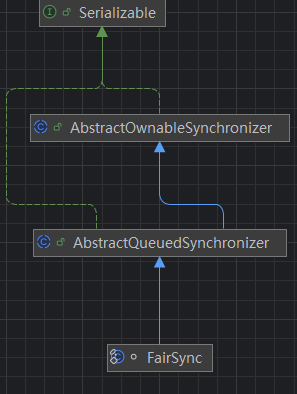
② 获取锁 lock.lock();
实际执行的是 FairSync 类的 lock 方法:
final void lock() {
acquire(1);
}
public final void acquire(int arg) {
    if (!tryAcquire(arg) &&
        acquireQueued(addWaiter(Node.EXCLUSIVE), arg))
        selfInterrupt();
}
如下,当第一个线程t1启动时,会尝试获取锁,即进入 if (c == 0) 代码块,
protected final boolean tryAcquire(int acquires) {
   final Thread current = Thread.currentThread();
    // 获取当前 state 值,为0时才可以修改其值
    int c = getState();
    if (c == 0) {
        if (!hasQueuedPredecessors() &&
            compareAndSetState(0, acquires)) {
            setExclusiveOwnerThread(current);
            return true;
        }
    }
    else if (current == getExclusiveOwnerThread()) {
        int nextc = c + acquires;
        if (nextc < 0)
            throw new Error("Maximum lock count exceeded");
        setState(nextc);
        return true;
    }
    return false;
}
当线程t1第一次执行时,tail = null,head = null,所以该方法返回 false,
// 判断AbstractQueuedSynchronizer中有没有等待的队列
public final boolean hasQueuedPredecessors() {
    // The correctness of this depends on head being initialized
    // before tail and on head.next being accurate if the current
    // thread is first in queue.
    Node t = tail; // Read fields in reverse initialization order
    Node h = head;
    Node s;
    return h != t &&
        ((s = h.next) == null || s.thread != Thread.currentThread());
}
接着执行 compareAndSetState(0, acquires) 代码,即通过 CAS 将 state 状态由 0 改成 1 ,由于主线程睡眠了10毫秒,所以其他线程启动推迟,大概率由 t1 获取锁成功,所以此时 exclusiveOwnerThread = t1。
// AbstractOwnableSynchronizer  类方法,将当前获取到锁的线程赋值给 exclusiveOwnerThread 变量
protected final void setExclusiveOwnerThread(Thread thread) {
    exclusiveOwnerThread = thread;
}
② 其他尝试获取锁的线程加入等待队列
当线程没有获取到锁时,使用 Node 记录等待线程然后加入队列,Node 是 抽象类 AbstractQueuedSynchronizer 的内部类:
static final class Node {
    /** Marker to indicate a node is waiting in shared mode */
    static final Node SHARED = new Node();
    /** Marker to indicate a node is waiting in exclusive mode */
    static final Node EXCLUSIVE = null;

    /** waitStatus value to indicate thread has cancelled */
    static final int CANCELLED =  1;
    /** waitStatus value to indicate successor's thread needs unparking */
    static final int SIGNAL    = -1;
    /** waitStatus value to indicate thread is waiting on condition */
    static final int CONDITION = -2;
    /**
     * waitStatus value to indicate the next acquireShared should
     * unconditionally propagate
     */
    static final int PROPAGATE = -3;

    volatile int waitStatus;

    volatile Node prev;

    volatile Node next;

    /**
     * The thread that enqueued this node.  Initialized on
     * construction and nulled out after use.
     */
    volatile Thread thread;

    /**
     * Link to next node waiting on condition, or the special
     * value SHARED.  Because condition queues are accessed only
     * when holding in exclusive mode, we just need a simple
     * linked queue to hold nodes while they are waiting on
     * conditions. They are then transferred to the queue to
     * re-acquire. And because conditions can only be exclusive,
     * we save a field by using special value to indicate shared
     * mode.
     */
    Node nextWaiter;

    /**
     * Returns true if node is waiting in shared mode.
     */
    final boolean isShared() {
        return nextWaiter == SHARED;
    }

    final Node predecessor() throws NullPointerException {
        Node p = prev;
        if (p == null)
            throw new NullPointerException();
        else
            return p;
    }

    Node() {    // Used to establish initial head or SHARED marker
    }

    Node(Thread thread, Node mode) {     // Used by addWaiter
        this.nextWaiter = mode;
        this.thread = thread;
    }

    Node(Thread thread, int waitStatus) { // Used by Condition
        this.waitStatus = waitStatus;
        this.thread = thread;
    }
}
线程 t1 获取锁成功后开始执行 run 方法循环体中的 doTask 方法,其他线程启动后也会调用 lock.lock(); 方法, 由于此时 state =1 (即锁被 t1 持有),所以 tryAcquire 返回 false,此时线程 t2 执行 acquireQueued(addWaiter(Node.EXCLUSIVE), arg) 方法
private Node addWaiter(Node mode) {
    Node node = new Node(Thread.currentThread(), mode);
    // Try the fast path of enq; backup to full enq on failure
    Node pred = tail;
    if (pred != null) {
        node.prev = pred;
        if (compareAndSetTail(pred, node)) {
            pred.next = node;
            return node;
        }
    }
    enq(node);
    return node;
}
如下,t2 准备加入队列时,此时队列为空,首先会创建一个空的节点,head 和 tail 都指向这个空 node,
      				+------+
 head 	====>		|  空  | 	 <====  tail        备注: <==== 和 ====> 表示指向,<----表示 prev ,----> 表示 next
      				+------+
当执行一次循环后,队列里已经有了一个空节点,此时进入else逻辑,此时队列节点如下
      		+------+  <----  +-----+
 head ====> |  空  | 	     |  t2 | <==== tail
      		+------+  ---->  +-----+
private Node enq(final Node node) {
    for (;;) {
        Node t = tail;
        // 第一次执行时 t == null
        if (t == null) { // Must initialize
            // 当队列为空时,会创建一个空的节点
            if (compareAndSetHead(new Node()))
                tail = head;
        } else {
            node.prev = t;
            if (compareAndSetTail(t, node)) {
                t.next = node;
                return t;
            }
        }
    }
}
当 t2 加入队列后执行如下方法,第一次循环时,t2 节点的上一个节点 p waitStatus = 0 ,shouldParkAfterFailedAcquire 方法将 p 节点waitStatus 改成 Node.SIGNAL(-1) 并且返回false,再次循环,shouldParkAfterFailedAcquire 方法返回true
final boolean acquireQueued(final Node node, int arg) {
    boolean failed = true;
    try {
        boolean interrupted = false;
        for (;;) {
            // 获取 node 节点的上一个节点
            final Node p = node.predecessor();
            if (p == head && tryAcquire(arg)) {
                setHead(node);
                p.next = null; // help GC
                failed = false;
                return interrupted;
            }
            if (shouldParkAfterFailedAcquire(p, node) &&
                parkAndCheckInterrupt())
                interrupted = true;
        }
    } finally {
        if (failed)
            cancelAcquire(node);
    }
}
t2 执行 parkAndCheckInterrupt 方法,t2 线程进入 waiting 状态。
private final boolean parkAndCheckInterrupt() {
    LockSupport.park(this);
    return Thread.interrupted();
}
其他线程类似,由于竞争不到锁,同样会加入等待队列,如下:
      		+------+  <----  +-----+  <----  +-----+  <----  +-----+  <----  +-----+
 head ====> |  空  | 	     |  t2 | 	     |  t3 | 	     |  t4 | 	     |  t5 | <==== tail
      		+------+  ---->  +-----+  ---->  +-----+  ---->  +-----+  ---->  +-----+
③ 释放锁 lock.unlock();
public void unlock() {
  sync.release(1);
}
AbstractQueuedSynchronizer 类 release 方法
public final boolean release(int arg) {
   if (tryRelease(arg)) {
       Node h = head;
       if (h != null && h.waitStatus != 0)
           unparkSuccessor(h);
       return true;
   }
   return false;
}
t1 释放锁时,c = 1 -1;进入 if (c == 0) ,将获取锁的线程 exclusiveOwnerThread 变量置null,并且将 state 改成 0,
protected final boolean tryRelease(int releases) {
    int c = getState() - releases;
    if (Thread.currentThread() != getExclusiveOwnerThread())
        throw new IllegalMonitorStateException();
    boolean free = false;
    if (c == 0) {
        free = true;
        setExclusiveOwnerThread(null);
    }
    setState(c);
    return free;
}
tryRelease 方法返回 true,执行 unparkSuccessor 方法:
第一步:将 t2 的前一个节点,即空节点 p 的 waitStatus 状态由 SIGNAL (-1) 改成 0 ,compareAndSetWaitStatus(node, ws, 0);
第二步:调用 LockSupport.unpark(s.thread); 将 t2 线程由 waiting 状态改成 runnable
private void unparkSuccessor(Node node) {
   /*
     * If status is negative (i.e., possibly needing signal) try
     * to clear in anticipation of signalling.  It is OK if this
     * fails or if status is changed by waiting thread.
     */
    int ws = node.waitStatus;
    if (ws < 0)
        compareAndSetWaitStatus(node, ws, 0);

    /*
     * Thread to unpark is held in successor, which is normally
     * just the next node.  But if cancelled or apparently null,
     * traverse backwards from tail to find the actual
     * non-cancelled successor.
     */
    Node s = node.next;
    if (s == null || s.waitStatus > 0) {
        s = null;
        for (Node t = tail; t != null && t != node; t = t.prev)
            if (t.waitStatus <= 0)
                s = t;
    }
    if (s != null)
        LockSupport.unpark(s.thread);
}
④ 其他线程获取锁 lock.lock();
此时 t1 和 t2 线程都处于 runnable 的状态,t1 执行下一次循环,重新尝试获取锁 lock.lock(); 但是由于调用 tryAcquire 方法时hasQueuedPredecessors 方法返回 true,主要是 s.thread != Thread.currentThread() ,因为此时头结点的下一个节点是 t2 ,此时线程是 t1 ,所以 线程 t1 会加入到等待队列。
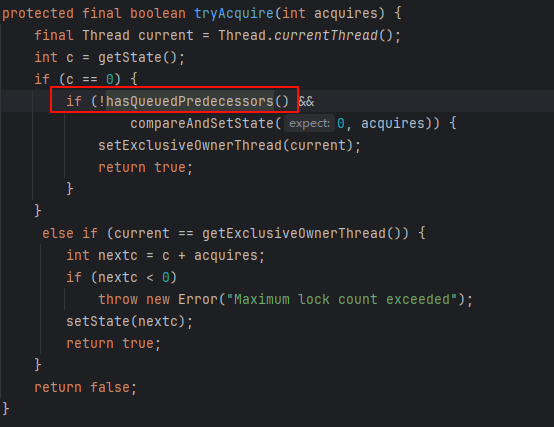
而线程 t2 会从 if (shouldParkAfterFailedAcquire(p, node) && 继续执行,从新开始循环,执行 tryAcquire 方法成功,即 t2 获取锁成功。
final boolean acquireQueued(final Node node, int arg) {
    boolean failed = true;
    try {
        boolean interrupted = false;
        for (;;) {
            final Node p = node.predecessor();
            if (p == head && tryAcquire(arg)) {
                // 将原来的头结点的下一个节点设置成头节点
                setHead(node);
                // 将原来的头节点断开
                p.next = null; // help GC
                failed = false;
                return interrupted;
            }
            if (shouldParkAfterFailedAcquire(p, node) &&
                parkAndCheckInterrupt())
                // 从这里继续执行。
                interrupted = true;
        }
    } finally {
        if (failed)
            cancelAcquire(node);
    }
}
所以新的队列是这样的:
      		+------+  <----  +-----+  <----  +-----+  <----  +-----+  <----  +-----+
 head ====> |  t2  | 	     |  t3 | 	     |  t4 | 	     |  t5 | 	     |  t1 | <==== tail
      		+------+  ---->  +-----+  ---->  +-----+  ---->  +-----+  ---->  +-----+
依次力推。。。。

 3205


 扫一扫


 被折叠的 条评论
为什么被折叠?
 到【灌水乐园】发言


