



作者简介:大家好,我是smart哥,前中兴通讯、美团架构师,现某互联网公司CTO
联系qq:184480602,加我进群,大家一起学习,一起进步,一起对抗互联网寒冬
学习必须往深处挖,挖的越深,基础越扎实!
阶段1、深入多线程
阶段2、深入多线程设计模式
阶段3、深入juc源码解析
码哥源码部分
码哥讲源码-原理源码篇【2024年最新大厂关于线程池使用的场景题】
码哥讲源码-原理源码篇【揭秘join方法的唤醒本质上决定于jvm的底层析构函数】
码哥源码-原理源码篇【Doug Lea为什么要将成员变量赋值给局部变量后再操作?】
码哥讲源码【谁再说Spring不支持多线程事务,你给我抽他!】
打脸系列【020-3小时讲解MESI协议和volatile之间的关系,那些将x86下的验证结果当作最终结果的水货们请闭嘴】
整数集合,是一个有序的数值数组对象,存储的数值不允许重复。源码在 intset.c
1. 数据结构
    /* Note that these encodings are ordered, so:
     * INTSET_ENC_INT16 < INTSET_ENC_INT32 < INTSET_ENC_INT64. */
    #define INTSET_ENC_INT16 (sizeof(int16_t))
    #define INTSET_ENC_INT32 (sizeof(int32_t))
    #define INTSET_ENC_INT64 (sizeof(int64_t))

    typedef struct intset {
        uint32_t encoding; // 编码。
        uint32_t length;   // 数组长度。
        int8_t contents[]; // 整数值数值。
    } intset;
根据插入数值大小,决定 contents 数组的 encoding 格式。编码格式分别有 int16_t,int32_t,int64_t。以最大的数值为准,如果最大的数值是 int64_t 那么数组的每个 item 都是 int64_t,优点是统一简单,提高数组查找效率——源码实现是通过二分法查找。如果数组不同数值用不同的编码存储,就很难用二分法查找了。 但是这样做一方面提高了查找效率,另一方面也会导致内存浪费,如果所有数据中,只有一个数据是 int64_t,其它数据都是 int16_t,整个数组 item 都以 int64_t 存储,显然会造成内存浪费。 当然 redis 的数据结构是丰富的,连续内存上的数据管理有:字符串对象(sds),压缩列表(ziplist),这里有整数集合(intset),都分别针对不同的应用场景进行应用。
2. 接口
2.1. 数值编码
    #define INT8_MAX         127
    #define INT16_MAX        32767
    #define INT32_MAX        2147483647
    #define INT64_MAX        9223372036854775807LL

    #define INT8_MIN          -128
    #define INT16_MIN         -32768

    /* Return the required encoding for the provided value. */
    static uint8_t _intsetValueEncoding(int64_t v) {
        if (v < INT32_MIN || v > INT32_MAX)
            return INTSET_ENC_INT64;
        else if (v < INT16_MIN || v > INT16_MAX)
            return INTSET_ENC_INT32;
        else
            return INTSET_ENC_INT16;
    }
2.2. 插入数据
检查插入数据是否大于当前编码格式,决定是否需要升级
    /* Insert an integer in the intset */
    intset *intsetAdd(intset *is, int64_t value, uint8_t *success) {
        uint8_t valenc = _intsetValueEncoding(value);
        uint32_t pos;
        if (success) *success = 1;

        /* Upgrade encoding if necessary. If we need to upgrade, we know that
         * this value should be either appended (if > 0) or prepended (if < 0),
         * because it lies outside the range of existing values. */
        // 如果插入数值大于当前编码,那么需要升级数组
        if (valenc > intrev32ifbe(is->encoding)) {
            /* This always succeeds, so we don't need to curry *success. */
            return intsetUpgradeAndAdd(is,value);
        } else {
            /* Abort if the value is already present in the set.
             * This call will populate "pos" with the right position to insert
             * the value when it cannot be found. */
            // 如果数值已经存在,就不需要插入数据了。*success = 0;
            if (intsetSearch(is,value,&pos)) {
                if (success) *success = 0;
                return is;
            }

            // 数据增长,重新申请内存。
            is = intsetResize(is,intrev32ifbe(is->length)+1);
            if (pos < intrev32ifbe(is->length)) intsetMoveTail(is,pos,pos+1);
        }

        _intsetSet(is,pos,value);
        is->length = intrev32ifbe(intrev32ifbe(is->length)+1);
        return is;
    }
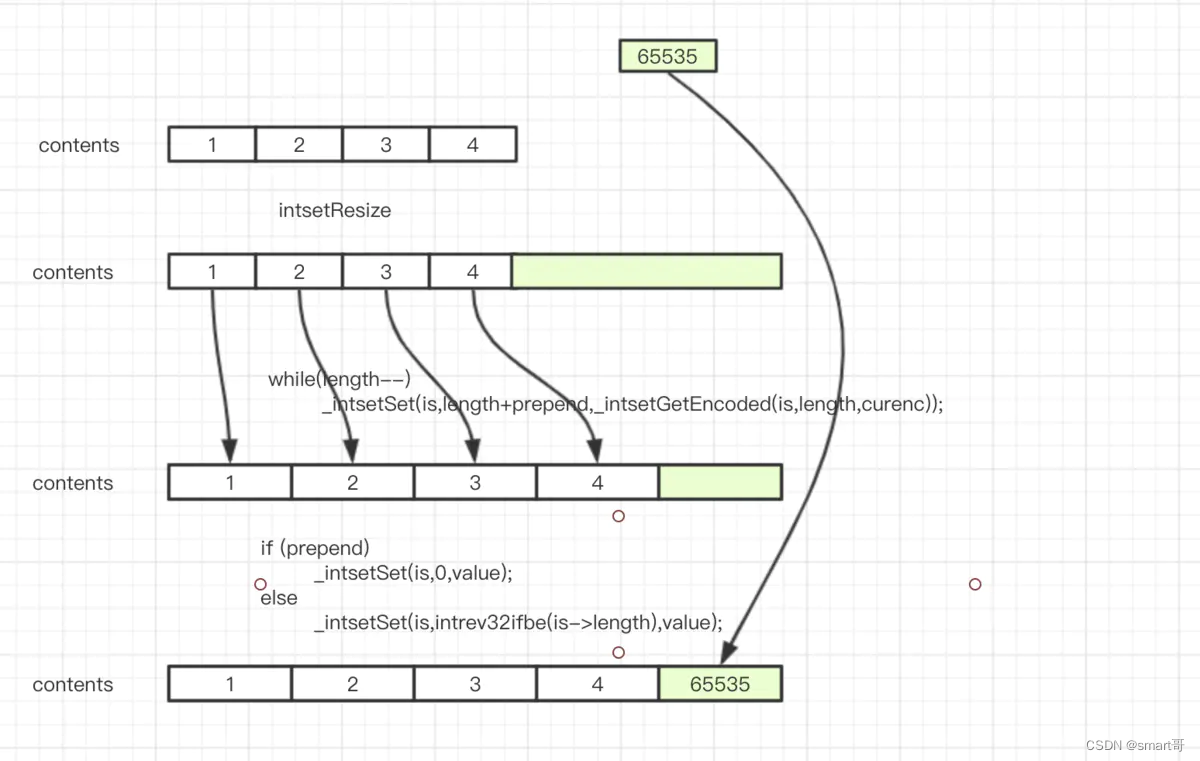
2.3. 升级
    /* Upgrades the intset to a larger encoding and inserts the given integer. */
    static intset *intsetUpgradeAndAdd(intset *is, int64_t value) {
        uint8_t curenc = intrev32ifbe(is->encoding);
        uint8_t newenc = _intsetValueEncoding(value);
        int length = intrev32ifbe(is->length);

        // 因为插入新的数据,而且数据超出了当前数组所有数值的范围才会升级。
        // 超出了负数,或者超出了正数。正数在数组末添加,负数在数组前面添加。
        int prepend = value < 0 ? 1 : 0;

        /* First set new encoding and resize */
        is->encoding = intrev32ifbe(newenc);
        is = intsetResize(is,intrev32ifbe(is->length)+1);

        /* Upgrade back-to-front so we don't overwrite values.
         * Note that the "prepend" variable is used to make sure we have an empty
         * space at either the beginning or the end of the intset. */
        // 扩充内存后,迁移数据。
        while(length--)
            _intsetSet(is,length+prepend,_intsetGetEncoded(is,length,curenc));

        /* Set the value at the beginning or the end. */
        if (prepend)
            _intsetSet(is,0,value);
        else
            _intsetSet(is,intrev32ifbe(is->length),value);
        is->length = intrev32ifbe(intrev32ifbe(is->length)+1);
        return is;
    }
2.4. 搜索
二分法搜索数组数据。
    /* Search for the position of "value". Return 1 when the value was found and
     * sets "pos" to the position of the value within the intset. Return 0 when
     * the value is not present in the intset and sets "pos" to the position
     * where "value" can be inserted. */
    static uint8_t intsetSearch(intset *is, int64_t value, uint32_t *pos) {
        int min = 0, max = intrev32ifbe(is->length)-1, mid = -1;
        int64_t cur = -1;

        /* The value can never be found when the set is empty */
        if (intrev32ifbe(is->length) == 0) {
            if (pos) *pos = 0;
            return 0;
        } else {
            // 检查数值是否大于或小于数组里的所有数值。
            /* Check for the case where we know we cannot find the value,
             * but do know the insert position. */
            if (value > _intsetGet(is,max)) {
                if (pos) *pos = intrev32ifbe(is->length);
                return 0;
            } else if (value < _intsetGet(is,0)) {
                if (pos) *pos = 0;
                return 0;
            }
        }

        // 数值如果在存储的数据中间,用二分法查找。
        while(max >= min) {
            mid = ((unsigned int)min + (unsigned int)max) >> 1;
            cur = _intsetGet(is,mid);
            if (value > cur) {
                min = mid+1;
            } else if (value < cur) {
                max = mid-1;
            } else {
                break;
            }
        }

        if (value == cur) {
            if (pos) *pos = mid;
            return 1;
        } else {
            if (pos) *pos = min;
            return 0;
        }
    }





 扫一扫
扫一扫


 630
630

 被折叠的 条评论
为什么被折叠?
被折叠的 条评论
为什么被折叠?
 到【灌水乐园】发言





