基于xml的事务控制
<?xml version="1.0" encoding="UTF-8"?>
<beans xmlns="http://www.springframework.org/schema/beans"
xmlns:xsi="http://www.w3.org/2001/XMLSchema-instance"
xmlns:aop="http://www.springframework.org/schema/aop"
xmlns:tx="http://www.springframework.org/schema/tx"
xsi:schemaLocation="
http://www.springframework.org/schema/beans
http://www.springframework.org/schema/beans/spring-beans.xsd
http://www.springframework.org/schema/tx
http://www.springframework.org/schema/tx/spring-tx.xsd
http://www.springframework.org/schema/aop
http://www.springframework.org/schema/aop/spring-aop.xsd">
<bean id="accountService" class="com.itheima.service.impl.AccountServiceImpl">
<property name="accountDao" ref="accountDao"></property>
</bean>
<bean id="accountDao" class="com.itheima.dao.impl.AccountDaoImpl">
<property name="dataSource" ref="dataSource"></property>
</bean>
<bean id="dataSource" class="org.springframework.jdbc.datasource.DriverManagerDataSource">
<property name="driverClassName" value="com.mysql.jdbc.Driver"></property>
<property name="url" value="jdbc:mysql://localhost:3306/eesy"></property>
<property name="username" value="root"></property>
<property name="password" value="1234"></property>
</bean>
<bean id="transactionManager" class="org.springframework.jdbc.datasource.DataSourceTransactionManager">
<property name="dataSource" ref="dataSource"></property>
</bean>
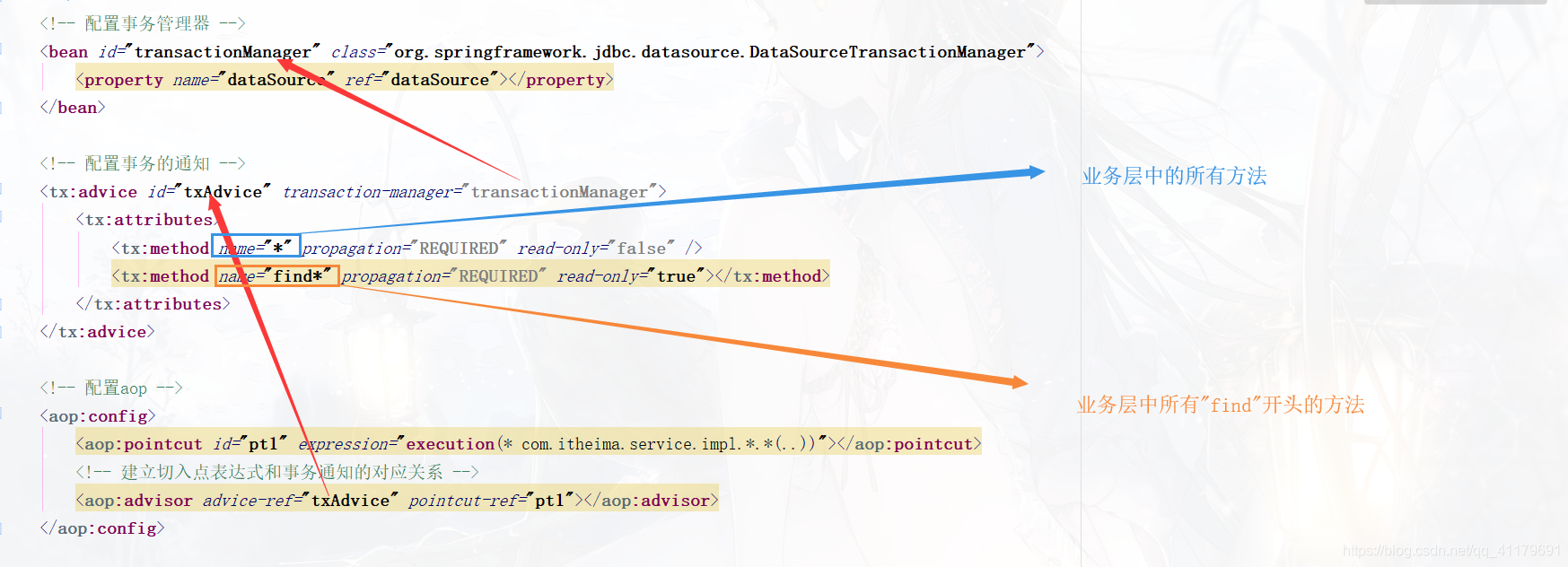
<tx:advice id="txAdvice" transaction-manager="transactionManager">
<tx:attributes>
<tx:method name="*" propagation="REQUIRED" read-only="false" />
<tx:method name="find*" propagation="REQUIRED" read-only="true"></tx:method>
</tx:attributes>
</tx:advice>
<aop:config>
<aop:pointcut id="pt1" expression="execution(* com.itheima.service.impl.*.*(..))"></aop:pointcut>
<aop:advisor advice-ref="txAdvice" pointcut-ref="pt1"></aop:advisor>
</aop:config>
</beans>
基于注解的事务控制
<?xml version="1.0" encoding="UTF-8"?>
<beans xmlns="http://www.springframework.org/schema/beans"
xmlns:xsi="http://www.w3.org/2001/XMLSchema-instance"
xmlns:aop="http://www.springframework.org/schema/aop"
xmlns:tx="http://www.springframework.org/schema/tx"
xmlns:context="http://www.springframework.org/schema/context"
xsi:schemaLocation="
http://www.springframework.org/schema/beans
http://www.springframework.org/schema/beans/spring-beans.xsd
http://www.springframework.org/schema/tx
http://www.springframework.org/schema/tx/spring-tx.xsd
http://www.springframework.org/schema/aop
http://www.springframework.org/schema/aop/spring-aop.xsd
http://www.springframework.org/schema/context
http://www.springframework.org/schema/context/spring-context.xsd">
<context:component-scan base-package="com.itheima"></context:component-scan>
<bean id="jdbcTemplate" class="org.springframework.jdbc.core.JdbcTemplate">
<property name="dataSource" ref="dataSource"></property>
</bean>
<bean id="dataSource" class="org.springframework.jdbc.datasource.DriverManagerDataSource">
<property name="driverClassName" value="com.mysql.jdbc.Driver"></property>
<property name="url" value="jdbc:mysql://localhost:3306/eesy"></property>
<property name="username" value="root"></property>
<property name="password" value="1234"></property>
</bean>
<bean id="transactionManager" class="org.springframework.jdbc.datasource.DataSourceTransactionManager">
<property name="dataSource" ref="dataSource"></property>
</bean>
<tx:annotation-driven transaction-manager="transactionManager"></tx:annotation-driven>
</beans>
package com.itheima.service.impl;
import com.itheima.dao.IAccountDao;
import com.itheima.domain.Account;
import com.itheima.service.IAccountService;
import org.springframework.beans.factory.annotation.Autowired;
import org.springframework.stereotype.Service;
import org.springframework.transaction.annotation.Propagation;
import org.springframework.transaction.annotation.Transactional;
@Service("accountService")
@Transactional(propagation = Propagation.SUPPORTS, readOnly = true)
public class AccountServiceImpl implements IAccountService{
@Autowired
private IAccountDao accountDao;
@Override
public Account findAccountById(Integer accountId) {
return accountDao.findAccountById(accountId);
}
@Override
@Transactional(propagation = Propagation.REQUIRED, readOnly = false)
public void transfer(String sourceName, String targetName, Float money) {
System.out.println("transfer....");
Account source = accountDao.findAccountByName(sourceName);
Account target = accountDao.findAccountByName(targetName);
source.setMoney(source.getMoney()-money);
target.setMoney(target.getMoney()+money);
accountDao.updateAccount(source);
int i=1/0;
accountDao.updateAccount(target);
}
}



 本文深入解析Spring框架中基于XML和注解的事务控制配置方法,包括事务管理器、通知、属性及AOP集成,适用于业务层的事务处理。





 扫一扫
扫一扫


 262
262

 被折叠的 条评论
为什么被折叠?
被折叠的 条评论
为什么被折叠?
 到【灌水乐园】发言





