



DextrAH-G 教师网络
Network(
  (value_mean_std): RunningMeanStd()
  (running_mean_std): RunningMeanStd()
  (a2c_network): Network(
    (actor_cnn): Sequential()
    (critic_cnn): Sequential()
    (actor_mlp): Sequential(
      (0): Linear(in_features=1024, out_features=512, bias=True)
      (1): ELU(alpha=1.0)
      (2): Linear(in_features=512, out_features=512, bias=True)
      (3): ELU(alpha=1.0)
    )
    (critic_mlp): Sequential()
    (rnn): LSTMWithDones(
      (rnn): LSTM(319, 1024)
    )
    (layer_norm): LayerNorm((1024,), eps=1e-05, elementwise_affine=True)
    (value): Linear(in_features=512, out_features=1, bias=True)
    (value_act): Identity()
    (mu): Linear(in_features=512, out_features=11, bias=True)
    (mu_act): Identity()
    (sigma_act): Identity()
  )
)
网络结构解释
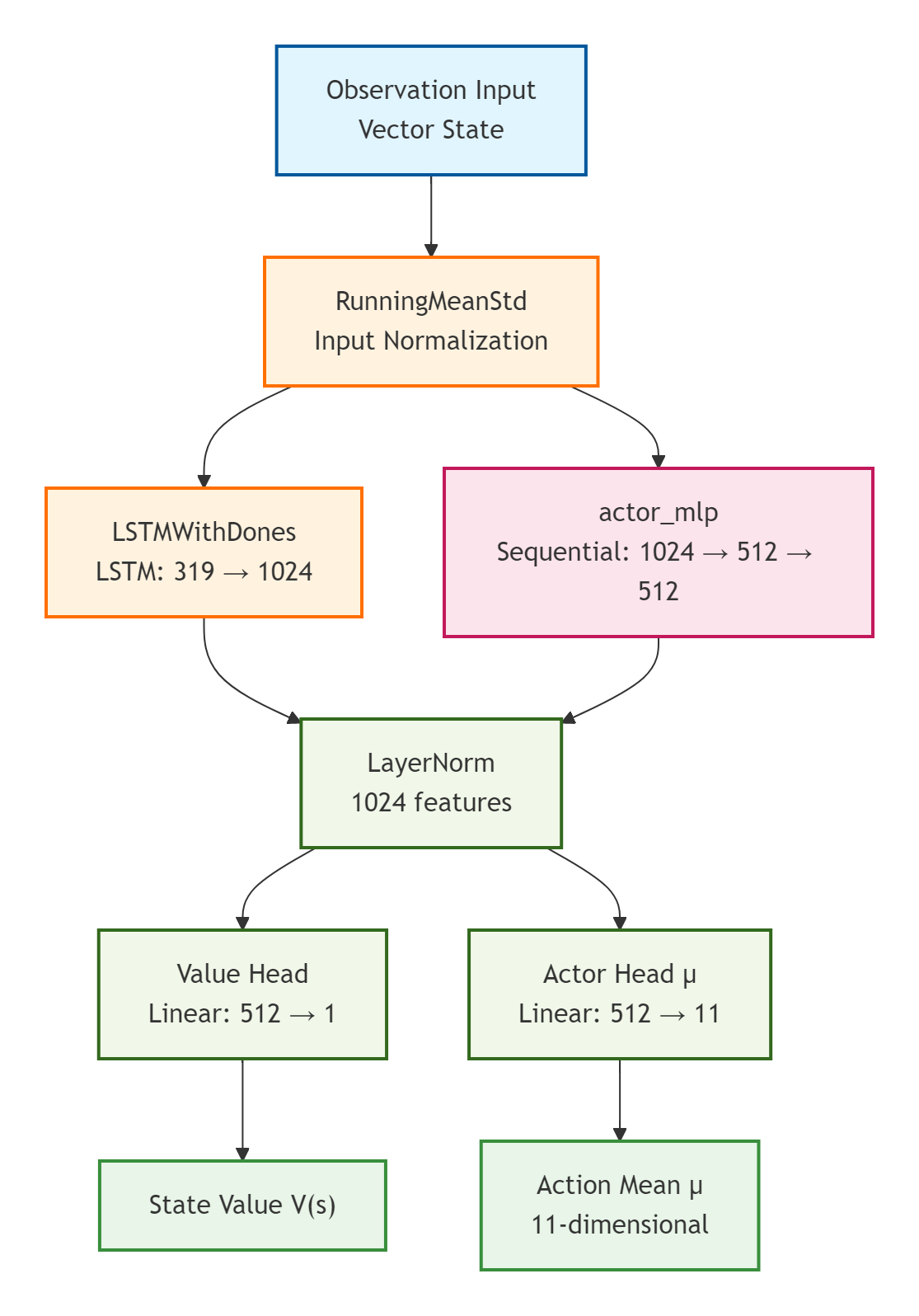
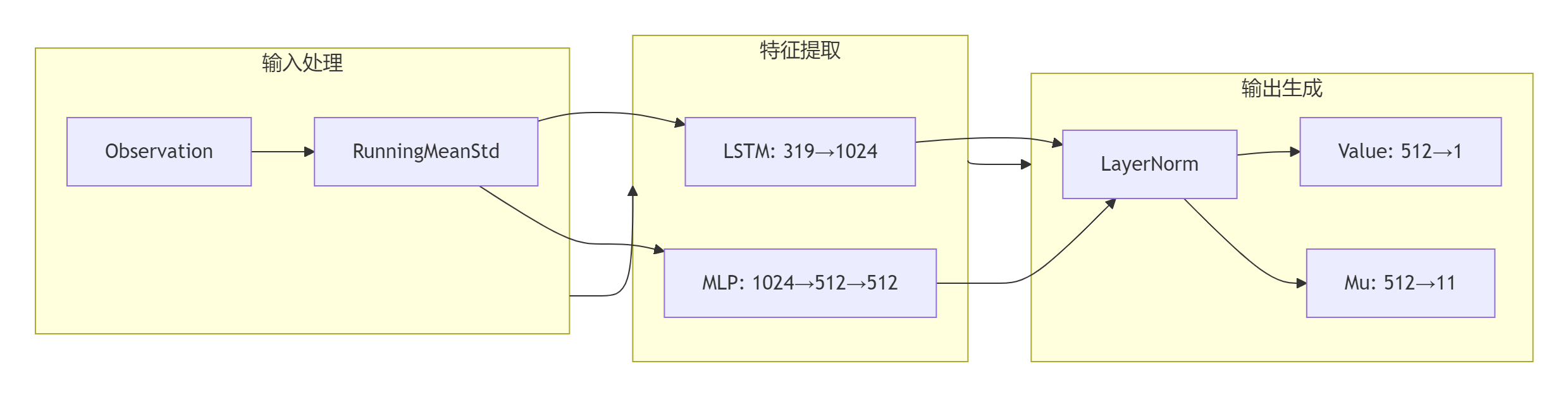
这是一个典型的 Actor-Critic 架构,专为连续动作空间的强化学习任务设计,具有以下特点:
🔍 核心组件分析
1. 标准化层(Normalization)
- value_mean_std和 running_mean_std:用于对输入状态和值函数进行动态标准化,提高训练稳定性
2. 特征提取网络(A2C Network)
- CNN部分:actor_cnn和 critic_cnn都是空的,说明不使用图像输入
- MLP部分:- actor_mlp:两层全连接 (1024→512→512) + ELU激活,用于提取策略特征
- critic_mlp:空的,可能与actor共享特征或使用其他方式
3. 时序处理(RNN)
- LSTM(319, 1024):处理319维输入,输出1024维隐藏状态
- 适用于部分可观测环境或需要记忆的任务
4. 输出层
- Critic:Linear(512→1)→ 输出状态价值 V(s)
- Actor:Linear(512→11)→ 输出11维连续动作的均值 μ
- 使用高斯策略:动作 ~ N(μ, σ),其中σ可能是固定值或可学习参数
🎯 任务类型
- 连续控制任务:11维动作空间(机器人关节控制)
- 向量输入:非图像输入状态向量
- 时序依赖:使用LSTM处理部分可观测或序列依赖任务
网络结构图
数据流说明
创建教师模型的demo
创建这个特定网络结构的完整代码。
这个网络是一个带有 LSTM 的 Actor-Critic 架构,适用于连续控制任务。
import torch
import torch.nn as nn
import torch.nn.functional as F
import numpy as np
from typing import Dict, Tuple, Optional

class RunningMeanStd(nn.Module):
    """Running mean and standard deviation normalization"""
    def __init__(self, shape: tuple = (1,), epsilon: float = 1e-4):
        super().__init__()
        self.register_buffer('mean', torch.zeros(shape))
        self.register_buffer('var', torch.ones(shape))
        self.register_buffer('count', torch.tensor(epsilon))

    def forward(self, x: torch.Tensor) -> torch.Tensor:
        """Normalize input using running statistics"""
        if self.training:
            # Update statistics during training
            batch_mean = x.mean(dim=0)
            batch_var = x.var(dim=0, unbiased=False)
            batch_count = x.size(0)

            # Update running statistics
            delta = batch_mean - self.mean
            total_count = self.count + batch_count

            self.mean = self.mean + delta * batch_count / total_count
            self.var = (self.var * self.count + batch_var * batch_count +
                       delta ** 2 * self.count * batch_count / total_count) / total_count
            self.count = total_count

        # Normalize input
        return (x - self.mean) / torch.sqrt(self.var + 1e-8)

class LSTMWithDones(nn.Module):
    """LSTM with proper hidden state reset on episode termination"""
    def __init__(self, input_size: int, hidden_size: int):
        super().__init__()
        self.input_size = input_size
        self.hidden_size = hidden_size
        self.lstm = nn.LSTM(input_size, hidden_size, batch_first=True)

    def forward(self, x: torch.Tensor, dones: torch.Tensor,
                hidden_state: Optional[Tuple[torch.Tensor, torch.Tensor]] = None) -> Tuple[torch.Tensor, Tuple]:
        """
        Args:
            x: input tensor of shape (batch, seq_len, input_size)
            dones: episode termination flags of shape (batch, seq_len)
            hidden_state: previous hidden and cell states
        """
        batch_size, seq_len = x.shape[0], x.shape[1]

        if hidden_state is None:
            # Initialize hidden state
            h = torch.zeros(1, batch_size, self.hidden_size, device=x.device)
            c = torch.zeros(1, batch_size, self.hidden_size, device=x.device)
            hidden_state = (h, c)

        # Process sequence through LSTM
        lstm_out, (h_n, c_n) = self.lstm(x, hidden_state)

        # Reset hidden states where episodes are done
        dones = dones.unsqueeze(-1).unsqueeze(-1)  # shape: (batch, seq_len, 1, 1)
        h_n = h_n * (1 - dones[:, -1:]).transpose(0, 1)
        c_n = c_n * (1 - dones[:, -1:]).transpose(0, 1)

        return lstm_out, (h_n, c_n)

class A2CNetwork(nn.Module):
    """Core Actor-Critic network with LSTM"""
    def __init__(self, obs_size: int, action_size: int = 11,
                 lstm_hidden_size: int = 1024, mlp_hidden_size: int = 512):
        super().__init__()

        self.obs_size = obs_size
        self.action_size = action_size
        self.lstm_hidden_size = lstm_hidden_size
        self.mlp_hidden_size = mlp_hidden_size

        # Empty CNN components (not used in this configuration)
        self.actor_cnn = nn.Sequential()
        self.critic_cnn = nn.Sequential()

        # Actor MLP
        self.actor_mlp = nn.Sequential(
            nn.Linear(lstm_hidden_size, mlp_hidden_size),
            nn.ELU(),
            nn.Linear(mlp_hidden_size, mlp_hidden_size),
            nn.ELU()
        )

        # Critic MLP (empty in your structure)
        self.critic_mlp = nn.Sequential()

        # LSTM for temporal processing
        self.rnn = LSTMWithDones(obs_size, lstm_hidden_size)

        # Layer normalization
        self.layer_norm = nn.LayerNorm(lstm_hidden_size)

        # Value head
        self.value = nn.Linear(mlp_hidden_size, 1)
        self.value_act = nn.Identity()

        # Policy head (mu for continuous actions)
        self.mu = nn.Linear(mlp_hidden_size, action_size)
        self.mu_act = nn.Identity()

        # Sigma activation (sigma might be learned separately)
        self.sigma_act = nn.Identity()

        # Learnable log_std parameter for Gaussian policy
        self.log_std = nn.Parameter(torch.zeros(1, action_size))

    def forward(self, obs: torch.Tensor, dones: torch.Tensor = None,
                hidden_state: Optional[Tuple] = None) -> Dict[str, torch.Tensor]:
        """
        Forward pass through the network

        Args:
            obs: observations of shape (batch, seq_len, obs_size) or (batch, obs_size)
            dones: episode termination flags
            hidden_state: previous LSTM hidden state

        Returns:
            Dictionary containing value, action mean, and other outputs
        """
        # Handle single step vs sequence input
        if len(obs.shape) == 2:
            obs = obs.unsqueeze(1)  # (batch, 1, obs_size)
            if dones is not None:
                dones = dones.unsqueeze(1)

        batch_size, seq_len = obs.shape[0], obs.shape[1]

        # Initialize dones if not provided
        if dones is None:
            dones = torch.zeros(batch_size, seq_len, device=obs.device)

        # Process through LSTM
        lstm_out, new_hidden = self.rnn(obs, dones, hidden_state)

        # Apply layer normalization
        normalized_out = self.layer_norm(lstm_out)

        # Process through actor MLP
        actor_features = self.actor_mlp(normalized_out)

        # Get value and action outputs
        value = self.value_act(self.value(actor_features))
        mu = self.mu_act(self.mu(actor_features))

        # Sigma is typically a learned parameter for Gaussian policy
        sigma = torch.exp(self.log_std).expand_as(mu)

        return {
            'value': value,           # State value V(s)
            'mu': mu,                 # Action mean
            'sigma': sigma,           # Action standard deviation
            'hidden_state': new_hidden  # New LSTM hidden state
        }

    def get_action(self, obs: torch.Tensor, hidden_state: Optional[Tuple] = None,
                  deterministic: bool = False) -> Dict[str, torch.Tensor]:
        """Sample action from policy distribution"""
        with torch.no_grad():
            output = self.forward(obs.unsqueeze(0), hidden_state=hidden_state)

            if deterministic:
                action = output['mu']
            else:
                # Sample from Gaussian distribution
                dist = torch.distributions.Normal(output['mu'], output['sigma'])
                action = dist.sample()

            return {
                'action': action.squeeze(0),
                'value': output['value'].squeeze(0),
                'hidden_state': output['hidden_state'],
                'log_prob': dist.log_prob(action).sum(-1) if not deterministic else None
            }

class Network(nn.Module):
    """Main network wrapper with normalization"""
    def __init__(self, obs_size: int, action_size: int = 11):
        super().__init__()

        self.value_mean_std = RunningMeanStd(shape=(1,))
        self.running_mean_std = RunningMeanStd(shape=(obs_size,))

        self.a2c_network = A2CNetwork(obs_size, action_size)

    def forward(self, obs: torch.Tensor, dones: torch.Tensor = None,
                hidden_state: Optional[Tuple] = None) -> Dict[str, torch.Tensor]:
        """Forward pass with input normalization"""
        # Normalize observations
        normalized_obs = self.running_mean_std(obs)

        # Pass through A2C network
        return self.a2c_network(normalized_obs, dones, hidden_state)

    def get_value_normalized(self, values: torch.Tensor) -> torch.Tensor:
        """Normalize value outputs"""
        return self.value_mean_std(values)
使用示例
def create_and_test_network():
    """创建并测试网络"""
    # 网络参数
    OBS_SIZE = 319  # LSTM输入维度
    ACTION_SIZE = 11  # 连续动作空间维度
    BATCH_SIZE = 32
    SEQ_LEN = 10

    # 创建网络实例
    network = Network(obs_size=OBS_SIZE, action_size=ACTION_SIZE)

    print("网络结构:")
    print(network)
    print(f"\n参数数量: {sum(p.numel() for p in network.parameters()):,}")

    # 测试前向传播
    dummy_obs = torch.randn(BATCH_SIZE, SEQ_LEN, OBS_SIZE)
    dummy_dones = torch.zeros(BATCH_SIZE, SEQ_LEN)

    print(f"\n输入形状: {dummy_obs.shape}")

    # 前向传播
    output = network(dummy_obs, dummy_dones)

    print(f"价值输出形状: {output['value'].shape}")
    print(f"动作均值形状: {output['mu'].shape}")
    print(f"动作标准差形状: {output['sigma'].shape}")

    # 测试动作采样
    single_obs = torch.randn(OBS_SIZE)
    action_output = network.a2c_network.get_action(single_obs)

    print(f"\n单步动作采样:")
    print(f"动作形状: {action_output['action'].shape}")
    print(f"价值形状: {action_output['value'].shape}")

    return network

def training_example():
    """训练示例"""
    # 创建网络和优化器
    network = Network(obs_size=319, action_size=11)
    optimizer = torch.optim.Adam(network.parameters(), lr=1e-4)

    # 模拟训练循环
    for episode in range(100):
        # 生成模拟数据
        obs_sequence = torch.randn(16, 20, 319)  # (batch, seq_len, obs_size)
        dones = torch.zeros(16, 20)
        targets = torch.randn(16, 20, 1)  # 价值目标

        # 前向传播
        outputs = network(obs_sequence, dones)

        # 计算损失(示例)
        value_loss = F.mse_loss(outputs['value'], targets)

        # 反向传播和优化
        optimizer.zero_grad()
        value_loss.backward()
        optimizer.step()

        if episode % 10 == 0:
            print(f"Episode {episode}, Value Loss: {value_loss.item():.4f}")

if __name__ == "__main__":
    # 创建并测试网络
    model = create_and_test_network()

    # 运行训练示例
    print("\n" + "="*50)
    print("开始训练示例...")
    training_example()
网络统计
def print_network_details(network):
    """打印网络详细参数信息"""
    total_params = 0
    print("\n网络各层参数详情:")
    print("-" * 60)

    for name, module in network.named_modules():
        if isinstance(module, (nn.Linear, nn.LSTM, nn.LayerNorm)):
            num_params = sum(p.numel() for p in module.parameters())
            total_params += num_params

            if isinstance(module, nn.Linear):
                print(f"{name:30} | Linear({module.in_features}→{module.out_features}) | {num_params:>8,} params")
            elif isinstance(module, nn.LSTM):
                print(f"{name:30} | LSTM({module.input_size}→{module.hidden_size}) | {num_params:>8,} params")
            elif isinstance(module, nn.LayerNorm):
                print(f"{name:30} | LayerNorm({module.normalized_shape}) | {num_params:>8,} params")

    print("-" * 60)
    print(f"{'总参数数量':30} | {total_params:>8,} params")

# 运行详细分析
network = Network(obs_size=319, action_size=11)
print_network_details(network)
配置类(可选)
class NetworkConfig:
    """网络配置类"""
    def __init__(self):
        self.obs_size = 319
        self.action_size = 11
        self.lstm_hidden_size = 1024
        self.mlp_hidden_size = 512
        self.use_lstm = True
        self.use_layer_norm = True

    def create_network(self):
        """根据配置创建网络"""
        return Network(
            obs_size=self.obs_size,
            action_size=self.action_size
        )

# 使用配置创建网络
config = NetworkConfig()
network = config.create_network()





 扫一扫
扫一扫


 1731
1731

 被折叠的 条评论
为什么被折叠?
被折叠的 条评论
为什么被折叠?
 到【灌水乐园】发言





