测试二、 测试模型

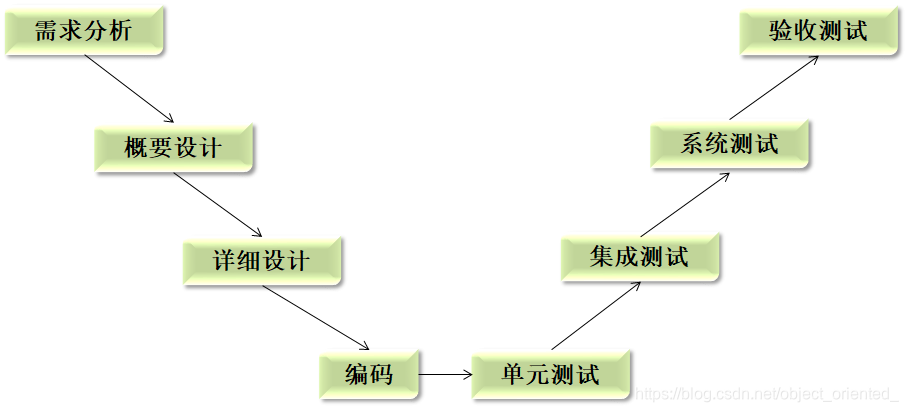
V模型:
           

需求分析:  用户需求、业务需求、需求规格说明书
概要设计: 系统架构、模块划分、模块与模块之间的接口
详细设计: 模块内部实现的逻辑和方法
编      码:  实现上面的设计
单元测试: 检测代码的开发是否符合详细设计的要求。
集成测试: 检测此前测试过的各组成部分是否能完好地结合到一起。

系统测试: 检测已集成在一起的产品是否符合系统规格说明书的要求。
验收测试: 检测产品是否符合最终用户的需求。


1. V模型是最具有代表意义的测试模型,最早是由Paul  Rook在20世纪80年代后期提出,由英国国家计算机中心文献中发布,旨在改进软件开发的效率和效果

IEEE Std 1012-2012 系统、软件测试与验证标准 IEEE Standard for System and Software Verification and Validation IEEE Std 1012-2012 Front Cover -14 Title Page -12 Notice to users -9 Laws and regulations -9 Copyrights -9 Updating of IEEE documents -9 Errata -9 Patents -8 Participants -7 Introduction -5 Contents -3 Important notice 1 1. Overview 1 1.1 Scope 1 1.2 Purpose 2 1.3 Field of application 3 1.4 V&V objectives 4 1.5 Organization of the standard 4 1.6 Audience 6 1.7 Conformance 7 1.8 Disclaimer 7 2. Normative references 7 3. Definitions, abbreviations, and acronyms 7 3.1 Definitions 7 3.2 Abbreviations and acronyms 11 4. Relationships between V&V and life cycle processes 12 5. Integrity levels 15 6. V&V processes overview 17 6.1 General 17 6.2 V&V testing 18 7. Common V&V activities 19 7.1 Activity: V&V Management 19 7.2 Activity: Acquisition Support V&V 20 7.3 Activity: Supply Planning V&V 21 7.4 Activity: Project Planning V&V 21 7.5 Activity: Configuration Management V&V 21 8. System V&V activities 33 8.1 Activity: Stakeholder Requirements Definition V&V 33 The purpose of the Stakeholder Requirements Definition Process is to define the requirements for a system that can provide the services needed by users and other stakeholders in a defined environment. It identifies stakeholders, or stakeholder classes... 33 The V&V effort shall perform, as specified in Table 2b for the selected integrity level, the following Stakeholder Requirements Definition V&V tasks described in Table 1b: 33 8.2 Activity: Requirements Analysis V&V 33 8.3 Activity: Architectural Design V&V 34 8.4 Activity: Implementation V&V 35 8.5 Activity: Integration V&V 35 8.6 Activity: Transition V&V 36 8.7 Activity: Operation V&V 36 8.8 Activity: Maintenance V&V 37 8.9 Activity: Disposal V&V 38 9. Software V&V activities 68 9.1 Activity: Software Concept V&V 68 9.2 Activity: Software Requirements V&V 68 9.3 Activity: Software Design V&V 69 9.4 Activity: Software Construction V&V 69 9.5 Activity: Software Integration Test V&V 70 9.6 Activity: Software Qualification Test V&V 70 9.7 Activity: Software Acceptance Test V&V 71 9.8 Activity: Software Installation and Checkout V&V 71 9.9 Activity: Software Operation V&V 72 9.10 Activity: Software Maintenance V&V 72 9.11 Activity: Software Disposal V&V 73 10. Hardware V&V activities 110 10.1 Activity: Hardware Concept V&V 110 10.2 Activity: Hardware Requirements V&V 110 10.3 Activity: Hardware Design V&V 111 10.4 Activity: Hardware Fabrication V&V 111 10.5 Activity: Hardware Integration Test V&V 112 10.6 Activity: Hardware Qualification Test V&V 112 10.7 Activity: Hardware Acceptance Test V&V 113 10.8 Activity: Hardware Transition V&V 113 10.9 Activity: Hardware Operation V&V 114 10.10 Activity: Hardware Maintenance V&V 114 10.11 Activity: Hardware Disposal V&V 115 11. V&V reporting, administrative, and documentation requirements 147 11.1 V&V reporting requirements 147 11.2 V&V administrative requirements 150 11.3 V&V documentation requirements 150 12. V&V plan outline 151 12.1 Overview 151 12.2 VVP Section 1: Purpose 152 12.3 VVP Section 2: Referenced documents 152 12.4 VVP Section 3: Definitions 152 12.5 VVP Section 4: V&V overview 152 12.5.1 VVP Section 4.1: Organization 152 12.5.2 VVP Section 4.2: Master schedule 153 12.5.3 VVP Section 4.3: Integrity level scheme 153 12.5.4 VVP Section 4.4: Resources summary 153 12.5.5 VVP Section 4.5: Responsibilities 153 12.5.6 VVP Section 4.6: Tools, techniques, and methods 153 12.6 VVP Section 5: V&V processes 154 12.6.1 VVP Section 5.1: Common V&V Processes, Activities, and Tasks 154 12.6.2 VVP Section 5.2: System V&V Processes, Activities, and Tasks 154 12.6.3 VVP Section 5.3: Software V&V Processes, Activities, and Tasks 154 12.6.4 VVP Section 5.4: Hardware V&V Processes, Activities, and Tasks 154 12.7 VVP Section 6: V&V reporting requirements 154 12.8 VVP Section 7: V&V administrative requirements 154 12.8.1 General 154 12.8.2 VVP Section 7.1: Anomaly resolution and reporting 154 12.8.3 VVP Section 7.2: Task iteration policy 154 12.8.4 VVP Section 7.3: Deviation policy 155 12.8.5 VVP Section 7.4: Control procedures 155 12.8.6 VVP Section 7.5: Standards, practices, and conventions 155 12.9 VVP Section 8: V&V test documentation requirements 155 Annex A (informative) Mapping of IEEE 1012 V&V activities and tasks 156 A.1 Mapping of ISO/IEC 15288 V&V requirements to IEEE 1012 V&V activities and tasks 156 A.2 Mapping of IEEE 1012 V&V activities to ISO/IEC 15288 system life cycle processes and activities 158 A.3 Mapping of ISO/IEC 12207 V&V requirements to IEEE 1012 V&V activities and tasks 159 A.4 Mapping of IEEE 1012 V&V activities to IEEE 12207 software life cycle processes and activities 161 Annex B (informative) A risk-based, integrity-level scheme 163 Annex C (informative) Definition of independent V&V (IV&V) 165 C.1 Technical independence 165 C.2 Managerial independence 165 C.3 Financial independence 165 C.4 Forms of independence 165 C.4.1 Classical IV&V 166 C.4.2 Modified IV&V 166 C.4.3 Integrated IV&V 166 C.4.4 Internal IV&V 166 C.4.5 Embedded V&V 167 Annex D (informative) V&V of reuse software 168 D.1 Purpose 168 D.2 V&V of software developed in a reuse process 169 D.2.1 V&V of assets in development 169 D.2.2 V&V of reused assets 169 D.3 V&V of software developed and reused outside of a reuse process 169 Annex E (informative) V&V measures 175 E.1 Introduction 175 E.2 Measures for evaluating anomaly density 175 E.3 Measures for evaluating V&V effectiveness 176 E.4 Measures for evaluating V&V efficiency 176 Annex F (informative) Example of V&V relationships to other project responsibilities 178 Annex G (informative) Optional V&V tasks 179 Annex H (informative) Environmental factors considerations 185 H.1 Introduction 185 H.2 In the agreement processes 185 H.3 In the organizational project-enabling processes 185 H.4 In the project processes 186 H.5 In the technical processes 186 Annex I (informative) V&V of system, software, and hardware integration 188 I.1 Introduction 188 I.2 Examples of system failures caused by integration issues 188 I.2.1 Year 2000 System Integration Issue 189 I.2.2 System architecture integration issues 189 I.3 System, software, and hardware interaction issues 190 Annex J (informative) Hazard, security, and risk analyses 193 J.1 Hazard analysis 193 Annex K (informative) Example of assigning and changing the system integrity level of “supporting system functions” 198 Annex L (informative) Mapping of ISO/IEC/IEEE 15288 and IEEE 12207 process outcomes to V&V tasks 200 Annex M (informative) Bibliography 209 立即下载

相关推荐

10行代码搞定QMT实盘交易:手把手教你用Python自动化买卖股票(附完整源代码)

本文提供了一份详尽的QMT实盘交易教程,手把手教你使用Python构建自动化交易系统。内容涵盖环境配置、账户连接、查询与下单等核心代码,并附有完整的源代码示例,帮助开发者快速掌握从零到实盘的完整流程,实现安全可靠的股票自动化买卖。

weixin_29214335的博客 443

终端效率神器:Tmux 安装与使用全指南

终端效率神器:Tmux 安装与使用全指南

身在被窝_心在编程 1362

MAC下SecureCRT 8.0.4破解版远程连接工具的安装与配置

一 SCRT的软件的安装:首先访问 http://xclient.info/s/securecrt.html?_=4365bb5cf097dc2c135a57c2ce30b264 选择8.0.4的版本进行下载,安装后将图标拖入application中,如下图所示 这时候需要进行以下几个步骤进行激活: 详细做法是: 一:打开mac的终端输入sudo spctl --master-d...

weixin_30528371的博客 855

华为ITR流程实战指南:从设计到落地的全流程解析(附完整方案下载)

本文深度解析华为ITR流程从设计到落地的全流程实战指南。ITR不仅是高效处理客户问题的“救火”系统,更是驱动产品改进、预防问题的企业“免疫系统”。文章详细拆解了流程设计的四步走策略、三层技术支持体系的组织保障、以闭环改进为核心的考核激励,并探讨了如何借鉴其精髓,优化自身问题管理,实现从被动响应到主动服务的跨越。

y2z3a4b5c的博客 383

Cluster Computing投稿

在overleaf中新建picins.sty文件,该文件是导入的包在.tex文件中添加以下内容\usepackage{picins}%实现作者简介%下边这块有几个人复制几段\vspace{0\baselineskip} %这一行控制作者间隔,可视情况改数字!!!!!!!!

这里是萤石ym的学习路途,努力搬砖! 5539

Java中使用工厂模式和策略模式优雅消除if-else语句(UML类图+案例分析)

在最近的后端开发中,多多少少会发现有很多if-else语句,如果条件过多则会造成整体代码看起来非常臃肿。本篇博客汇总了我对工厂模式和策略模式的理解,以及我是如何把它们巧妙运用在实际项目当中的一些技巧进行了分享,如有问题,欢迎评论区讨论!

黄团团的个人博客 2614

RK3588 部署 YOLO26 目标检测:从环境搭建到 NPU 推理

采集图像(500+ 张,覆盖不同光照和角度)→ 筛选(删除模糊、无目标的图像)→ LabelImg 标注(选择 YOLO 格式)→ 划分 train:val:test = 7:2:1labelImg├── train/├── val/nc: 3类别顺序必须与 LabelImg 标注时一致。YOLO26 在 RK3588 上的部署流程是 PC 端训练 → ONNX 导出(opset=11)→ RKNN 转换(INT8 量化)→ 板端推理。

LXY_LOVE36的博客 419

YOLO26改进策略【卷积层】| DWRSeg :高效获取多尺度上下文信息,二次改进C3k2

本文记录的是利用DWR 模块改进 YOLO26 的特征提取部分。(Dilation-wise Residual)通过两步残差流程(区域残差化-语义残差化)与分支化空洞卷积结合,引导解码器处理特征与跳接特征的多尺度精准融合。本文利用模块,通过区域残差化生成简洁区域型特征图以简化融合基础,再通过分支化空洞卷积捕捉多尺度空间上下文,同时依托残差连接保留原始特征信息,对YOLO26中不同尺度目标特征进行针对性强化、抑制无效背景特征干扰,在特征融合阶段实现多尺度语义与细节信息的高效互补,避免传统多感受野卷积的冗余计算

Limiiiing的博客 160

最新的sdio 4.0 spec 协议标准 带书签 高清完整PDF版

Part-E1-SDIO-Specification-Ver4.00-Final-120220.pdf:最新的sdio 4.0 spec 协议标准 带书签 高清完整PDF版,包括SDIO 接口的外设,SDIO 接口官方协议等。

贝叶斯统计 [韦来生编]

贝叶斯(Bayes)统计是近几十年来迅速发展起来的数理统计的一个重要分支。贝叶斯方法与经典统计方法的主要不同之处是进行统计推断时除了利用样本信息外,还要利用参数的先验信息,因此可以提高统计推断或统计决策的效果。它在经济、金融、生物、医学、自然科学和社会科学等许多领域具有广泛的应用。贝叶斯方法的研究已渗透到了统计学的几乎所有领域。作者在给中国科学技术大学概率论与数理统计专业本科生开设的“数理统计”课程中有一章专门讲授“贝叶斯方法和统计决策理论”,近十年来也给中国科学技术大学概率统计专业研究生开设过几次“贝叶斯分析”课。本书是在对过去讲稿的内容作了适当的增减和调整的基础上完成的。  本书共分六章。第1章是绪论,介绍了贝叶斯统计的若干基本概念,同时对必要的数理统计的基础知识有重点地作了回顾。第二章介绍了确定先验分布的若干可供选择的方法。第三章介绍了几类常见统计模型参数的后验分布的主要结果和计算方法。第四章和第五章分别介绍了“贝叶斯统计推断”和“贝叶斯统计决策”的内容。第六章介绍了贝叶斯统计计算的若干方法,包括蒙特卡洛方法和马尔可夫链蒙特卡洛(MCMC)方法以及相关统计软件的简介。本书的每一章附右大量的例题和习题,书末附有常用的几个表格和部分习题解答供读者查用。  大约可在54学时内讲授本书的第1章至第六章的主要内容,教师可根据学时需要选讲本书第1章至第六章的部分内容。书中标“*”号的章节可略去不讲,留给读者作为阅读材料。第六章例题中的R代码和部分例题的数据文件等可从作者个人主页下载。  作者在编写本书的过程中参考了J.O.Berger教授的《统计决策论及贝叶斯分析》和茆诗松教授编写的《贝叶斯统计》等书中的一些内容,以及《贝叶斯分析》一书中由张伟平博士编写的有关贝叶斯统计计算的一些内容。在此表示衷心感谢。  本书编写准备过程中,中国科学技术大学统计与金融系的几个研究生帮助完成了本书部分中文的录入和排版,作者对他们的辛勤工作表示真诚的感谢。高等教育出版社为本书的出版给予了大力支持。在此一并致谢。

Statistics and Machine Learning Toolbox

Statistics and Machine Learning Toolbox(带书签),MATLAB统计学习工具

ET2012新版免狗免安装绿色软件

ET2012新版免狗免安祖昂绿色软件。,新界面,新视觉,

上一篇: 测试一、 开发模型
下一篇: 测试三、 软件测试的分类
object_oriented_uy
博客等级 码龄8年 195粉丝 136原创
评论
成就一亿技术人!
拼手气红包6.0元
还能输入1000个字符
 
 条评论被折叠 查看
添加红包

请填写红包祝福语或标题

个

红包个数最小为10个

元

红包金额最低5元

当前余额3.43元 前往充值 >
需支付:10.00元
成就一亿技术人!
领取后你会自动成为博主和红包主的粉丝 规则
hope_wisdom
发出的红包
实付元
使用余额支付
点击重新获取
扫码支付
钱包余额 0

抵扣说明:

1.余额是钱包充值的虚拟货币,按照1:1的比例进行支付金额的抵扣。
2.余额无法直接购买下载,可以购买VIP、付费专栏及课程。

余额充值