



 本文探讨了光线实验中光线相交问题,教授如何通过输入光线进入和退出孔洞的位置信息,计算出最大的相交光线组的数量。通过实例解释并提供了解决方法。
Description
Professor Phunsuk Wangdu has performed some experiments on rays. The setup for n rays is as follows.
There is a rectangular box having exactly n holes on the opposite faces. All rays enter from the holes of the first side and exit from the holes of the other side of the box. Exactly one ray can enter or exit from each hole. The holes are in a straight line.
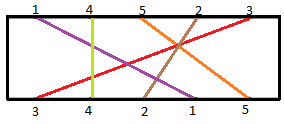
Professor Wangdu is showing his experiment to his students. He shows that there are cases, when all the rays are intersected by every other ray. A curious student asked the professor: "Sir, there are some groups of rays such that all rays in that group intersect every other ray in that group. Can we determine the number of rays in the largest of such groups?".
Professor Wangdu now is in trouble and knowing your intellect he asks you to help him.
Input
The first line contains n (1 ≤ n ≤ 106), the number of rays. The second line contains n distinct integers. The i-th integer xi (1 ≤ xi ≤ n) shows that the xi-th ray enters from the i-th hole. Similarly, third line contains n distinct integers. The i-th integer yi (1 ≤ yi ≤ n) shows that the yi-th ray exits from the i-th hole. All rays are numbered from 1 to n.
Output
Output contains the only integer which is the number of rays in the largest group of rays all of which intersect each other.
Sample Input
5
1 4 5 2 3
3 4 2 1 5
3
3
3 1 2
2 3 1
2
Hint
For the first test case, the figure is shown above. The output of the first test case is 3, since the rays number 1, 4 and 3 are the ones which are intersected by each other one i.e. 1 is intersected by 4 and 3, 3 is intersected by 4 and 1, and 4 is intersected by 1 and 3. Hence every ray in this group is intersected by each other one. There does not exist any group containing more than 3 rays satisfying the above-mentioned constraint.
#include<iostream>
#include<algorithm>
#include<cstring>
#include<cstdio>
using namespace std;
const int mm=1e6+9;
int p[mm],a[mm];
int main()
{ int x,n;
  while(scanf("%d",&n)!=EOF)
  { memset(p,0,sizeof(p));
    for(int i=0;i<n;++i)
    {
      scanf("%d",&x);p[x]=i+1;///x之前有几条线
    }
    for(int i=0;i<n;++i)
    {
      scanf("%d",&x);a[i]=-p[x];///用负就取反了
    }
    memset(p,0,sizeof(p));
    for(int i=0;i<n;++i)///其实如果不用负数,如果后一个比前一个小就一定和前一个相交
      *lower_bound(p,p+n,a[i])=a[i];///找出两两相交的线并且更新
    printf("%d\n",lower_bound(p,p+n,0)-p);
  }
}






 扫一扫
扫一扫


 428
428

 被折叠的 条评论
为什么被折叠?
被折叠的 条评论
为什么被折叠?
 到【灌水乐园】发言





