



 本文深入探讨了Java中null的概念,包括null的意义、内存中的表现形式以及变量如何存储null值。通过具体的例子帮助读者理解null与对象引用之间的区别。
http://www.programcreek.com/2013/12/what-exactly-is-null-in-java/
Let’s start from the following statement:
String x=null;
1. What exactly does this statement do?
Recall what is a variable and what is a value. A common metaphor is that a variable is similar to a box. Just as you can use a box to store something, you can use a variable to store a value. When declaring a variable, we need to set its type.
There are two major categories of types in Java: primitive and reference. Variables declared of a primitive type store values; variables declared of a reference type store references. In this case, the initialization statement declares a variables “x”. “x” stores String reference. It is null here.
The following visualization gives a better sense about this concept.
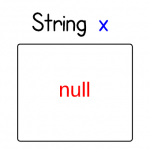
If x = “abc”, it looks like the following:

2. What exactly is null in memory?
What exactly is null in memory? Or What is the null value in Java?
First of all, null is not a valid object instance, so there is no memory allocated for it. It is simply a value that indicates that the object reference is not currently referring to an object.
From JVM Specifications:
The Java Virtual Machine specification does not mandate a concrete value encoding null.
I would assume it is all zeros of something similar like itis on other C like languages.
3. What exactly is x in memory?
Now we know what null is. And we know a variable is a storage location and an associated symbolic name (an identifier) which contains some value. Where exactly x is in memory?
From the diagram of JVM run-time data areas, we know that since each method has a private stack frame within the thread’s steak, the local variable are located on that frame.





 扫一扫
扫一扫


 439
439

 被折叠的 条评论
为什么被折叠?
被折叠的 条评论
为什么被折叠?
 到【灌水乐园】发言





