



 本文深入探讨Transformer编码器的实现细节,包括多头注意力机制的数学原理和代码实现。通过逐层解析,展示了如何从输入序列计算注意力权重并生成上下文向量。此外,介绍了预训练阶段的数据处理,包括创建训练实例、生成TFRecord文件以及预训练目标的设定。预训练旨在减小预训练与微调之间的差异,并为BERT模型的高效学习奠定基础。
接上一篇。
最主要的Transformer encoder结构代码如下:
def transformer_model(input_tensor,
                      attention_mask=None,
                      hidden_size=768,
                      num_hidden_layers=12,
                      num_attention_heads=12,
                      intermediate_size=3072,
                      intermediate_act_fn=gelu,
                      hidden_dropout_prob=0.1,
                      attention_probs_dropout_prob=0.1,
                      initializer_range=0.02,
                      do_return_all_layers=False):
  """Multi-headed, multi-layer Transformer from "Attention is All You Need".

  This is almost an exact implementation of the original Transformer encoder.

  See the original paper:
  https://arxiv.org/abs/1706.03762

  Also see:
  https://github.com/tensorflow/tensor2tensor/blob/master/tensor2tensor/models/transformer.py

  Args:
    input_tensor: float Tensor of shape [batch_size, seq_length, hidden_size].
    attention_mask: (optional) int32 Tensor of shape [batch_size, seq_length,
      seq_length], with 1 for positions that can be attended to and 0 in
      positions that should not be.
    hidden_size: int. Hidden size of the Transformer.
    num_hidden_layers: int. Number of layers (blocks) in the Transformer.
    num_attention_heads: int. Number of attention heads in the Transformer.
    intermediate_size: int. The size of the "intermediate" (a.k.a., feed
      forward) layer.
    intermediate_act_fn: function. The non-linear activation function to apply
      to the output of the intermediate/feed-forward layer.
    hidden_dropout_prob: float. Dropout probability for the hidden layers.
    attention_probs_dropout_prob: float. Dropout probability of the attention
      probabilities.
    initializer_range: float. Range of the initializer (stddev of truncated
      normal).
    do_return_all_layers: Whether to also return all layers or just the final
      layer.

  Returns:
    float Tensor of shape [batch_size, seq_length, hidden_size], the final
    hidden layer of the Transformer.

  Raises:
    ValueError: A Tensor shape or parameter is invalid.
  """
  if hidden_size % num_attention_heads != 0:
    raise ValueError(
        "The hidden size (%d) is not a multiple of the number of attention "
        "heads (%d)" % (hidden_size, num_attention_heads))
  #multi-head是将每个head attn 连接起来,输出的维度为hidden size,因此每个head维度计算如下
  attention_head_size = int(hidden_size / num_attention_heads)
  input_shape = get_shape_list(input_tensor, expected_rank=3)
  batch_size = input_shape[0]
  seq_length = input_shape[1]
  input_width = input_shape[2]

  # The Transformer performs sum residuals on all layers so the input needs
  # to be the same as the hidden size.
  #因为要加残差加到self-attn的输出,因此要求维度相同,也就是embedding维度与hidden_size相同
  if input_width != hidden_size:
    raise ValueError("The width of the input tensor (%d) != hidden size (%d)" %
                     (input_width, hidden_size))

  # We keep the representation as a 2D tensor to avoid re-shaping it back and
  # forth from a 3D tensor to a 2D tensor. Re-shapes are normally free on
  # the GPU/CPU but may not be free on the TPU, so we want to minimize them to
  # help the optimizer.为了避免在2D和3D之间来回reshape,我们统一把所有的3D Tensor用2D来表示。
  #虽然reshape在GPU/CPU上很快,但是在TPU上却不是这样,这样做的目的是为了优化TPU
  prev_output = reshape_to_matrix(input_tensor)

  all_layer_outputs = []
  for layer_idx in range(num_hidden_layers):
    with tf.variable_scope("layer_%d" % layer_idx):
      layer_input = prev_output

      with tf.variable_scope("attention"):
        attention_heads = []
        with tf.variable_scope("self"):
          attention_head = attention_layer(
              from_tensor=layer_input,
              to_tensor=layer_input,
              attention_mask=attention_mask,
              num_attention_heads=num_attention_heads,
              size_per_head=attention_head_size,
              attention_probs_dropout_prob=attention_probs_dropout_prob,
              initializer_range=initializer_range,
              do_return_2d_tensor=True,
              batch_size=batch_size,
              from_seq_length=seq_length,
              to_seq_length=seq_length)
          attention_heads.append(attention_head)

        attention_output = None
        if len(attention_heads) == 1:
          attention_output = attention_heads[0]
        else:
          # In the case where we have other sequences, we just concatenate
          # them to the self-attention head before the projection.
          attention_output = tf.concat(attention_heads, axis=-1)

        # Run a linear projection of `hidden_size` then add a residual
        # with `layer_input`.
        with tf.variable_scope("output"):
          attention_output = tf.layers.dense(
              attention_output,
              hidden_size,
              kernel_initializer=create_initializer(initializer_range))
          attention_output = dropout(attention_output, hidden_dropout_prob)
          attention_output = layer_norm(attention_output + layer_input)

      # The activation is only applied to the "intermediate" hidden layer.
      #这步对应Feed Forward,全连接层
      with tf.variable_scope("intermediate"):
        intermediate_output = tf.layers.dense(
            attention_output,
            intermediate_size,
            activation=intermediate_act_fn,
            kernel_initializer=create_initializer(initializer_range))

      # Down-project back to `hidden_size` then add the residual.用dense将shape变为‘hidden_size’才能加残差
      with tf.variable_scope("output"):
        layer_output = tf.layers.dense(
            intermediate_output,
            hidden_size,
            kernel_initializer=create_initializer(initializer_range))
        layer_output = dropout(layer_output, hidden_dropout_prob)
        layer_output = layer_norm(layer_output + attention_output)
        prev_output = layer_output
        all_layer_outputs.append(layer_output)

  if do_return_all_layers:
    final_outputs = []
    for layer_output in all_layer_outputs:
      final_output = reshape_from_matrix(layer_output, input_shape)
      final_outputs.append(final_output)
    return final_outputs
  else:
    final_output = reshape_from_matrix(prev_output, input_shape)
    return final_output
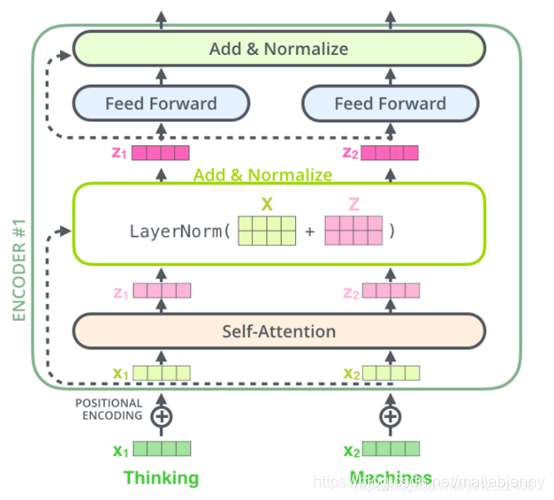
对应一步一步对应下图:
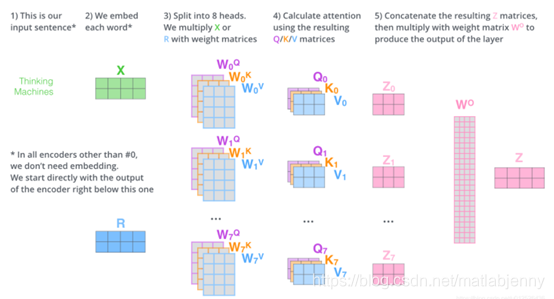
下面是multi-head attention的具体实现代码了,先来张图来回忆一下具体做法:
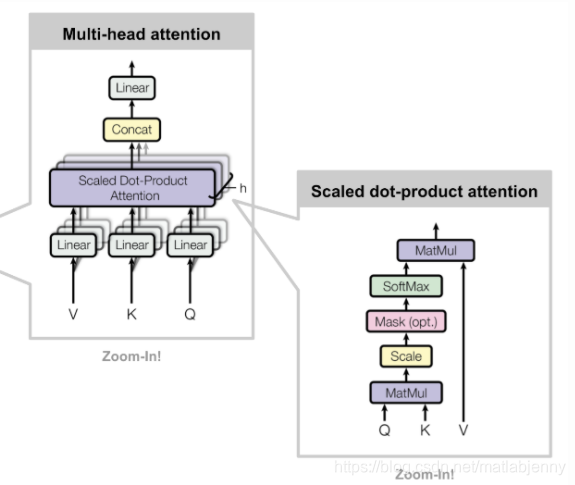
这个函数实现论文"Attention is all you Need"里的multi-head attention。如果from_tensor和to_tensor是同一个tensor,那么就实现Self-Attention。from_tensor的每个时刻都会attends to to_tensor,也就是用from的Query去乘以所有to的Key,得到weight,然后把所有to的Value加权求和起来。
这个函数首先把from_tensor变换成一个"query" tensor,然后把to_tensor变成"key"和"value" tensors。总共有num_attention_heads组Query、Key和Value,每一个Query,Key和Value的shape都是[batch_size, seq_length, size_per_head(768/12=64)].
然后计算query和key的内积并且除以size_per_head的平方根(8)。然后softmax变成概率,最后用概率加权value得到输出。因为有多个Head,每个Head都输出[batch_size, seq_length, size_per_head],最后把12个Head的结果concat起来,就最终得到[batch_size, seq_length, size_per_head*12=768]
实际上我们是把这8个Head的Query,Key和Value都放在一个Tensor里面的,因此实际通过transpose和reshape就达到了上面的效果。
def attention_layer(from_tensor,
                    to_tensor,
                    attention_mask=None,
                    num_attention_heads=1,
                    size_per_head=512,
                    query_act=None,
                    key_act=None,
                    value_act=None,
                    attention_probs_dropout_prob=0.0,
                    initializer_range=0.02,
                    do_return_2d_tensor=False,
                    batch_size=None,
                    from_seq_length=None,
                    to_seq_length=None):
  """Performs multi-headed attention from `from_tensor` to `to_tensor`.

  This is an implementation of multi-headed attention based on "Attention
  is all you Need". If `from_tensor` and `to_tensor` are the same, then
  this is self-attention. Each timestep in `from_tensor` attends to the
  corresponding sequence in `to_tensor`, and returns a fixed-with vector.

  This function first projects `from_tensor` into a "query" tensor and
  `to_tensor` into "key" and "value" tensors. These are (effectively) a list
  of tensors of length `num_attention_heads`, where each tensor is of shape
  [batch_size, seq_length, size_per_head].

  Then, the query and key tensors are dot-producted and scaled. These are
  softmaxed to obtain attention probabilities. The value tensors are then
  interpolated by these probabilities, then concatenated back to a single
  tensor and returned.

  In practice, the multi-headed attention are done with transposes and
  reshapes rather than actual separate tensors.

  Args:
    from_tensor: float Tensor of shape [batch_size, from_seq_length,
      from_width].
    to_tensor: float Tensor of shape [batch_size, to_seq_length, to_width].
    attention_mask: (optional) int32 Tensor of shape [batch_size,
      from_seq_length, to_seq_length]. The values should be 1 or 0. The
      attention scores will effectively be set to -infinity for any positions in
      the mask that are 0, and will be unchanged for positions that are 1.
    num_attention_heads: int. Number of attention heads.
    size_per_head: int. Size of each attention head.
    query_act: (optional) Activation function for the query transform.
    key_act: (optional) Activation function for the key transform.
    value_act: (optional) Activation function for the value transform.
    attention_probs_dropout_prob: (optional) float. Dropout probability of the
      attention probabilities.
    initializer_range: float. Range of the weight initializer.
    do_return_2d_tensor: bool. If True, the output will be of shape [batch_size
      * from_seq_length, num_attention_heads * size_per_head]. If False, the
      output will be of shape [batch_size, from_seq_length, num_attention_heads
      * size_per_head].
    batch_size: (Optional) int. If the input is 2D, this might be the batch size
      of the 3D version of the `from_tensor` and `to_tensor`.
    from_seq_length: (Optional) If the input is 2D, this might be the seq length
      of the 3D version of the `from_tensor`.
    to_seq_length: (Optional) If the input is 2D, this might be the seq length
      of the 3D version of the `to_tensor`.

  Returns:
    float Tensor of shape [batch_size, from_seq_length,
      num_attention_heads * size_per_head]. (If `do_return_2d_tensor` is
      true, this will be of shape [batch_size * from_seq_length,
      num_attention_heads * size_per_head]).

  Raises:
    ValueError: Any of the arguments or tensor shapes are invalid.
  """

  def transpose_for_scores(input_tensor, batch_size, num_attention_heads,
                           seq_length, width):
    output_tensor = tf.reshape(
        input_tensor, [batch_size, seq_length, num_attention_heads, width])

    output_tensor = tf.transpose(output_tensor, [0, 2, 1, 3])
    return output_tensor

  from_shape = get_shape_list(from_tensor, expected_rank=[2, 3])
  to_shape = get_shape_list(to_tensor, expected_rank=[2, 3])

  if len(from_shape) != len(to_shape):
    raise ValueError(
        "The rank of `from_tensor` must match the rank of `to_tensor`.")

  if len(from_shape) == 3:
    batch_size = from_shape[0]
    from_seq_length = from_shape[1]
    to_seq_length = to_shape[1]
  elif len(from_shape) == 2:
    if (batch_size is None or from_seq_length is None or to_seq_length is None):
      raise ValueError(
          "When passing in rank 2 tensors to attention_layer, the values "
          "for `batch_size`, `from_seq_length`, and `to_seq_length` "
          "must all be specified.")

  # Scalar dimensions referenced here:
  #   B = batch size (number of sequences)
  #   F = `from_tensor` sequence length
  #   T = `to_tensor` sequence length
  #   N = `num_attention_heads`
  #   H = `size_per_head`
  #压缩为2d
  from_tensor_2d = reshape_to_matrix(from_tensor)
  to_tensor_2d = reshape_to_matrix(to_tensor)

  # `query_layer` = [B*F, N*H] F表示From,from_tensor_2d维度是[batch_size*seq_length,hidden_size]
  #得到[B*F, N*H]=[batch_size*seq_length,num_attention_heads * size_per_head]

  query_layer = tf.layers.dense(
      from_tensor_2d,
      num_attention_heads * size_per_head,
      activation=query_act,
      name="query",
      kernel_initializer=create_initializer(initializer_range))

  # `key_layer` = [B*T, N*H] T表示To
  key_layer = tf.layers.dense(
      to_tensor_2d,
      num_attention_heads * size_per_head,
      activation=key_act,
      name="key",
      kernel_initializer=create_initializer(initializer_range))

  # `value_layer` = [B*T, N*H]
  value_layer = tf.layers.dense(
      to_tensor_2d,
      num_attention_heads * size_per_head,
      activation=value_act,
      name="value",
      kernel_initializer=create_initializer(initializer_range))

  # `query_layer` = [B, N, F, H]
  query_layer = transpose_for_scores(query_layer, batch_size,
                                     num_attention_heads, from_seq_length,
                                     size_per_head)

  # `key_layer` = [B, N, T, H]
  key_layer = transpose_for_scores(key_layer, batch_size, num_attention_heads,
                                   to_seq_length, size_per_head)

  # Take the dot product between "query" and "key" to get the raw
  # attention scores.
  # `attention_scores` = [B, N, F, T]
  attention_scores = tf.matmul(query_layer, key_layer, transpose_b=True)#将key转置以后相乘
  attention_scores = tf.multiply(attention_scores,
                                 1.0 / math.sqrt(float(size_per_head)))

  if attention_mask is not None:
    # `attention_mask` = [B, 1, F, T]
    attention_mask = tf.expand_dims(attention_mask, axis=[1])

    # Since attention_mask is 1.0 for positions we want to attend and 0.0 for
    # masked positions, this operation will create a tensor which is 0.0 for
    # positions we want to attend and -10000.0 for masked positions.
    adder = (1.0 - tf.cast(attention_mask, tf.float32)) * -10000.0

    # Since we are adding it to the raw scores before the softmax, this is
    # effectively the same as removing these entirely.
    attention_scores += adder

  # Normalize the attention scores to probabilities.
  # `attention_probs` = [B, N, F, T]
  attention_probs = tf.nn.softmax(attention_scores)

  # This is actually dropping out entire tokens to attend to, which might
  # seem a bit unusual, but is taken from the original Transformer paper.
  attention_probs = dropout(attention_probs, attention_probs_dropout_prob)

  # `value_layer` = [B, T, N, H]
  value_layer = tf.reshape(
      value_layer,
      [batch_size, to_seq_length, num_attention_heads, size_per_head])

  # `value_layer` = [B, N, T, H]
  value_layer = tf.transpose(value_layer, [0, 2, 1, 3])

  # `context_layer` = [B, N, F, H]
  context_layer = tf.matmul(attention_probs, value_layer)

  # `context_layer` = [B, F, N, H]
  context_layer = tf.transpose(context_layer, [0, 2, 1, 3])

  if do_return_2d_tensor:
    # `context_layer` = [B*F, N*H]
    context_layer = tf.reshape(
        context_layer,
        [batch_size * from_seq_length, num_attention_heads * size_per_head])
  else:
    # `context_layer` = [B, F, N*H]
    context_layer = tf.reshape(
        context_layer,
        [batch_size, from_seq_length, num_attention_heads * size_per_head])

  return context_layer
attention_scores += adder是利用attention_mask让padding的部分变成无穷小,这样padding部分softmax就接近0了(这样看前面源码计算attention_mask不太对呢,keras实现的那个更准确)。
对应着看,也很简单啦。
到这里,模型主要部分算是结束了。后面就是pre-training和finetune了。
预训练
虽然goole提供了很多预训练的模型,但是我们也要学会自己通过Mask LM和Next Sentence来进行预训练,自己预训练的时候如果机器资源有限可以使用goole提供的checkpoint作为初始值来减少预训练的时间。
预训练数据格式:每一篇文档之间使用空行隔开,每一行为一句。
我们首先需要使用create_pretraining_data.py把文本文件变成TFRecord格式,便于后面的代码进行Pretraining。由于这个脚本会把整个文本文件加载到内存,因此这个文件不能太大。如果读者有很多文档要训练,比如1000万。那么我们可以把这1000万文档拆分成1万个文件,每个文件1000个文档,从而生成1000个TFRecord文件。
我们先看create_pretraining_data.py的用法:
python create_pretraining_data.py
–input_file=./sample_text.txt
–output_file=/tmp/tf_examples.tfrecord
–vocab_file=$BERT_BASE_DIR/vocab.txt
–do_lower_case=True
–max_seq_length=128
–max_predictions_per_seq=20
–masked_lm_prob=0.15
–random_seed=12345
–dupe_factor=5
- max_seq_length Token序列的最大长度
- max_predictions_per_seq 最多生成多少个MASK
- masked_lm_prob 多少比例的Token变成MASK
- dupe_factor 一个文档重复多少次
首先说一下参数dupe_factor,比如一个句子”it is a good day”,为了充分利用数据,我们可以多次随机的生成MASK,比如第一次可能生成”it is a [MASK] day”,第二次可能生成”it [MASK] a good day”。这个参数控制重复的次数。
masked_lm_prob就是论文里的参数15%。max_predictions_per_seq是一个序列最多MASK多少个Token,它通常等于max_seq_length * masked_lm_prob。这么看起来这个参数没有必要提供,但是后面的脚本也需要用到这个同样的值,而后面的脚本并没有这两个参数。
def main(_):
  tf.logging.set_verbosity(tf.logging.INFO)

  tokenizer = tokenization.FullTokenizer(
      vocab_file=FLAGS.vocab_file, do_lower_case=FLAGS.do_lower_case)

  input_files = []
  for input_pattern in FLAGS.input_file.split(","):
    input_files.extend(tf.gfile.Glob(input_pattern))

  tf.logging.info("*** Reading from input files ***")
  for input_file in input_files:
    tf.logging.info("  %s", input_file)

  rng = random.Random(FLAGS.random_seed)
  instances = create_training_instances(
      input_files, tokenizer, FLAGS.max_seq_length, FLAGS.dupe_factor,
      FLAGS.short_seq_prob, FLAGS.masked_lm_prob, FLAGS.max_predictions_per_seq,
      rng)

  output_files = FLAGS.output_file.split(",")
  tf.logging.info("*** Writing to output files ***")
  for output_file in output_files:
    tf.logging.info("  %s", output_file)

  write_instance_to_example_files(instances, tokenizer, FLAGS.max_seq_length,
                                  FLAGS.max_predictions_per_seq, output_files)
create_pretraining_data.py的main函数如上,输入文本文件列表是input_files,通过函数create_training_instances构建训练的instances,然后调用write_instance_to_example_files以TFRecord格式写到output_files。
直接来看create_instances_from_document:
def create_instances_from_document(
    all_documents, document_index, max_seq_length, short_seq_prob,
    masked_lm_prob, max_predictions_per_seq, vocab_words, rng):
  """Creates `TrainingInstance`s for a single document."""
  document = all_documents[document_index]

  # Account for [CLS], [SEP], [SEP]
  max_num_tokens = max_seq_length - 3

  # We *usually* want to fill up the entire sequence since we are padding
  # to `max_seq_length` anyways, so short sequences are generally wasted
  # computation. However, we *sometimes*
  # (i.e., short_seq_prob == 0.1 == 10% of the time) want to use shorter
  # sequences to minimize the mismatch between pre-training and fine-tuning.
  # The `target_seq_length` is just a rough target however, whereas
  # `max_seq_length` is a hard limit.
  #我们通常希望Token序列长度为最大的max_seq_length,否则padding后的计算是无意义的,浪费计
  # 算资源。但是有的时候我们有希望生成一些短的句子,因为在实际应用中会有短句,如果都是
  # 长句子,会出现pre-training and fine-tuning之间的mismatch,所有我们以short_seq_prob == 0.1 的
  #概率来生成短句子
  target_seq_length = max_num_tokens
  if rng.random() < short_seq_prob:
    target_seq_length = rng.randint(2, max_num_tokens)
代码有点长,但是逻辑很简单,那么算法首先找到一个chunk,它会不断往chunk加入一个句子的所有Token,使得chunk里的token数量大于等于target_seq_length。通常我们期望target_seq_length为max_num_tokens(128-3),这样padding的尽量少,训练的效率高。但是有时候我们也需要生成一些短的序列,否则会出现训练与实际使用不匹配的问题。
找到一个chunk之后,比如这个chunk有5个句子,那么我们随机的选择一个切分点,比如3。把前3个句子当成句子A,后两个句子当成句子B。这是两个句子A和B有关系的样本(is_random_next=False)。为了生成无关系的样本,我们还以50%的概率把B用随机从其它文档抽取的句子替换掉,这样就得到无关系的样本(is_random_next=True)。如果是这种情况,后面两个句子需要放回去,以便在下一层循环中能够被再次利用。
有了句子A和B之后,我们就可以填充tokens和segment_ids,这里会加入特殊的[CLS]和[SEP]。接下来使用create_masked_lm_predictions来随机的选择某些Token,把它变成[MASK]。
create_masked_lm_predictions也很简单,就不详细说了。
下面说一下get_masked_lm_output:
未完待续。。。
参考:
https://jalammar.github.io/
https://codewithzichao.github.io/2020/07/04/NLP-BERT%E6%BA%90%E7%A0%81%E8%A7%A3%E8%AF%BB/
http://fancyerii.github.io/2019/03/09/bert-codes/





 扫一扫
扫一扫


 2684
2684

 被折叠的 条评论
为什么被折叠?
被折叠的 条评论
为什么被折叠?
 到【灌水乐园】发言





