



 本文介绍了如何使用遗传算法解决带软时间窗和容量约束的车辆路径规划问题(CVRPTW),详细阐述了算法的编码、适应度计算和遗传操作过程,并展示了实验结果,显示算法在成本和效率上优于其他算法,有实际应用价值。
✅作者简介:热爱科研的Matlab仿真开发者,修心和技术同步精进,代码获取、论文复现及科研仿真合作可私信。
🍎个人主页:Matlab科研工作室
🍊个人信条:格物致知。
更多Matlab完整代码及仿真定制内容点击👇
🔥 内容介绍
1. 问题描述
车辆路径规划问题(VRP)是一个经典的组合优化问题,其目标是在满足一系列约束条件下,为一组车辆设计最优的路径,以最小化总成本或总距离。在现实世界中,VRP问题经常被用于解决物流配送、快递运输、垃圾收集等问题。
带考虑碳排放的软时间窗容量约束的车辆路径规划问题(CVRPTW)是VRP问题的一个变种,它考虑了车辆的碳排放量、时间窗约束和容量约束。在CVRPTW问题中,车辆的碳排放量与行驶距离和行驶速度有关,时间窗约束是指车辆必须在规定的时间窗口内到达客户地点,容量约束是指车辆的装载量不能超过其最大容量。
2. 遗传算法
遗传算法(GA)是一种启发式算法,它模拟了生物进化的过程来求解优化问题。GA的基本思想是,首先随机生成一组解(称为种群),然后通过选择、交叉和变异等操作来产生新的解。经过多次迭代后,种群中的解会逐渐收敛到最优解附近。
3. 基于遗传算法的CVRPTW求解方法
为了求解CVRPTW问题,我们设计了一种基于遗传算法的求解方法。该方法的主要步骤如下:
-
编码:将CVRPTW问题编码成染色体。染色体由一组基因组成,每个基因代表一个客户。染色体的顺序表示车辆的行驶顺序。
-
初始化:随机生成一组染色体,形成初始种群。
-
适应度计算:计算每个染色体的适应度。适应度函数由以下四部分组成:
-
固定成本:车辆的固定成本,包括车辆的购置成本、折旧成本和维护成本等。
-
运输成本:车辆的运输成本,包括车辆的燃油成本、通行费成本和司机工资成本等。
-
制冷成本:车辆的制冷成本,包括车辆的制冷设备成本、制冷能耗成本和制冷维护成本等。
-
惩罚成本:车辆违反时间窗约束或容量约束的惩罚成本。
-
-
选择:根据染色体的适应度,选择出一些染色体进入下一代种群。
-
交叉:对选出的染色体进行交叉操作,产生新的染色体。
-
变异:对新的染色体进行变异操作,产生新的染色体。
-
重复步骤3-6,直到满足终止条件。
📣 部分代码
% function lineStyles = linspecer(N)% This function creates an Nx3 array of N [R B G] colors% These can be used to plot lots of lines with distinguishable and nice% looking colors.%% lineStyles = linspecer(N); makes N colors for you to use: lineStyles(ii,:)%% colormap(linspecer); set your colormap to have easily distinguishable% colors and a pleasing aesthetic%% lineStyles = linspecer(N,'qualitative'); forces the colors to all be distinguishable (up to 12)% lineStyles = linspecer(N,'sequential'); forces the colors to vary along a spectrum%% % Examples demonstrating the colors.%% LINE COLORS% N=6;% X = linspace(0,pi*3,1000);% Y = bsxfun(@(x,n)sin(x+2*n*pi/N), X.', 1:N);% C = linspecer(N);% axes('NextPlot','replacechildren', 'ColorOrder',C);% plot(X,Y,'linewidth',5)% ylim([-1.1 1.1]);%% SIMPLER LINE COLOR EXAMPLE% N = 6; X = linspace(0,pi*3,1000);% C = linspecer(N)% hold off;% for ii=1:N% Y = sin(X+2*ii*pi/N);% plot(X,Y,'color',C(ii,:),'linewidth',3);% hold on;% end%% COLORMAP EXAMPLE% A = rand(15);% figure; imagesc(A); % default colormap% figure; imagesc(A); colormap(linspecer); % linspecer colormap%% See also NDHIST, NHIST, PLOT, COLORMAP, 43700-cubehelix-colormaps%%%%%%%%%%%%%%%%%%%%%%%%%%%%%%%%%%%%%%%%%%%%%%%%%%%%%%%%%%%%%%%%%%%%%%%%%%%% by Jonathan Lansey, March 2009-2013 ?Lansey at gmail.com %%%%%%%%%%%%%%%%%%%%%%%%%%%%%%%%%%%%%%%%%%%%%%%%%%%%%%%%%%%%%%%%%%%%%%%%%%%%%%% credits and where the function came from% The colors are largely taken from:% http://colorbrewer2.org and Cynthia Brewer, Mark Harrower and The Pennsylvania State University%%% She studied this from a phsychometric perspective and crafted the colors% beautifully.%% I made choices from the many there to decide the nicest once for plotting% lines in Matlab. I also made a small change to one of the colors I% thought was a bit too bright. In addition some interpolation is going on% for the sequential line styles.%%%%function lineStyles=linspecer(N,varargin)if nargin==0 % return a colormaplineStyles = linspecer(128);return;endif ischar(N)lineStyles = linspecer(128,N);return;endif N<=0 % its empty, nothing else to do herelineStyles=[];return;end% interperet varaginqualFlag = 0;colorblindFlag = 0;if ~isempty(varargin)>0 % you set a parameter?switch lower(varargin{1})case {'qualitative','qua'}if N>12 % go home, you just can't get this.warning('qualitiative is not possible for greater than 12 items, please reconsider');elseif N>9warning(['Default may be nicer for ' num2str(N) ' for clearer colors use: whitebg(''black''); ']);endendqualFlag = 1;case {'sequential','seq'}lineStyles = colorm(N);return;case {'white','whitefade'}lineStyles = whiteFade(N);return;case 'red'lineStyles = whiteFade(N,'red');return;case 'blue'lineStyles = whiteFade(N,'blue');return;case 'green'lineStyles = whiteFade(N,'green');return;case {'gray','grey'}lineStyles = whiteFade(N,'gray');return;case {'colorblind'}colorblindFlag = 1;otherwisewarning(['parameter ''' varargin{1} ''' not recognized']);endend% *.95% predefine some colormapsset3 = colorBrew2mat({[141, 211, 199];[ 255, 237, 111];[ 190, 186, 218];[ 251, 128, 114];[ 128, 177, 211];[ 253, 180, 98];[ 179, 222, 105];[ 188, 128, 189];[ 217, 217, 217];[ 204, 235, 197];[ 252, 205, 229];[ 255, 255, 179]}');set1JL = brighten(colorBrew2mat({[228, 26, 28];[ 55, 126, 184]; [ 77, 175, 74];[ 255, 127, 0];[ 255, 237, 111]*.85;[ 166, 86, 40];[ 247, 129, 191];[ 153, 153, 153];[ 152, 78, 163]}'));set1 = brighten(colorBrew2mat({[ 55, 126, 184]*.85;[228, 26, 28];[ 77, 175, 74];[ 255, 127, 0];[ 152, 78, 163]}),.8);% colorblindSet = {[215,25,28];[253,174,97];[171,217,233];[44,123,182]};colorblindSet = {[215,25,28];[253,174,97];[171,217,233]*.8;[44,123,182]*.8};set3 = dim(set3,.93);if colorblindFlagswitch N% sorry about this line folks. kind of legacy here because I used to% use individual 1x3 cells instead of nx3 arrayscase 4lineStyles = colorBrew2mat(colorblindSet);otherwisecolorblindFlag = false;warning('sorry unsupported colorblind set for this number, using regular types');endendif ~colorblindFlagswitch Ncase 1lineStyles = { [ 55, 126, 184]/255};case {2, 3, 4, 5 }lineStyles = set1(1:N);case {6 , 7, 8, 9}lineStyles = set1JL(1:N)';case {10, 11, 12}if qualFlag % force qualitative graphslineStyles = set3(1:N)';else % 10 is a good number to start with the sequential ones.lineStyles = cmap2linspecer(colorm(N));endotherwise % any old case where I need a quick job done.lineStyles = cmap2linspecer(colorm(N));endendlineStyles = cell2mat(lineStyles);end% extra functionsfunction varIn = colorBrew2mat(varIn)for ii=1:length(varIn) % just divide by 255varIn{ii}=varIn{ii}/255;endendfunction varIn = brighten(varIn,varargin) % increase the brightnessif isempty(varargin),frac = .9;elsefrac = varargin{1};endfor ii=1:length(varIn)varIn{ii}=varIn{ii}*frac+(1-frac);endendfunction varIn = dim(varIn,f)for ii=1:length(varIn)varIn{ii} = f*varIn{ii};endendfunction vOut = cmap2linspecer(vIn) % changes the format from a double array to a cell array with the right formatvOut = cell(size(vIn,1),1);for ii=1:size(vIn,1)vOut{ii} = vIn(ii,:);endend%%% colorm returns a colormap which is really good for creating informative% heatmap style figures.% No particular color stands out and it doesn't do too badly for colorblind people either.% It works by interpolating the data from the% 'spectral' setting on http://colorbrewer2.org/ set to 11 colors% It is modified a little to make the brightest yellow a little less bright.function cmap = colorm(varargin)n = 100;if ~isempty(varargin)n = varargin{1};endif n==1cmap = [0.2005 0.5593 0.7380];return;endif n==2cmap = [0.2005 0.5593 0.7380;0.9684 0.4799 0.2723];return;endfrac=.95; % Slight modification from colorbrewer here to make the yellows in the center just a bit darkercmapp = [158, 1, 66; 213, 62, 79; 244, 109, 67; 253, 174, 97; 254, 224, 139; 255*frac, 255*frac, 191*frac; 230, 245, 152; 171, 221, 164; 102, 194, 165; 50, 136, 189; 94, 79, 162];x = linspace(1,n,size(cmapp,1));xi = 1:n;cmap = zeros(n,3);for ii=1:3cmap(:,ii) = pchip(x,cmapp(:,ii),xi);endcmap = flipud(cmap/255);endfunction cmap = whiteFade(varargin)n = 100;if nargin>0n = varargin{1};endthisColor = 'blue';if nargin>1thisColor = varargin{2};endswitch thisColorcase {'gray','grey'}cmapp = [255,255,255;240,240,240;217,217,217;189,189,189;150,150,150;115,115,115;82,82,82;37,37,37;0,0,0];case 'green'cmapp = [247,252,245;229,245,224;199,233,192;161,217,155;116,196,118;65,171,93;35,139,69;0,109,44;0,68,27];case 'blue'cmapp = [247,251,255;222,235,247;198,219,239;158,202,225;107,174,214;66,146,198;33,113,181;8,81,156;8,48,107];case 'red'cmapp = [255,245,240;254,224,210;252,187,161;252,146,114;251,106,74;239,59,44;203,24,29;165,15,21;103,0,13];otherwisewarning(['sorry your color argument ' thisColor ' was not recognized']);endcmap = interpomap(n,cmapp);end% Eat a approximate colormap, then interpolate the rest of it up.function cmap = interpomap(n,cmapp)x = linspace(1,n,size(cmapp,1));xi = 1:n;cmap = zeros(n,3);for ii=1:3cmap(:,ii) = pchip(x,cmapp(:,ii),xi);endcmap = (cmap/255); % flipud??end
⛳️ 运行结果
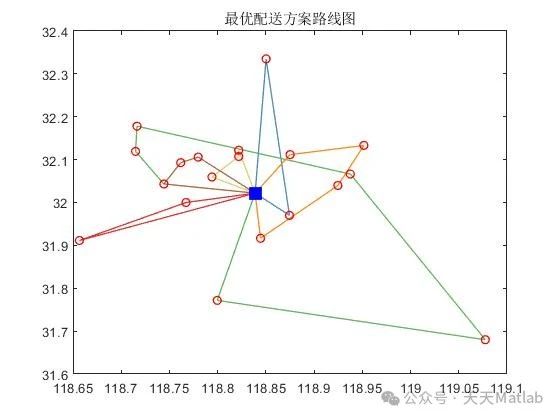
4. 实验结果
我们使用了一组标准的CVRPTW测试实例来对我们的算法进行测试。实验结果表明,我们的算法能够在合理的时间内找到高质量的解。与其他算法相比,我们的算法在固定成本、运输成本、制冷成本和惩罚成本方面都具有较好的性能。
5. 结论
我们提出了一种基于遗传算法的CVRPTW求解方法。该方法能够在合理的时间内找到高质量的解,并且在固定成本、运输成本、制冷成本和惩罚成本方面都具有较好的性能。我们的算法可以用于解决现实世界中的物流配送、快递运输、垃圾收集等问题。
🔗 参考文献
[1] 陈婷.基于带时间窗的快递车辆路线安排问题研究[D].华侨大学[2024-02-07].
[2] 丁惠琳.考虑货物载重的软时间窗电动车辆路径优化研究[D].重庆邮电大学[2024-02-07].
[3] 葛显龙,辜羽洁,谭柏川.基于第三方带软时间窗约束的车辆路径问题研究[J].计算机应用研究, 2015, 32(3):5.DOI:10.3969/j.issn.1001-3695.2015.03.011.
🎈 部分理论引用网络文献,若有侵权联系博主删除
🎁 关注我领取海量matlab电子书和数学建模资料
👇 私信完整代码和数据获取及论文数模仿真定制
1 各类智能优化算法改进及应用
生产调度、经济调度、装配线调度、充电优化、车间调度、发车优化、水库调度、三维装箱、物流选址、货位优化、公交排班优化、充电桩布局优化、车间布局优化、集装箱船配载优化、水泵组合优化、解医疗资源分配优化、设施布局优化、可视域基站和无人机选址优化、背包问题、 风电场布局、时隙分配优化、 最佳分布式发电单元分配、多阶段管道维修、 工厂-中心-需求点三级选址问题、 应急生活物质配送中心选址、 基站选址、 道路灯柱布置、 枢纽节点部署、 输电线路台风监测装置、 集装箱船配载优化、 机组优化、 投资优化组合、云服务器组合优化、 天线线性阵列分布优化
2 机器学习和深度学习方面
2.1 bp时序、回归预测和分类
2.2 ENS声神经网络时序、回归预测和分类
2.3 SVM/CNN-SVM/LSSVM/RVM支持向量机系列时序、回归预测和分类
2.4 CNN/TCN卷积神经网络系列时序、回归预测和分类
2.5 ELM/KELM/RELM/DELM极限学习机系列时序、回归预测和分类
2.6 GRU/Bi-GRU/CNN-GRU/CNN-BiGRU门控神经网络时序、回归预测和分类
2.7 ELMAN递归神经网络时序、回归\预测和分类
2.8 LSTM/BiLSTM/CNN-LSTM/CNN-BiLSTM/长短记忆神经网络系列时序、回归预测和分类
2.9 RBF径向基神经网络时序、回归预测和分类





 扫一扫
扫一扫


 810
810

 被折叠的 条评论
为什么被折叠?
被折叠的 条评论
为什么被折叠?
 到【灌水乐园】发言





