 改进的粒子群优化算法:自治群体粒子群优化



 本文提出了一种名为自治群体粒子群优化(AGPSO)的改进PSO算法,旨在解决高维问题中陷入局部极小值和收敛速度慢的问题。该算法受到鸟类群集或昆虫群集中的个体多样性启发,通过数学模型模拟不同能力的个体形成自主群体,调整PSO算法的社会和认知参数,赋予粒子不同的行为。实验结果显示,AGPSO在跳出局部极小值和收敛速度方面优于传统和一些近期的PSO变体。
1 简介
In this paper, a modified particle swarm optimization (PSO) algorithm called autonomous groups particles swarm optimization (AGPSO) is proposed to further alleviate the two problems of trapping in local minima and slow convergence rate in solving high-dimensional problems. The main idea of AGPSO algorithm is inspired by individuals’ diversity in bird flocking or insect swarming. In natural colonies, individuals are not basically quite similar in terms of intelligence and ability, but they all do their duties as members of a colony. Each individual’s ability can be useful in a particular situation. In this paper, a mathematical model of diverse particles groups called autonomous groups is proposed. In other words different functions with diverse slopes, curvatures, and interception points are employed to tune the social and cognitive parameters of the PSO algorithm to give particles different behaviors as in natural colonies. The results show that PSO with autonomous groups of particles outperforms the conventional and some recent modifications of PSO in terms of escaping local minima and convergence speed. The results also indicate that dividing particles in groups and allowing them to have different individual and social thinking can improve the performance of PSO significantly.
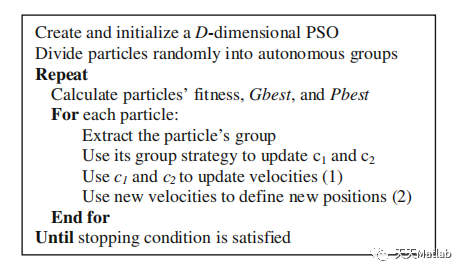
2 部分代码
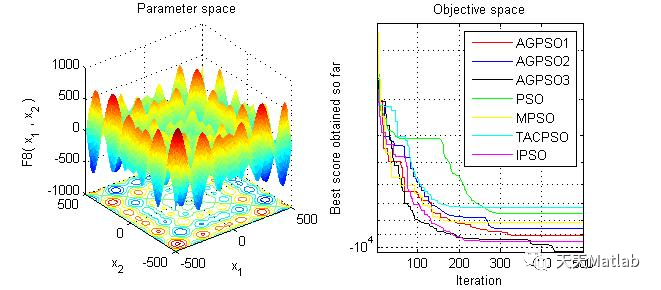
% Autonomous Groups Particles Swarm Optimization (AGPSO) source codes version 1.1 %% %% Developed in MATLAB R2014a(7.13) %% %%% You can simply define your cost in a seperate file and load its handle to fobj% The initial parameters that you need are:%__________________________________________% fobj = @YourCostFunction% dim = number of your variables% Max_iteration = maximum number of generations% SearchAgents_no = number of search agents% lb=[lb1,lb2,...,lbn] where lbn is the lower bound of variable n% ub=[ub1,ub2,...,ubn] where ubn is the upper bound of variable n% If all the variables have equal lower bound you can just% define lb and ub as two single number numbers% To run AGPSO3: [Best_score,Best_pos,GWO_cg_curve]=AGPSO3(SearchAgents_no,Max_iteration,lb,ub,dim,fobj)%__________________________________________clear allclcSearchAgents_no=30; % Number of search agentsFunction_name='F8'; % Name of the test function that can be from F1 to F23 (Table 1,2,3 in the paper)Max_iteration=500; % Maximum numbef of iterations% Load details of the selected benchmark function[lb,ub,dim,fobj]=Get_Functions_details(Function_name);[Best_score1,Best_pos1,AGPSO1_cg_curve]= AGPSO1(SearchAgents_no,Max_iteration,lb,ub,dim,fobj);[Best_score2,Best_pos2,AGPSO2_cg_curve]= AGPSO2(SearchAgents_no,Max_iteration,lb,ub,dim,fobj);[Best_score3,Best_pos3,AGPSO3_cg_curve]= AGPSO3(SearchAgents_no,Max_iteration,lb,ub,dim,fobj);[Best_score4,Best_pos4,PSO_cg_curve] = PSO(SearchAgents_no,Max_iteration,lb,ub,dim,fobj);[Best_score5,Best_pos5,IPSO_cg_curve]= IPSO(SearchAgents_no,Max_iteration,lb,ub,dim,fobj);[Best_score6,Best_pos6,TACPSO_cg_curve]= TACPSO(SearchAgents_no,Max_iteration,lb,ub,dim,fobj);[Best_score7,Best_pos7,MPSO_cg_curve]= MPSO(SearchAgents_no,Max_iteration,lb,ub,dim,fobj);figure('Position',[300 300 660 290])%Draw search spacesubplot(1,2,1);func_plot(Function_name);title('Parameter space')xlabel('x_1');ylabel('x_2');zlabel([Function_name,'( x_1 , x_2 )'])%Draw convergence curvessubplot(1,2,2);semilogy(AGPSO1_cg_curve,'Color','r')hold onsemilogy(AGPSO2_cg_curve,'Color','b')semilogy(AGPSO3_cg_curve,'Color','k')semilogy(PSO_cg_curve,'Color','g')semilogy(MPSO_cg_curve,'Color','y')semilogy(TACPSO_cg_curve,'Color','c')semilogy(IPSO_cg_curve,'Color','m')title('Objective space')xlabel('Iteration');ylabel('Best score obtained so far');axis tightgrid onbox onlegend('AGPSO1','AGPSO2','AGPSO3', 'PSO', 'MPSO', 'TACPSO', 'IPSO')display(['The best solution obtained by AGPSO1 is : ', num2str(Best_pos1)]);display(['The best optimal value obtained by AGPSO1 is : ', num2str(Best_score1)]);display(['The best solution obtained by AGPSO2 is : ', num2str(Best_pos2)]);display(['The best optimal value obtained by AGPSO2 is : ', num2str(Best_score2)]);display(['The best solution obtained by AGPSO3 is : ', num2str(Best_pos3)]);display(['The best optimal value obtained by AGPSO3 is : ', num2str(Best_score3)]);display(['The best solution obtained by SPSO is : ', num2str(Best_pos4)]);display(['The best optimal value obtained by SPSO is : ', num2str(Best_score4)]);display(['The best solution obtained by MPSO is : ', num2str(Best_pos5)]);display(['The best optimal value obtained by MPSO is : ', num2str(Best_score5)]);display(['The best solution obtained by TACPSO is : ', num2str(Best_pos6)]);display(['The best optimal value obtained by TACPSO is : ', num2str(Best_score6)]);display(['The best solution obtained by IPSO is : ', num2str(Best_pos1)]);display(['The best optimal value obtained by IPSO is : ', num2str(Best_score1)]);
3 仿真结果
4 参考文献
[1] Mirjalili S , Lewis A , Sadiq A S . Autonomous Particles Groups for Particle Swarm Optimization[J]. Arabian Journal for Science & Engineering, 2014, 39(6):4683-4697.
博主简介:擅长智能优化算法、神经网络预测、信号处理、元胞自动机、图像处理、路径规划、无人机等多种领域的Matlab仿真,相关matlab代码问题可私信交流。
部分理论引用网络文献,若有侵权联系博主删除。





 扫一扫
扫一扫


 980
980

 被折叠的 条评论
为什么被折叠?
被折叠的 条评论
为什么被折叠?
 到【灌水乐园】发言





