


 本文介绍了在SpringBoot应用中如何使用@Async注解实现异步方法,包括无返回值和有返回值的情况。通过配置ThreadPoolTaskExecutor线程池,可以优雅地处理多线程任务。当异步方法有返回值时,使用CompletableFuture进行组合和结果获取。文章还提到了@Async注解可能失效的场景,并强调了返回值限制。
本文带你快速了解@Async注解的用法,包括异步方法无返回值、有返回值,最后总结了@Async注解失效的几个坑。
在 SpringBoot 应用中,经常会遇到在一个接口中,同时做事情1,事情2,事情3,如果同步执行的话,则本次接口时间取决于事情1 2 3执行时间之和;如果三件事同时执行,则本次接口时间取决于事情1 2 3执行时间最长的那个,合理使用多线程,可以大大缩短接口时间。那么在 SpringBoot 应用中如何优雅的使用多线程呢?
Don't bb, show me code.
快速使用
SpringBoot应用中需要添加@EnableAsync注解,来开启异步调用,一般还会配置一个线程池,异步的方法交给特定的线程池完成,如下:
@Configuration
@EnableAsync
public class AsyncConfiguration {

    @Bean("doSomethingExecutor")
    public Executor doSomethingExecutor() {
        ThreadPoolTaskExecutor executor = new ThreadPoolTaskExecutor();
        // 核心线程数:线程池创建时候初始化的线程数
        executor.setCorePoolSize(10);
        // 最大线程数:线程池最大的线程数,只有在缓冲队列满了之后才会申请超过核心线程数的线程
        executor.setMaxPoolSize(20);
        // 缓冲队列:用来缓冲执行任务的队列
        executor.setQueueCapacity(500);
        // 允许线程的空闲时间60秒:当超过了核心线程之外的线程在空闲时间到达之后会被销毁
        executor.setKeepAliveSeconds(60);
        // 线程池名的前缀:设置好了之后可以方便我们定位处理任务所在的线程池
        executor.setThreadNamePrefix("do-something-");
        // 缓冲队列满了之后的拒绝策略:由调用线程处理(一般是主线程)
        executor.setRejectedExecutionHandler(new ThreadPoolExecutor.DiscardPolicy());
        executor.initialize();
        return executor;
    }

}
使用的方式非常简单,在需要异步的方法上加@Async注解
@RestController
public class AsyncController {

    @Autowired
    private AsyncService asyncService;

    @GetMapping("/open/something")
    public String something() {
        int count = 10;
        for (int i = 0; i < count; i++) {
            asyncService.doSomething("index = " + i);
        }
        return "success";
    }
}


@Slf4j
@Service
public class AsyncService {

    // 指定使用beanname为doSomethingExecutor的线程池
    @Async("doSomethingExecutor")
    public String doSomething(String message) {
        log.info("do something, message={}", message);
        try {
            Thread.sleep(1000);
        } catch (InterruptedException e) {
            log.error("do something error: ", e);
        }
        return message;
    }
}
访问:127.0.0.1:8080/open/something,日志如下
2023-02-06 23:42:42.486  INFO 21168 --- [io-8200-exec-17] x.g.b.system.controller.AsyncController  : do something end, time 8 milliseconds
2023-02-06 23:42:42.488  INFO 21168 --- [ do-something-1] x.gits.boot.system.service.AsyncService  : do something, message=index = 0
2023-02-06 23:42:42.488  INFO 21168 --- [ do-something-5] x.gits.boot.system.service.AsyncService  : do something, message=index = 4
2023-02-06 23:42:42.488  INFO 21168 --- [ do-something-4] x.gits.boot.system.service.AsyncService  : do something, message=index = 3
2023-02-06 23:42:42.488  INFO 21168 --- [ do-something-6] x.gits.boot.system.service.AsyncService  : do something, message=index = 5
2023-02-06 23:42:42.488  INFO 21168 --- [ do-something-9] x.gits.boot.system.service.AsyncService  : do something, message=index = 8
2023-02-06 23:42:42.488  INFO 21168 --- [ do-something-8] x.gits.boot.system.service.AsyncService  : do something, message=index = 7
2023-02-06 23:42:42.488  INFO 21168 --- [do-something-10] x.gits.boot.system.service.AsyncService  : do something, message=index = 9
2023-02-06 23:42:42.488  INFO 21168 --- [ do-something-7] x.gits.boot.system.service.AsyncService  : do something, message=index = 6
2023-02-06 23:42:42.488  INFO 21168 --- [ do-something-2] x.gits.boot.system.service.AsyncService  : do something, message=index = 1
2023-02-06 23:42:42.488  INFO 21168 --- [ do-something-3] x.gits.boot.system.service.AsyncService  : do something, message=index = 2
由此可见已经达到异步执行的效果了,并且使用到了咱们配置的线程池。
获取异步方法返回值
当异步方法有返回值时,如何获取异步方法执行的返回结果呢?这时需要异步调用的方法带有返回值CompletableFuture。
CompletableFuture是对Feature的增强,Feature只能处理简单的异步任务,而CompletableFuture可以将多个异步任务进行复杂的组合。如下:
@RestController
public class AsyncController {

    @Autowired
    private AsyncService asyncService;

    @SneakyThrows
    @ApiOperation("异步 有返回值")
    @GetMapping("/open/somethings")
    public String somethings() {
        CompletableFuture<String> createOrder = asyncService.doSomething1("create order");
        CompletableFuture<String> reduceAccount = asyncService.doSomething2("reduce account");
        CompletableFuture<String> saveLog = asyncService.doSomething3("save log");

        // 等待所有任务都执行完
        CompletableFuture.allOf(createOrder, reduceAccount, saveLog).join();
        // 获取每个任务的返回结果
        String result = createOrder.get() + reduceAccount.get() + saveLog.get();
        return result;
    }
}


@Slf4j
@Service
public class AsyncService {

    @Async("doSomethingExecutor")
    public CompletableFuture<String> doSomething1(String message) throws InterruptedException {
        log.info("do something1: {}", message);
        Thread.sleep(1000);
        return CompletableFuture.completedFuture("do something1: " + message);
    }

    @Async("doSomethingExecutor")
    public CompletableFuture<String> doSomething2(String message) throws InterruptedException {
        log.info("do something2: {}", message);
        Thread.sleep(1000);
        return CompletableFuture.completedFuture("; do something2: " + message);
    }

    @Async("doSomethingExecutor")
    public CompletableFuture<String> doSomething3(String message) throws InterruptedException {
        log.info("do something3: {}", message);
        Thread.sleep(1000);
        return CompletableFuture.completedFuture("; do something3: " + message);
    }
}
访问接口
C:\Users\Administrator>curl -X GET "http://localhost:8080/open/something"  -H "accept: */*"
do something1: create order;
do something2: reduce account;
do something3: save log
控制台上关键日志如下:
2023-02-06 00:27:42.238  INFO 5672 --- [ do-something-3] x.gits.boot.system.service.AsyncService  : do something3: save log
2023-02-06 00:27:42.238  INFO 5672 --- [ do-something-2] x.gits.boot.system.service.AsyncService  : do something2: reduce account
2023-02-06 00:27:42.238  INFO 5672 --- [ do-something-1] x.gits.boot.system.service.AsyncService  : do something1: create order
注意事项
@Async注解会在以下几个场景失效,也就是说明明使用了@Async注解,但就没有走多线程。
- 异步方法使用static关键词修饰;
- 异步类不是一个Spring容器的bean(一般使用注解
@Component和@Service,并且能被Spring扫描到); - SpringBoot应用中没有添加
@EnableAsync注解; - 在同一个类中,一个方法调用另外一个有@Async注解的方法,注解不会生效。原因是@Async注解的方法,是在代理类中执行的。
需要注意的是: 异步方法使用注解@Async的返回值只能为void或者Future及其子类,当返回结果为其他类型时,方法还是会异步执行,但是返回值都是null,部分源码如下:
AsyncExecutionInterceptor#invoke
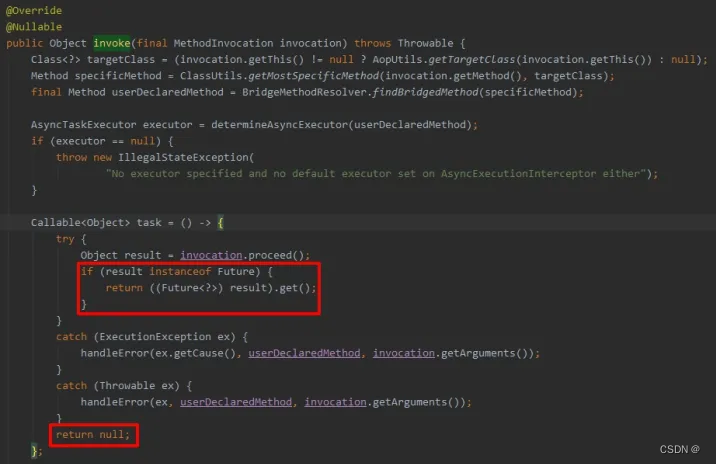
通过上边几个示例,@Async实际还是通过Future或CompletableFuture来异步执行的,Spring又封装了一下,让我们使用的更方便。
你在SpringBoot应用中如何使用多线程的呢,不妨留言说说你遇到的坑





 扫一扫
扫一扫


 1898
1898

 被折叠的 条评论
为什么被折叠?
被折叠的 条评论
为什么被折叠?
 到【灌水乐园】发言





