


 本文详细分析了Retrofit网络请求库的源码,揭示了其Builder构造函数中对不同返回类型的处理,包括CallAdapter和Converter的使用,以及默认支持的返回类型如Call和CompletableFuture。
前言
网络请求库,A type-safe HTTP client for Android and Java.
使用方法参照官方文档。
本篇文章想通过分析源码看一下api接口中都支持哪些返回类型。
源码
- Retrofit.Builder
//建造者模式
public Retrofit build() {
      //传入的baseUrl
      if (baseUrl == null) {
        throw new IllegalStateException("Base URL required.");
      }

      //传入的OkHttpClient
      okhttp3.Call.Factory callFactory = this.callFactory;
      if (callFactory == null) {
        callFactory = new OkHttpClient();
      }

      //传入的callbackExecutor
      Executor callbackExecutor = this.callbackExecutor;
      if (callbackExecutor == null) {
        callbackExecutor = platform.defaultCallbackExecutor();
      }

      //保护性拷贝adapters,最后加入默认的callAdapterFactories。
      List<CallAdapter.Factory> callAdapterFactories = new ArrayList<>(this.callAdapterFactories);
      callAdapterFactories.addAll(platform.defaultCallAdapterFactories(callbackExecutor));

      //保护性拷贝converterFactories
      List<Converter.Factory> converterFactories = new ArrayList<>(
          1 + this.converterFactories.size() + platform.defaultConverterFactoriesSize());

      // 先加入BuiltInConverters,最后加入默认的converterFactories。
      converterFactories.add(new BuiltInConverters());
      converterFactories.addAll(this.converterFactories);
      converterFactories.addAll(platform.defaultConverterFactories());

      return new Retrofit(callFactory, baseUrl, unmodifiableList(converterFactories),
          unmodifiableList(callAdapterFactories), callbackExecutor, validateEagerly);
    }
- 动态代理
public <T> T create(final Class<T> service) {
  Utils.validateServiceInterface(service);
  if (validateEagerly) {
    eagerlyValidateMethods(service);
  }
  return (T) Proxy.newProxyInstance(service.getClassLoader(), new Class<?>[] { service },
      new InvocationHandler() {
        private final Platform platform = Platform.get();
        private final Object[] emptyArgs = new Object[0];

        @Override public @Nullable Object invoke(Object proxy, Method method,
            @Nullable Object[] args) throws Throwable {
          // If the method is a method from Object then defer to normal invocation.
          if (method.getDeclaringClass() == Object.class) {
            return method.invoke(this, args);
          }
          if (platform.isDefaultMethod(method)) {
            return platform.invokeDefaultMethod(method, service, proxy, args);
          }
          return loadServiceMethod(method).invoke(args != null ? args : emptyArgs);
        }
      });
}
ServiceMethod,Coroutines
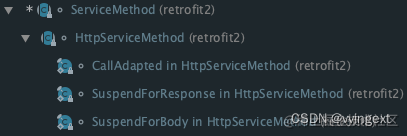
- ServiceMethod
abstract class ServiceMethod<T> {

  static <T> ServiceMethod<T> parseAnnotations(Retrofit retrofit, Method method) {
    RequestFactory requestFactory = RequestFactory.parseAnnotations(retrofit, method);

    Type returnType = method.getGenericReturnType();
    if (Utils.hasUnresolvableType(returnType)) {
      throw methodError(method,
          "Method return type must not include a type variable or wildcard: %s", returnType);
    }
    if (returnType == void.class) {
      throw methodError(method, "Service methods cannot return void.");
    }
    //调用HttpServiceMethod的parseAnnotations生成ServiceMethod
    return HttpServiceMethod.parseAnnotations(retrofit, method, requestFactory);
  }

  abstract @Nullable T invoke(Object[] args);
}
-
HttpServiceMethod
abstract class HttpServiceMethod<ResponseT, ReturnT> extends ServiceMethod<ReturnT> { static <ResponseT, ReturnT> HttpServiceMethod<ResponseT, ReturnT> parseAnnotations( Retrofit retrofit, Method method, RequestFactory requestFactory) { //前面代码省略,根据条件创建不同的ServiceMethod if (!isKotlinSuspendFunction) { //如果不是挂起函数就创建CallAdapted,使用callAdapter return new CallAdapted<>(requestFactory, callFactory, responseConverter, callAdapter); } else if (continuationWantsResponse) { //协程 return (HttpServiceMethod<ResponseT, ReturnT>) new SuspendForResponse<>(requestFactory, callFactory, responseConverter, (CallAdapter<ResponseT, Call<ResponseT>>) callAdapter); } else { //协程 return (HttpServiceMethod<ResponseT, ReturnT>) new SuspendForBody<>(requestFactory, callFactory, responseConverter, (CallAdapter<ResponseT, Call<ResponseT>>) callAdapter, continuationBodyNullable); } } //前面Retrofit动态代理调用的invoke方法在这里实现 @Override final @Nullable ReturnT invoke(Object[] args) { Call<ResponseT> call = new OkHttpCall<>(requestFactory, args, callFactory, responseConverter); return adapt(call, args); } protected abstract @Nullable ReturnT adapt(Call<ResponseT> call, Object[] args); } -
CallAdapted
final class CallAdapted<ResponseT, ReturnT> extends HttpServiceMethod<ResponseT, ReturnT> { //通过Call完成网络请求,再用前面传入的callAdapter将结果转换为需要的类型 @Override protected ReturnT adapt(Call<ResponseT> call, Object[] args) { return callAdapter.adapt(call); } } -
SuspendForResponse,用于method是挂起函数且返回类型是Response的情况
final class SuspendForResponse<ResponseT> extends HttpServiceMethod<ResponseT, Object> {


  @Override protected Object adapt(Call<ResponseT> call, Object[] args) {
    call = callAdapter.adapt(call);

    //挂起函数会自动在参数列表最后加入Continuation,这时候把这个continuation取出来
    Continuation<Response<ResponseT>> continuation =
        (Continuation<Response<ResponseT>>) args[args.length - 1];

    // See SuspendForBody for explanation about this try/catch.
    try {
      return KotlinExtensions.awaitResponse(call, continuation);
    } catch (Exception e) {
      return KotlinExtensions.yieldAndThrow(e, continuation);
    }
  }
}
协程部分用到了suspendCancellableCoroutine,Call和Response是OkHttp对应类的封装,本质上还是调用call.enqueue,结果通过continuation回调返回
suspend fun <T : Any> Call<T>.awaitResponse(): Response<T> { return suspendCancellableCoroutine { continuation -> continuation.invokeOnCancellation { cancel() } enqueue(object : Callback<T> { override fun onResponse(call: Call<T>, response: Response<T>) { continuation.resume(response) } override fun onFailure(call: Call<T>, t: Throwable) { continuation.resumeWithException(t) } }) } } -
SuspendForBody(部分代码),用于method是挂起函数且返回类型是ResponseT的情况,就是converter转换的对象类型
final class SuspendForBody<ResponseT> extends HttpServiceMethod<ResponseT, Object> { private final boolean isNullable; @Override protected Object adapt(Call<ResponseT> call, Object[] args) { call = callAdapter.adapt(call); //挂起函数会自动在参数列表最后加入Continuation,这时候把这个continuation取出来 Continuation<ResponseT> continuation = (Continuation<ResponseT>) args[args.length - 1]; //分为返回类型是否可为空,KotlinExtensions.await会在返回对象为空时抛出异常 try { return isNullable ? KotlinExtensions.awaitNullable(call, continuation) : KotlinExtensions.await(call, continuation); } catch (Exception e) { return KotlinExtensions.yieldAndThrow(e, continuation); } } }@JvmName("awaitNullable") suspend fun <T : Any> Call<T?>.await(): T? { return suspendCancellableCoroutine { continuation -> continuation.invokeOnCancellation { cancel() } enqueue(object : Callback<T?> { override fun onResponse(call: Call<T?>, response: Response<T?>) { if (response.isSuccessful) { continuation.resume(response.body()) } else { continuation.resumeWithException(HttpException(response)) } } override fun onFailure(call: Call<T?>, t: Throwable) { continuation.resumeWithException(t) } }) } }
CallAdapter
-
CallAdapter.Factory
abstract class Factory { /** * 通过动态代理的method返回类型来返回一个CallAdapter,如果factory不能处理则返回null */ public abstract @Nullable CallAdapter<?, ?> get(Type returnType, Annotation[] annotations, Retrofit retrofit); /** * 通过index和type取出泛型参数的上届通配符。 * 例如:Map<String, ? extends Runnable>,index为1时返回Runnable. */ protected static Type getParameterUpperBound(int index, ParameterizedType type) { return Utils.getParameterUpperBound(index, type); } /** * 通过type取出原始类型。例如:List<? extends Runnable>返回List.class */ protected static Class<?> getRawType(Type type) { return Utils.getRawType(type); } } -
DefaultCallAdapterfFactory
- 有2种默认的CallAdapterfFactory:DefaultCallAdapterfFactory和CompletableFutureCallAdapterFactory都继承自CallAdapter.Factory
- CallAdapterfFactory的集合会先加入通过addCallAdapterFactory加入的factory,最后默认都会加入DefaultCallAdapterfFactory,Platform会判断api>=24时加入CompletableFutureCallAdapterFactory(单例饿汉)
- DefaultCallAdapterfFactory会处理method返回类型为Call的情况,ExecutorCallbackCall实现Call接口(装饰器模式)目的是call.enqueue的回调切到主线程执行(使用MainThreadExecutor切换线程)。
- CompletableFutureCallAdapterFactory会处理method返回类型为CompletableFuture的情况,T是Converter转换的类型或是Response
- 综上默认的CallAdapterfFactory支持method返回类型为Call和CompletableFuture,其余的返回类型需要传入的CallAdapterfFactory支持,如RxJava2CallAdapterFactory
-
CallAdapter(适配器模式)
public interface CallAdapter<R, T> {
  /**
   * 返回的对象类型
   */
  Type responseType();

  /**
   * 返回的对象
   */
  T adapt(Call<R> call);
}
Converter
-
Converter.Factory
abstract class Factory { /** * 返回一个converter用于转换HTTP ResponseBody到type类型,如果不能处理则返回null。 * 例如从Call<SimpleResponse>转换为类型SimpleResponse。 */ public @Nullable Converter<ResponseBody, ?> responseBodyConverter(Type type, Annotation[] annotations, Retrofit retrofit) { return null; } /** * 返回一个converter用于转换type类型到HTTP RequestBody,如果不能处理则返回null。 * 通常用于@Body,@Part,@PartMap注解的type。 */ public @Nullable Converter<?, RequestBody> requestBodyConverter(Type type, Annotation[] parameterAnnotations, Annotation[] methodAnnotations, Retrofit retrofit) { return null; } /** * 返回一个converter用于转换type类型到String,如果不能处理则返回null。 * 通常用于@Field,@FieldMap,@Header,@HeaderMap,@Path,@Query,@QueryMap注解的type。 */ public @Nullable Converter<?, String> stringConverter(Type type, Annotation[] annotations, Retrofit retrofit) { return null; } /** * 通过index和type取出泛型参数的上届通配符.. * 例如:Map<String, ? extends Runnable>,index为1时返回Runnable. */ protected static Type getParameterUpperBound(int index, ParameterizedType type) { return Utils.getParameterUpperBound(index, type); } /** * 通过type取出原始类型。例如:List<? extends Runnable>返回List.class */ protected static Class<?> getRawType(Type type) { return Utils.getRawType(type); } } -
BuiltInConverters:请求时RequestBody转为RequestBody,响应时ResponseBody转为Void,Unit,ResponseBody。
-
OptionalConverterFactory:api>=24时会通过defaultConverterFactories加入,响应时会创建OptionalConverter,将ResponseBody转为Optional
-
Converter
/** * 对象和HTTP中代表的含义相互转换,通过Converter.Factory创建。 * Request创建Converter<T, RequestBody>,Response创建Converter<ResponseBody, T> */ public interface Converter<F, T> { @Nullable T convert(F value) throws IOException; } -
ToStringConverter会处理Object转为String的情况,优先级最低,会先到自定义的converterFactories查找,如没找到才会使用ToStringConverter。在RequestFactory的parseParameterAnnotation方法中使用,
static final class ToStringConverter implements Converter<Object, String> {
  static final ToStringConverter INSTANCE = new ToStringConverter();

  @Override public String convert(Object value) {
    return value.toString();
  }
}





 扫一扫
扫一扫


 1039
1039

 被折叠的 条评论
为什么被折叠?
被折叠的 条评论
为什么被折叠?
 到【灌水乐园】发言





