





引用来源
参考:Adaptive Subdivision Schemes for Triangular Meshes这篇文章
先按照上面的方法做了线性细分,看起来并没有什么问题,下面详细介绍一下是怎么做的
这篇文章是相当经典的一篇文章,基本上是三角网格自适应细分的先驱,我看到由非常高的引用,该方法主要是基于计算二面角得到的,主要计算一个面和周围的面的夹角来确定这个面是不是应该细分。
算法步骤
算法主要分为四步:
1.对于每个面片计算其法向
2.对于每个面计算其与邻接边的夹角(二面角)
3.如果所有的二面角都小于一个设定的阈值,该面被标记为平坦的flat
4.对于每一个面,与周围三个三角形的二面角是否被标记为flat存在好几种情况,其最小值为0,最大值为3。对于不同的情况,细分情况如下

其中n=1的时候其实有两种不同的细分方案,另外一种我拿橙色的线标记出了,其实两种方法都是可以的,下面就要介绍下怎样进行实现了
MATLAB实现
首先是计算法向的函数compute_face_normal.m
function [normalf] = compute_face_normal(vertex,face)

% compute_normal - compute the normal of a triangulation
%
%   [normal,normalf] = compute_normal(vertex,face);
%
%   normal(i,:) is the normal at vertex i.
%   normalf(j,:) is the normal at face j.
%
%   Copyright (c) 2004 Gabriel Peyr?

[vertex,face] = check_face_vertex(vertex,face);

nvert = size(vertex,2);
normal = zeros(3, nvert);

% unit normals to the faces
normalf = crossp( vertex(:,face(2,:))-vertex(:,face(1,:)), ...
                  vertex(:,face(3,:))-vertex(:,face(1,:)) );
d = sqrt( sum(normalf.^2,1) ); d(d<eps)=1;
normalf = normalf ./ repmat( d, 3,1 );

% unit normal to the vertex
normal = zeros(3,nvert);


% enforce that the normal are outward
v = vertex - repmat(mean(vertex,1), 3,1);
s = sum( v.*normal, 2 );
if sum(s>0)<sum(s<0)
    % flip
    normalf = -normalf;
end
end


%%%%%%%%%%%%%%%%%%%%%%%%%%%%%%%%%%%%%%%%%%%%%%%
%%%%%%%%%%%%%%%%%%%%%%%%%%%%%%%%%%%%%%%%%%%%%%%
%%%%%%%%%%%%%%%%%%%%%%%%%%%%%%%%%%%%%%%%%%%%%%%
function z = crossp(x,y)
% x and y are (m,3) dimensional
z = x;
z(1,:) = x(2,:).*y(3,:) - x(3,:).*y(2,:);
z(2,:) = x(3,:).*y(1,:) - x(1,:).*y(3,:);
z(3,:) = x(1,:).*y(2,:) - x(2,:).*y(1,:);
end
计算边对应面的函数compute_edge_face_ring.m
输入的是面,输出的是一个稀疏矩阵,是n*n的矩阵,n代表点的个数,第(i,j)位置表示i,j位置的点连线对应的面的索引
function A = compute_edge_face_ring(face)

% compute_edge_face_ring - compute faces adjacent to each edge
%
%   e2f = compute_edge_face_ring(face);
%
%   e2f(i,j) and e2f(j,i) are the number of the two faces adjacent to
%   edge (i,j).
%
%   Copyright (c) 2007 Gabriel Peyre


[~,face] = check_face_vertex([],face);

n = max(face(:));
m = size(face,2);
i = [face(1,:) face(2,:) face(3,:)];
j = [face(2,:) face(3,:) face(1,:)];
s = [1:m 1:m 1:m];

% first without duplicate
[~,I] = unique( i+(max(i)+1)*j );
% remaining items
J = setdiff(1:length(s), I);

% flip the duplicates
i1 = [i(I) j(J)];
j1 = [j(I) i(J)];
s = [s(I) s(J)];

% remove doublons
[~,I] = unique( i1+(max(i1)+1)*j1 );
i1 = i1(I); j1 = j1(I); s = s(I);

A = sparse(i1,j1,s,n,n);


% add missing points
I = find( A'~=0 );
I = I( A(I)==0 );
A( I ) = -1;
end
计算一个面邻接面的compute_face_ring.m
同样输入的是面,输出的是1*m个cell,m代表面的个数,每个cell里是该面邻接面的索引
function fring = compute_face_ring(face)

% compute_face_ring - compute the 1 ring of each face in a triangulation.
%
%   fring = compute_face_ring(face);
%
%   fring{i} is the set of faces that are adjacent
%   to face i.
%
%   Copyright (c) 2004 Gabriel Peyre

% the code assumes that faces is of size (3,nface)
[~,face] = check_face_vertex([],face);

nface = size(face,2);
nvert = max(max(face));

A = compute_edge_face_ring(face);
[~,~,s1] = find(A);     % direct link
[i,j,s2] = find(A');    % reverse link

I = find(i<j);
s1 = s1(I); s2 = s2(I);

fring{nface} = [];
for k=1:length(s1)
    if s1(k)>0 && s2(k)>0
        fring{s1(k)}(end+1) = s2(k);
        fring{s2(k)}(end+1) = s1(k);
    end
end

return;

for i=1:nface
    face(i,:) = sort(face(i,:));
end

edges = zeros(3*nface,2);

edges( 1:nface, : ) = face(:,1:2);
edges( (nface+1):2*nface, : ) = face(:,2:3);
edges( (2*nface+1):3*nface, : ) = face(:,[1,3]);

for i=1:nface
    fring{i} = [];
end

for i=1:3*nface
    e = edges(i,:);
    I = find(edges(:,1)==e(1) & edges(:,2)==e(2));
    if length(I)==2
        f1 = mod( I(1)-1, nface)+1;
        f2 = mod( I(2)-1, nface)+1;
        fring{f1} = [fring{f1}, f2];
        fring{f2} = [fring{f2}, f1];
        edges(I,:) = rand(length(I),2);
    end
end

return;

return;
h = waitbar(0,'Computing Face 1-ring');
for i=1:nface
    waitbar(i/nface);
    fring{i} = [];
    for j=1:3
        j1 = j;
        j2 = mod(j,3)+1;
        v1= face(i,j1);
        v2= face(i,j2);
        % test if another face share the same vertices
        f = [];
        for i1=1:nface
            for a=1:3
                if face(i1,a)==v1 && i1~=i
                    for b=1:3
                        if face(i1,b)==v2
                            % add to the ring
                            fring{i} = [fring{i}, i1];
                        end
                    end
                end
            end
        end

    end
end
close(h);
计算二面角的函数compute_adface_angle.m函数
输出值是每个面的flat度和邻接面是否是flat的判断cell,每个cell里是0和1。0表示对应的邻接面是flat的,红色的30可以修改,表示阈值,小于30度标记为flat
function  [sum_num_of_flat_faces, num_of_flat_faces]=compute_adface_angle(vertex,face)
%COMPUTE_ADFACE_ANGLE Summary of this function goes here
%   Detailed explanation goes here

%the first face is made of 1th and 2nd points
%the second face is made of 1th and 3rd points
%the third face is made of 2nd and 3rd face
fring=compute_face_ring(face);
normalf=compute_face_normal(vertex,face);
nface = size(face,2);
face_angle_cos{nface} = [];
face_angle{nface}=[];
sum_num_of_flat_faces=zeros(1,nface);
num_of_flat_faces{nface}=[];
for i=1:nface
  for j=1:3
      face_angle_cos{i}(1,j)=dot(normalf(:,i),normalf(:,fring{i}(1,j)));
      %compute the angle between the faces
      face_angle{i}(1,j)=rad2deg(acos(face_angle_cos{i}(1,j)));

      if face_angle{i}(1,j)>30
          num_of_flat_faces{i}(1,j)=1;
          sum_num_of_flat_faces(i)=sum_num_of_flat_faces(i)+1;

      else
          num_of_flat_faces{i}(1,j)=0;
      end
  end

end


end
还有一个辅助函数check_face_vertex.m
function [vertex,face] = check_face_vertex(vertex,face)

% check_face_vertex - check that vertices and faces have the correct size
%
%   [vertex,face] = check_face_vertex(vertex,face);
%
%   Copyright (c) 2007 Gabriel Peyre

vertex = check_size(vertex,2,4);
face = check_size(face,3,4);
end

%%%%%%%%%%%%%%%%%%%%%%%%%%%%%
function a = check_size(a,vmin,vmax)
if isempty(a)
    return;
end
if size(a,1)>size(a,2)
    a = a';
end
if size(a,1)<3 && size(a,2)==3
    a = a';
end
if size(a,1)<=3 && size(a,2)>=3 && sum(abs(a(:,3)))==0
    % for flat triangles
    a = a';
end
if size(a,1)<vmin ||  size(a,1)>vmax
    error('face or vertex is not of correct size');
end
end
最后就是细分函数啦
function [newVertices, newFaces] =  linearSubdivision(vertices, faces)
% Mesh subdivision using the Loop scheme.
%
%  Dimensions:
%    vertices: 3xnVertices
%    faces:    3xnFaces
%
%  Author: Jesus Mena

    global edgeVertex;
    global newIndexOfVertices;
    newFaces = [];
    newVertices = vertices;


    nVertices = size(vertices,2);
    nFaces    = size(faces,2);
    edgeVertex = zeros(nVertices, nVertices);
    newIndexOfVertices = nVertices;
    A = compute_edge_face_ring(faces);
    fring = compute_face_ring(faces);
    [valence, num_of_flat_faces]=compute_adface_angle(vertices,faces);


    for i=1:nFaces
        [vaIndex, vbIndex, vcIndex] = deal(faces(1,i), faces(2,i), faces(3,i));
        if valence(i)==3
            % ------------------------------------------------------------------------ %
            % create a matrix of edge-vertices and the new triangulation (newFaces).
            % computational complexity = O(3*nFaces)
            %
            % * edgeVertice(x,y,1): index of the new vertice between (x,y)
            % * edgeVertice(x,y,2): index of the first opposite vertex between (x,y)
            % * edgeVertice(x,y,3): index of the second opposite vertex between (x,y)
            %
            %  0riginal vertices: va, vb, vc, vd.
            %  New vertices: vp, vq, vr.
            %
            %      vb                   vb
            %     / \                  /  \
            %    /   \                vp--vq
            %   /     \              / \  / \
            % va ----- vc   ->     va-- vr --vc
            %   \     /              \      /
            %    \   /                \    /
            %     \ /                  \  /
            %      vd                   vd

            vpIndex = addEdgeVertex(vaIndex, vbIndex);
            vqIndex = addEdgeVertex(vbIndex, vcIndex);
            vrIndex = addEdgeVertex(vaIndex, vcIndex);

            fourFaces = [vaIndex,vpIndex,vrIndex; vpIndex,vbIndex,vqIndex; vrIndex,vqIndex,vcIndex; vrIndex,vpIndex,vqIndex]';
            newFaces  = [newFaces, fourFaces];


        elseif valence(i)==2
            % ------------------------------------------------------------------------ %
            % create a matrix of edge-vertices and the new triangulation (newFaces).
            % computational complexity = O(3*nFaces)
            %
            % * edgeVertice(x,y,1): index of the new vertice between (x,y)
            % * edgeVertice(x,y,2): index of the first opposite vertex between (x,y)
            % * edgeVertice(x,y,3): index of the second opposite vertex between (x,y)
            %
            %  0riginal vertices: va, vb, vc, vd.
            %  New vertices: vp, vq, vr.
            %    flat
            % vd------vb-----ve        vd------vb------ve
            %  \     / \     /          \     / |\     /
            %   \   /   \   /            \   /  | vq  /
            %    \ /     \ /              \ /   |/ \ /
            %     va ----- vc   ->         va-- vr --vc
            %      \     /                  \      /
            %       \   /                    \    /
            %        \ /                      \  /
            %         vf                       vf
            for k=1:3
                if num_of_flat_faces{i}(1,k)==0
                the_flat_face=fring{i}(1,k);
                %represent the flat face
                break;
                end
            end

            if A(faces(1,i), faces(2,i))==the_flat_face||A(faces(2,i),faces(1,i))==the_flat_face
                vqIndex = addEdgeVertex(vbIndex, vcIndex);
                vrIndex = addEdgeVertex(vaIndex, vcIndex);
                threeFaces = [vaIndex,vbIndex,vrIndex; vrIndex,vbIndex,vqIndex; vrIndex,vqIndex,vcIndex]';
            elseif A(faces(2,i), faces(3,i))==the_flat_face||A(faces(3,i),faces(2,i))==the_flat_face
                vpIndex = addEdgeVertex(vaIndex, vbIndex);
                vrIndex = addEdgeVertex(vaIndex, vcIndex);
                threeFaces = [vaIndex,vpIndex,vrIndex; vpIndex,vbIndex,vcIndex; vrIndex,vpIndex,vcIndex]';
            else
                vpIndex = addEdgeVertex(vaIndex, vbIndex);
                vqIndex = addEdgeVertex(vbIndex, vcIndex);
                threeFaces = [vaIndex,vpIndex,vqIndex; vpIndex,vbIndex,vqIndex; vaIndex,vqIndex,vcIndex]';
            end
            newFaces  = [newFaces, threeFaces];

        elseif valence(i)==1
            %
            % * edgeVertice(x,y,1): index of the new vertice between (x,y)
            % * edgeVertice(x,y,2): index of the first opposite vertex between (x,y)
            % * edgeVertice(x,y,3): index of the second opposite vertex between (x,y)
            %
            %  0riginal vertices: va, vb, vc, vd.
            %  New vertices: vp, vq, vr.
            %    flat    flat
            % vd------vb-----ve        vd------vb------ve
            %  \     / \     /          \     / |\     /
            %   \   /   \   /            \   /  | \   /
            %    \ /     \ /              \ /   |  \ /
            %     va ----- vc   ->         va-- vr --vc
            %      \     /                  \      /
            %       \   /                    \    /
            %        \ /                      \  /
            %         vf                       vf
            for k=1:3
                if num_of_flat_faces{i}(1,k)==1
                the_not_flat_face=fring{i}(1,k);
                %represent the flat face
                break;
                end
            end

            if     A(faces(1,i), faces(2,i))==the_not_flat_face||A(faces(2,i),faces(1,i))==the_not_flat_face
                vpIndex = addEdgeVertex(vaIndex, vbIndex);
                twoFaces = [vaIndex,vpIndex,vcIndex; vpIndex,vbIndex,vcIndex]';
            elseif A(faces(2,i), faces(3,i))==the_not_flat_face||A(faces(3,i),faces(2,i))==the_not_flat_face
                vqIndex = addEdgeVertex(vbIndex, vcIndex);
                twoFaces = [vaIndex,vbIndex,vqIndex; vaIndex,vqIndex,vcIndex]';
            else
                vrIndex = addEdgeVertex(vaIndex, vcIndex);
                twoFaces = [vaIndex,vbIndex,vrIndex; vrIndex,vbIndex,vcIndex]';
            end
            newFaces  = [newFaces, twoFaces];
        else
            oneFace=[vaIndex, vbIndex, vcIndex]';
            newFaces  = [newFaces, oneFace];
        end
    end;

    % ------------------------------------------------------------------------ %
    % positions of the new vertices
    for v1=1:nVertices-1
        for v2=v1:nVertices
            vNIndex = edgeVertex(v1,v2);
            if (vNIndex>0)
                newVertices(:,vNIndex) = 1/2*(vertices(:,v1)+vertices(:,v2));
            end;
        end;
    end;


end


function vNIndex = addEdgeVertex(v1Index, v2Index)
    global edgeVertex;
    global newIndexOfVertices;

    if (v1Index>v2Index) % setting: v1 <= v2
        vTmp = v1Index;
        v1Index = v2Index;
        v2Index = vTmp;
    end;

    if (edgeVertex(v1Index, v2Index)==0)  % new vertex
        newIndexOfVertices = newIndexOfVertices+1;
        edgeVertex(v1Index, v2Index) = newIndexOfVertices;
    end;

    vNIndex = edgeVertex(v1Index, v2Index);

    return;
end
实现效果
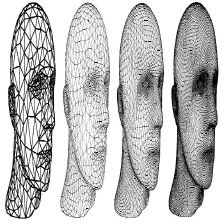
再对之前的200个点的兔子做细分
分别设置阈值为0,30,50,180,也就是二面角小于0,30,50,180度设置为flat的,一次细分得到的分别为
 |  |  |  |
| 0 | 30 | 50 | 180 |
可以很明显的看出来阈值不同对不同地方细分的程度是不同的





 扫一扫
扫一扫


 4337
4337


 到【灌水乐园】发言



