



 本文探讨了一个好奇的孩子使用N个小砖块构建不同阶梯的问题。阶梯由大小递减的步骤组成,不允许有相同大小的步骤。任务是编写程序,计算能够用确切N个砖块构建的不同阶梯的数量。
1017. Staircases
Time Limit: 1.0 second
Memory Limit: 16 MB
Memory Limit: 16 MB
One curious child has a set of N little bricks (5 ≤ N ≤ 500). From these bricks he builds different staircases. Staircase consists of steps of different sizes in a strictly descending
order. It is not allowed for staircase to have steps equal sizes. Every staircase consists of at least two steps and each step contains at least one brick. Picture gives examples of staircase for N=11 and N=5:
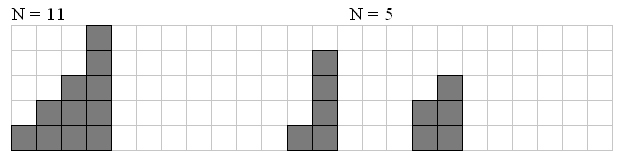
Your task is to write a program that reads the number N and writes the only number Q — amount of different staircases that can be built from exactly N bricks.
Input
Number N
Output
Number Q
Sample
| input | output |
|---|---|
212 |
995645335 |
dp,记录每i个方块,末尾有j个块的状态
(设置为double类型,可以不用贴大数相乘(但是__int64却不行
#include<cstdio>

double f[501][501], sum[501];

int main()
{
	int i, j, k, n;
	scanf("%d", &n);
	for (i=0; i<501; i++)
		for (j=0; j<501; j++)
			f[i][j] = 0;
	for (i=0; i<501; i++)
		sum[i] = 0;
	for (i=1; i<n; i++)
		f[i][i] = 1;

	for (i=3; i<=n; i++)
		for (j=1; j<i; j++)
		{
			for (k=1; k<j; k++)
				f[i][j] += f[i-j][k];
			sum[i] += f[i][j];
		}
	printf("%.0f\n", sum[n]);
}





 扫一扫
扫一扫


 被折叠的 条评论
为什么被折叠?
被折叠的 条评论
为什么被折叠?
 到【灌水乐园】发言





