


一、功能说明
SpringBoot的定时任务的加强工具,实现对SpringBoot原生的定时任务进行动态管理,完全兼容原生@Scheduled注解,无需对原本的定时任务进行修改
二、快速使用
具体的功能已经封装成SpringBoot-starter即插即用
<dependency>
    <groupId>com.github.guoyixing</groupId>
    <artifactId>spring-boot-starter-super-scheduled</artifactId>
    <version>0.3.1</version>
</dependency>
使用方法和源码:
码云:https://gitee.com/qiaodaimadewangcai/super-scheduled
github:https://github.com/guoyixing/super-scheduled
三、实现原理
1、动态管理实现
(1) 配置管理介绍
@Component("superScheduledConfig")
public class SuperScheduledConfig {
    /**
     * 执行定时任务的线程池
     */
    private ThreadPoolTaskScheduler taskScheduler;

    /**
     * 定时任务名称与定时任务回调钩子  的关联关系容器
     */
    private Map<String, ScheduledFuture> nameToScheduledFuture = new ConcurrentHashMap<>();

    /**
     * 定时任务名称与定时任务需要执行的逻辑  的关联关系容器
     */
    private Map<String, Runnable> nameToRunnable = new ConcurrentHashMap<>();

    /**
     * 定时任务名称与定时任务的源信息  的关联关系容器
     */
    private Map<String, ScheduledSource> nameToScheduledSource = new ConcurrentHashMap<>();
 /* 普通的get/sets省略 */
}
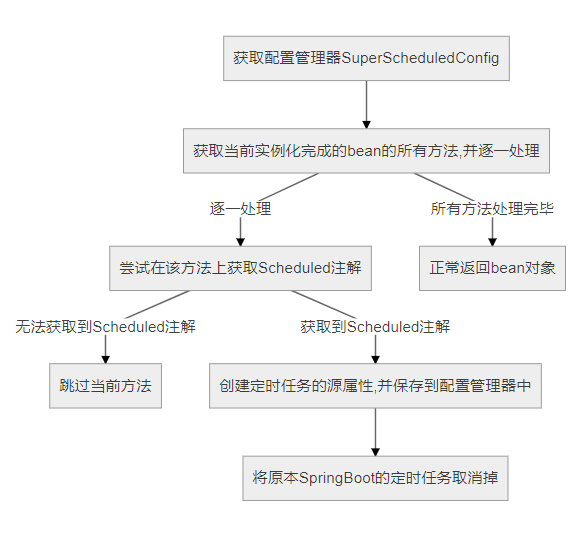
(2) 使用后处理器拦截SpringBoot原本的定时任务
实现ApplicationContextAware接口拿到SpringBoot的上下文
实现BeanPostProcessor接口,将这个类标记为后处理器,后处理器会在每个bean实例化之后执行
使用@DependsOn注解强制依赖SuperScheduledConfig类,让SpringBoot实例化SuperScheduledPostProcessor类之前先实例化SuperScheduledConfig类
主要实现逻辑在postProcessAfterInitialization()方法中
@DependsOn({"superScheduledConfig"})
@Component
@Order
public class SuperScheduledPostProcessor implements BeanPostProcessor, ApplicationContextAware {
    protected final Log logger = LogFactory.getLog(getClass());

    private ApplicationContext applicationContext;

    /**
     * 实例化bean之前的操作
     * @param bean bean实例
     * @param beanName bean的Name
     */
    @Override
    public Object postProcessBeforeInitialization(Object bean, String beanName) throws BeansException {
        return bean;
    }

    /**
     * 实例化bean之后的操作
     * @param bean bean实例
     * @param beanName bean的Name
     */
    @Override
    public Object postProcessAfterInitialization(Object bean,
                                                 String beanName) throws BeansException {
        //1.获取配置管理器
        SuperScheduledConfig superScheduledConfig = applicationContext.getBean(SuperScheduledConfig.class);

        //2.获取当前实例化完成的bean的所有方法
        Method[] methods = bean.getClass().getDeclaredMethods();
        //循环处理对每个方法逐一处理
        if (methods.length > 0) {
            for (Method method : methods) {
             //3.尝试在该方法上获取@Scheduled注解(SpringBoot的定时任务注解)
                Scheduled annotation = method.getAnnotation(Scheduled.class);
                //如果无法获取到@Scheduled注解,就跳过这个方法
                if (annotation == null) {
                    continue;
                }
                //4.创建定时任务的源属性
                //创建定时任务的源属性(用来记录定时任务的配置,初始化的时候记录的是注解上原本的属性)
                ScheduledSource scheduledSource = new ScheduledSource(annotation, method, bean);
                //对注解上获取到源属性中的属性进行检测
                if (!scheduledSource.check()) {
                    throw new SuperScheduledException("在" + beanName + "Bean中" + method.getName() + "方法的注解参数错误");
                }
                //生成定时任务的名称(id),使用beanName+“.”+方法名
                String name = beanName + "." + method.getName();
                //将以key-value的形式,将源数据存入配置管理器中,key:定时任务的名称 value:源数据
                superScheduledConfig.addScheduledSource(name, scheduledSource);
                try {
                 //5.将原本SpringBoot的定时任务取消掉
                    clearOriginalScheduled(annotation);
                } catch (Exception e) {
                    throw new SuperScheduledException("在关闭原始方法" + beanName + method.getName() + "时出现错误");
                }
            }
        }
        //最后bean保持原有返回
        return bean;
    }

    /**
     * 修改注解原先的属性
     * @param annotation 注解实例对象
     * @throws Exception
     */
    private void clearOriginalScheduled(Scheduled annotation) throws Exception {
        changeAnnotationValue(annotation, "cron", Scheduled.CRON_DISABLED);
        changeAnnotationValue(annotation, "fixedDelay", -1L);
        changeAnnotationValue(annotation, "fixedDelayString", "");
        changeAnnotationValue(annotation, "fixedRate", -1L);
        changeAnnotationValue(annotation, "fixedRateString", "");
        changeAnnotationValue(annotation, "initialDelay", -1L);
        changeAnnotationValue(annotation, "initialDelayString", "");
    }


    /**
     * 获取SpringBoot的上下文
     * @param applicationContext SpringBoot的上下文
     */
    @Override
    public void setApplicationContext(ApplicationContext applicationContext) throws BeansException {
        this.applicationContext = applicationContext;
    }
}
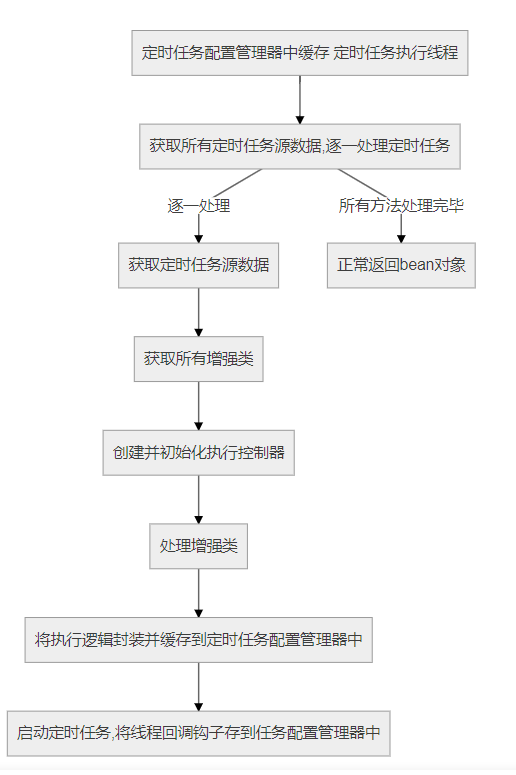
(3) 使用ApplicationRunner初始化自定义的定时任务运行器
实现ApplicationContextAware接口拿到SpringBoot的上下文
使用@DependsOn注解强制依赖threadPoolTaskScheduler类
实现ApplicationRunner接口,在所有bean初始化结束之后,运行自定义逻辑
主要实现逻辑在run()方法中
@DependsOn("threadPoolTaskScheduler")
@Component
public class SuperScheduledApplicationRunner implements ApplicationRunner, ApplicationContextAware {
    protected final Log logger = LogFactory.getLog(getClass());
    private DateTimeFormatter df = DateTimeFormatter.ofPattern("yyyy-MM-dd HH:mm:ss");
    private ApplicationContext applicationContext;

 /**
     * 定时任务配置管理器
     */
    @Autowired
    private SuperScheduledConfig superScheduledConfig;
    /**
     * 定时任务执行线程
     */
    @Autowired
    private ThreadPoolTaskScheduler threadPoolTaskScheduler;

    @Override
    public void run(ApplicationArguments args) {
     //1.定时任务配置管理器中缓存  定时任务执行线程
        superScheduledConfig.setTaskScheduler(threadPoolTaskScheduler);
        //2.获取所有定时任务源数据
        Map<String, ScheduledSource> nameToScheduledSource = superScheduledConfig.getNameToScheduledSource();
        //逐一处理定时任务
        for (String name : nameToScheduledSource.keySet()) {
            //3.获取定时任务源数据
            ScheduledSource scheduledSource = nameToScheduledSource.get(name);
            //4.获取所有增强类
            String[] baseStrengthenBeanNames = applicationContext.getBeanNamesForType(BaseStrengthen.class);
            //5.创建执行控制器
            SuperScheduledRunnable runnable = new SuperScheduledRunnable();
            //配置执行控制器
            runnable.setMethod(scheduledSource.getMethod());
            runnable.setBean(scheduledSource.getBean());
            //6.逐一处理增强类(增强器实现原理后面具体分析)
            List<Point> points = new ArrayList<>(baseStrengthenBeanNames.length);
            for (String baseStrengthenBeanName : baseStrengthenBeanNames) {
             //7.将增强器代理成point
                Object baseStrengthenBean = applicationContext.getBean(baseStrengthenBeanName);
                //创建代理
                Point proxy = ProxyUtils.getInstance(Point.class, new RunnableBaseInterceptor(baseStrengthenBean, runnable));
                proxy.setSuperScheduledName(name);
                //8.所有的points连成起来
                points.add(proxy);
            }
   //将point形成调用链
            runnable.setChain(new Chain(points));
            //将执行逻辑封装并缓存到定时任务配置管理器中
            superScheduledConfig.addRunnable(name, runnable::invoke);
            try {
             //8.启动定时任务
                ScheduledFuture<?> schedule = ScheduledFutureFactory.create(threadPoolTaskScheduler
                        , scheduledSource, runnable::invoke);
                //将线程回调钩子存到任务配置管理器中
                superScheduledConfig.addScheduledFuture(name, schedule);
                logger.info(df.format(LocalDateTime.now()) + "任务" + name + "已经启动...");

            } catch (Exception e) {
                throw new SuperScheduledException("任务" + name + "启动失败,错误信息:" + e.getLocalizedMessage());
            }
        }
    }

    @Override
    public void setApplicationContext(ApplicationContext applicationContext) throws BeansException {
        this.applicationContext = applicationContext;
    }
}
(4) 进行动态管理
@Component
public class SuperScheduledManager {
    protected final Log logger = LogFactory.getLog(getClass());
    private DateTimeFormatter df = DateTimeFormatter.ofPattern("yyyy-MM-dd HH:mm:ss");

    @Autowired
    private SuperScheduledConfig superScheduledConfig;

    /**
     * 修改Scheduled的执行周期
     *
     * @param name scheduled的名称
     * @param cron cron表达式
     */
    public void setScheduledCron(String name, String cron) {
        //终止原先的任务
        cancelScheduled(name);
        //创建新的任务
        ScheduledSource scheduledSource = superScheduledConfig.getScheduledSource(name);
        scheduledSource.clear();
        scheduledSource.setCron(cron);
        addScheduled(name, scheduledSource);
    }

    /**
     * 修改Scheduled的fixedDelay
     *
     * @param name       scheduled的名称
     * @param fixedDelay 上一次执行完毕时间点之后多长时间再执行
     */
    public void setScheduledFixedDelay(String name, Long fixedDelay) {
        //终止原先的任务
        cancelScheduled(name);
        //创建新的任务
        ScheduledSource scheduledSource = superScheduledConfig.getScheduledSource(name);
        scheduledSource.clear();
        scheduledSource.setFixedDelay(fixedDelay);
        addScheduled(name, scheduledSource);
    }

    /**
     * 修改Scheduled的fixedRate
     *
     * @param name      scheduled的名称
     * @param fixedRate 上一次开始执行之后多长时间再执行
     */
    public void setScheduledFixedRate(String name, Long fixedRate) {
        //终止原先的任务
        cancelScheduled(name);
        //创建新的任务
        ScheduledSource scheduledSource = superScheduledConfig.getScheduledSource(name);
        scheduledSource.clear();
        scheduledSource.setFixedRate(fixedRate);
        addScheduled(name, scheduledSource);
    }

    /**
     * 查询所有启动的Scheduled
     */
    public List<String> getRunScheduledName() {
        Set<String> names = superScheduledConfig.getNameToScheduledFuture().keySet();
        return new ArrayList<>(names);
    }

    /**
     * 查询所有的Scheduled
     */
    public List<String> getAllSuperScheduledName() {
        Set<String> names = superScheduledConfig.getNameToRunnable().keySet();
        return new ArrayList<>(names);
    }

    /**
     * 终止Scheduled
     *
     * @param name scheduled的名称
     */
    public void cancelScheduled(String name) {
        ScheduledFuture scheduledFuture = superScheduledConfig.getScheduledFuture(name);
        scheduledFuture.cancel(true);
        superScheduledConfig.removeScheduledFuture(name);
        logger.info(df.format(LocalDateTime.now()) + "任务" + name + "已经终止...");
    }

    /**
     * 启动Scheduled
     *
     * @param name            scheduled的名称
     * @param scheduledSource 定时任务的源信息
     */
    public void addScheduled(String name, ScheduledSource scheduledSource) {
        if (getRunScheduledName().contains(name)) {
            throw new SuperScheduledException("定时任务" + name + "已经被启动过了");
        }
        if (!scheduledSource.check()) {
            throw new SuperScheduledException("定时任务" + name + "源数据内容错误");
        }

        scheduledSource.refreshType();

        Runnable runnable = superScheduledConfig.getRunnable(name);
        ThreadPoolTaskScheduler taskScheduler = superScheduledConfig.getTaskScheduler();


        ScheduledFuture<?> schedule = ScheduledFutureFactory.create(taskScheduler, scheduledSource, runnable);
        logger.info(df.format(LocalDateTime.now()) + "任务" + name + "已经启动...");

        superScheduledConfig.addScheduledSource(name, scheduledSource);
        superScheduledConfig.addScheduledFuture(name, schedule);
    }

    /**
     * 以cron类型启动Scheduled
     *
     * @param name scheduled的名称
     * @param cron cron表达式
     */
    public void addCronScheduled(String name, String cron) {
        ScheduledSource scheduledSource = new ScheduledSource();
        scheduledSource.setCron(cron);

        addScheduled(name, scheduledSource);
    }

    /**
     * 以fixedDelay类型启动Scheduled
     *
     * @param name         scheduled的名称
     * @param fixedDelay   上一次执行完毕时间点之后多长时间再执行
     * @param initialDelay 第一次执行的延迟时间
     */
    public void addFixedDelayScheduled(String name, Long fixedDelay, Long... initialDelay) {
        ScheduledSource scheduledSource = new ScheduledSource();
        scheduledSource.setFixedDelay(fixedDelay);
        if (initialDelay != null && initialDelay.length == 1) {
            scheduledSource.setInitialDelay(initialDelay[0]);
        } else if (initialDelay != null && initialDelay.length > 1) {
            throw new SuperScheduledException("第一次执行的延迟时间只能传入一个参数");
        }

        addScheduled(name, scheduledSource);
    }

    /**
     * 以fixedRate类型启动Scheduled
     *
     * @param name         scheduled的名称
     * @param fixedRate    上一次开始执行之后多长时间再执行
     * @param initialDelay 第一次执行的延迟时间
     */
    public void addFixedRateScheduled(String name, Long fixedRate, Long... initialDelay) {
        ScheduledSource scheduledSource = new ScheduledSource();
        scheduledSource.setFixedRate(fixedRate);
        if (initialDelay != null && initialDelay.length == 1) {
            scheduledSource.setInitialDelay(initialDelay[0]);
        } else if (initialDelay != null && initialDelay.length > 1) {
            throw new SuperScheduledException("第一次执行的延迟时间只能传入一个参数");
        }

        addScheduled(name, scheduledSource);
    }

    /**
     * 手动执行一次任务
     *
     * @param name scheduled的名称
     */
    public void runScheduled(String name) {
        Runnable runnable = superScheduledConfig.getRunnable(name);
        runnable.run();
    }
}
2、增强接口实现
增强器实现的整体思路与SpringAop的思路一致,实现没有Aop复杂
(1) 增强接口
@Order(Ordered.HIGHEST_PRECEDENCE)
public interface BaseStrengthen {
    /**
     * 前置强化方法
     *
     * @param bean   bean实例(或者是被代理的bean)
     * @param method 执行的方法对象
     * @param args   方法参数
     */
    void before(Object bean, Method method, Object[] args);

    /**
     * 后置强化方法
     * 出现异常不会执行
     * 如果未出现异常,在afterFinally方法之后执行
     *
     * @param bean   bean实例(或者是被代理的bean)
     * @param method 执行的方法对象
     * @param args   方法参数
     */
    void after(Object bean, Method method, Object[] args);

    /**
     * 异常强化方法
     *
     * @param bean   bean实例(或者是被代理的bean)
     * @param method 执行的方法对象
     * @param args   方法参数
     */
    void exception(Object bean, Method method, Object[] args);

    /**
     * Finally强化方法,出现异常也会执行
     *
     * @param bean   bean实例(或者是被代理的bean)
     * @param method 执行的方法对象
     * @param args   方法参数
     */
    void afterFinally(Object bean, Method method, Object[] args);
}
(2) 代理抽象类
public abstract class Point {
    /**
     * 定时任务名
     */
    private String superScheduledName;

    /**
     * 抽象的执行方法,使用代理实现
     * @param runnable 定时任务执行器
     */
    public abstract Object invoke(SuperScheduledRunnable runnable);

    /* 普通的get/sets省略 */
}
(3) 调用链类
public class Chain {
    private List<Point> list;
    private int index = -1;
    /**
     * 索引自增1
     */
    public int incIndex() {
        return ++index;
    }

    /**
     * 索引还原
     */
    public void resetIndex() {
        this.index = -1;
    }
}
(4) cglib动态代理实现
使用cglib代理增强器,将增强器全部代理成调用链节点Point
public class RunnableBaseInterceptor implements MethodInterceptor {
    /**
     * 定时任务执行器
     */
    private SuperScheduledRunnable runnable;
    /**
     * 定时任务增强类
     */
    private BaseStrengthen strengthen;

    @Override
    public Object intercept(Object obj, Method method, Object[] args, MethodProxy methodProxy) throws Throwable {
        Object result;
        //如果执行的是invoke()方法
        if ("invoke".equals(method.getName())) {
         //前置强化方法
            strengthen.before(obj, method, args);
            try {
             //调用执行器中的invoke()方法
                result = runnable.invoke();
            } catch (Exception e) {
             //异常强化方法
                strengthen.exception(obj, method, args);
                throw new SuperScheduledException(strengthen.getClass() + "中强化执行时发生错误", e);
            } finally {
             //Finally强化方法,出现异常也会执行
                strengthen.afterFinally(obj, method, args);
            }
            //后置强化方法
            strengthen.after(obj, method, args);

        } else {
         //直接执行方法
            result = methodProxy.invokeSuper(obj, args);
        }
        return result;
    }

    public RunnableBaseInterceptor(Object object, SuperScheduledRunnable runnable) {
        this.runnable = runnable;
        if (BaseStrengthen.class.isAssignableFrom(object.getClass())) {
            this.strengthen = (BaseStrengthen) object;
        } else {
            throw new SuperScheduledException(object.getClass() + "对象不是BaseStrengthen类型");
        }
    }

    public RunnableBaseInterceptor() {

    }
}
(5) 定时任务执行器实现
public class SuperScheduledRunnable {
    /**
     * 原始的方法
     */
    private Method method;
    /**
     * 方法所在的bean
     */
    private Object bean;
    /**
     * 增强器的调用链
     */
    private Chain chain;


    public Object invoke() {
        Object result;
        //索引自增1
        if (chain.incIndex() == chain.getList().size()) {
            //调用链中的增强方法已经全部执行结束
            try {
                //调用链索引初始化
                chain.resetIndex();
                //增强器全部执行完毕,执行原本的方法
                result = method.invoke(bean);
            } catch (IllegalAccessException | InvocationTargetException e) {
                throw new SuperScheduledException(e.getLocalizedMessage());
            }
        } else {
            //获取被代理后的方法增强器
            Point point = chain.getList().get(chain.getIndex());
            //执行增强器代理
            //增强器代理中,会回调方法执行器,形成调用链,逐一运行调用链中的增强器
            result = point.invoke(this);
        }
        return result;
    }

    /* 普通的get/sets省略 */
}
(6) 增强器代理逻辑
com.gyx.superscheduled.core.SuperScheduledApplicationRunner类中的代码片段
//创建执行控制器
SuperScheduledRunnable runnable = new SuperScheduledRunnable();
runnable.setMethod(scheduledSource.getMethod());
runnable.setBean(scheduledSource.getBean());
//用来存放 增强器的代理对象
List<Point> points = new ArrayList<>(baseStrengthenBeanNames.length);
//循环所有的增强器的beanName
for (String baseStrengthenBeanName : baseStrengthenBeanNames) {
 //获取增强器的bean对象
    Object baseStrengthenBean = applicationContext.getBean(baseStrengthenBeanName);
    //将增强器代理成Point节点
    Point proxy = ProxyUtils.getInstance(Point.class, new RunnableBaseInterceptor(baseStrengthenBean, runnable));
    proxy.setSuperScheduledName(name);
    //增强器的代理对象缓存到list中
    points.add(proxy);
}
//将增强器代理实例的集合生成调用链
//执行控制器中设置调用链
runnable.setChain(new Chain(points)); 547


 扫一扫


 被折叠的 条评论
为什么被折叠?
 到【灌水乐园】发言


