



 SSDB是一款开源NoSQL数据库,可作为Redis的替代方案,支持十亿级别的列表数据存储。其具备高性能、主从复制及多种语言客户端支持等特点。本文介绍了SSDB的基本特性和安装配置方法,并提供了不同编程语言下的使用示例。
本文地址: http://www.ttlsa.com/redis/ssdb-redis-alternatives/
除非注明,博客文章均为"运维生存时间"原创,转载请标明本文地址
SSDB是一个快速的用来存储十亿级别列表数据的开源 NoSQL 数据库。
项目地址:https://github.com/ideawu/ssdb
http://ssdb.io/
特性
- 替代 Redis 数据库, Redis 的 100 倍容量
- LevelDB 网络支持, 使用 C/C++ 开发
- Redis API 兼容, 支持 Redis 客户端
- 适合存储集合数据, 如 list, hash, zset…
- 客户端 API 支持的语言包括: C++、PHP、Python、Cpy、Java、NodeJS、Ruby、Go。
- 持久化的队列服务
- 主从复制, 负载均衡
性能
1000请求:
writeseq : 0.546 ms/op 178.7 MB/s |
writerand : 0.519 ms/op 188.1 MB/s |
readseq : 0.304 ms/op 321.6 MB/s |
readrand : 0.310 ms/op 315.0 MB/s |
并发:
========== set ========== |
qps: 44251, time: 0.226 s |
========== get ========== |
qps: 55541, time: 0.180 s |
========== del ========== |
qps: 46080, time: 0.217 s |
========== hset ========== |
qps: 42338, time: 0.236 s |
========== hget ========== |
qps: 55601, time: 0.180 s |
========== hdel ========== |
qps: 46529, time: 0.215 s |
========== zset ========== |
qps: 37381, time: 0.268 s |
========== zget ========== |
qps: 41455, time: 0.241 s |
========== zdel ========== |
qps: 38792, time: 0.258 s |
在MacBook Pro 13 (Retina屏幕)上运行。
与redis的比较:
性能数据使用 ssdb-bench(SSDB) 和 redis-benchmark(Redis) 来获取。

架构
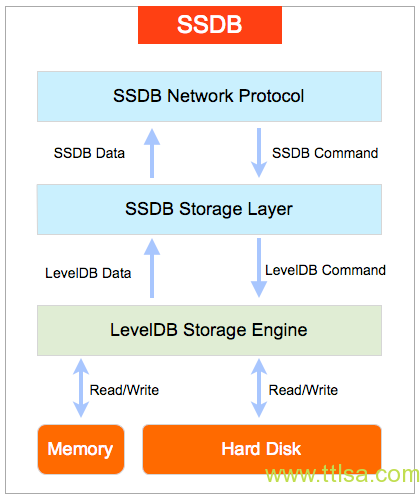
安装
下载压缩包,解压缩
wget --no-check-certificate https://github.com/ideawu/ssdb/archive/master.zip |
unzip master |
cd ssdb-master |
编译
make |
安装(可选)
sudo make install |
运行
./ssdb-server ssdb.conf |
或者以后台的方式运行
./ssdb-server -d ssdb.conf |
ssdb命令行
./tools/ssdb-cli -p 8888 |
停止ssdb-server
kill `cat ./var/ssdb.pid` |
使用
PHP
<?php |
include_once('SSDB.php'); |
try{ |
$ssdb = new SimpleSSDB('127.0.0.1', 8888); |
}catch(Exception $e){ |
die(__LINE__ . ' ' . $e->getMessage()); |
} |
$ret = $ssdb->set('key', 'value'); |
if($ret === false){ |
// error! |
} |
echo $ssdb->get('key'); |
Python
使用pyssdb
>>> import pyssdb |
>>> c = pyssdb.Client() |
>>> c.set('key', 'value') |
1 |
>>> c.get('key') |
'value' |
>>> c.hset('hash', 'item', 'value') |
1 |
>>> c.hget('hash', 'item') |
'value' |
>>> c.hget('hash', 'not exist') is None |
True |
>>> c.incr('counter') |
1 |
>>> c.incr('counter') |
2 |
>>> c.incr('counter') |
3 |
>>> c.keys('a', 'z', 1) |
['counter'] |
>>> c.keys('a', 'z', 10) |
['counter', 'key'] |
Ruby
使用ssdb-rb
require "ssdb" |
ssdb = SSDB.new url: "ssdb://1.2.3.4:8889" |
ssdb.set("mykey", "hello world") |
# => true |
ssdb.get("mykey") |
# => "hello world" |
ssdb.batch do |
ssdb.set "foo", "5" |
ssdb.get "foo" |
ssdb.incr "foo" |
end |
# => [true, "5", 6] |
Go
package main |
import ( |
"fmt" |
"os" |
"./ssdb" |
) |
func main(){ |
ip := "127.0.0.1"; |
port := 8888; |
db, err := ssdb.Connect(ip, port); |
if(err != nil){ |
os.Exit(1); |
} |
var val interface{}; |
db.Set("a", "xxx"); |
val, err = db.Get("a"); |
fmt.Printf("%s\n", val); |
db.Del("a"); |
val, err = db.Get("a"); |
fmt.Printf("%s\n", val); |
db.Do("zset", "z", "a", 3); |
db.Do("multi_zset", "z", "b", -2, "c", 5, "d", 3); |
resp, err := db.Do("zrange", "z", 0, 10); |
if err != nil{ |
os.Exit(1); |
} |
if len(resp) % 2 != 1{ |
fmt.Printf("bad response"); |
os.Exit(1); |
} |
fmt.Printf("Status: %s\n", resp[0]); |
for i:=1; i<len(resp); i+=2{ |
fmt.Printf(" %s : %3s\n", resp[i], resp[i+1]); |
} |
return; |
ngx_lua
使用lua-resty-ssdb
lua_package_path "/path/to/lua-resty-ssdb/lib/?.lua;;"; |
server { |
location /test { |
content_by_lua ' |
local ssdb = require "resty.ssdb" |
local db = ssdb:new() |
db:set_timeout(1000) -- 1 sec |
local ok, err = db:connect("127.0.0.1", 8888) |
if not ok then |
ngx.say("failed to connect: ", err) |
return |
end |
ok, err = db:set("dog", "an animal") |
if not ok then |
ngx.say("failed to set dog: ", err) |
return |
end |
ngx.say("set result: ", ok) |
local res, err = db:get("dog") |
if not res then |
ngx.say("failed to get dog: ", err) |
return |
end |
if res == ngx.null then |
ngx.say("dog not found.") |
return |
end |
ngx.say("dog: ", res) |
db:init_pipeline() |
db:set("cat", "Marry") |
db:set("horse", "Bob") |
db:get("cat") |
db:get("horse") |
local results, err = db:commit_pipeline() |
if not results then |
ngx.say("failed to commit the pipelined requests: ", err) |
return |
end |
for i, res in ipairs(results) do |
if type(res) == "table" then |
if not res[1] then |
ngx.say("failed to run command ", i, ": ", res[2]) |
else |
-- process the table value |
end |
else |
-- process the scalar value |
end |
end |
-- put it into the connection pool of size 100, |
-- with 0 idle timeout |
local ok, err = db:set_keepalive(0, 100) |
if not ok then |
ngx.say("failed to set keepalive: ", err) |
return |
end |
-- or just close the connection right away: |
-- local ok, err = db:close() |
-- if not ok then |
-- ngx.say("failed to close: ", err) |
-- return |
-- end |
'; |
} |
} |
C++
#include <stdio.h> |
#include <stdlib.h> |
#include <string> |
#include <vector> |
#include "SSDB.h" |
int main(int argc, char **argv){ |
const char *ip = (argc >= 2)? argv[1] : "127.0.0.1"; |
int port = (argc >= 3)? atoi(argv[2]) : 8888; |
ssdb::Client *client = ssdb::Client::connect(ip, port); |
if(client == NULL){ |
printf("fail to connect to server!\n"); |
return 0; |
} |
ssdb::Status s; |
s = client->set("k", "hello ssdb!"); |
if(s.ok()){ |
printf("k = hello ssdb!\n"); |
}else{ |
printf("error!\n"); |
} |
delete client; |
return 0; |
} |
<iframe id="aswift_0" style="left: 0px; position: absolute; top: 0px;" name="aswift_0" frameborder="0" marginwidth="0" marginheight="0" scrolling="no" width="728" height="90"></iframe>





 扫一扫
扫一扫


 9021
9021

 被折叠的 条评论
为什么被折叠?
被折叠的 条评论
为什么被折叠?
 到【灌水乐园】发言





