



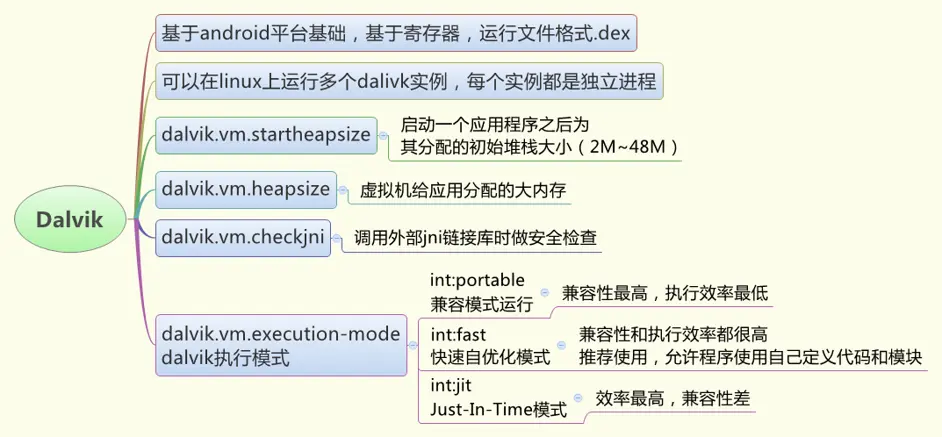
二.Dalvik启动过程
//AndroidRuntime.cpp
int AndroidRuntime::startVm(JavaVM** pJavaVM, JNIEnv** pEnv, bool zygote)
{
JavaVMInitArgs initArgs;
char propBuf[PROPERTY_VALUE_MAX];
char stackTraceFileBuf[sizeof(“-Xstacktracefile:”)-1 + PROPERTY_VALUE_MAX];
char jniOptsBuf[sizeof(“-Xjniopts:”)-1 + PROPERTY_VALUE_MAX];
char heapstartsizeOptsBuf[sizeof(“-Xms”)-1 + PROPERTY_VALUE_MAX];
char heapsizeOptsBuf[sizeof(“-Xmx”)-1 + PROPERTY_VALUE_MAX];
char heapgrowthlimitOptsBuf[sizeof(“-XX:HeapGrowthLimit=”)-1 + PROPERTY_VALUE_MAX];
char heapminfreeOptsBuf[sizeof(“-XX:HeapMinFree=”)-1 + PROPERTY_VALUE_MAX];
char heapmaxfreeOptsBuf[sizeof(“-XX:HeapMaxFree=”)-1 + PROPERTY_VALUE_MAX];
char usejitOptsBuf[sizeof(“-Xusejit:”)-1 + PROPERTY_VALUE_MAX];
char jitmaxsizeOptsBuf[sizeof(“-Xjitmaxsize:”)-1 + PROPERTY_VALUE_MAX];
char jitinitialsizeOptsBuf[sizeof(“-Xjitinitialsize:”)-1 + PROPERTY_VALUE_MAX];
char jitthresholdOptsBuf[sizeof(“-Xjitthreshold:”)-1 + PROPERTY_VALUE_MAX];
char useJitProfilesOptsBuf[sizeof(“-Xjitsaveprofilinginfo:”)-1 + PROPERTY_VALUE_MAX];
char jitprithreadweightOptBuf[sizeof(“-Xjitprithreadweight:”)-1 + PROPERTY_VALUE_MAX];
char jittransitionweightOptBuf[sizeof(“-Xjittransitionweight:”)-1 + PROPERTY_VALUE_MAX];
char gctypeOptsBuf[sizeof(“-Xgc:”)-1 + PROPERTY_VALUE_MAX];
char backgroundgcOptsBuf[sizeof(“-XX:BackgroundGC=”)-1 + PROPERTY_VALUE_MAX];
char heaptargetutilizationOptsBuf[sizeof(“-XX:HeapTargetUtilization=”)-1 + PROPERTY_VALUE_MAX];
char cachePruneBuf[sizeof(“-Xzygote-max-boot-retry=”)-1 + PROPERTY_VALUE_MAX];
char dex2oatXmsImageFlagsBuf[sizeof(“-Xms”)-1 + PROPERTY_VALUE_MAX];
char dex2oatXmxImageFlagsBuf[sizeof(“-Xmx”)-1 + PROPERTY_VALUE_MAX];
char dex2oatXmsFlagsBuf[sizeof(“-Xms”)-1 + PROPERTY_VALUE_MAX];
char dex2oatXmxFlagsBuf[sizeof(“-Xmx”)-1 + PROPERTY_VALUE_MAX];
char dex2oatCompilerFilterBuf[sizeof(“–compiler-filter=”)-1 + PROPERTY_VALUE_MAX];
char dex2oatImageCompilerFilterBuf[sizeof(“–compiler-filter=”)-1 + PROPERTY_VALUE_MAX];
char dex2oatThreadsBuf[sizeof(“-j”)-1 + PROPERTY_VALUE_MAX];
char dex2oatThreadsImageBuf[sizeof(“-j”)-1 + PROPERTY_VALUE_MAX];
char dex2oat_isa_variant_key[PROPERTY_KEY_MAX];
char dex2oat_isa_variant[sizeof(“–instruction-set-variant=”) -1 + PROPERTY_VALUE_MAX];
char dex2oat_isa_features_key[PROPERTY_KEY_MAX];
char dex2oat_isa_features[sizeof(“–instruction-set-features=”) -1 + PROPERTY_VALUE_MAX];
char dex2oatFlagsBuf[PROPERTY_VALUE_MAX];
char dex2oatImageFlagsBuf[PROPERTY_VALUE_MAX];
char extraOptsBuf[PROPERTY_VALUE_MAX];
char voldDecryptBuf[PROPERTY_VALUE_MAX];
…
/*
- Initialize the VM.
- The JavaVM* is essentially per-process, and the JNIEnv* is per-thread.
- If this call succeeds, the VM is ready, and we can start issuing
- JNI calls.
*/
if (JNI_CreateJavaVM(pJavaVM, pEnv, &initArgs) < 0) {
ALOGE(“JNI_CreateJavaVM failed\n”);
return -1;
}
return 0;
}
void AndroidRuntime::start(const char* className, const Vector& options, bool zygote)
自我介绍一下,小编13年上海交大毕业,曾经在小公司待过,也去过华为、OPPO等大厂,18年进入阿里一直到现在。
深知大多数初中级安卓工程师,想要提升技能,往往是自己摸索成长,但自己不成体系的自学效果低效又漫长,而且极易碰到天花板技术停滞不前!
因此收集整理了一份《2024年最新Android移动开发全套学习资料》送给大家,初衷也很简单,就是希望能够帮助到想自学提升又不知道该从何学起的朋友,同时减轻大家的负担。

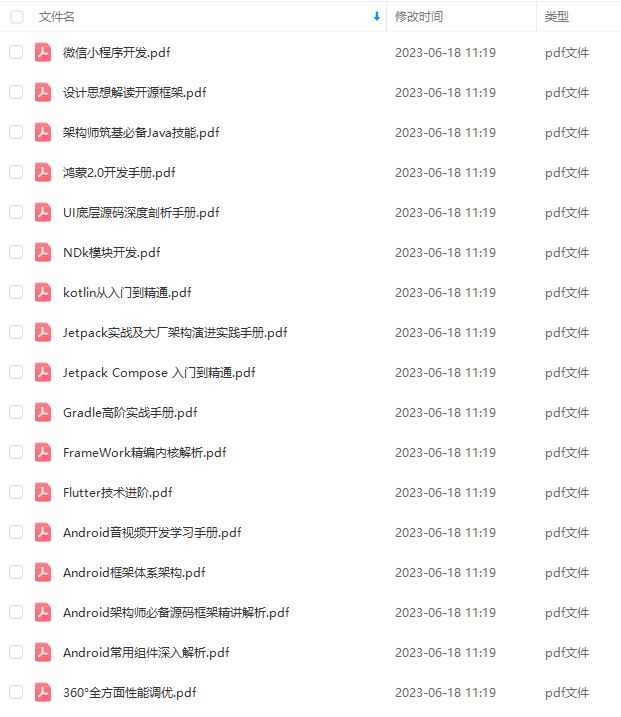

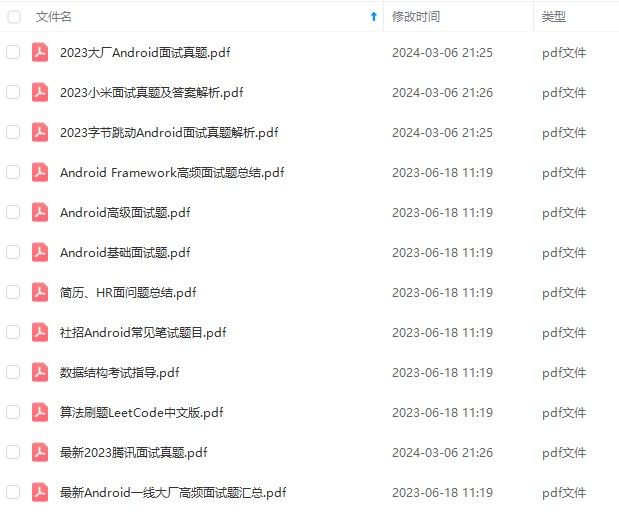
由于文件比较大,这里只是将部分目录截图出来,每个节点里面都包含大厂面经、学习笔记、源码讲义、实战项目、讲解视频
如果你觉得这些内容对你有帮助,可以添加下面V无偿领取!(备注Android)

尾声
评论里面有些同学有疑问关于如何学习material design控件,我的建议是去GitHub搜,有很多同行给的例子,这些栗子足够入门。
有朋友说要是动真格的话,需要NDK以及JVM等的知识,首现**NDK并不是神秘的东西,**你跟着官方的步骤走一遍就知道什么回事了,无非就是一些代码格式以及原生/JAVA内存交互,进阶一点的有原生/JAVA线程交互,线程交互确实有点蛋疼,但平常避免用就好了,再说对于初学者来说关心NDK干嘛,据鄙人以前的经历,只在音视频通信和一个嵌入式信号处理(离线)的两个项目中用过,嵌入式信号处理是JAVA->NDK->.SO->MATLAB这样调用的我原来MATLAB的代码,其他的大多就用在游戏上了吧,一般的互联网公司会有人给你公司的SO包的。
至于JVM,该掌握的那部分,相信我,你会掌握的,不该你掌握的,有那些专门研究JVM的人来做,不如省省心有空看看计算机系统,编译原理。
一句话,平常多写多练,这是最基本的程序员的素质,尽量挤时间,读理论基础书籍,JVM不是未来30年唯一的虚拟机,JAVA也不一定再风靡未来30年工业界,其他的系统和语言也会雨后春笋冒出来,但你理论扎实会让你很快理解学会一个语言或者框架,你平常写的多会让你很快熟练的将新学的东西应用到实际中。
初学者,一句话,多练。
和语言也会雨后春笋冒出来,但你理论扎实会让你很快理解学会一个语言或者框架,你平常写的多会让你很快熟练的将新学的东西应用到实际中。**
初学者,一句话,多练。
由于文章篇幅问题复制链接查看详细文章以及获取学习笔记链接:前往我的GitHub





 扫一扫
扫一扫


 825
825

 被折叠的 条评论
为什么被折叠?
被折叠的 条评论
为什么被折叠?
 到【灌水乐园】发言





