



一、什么是MoE架构?
核心定义
MoE是混合专家系统的缩写,是一种通过组合多个"专家"网络来构建更大模型的技术。每个专家都是相对较小的神经网络,而门控网络负责根据输入动态选择最相关的专家。
生动比喻:医院专科会诊系统
- 传统大模型:像全科神医
-
- 一个人掌握所有医学知识
- 每次看病都动用全部知识
- 成长困难:要学新知识就得重新学习所有内容
- MoE架构:像现代化医院
-
- 心脏科、神经科、骨科等各领域专家
- 根据病情分诊到最合适的专家
- 新专家可以随时加入,不影响其他科室
MoE的基本工作原理
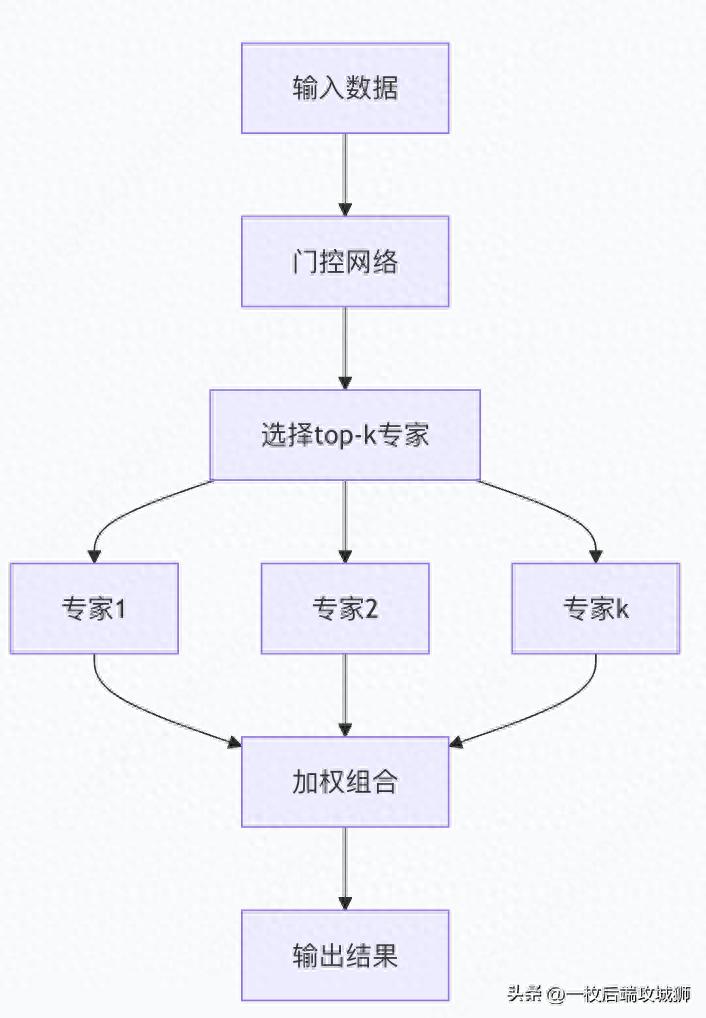
代码实现基础MoE层
import torch
import torch.nn as nn
import torch.nn.functional as F
class MoELayer(nn.Module):
    def __init__(self, input_dim, output_dim, num_experts, k=2):
        super().__init__()
        self.num_experts = num_experts
        self.k = k  # 每次激活的专家数量

        # 创建专家网络
        self.experts = nn.ModuleList([
            nn.Linear(input_dim, output_dim) for _ in range(num_experts)
        ])

        # 门控网络
        self.gate = nn.Linear(input_dim, num_experts)

    def forward(self, x):
        batch_size, seq_len, hidden_dim = x.shape

        # 门控网络计算每个专家的权重
        gate_scores = self.gate(x)  # [batch_size, seq_len, num_experts]

        # 选择top-k专家
        topk_weights, topk_indices = torch.topk(
            gate_scores, self.k, dim=-1
        )
        topk_weights = F.softmax(topk_weights, dim=-1)

        # 初始化输出
        output = torch.zeros_like(x)

        # 对每个选中的专家计算贡献
        for i in range(self.k):
            expert_mask = topk_indices == i
            expert_output = self.experts[i](x)

            # 加权累加
            weight = topk_weights[:, :, i:i+1]
            output += expert_output * weight

        return output
# 使用示例
moe_layer = MoELayer(
    input_dim=512,
    output_dim=512,
    num_experts=8,
    k=2
)
二、MoE架构的优点与全链路优势
MoE的核心优势
1.计算效率的革命
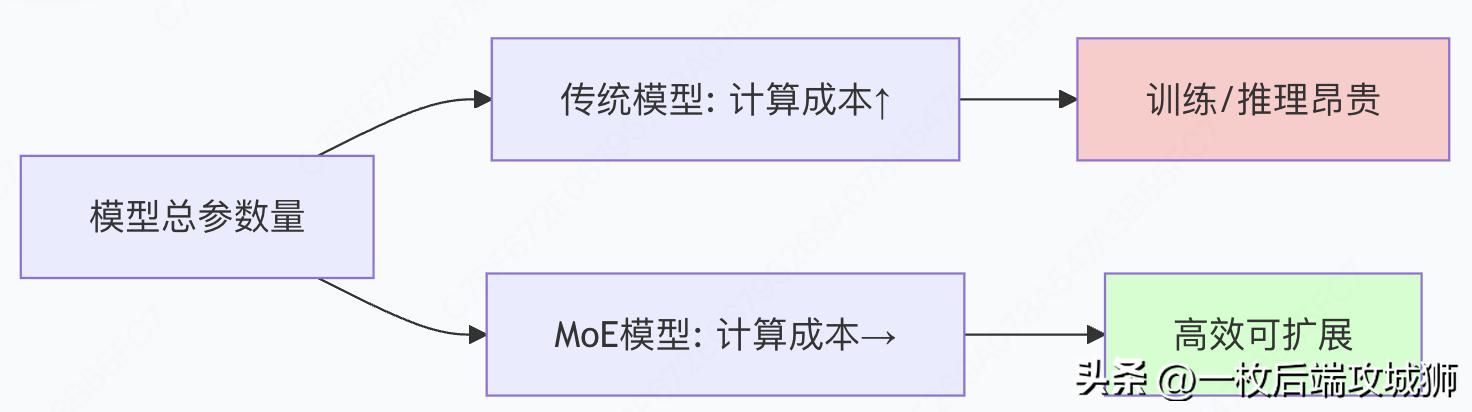
数学表达:
传统模型计算量: O(N)  # N为参数量
MoE模型计算量: O(N/k × k) = O(N)  # 但常数项更小
实际效果: 总参数↑,激活参数→
2.专家专业化
每个专家可以专注于不同的数据模式或任务领域:
# 专家专业化的直观示例
def visualize_expert_specialization():
    experts_specialization = {
        "expert_1": "处理数学推理和逻辑",
        "expert_2": "处理文学创作和修辞",
        "expert_3": "处理科学知识和事实",
        "expert_4": "处理编程代码",
        "expert_5": "处理多语言理解",
        "expert_6": "处理常识推理",
        "expert_7": "处理创造性思维",
        "expert_8": "处理分析性思考"
    }
    return experts_specialization
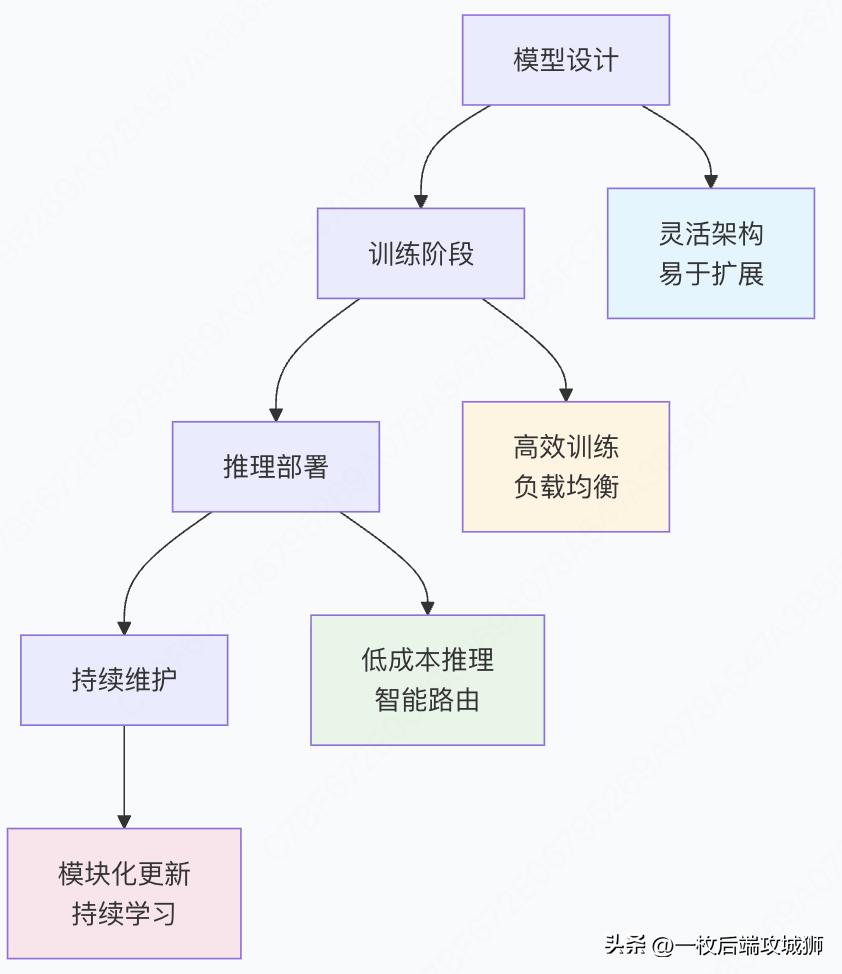
全链路优势分析
阶段1:模型设计与训练
训练效率提升:
# 传统模型 vs MoE模型训练对比
class TrainingComparison:
    def __init__(self):
        self.traditional_model = {
            "total_params": "175B",
            "active_params": "175B",  # 所有参数都激活
            "training_memory": "极高",
            "training_speed": "慢"
        }

        self.moe_model = {
            "total_params": "1.7T",     # 10倍参数量
            "active_params": "~20B",    # 每次只激活少量专家
            "training_memory": "中等",   # 类似20B模型
            "training_speed": "较快"     # 并行训练专家
        }
负载均衡技术:
class LoadBalancingLoss:
    """
    MoE训练中的负载均衡损失,确保专家利用率均衡
    """
    def __init__(self, num_experts, importance_weight=0.01):
        self.num_experts = num_experts
        self.importance_weight = importance_weight

    def __call__(self, gate_scores, expert_usage):
        # 计算专家利用率方差
        usage_variance = torch.var(expert_usage)

        # 计算重要性损失(防止门控网络总是选择相同专家)
        importance = gate_scores.sum(dim=0)
        importance_loss = torch.var(importance)

        return self.importance_weight * (usage_variance + importance_loss)
# 在训练循环中使用
def moe_training_step(model, batch, load_balance_loss):
    outputs = model(batch)
    task_loss = outputs.loss

    # 获取门控网络输出和专家使用情况
    gate_scores = outputs.gate_scores
    expert_usage = outputs.expert_usage

    # 计算负载均衡损失
    balance_loss = load_balance_loss(gate_scores, expert_usage)

    # 总损失
    total_loss = task_loss + balance_loss
    return total_loss
阶段2:推理与部署
推理成本优化:
# 推理时资源需求对比
inference_comparison = {
    "traditional_gpt3": {
        "parameters": "175B",
        "gpu_memory": "350GB+",  # 假设2字节/参数
        "inference_speed": "较慢",
        "cost_per_token": "高"
    },
    "moe_model": {
        "total_parameters": "1.7T",
        "active_parameters": "20B",     # 每次激活2个专家
        "gpu_memory": "40GB",          # 大幅减少
        "inference_speed": "较快",
        "cost_per_token": "低"
    }
}
动态专家选择:
class SmartMoEInference:
    """
    智能MoE推理,根据输入内容选择最相关专家
    """
    def __init__(self, moe_model, tokenizer):
        self.model = moe_model
        self.tokenizer = tokenizer
        self.expert_profiles = self.analyze_expert_specialization()

    def analyze_expert_specialization(self):
        """分析每个专家的专业领域"""
        # 通过分析训练数据中每个专家处理的内容
        # 建立专家能力画像
        profiles = {}
        for i in range(self.model.num_experts):
            profiles[i] = {
                "strengths": ["math", "code", "creative", ...],  # 专业领域
                "confidence_threshold": 0.3,  # 激活阈值
                "performance_metrics": {...}
            }
        return profiles

    def route_to_experts(self, input_text):
        """智能路由到相关专家"""
        # 分析输入内容
        content_analysis = self.analyze_content(input_text)

        # 基于内容分析选择最相关的专家
        relevant_experts = self.select_relevant_experts(content_analysis)

        return relevant_experts

    def generate(self, prompt, max_experts=2):
        """使用智能专家选择的生成"""
        relevant_experts = self.route_to_experts(prompt)

        # 限制使用的专家数量
        selected_experts = relevant_experts[:max_experts]

        # 使用选中的专家进行生成
        output = self.model.generate(
            prompt,
            active_experts=selected_experts
        )
        return output
阶段3:持续学习与更新
模块化更新优势:
class MoEContinuousLearning:
    """
    MoE模型的持续学习能力
    """
    def __init__(self, base_model):
        self.model = base_model

    def add_new_expert(self, new_domain_data):
        """添加处理新领域数据的专家"""
        # 1. 训练新专家
        new_expert = self.train_expert_on_new_domain(new_domain_data)

        # 2. 添加到模型(不影响现有专家)
        self.model.add_expert(new_expert)

        # 3. 微调门控网络学习何时使用新专家
        self.finetune_gating_network()

    def update_expert(self, expert_id, update_data):
        """更新特定专家"""
        # 只更新单个专家,不影响其他专家
        self.model.experts[expert_id].train_on_data(update_data)

    def expert_ablation_study(self):
        """专家贡献度分析"""
        contributions = {}
        for i, expert in enumerate(self.model.experts):
            # 临时禁用该专家,观察性能变化
            original_performance = self.evaluate_model()
            disabled_performance = self.evaluate_without_expert(i)

            contributions[i] = original_performance - disabled_performance

        return contributions
全链路优势总结
三、采用MoE架构的大模型
主流MoE模型概览
1.Google的MoE先驱
Switch Transformer:
# Switch Transformer配置
switch_transformer_config = {
    "model_name": "Switch Transformer",
    "release_date": "2021",
    "total_parameters": "1.6T",
    "active_parameters": "7B per token",
    "num_experts": 2048,
    "experts_used": 1,  # Switch: 每次只使用1个专家
    "key_innovation": "简化路由,每次只选1个专家",
    "performance": "在相同计算预算下,比T5快7倍"
}
# Switch Transformer的核心创新
class SwitchTransformerLayer(nn.Module):
    def __init__(self, d_model, d_ff, num_experts):
        super().__init__()
        # 使用Switch注意力:每个token路由到单个专家
        self.switch_layer = SwitchLinear(d_model, d_ff, num_experts)

    def forward(self, x):
        # 每个输入token独立选择最适合的专家
        return self.switch_layer(x)
GLaM模型:
glam_config = {
    "model_name": "GLaM",
    "total_parameters": "1.2T",
    "active_parameters": "96B per token",
    "num_experts": 64,
    "experts_used": 2,
    "specialization": "每个专家专注不同主题领域",
    "performance": "在29个NLP任务中超越GPT-3"
}
2.开源社区的MoE模型
Mixtral 8x7B:
mixtral_config = {
    "model_name": "Mixtral 8x7B",
    "developer": "Mistral AI",
    "total_parameters": "47B",  # 8个专家×7B,但实际有效参数量
    "active_parameters": "13B", # 每次激活2个专家
    "num_experts": 8,
    "experts_used": 2,
    "context_length": "32K",
    "key_features": [
        "开源可用",
        "多语言支持",
        "代码能力优秀",
        "推理成本相当于13B模型"
    ]
}
# Mixtral的架构特点
class MixtralArchitecture:
    def __init__(self):
        self.base_model = "Mistral 7B"
        self.moe_layers = [4, 8, 16, 20, 24, 28]  # 在这些层使用MoE
        self.expert_architecture = {
            "type": "前馈网络专家",
            "size": "与Mistral 7B的FFN相同",
            "activation": "SiLU"
        }
DeepSeek-MoE:
deepseek_moe_config = {
    "model_name": "DeepSeek-MoE",
    "total_parameters": "16B",
    "active_parameters": "2.8B",
    "num_experts": 64,
    "experts_used": 4,
    "compression_ratio": "5.7x",  # 参数压缩比
    "innovation": "细粒度专家设计"
}
3.商业化MoE模型
GPT-4的推测架构:
# 基于公开信息的推测
gpt4_moe_speculation = {
    "model_name": "GPT-4",
    "total_parameters": "~1.8T",
    "active_parameters": "~100B per token",
    "num_experts": "8-16",
    "architecture": "混合专家Transformer",
    "evidence": [
        "不同回答风格显示专家专业化",
        "计算成本远低于同等参数量的稠密模型",
        "多模态能力可能对应不同专家组"
    ]
}
MoE模型对比表格
|
模型 |
总参数量 |
激活参数量 |
专家数量 |
使用专家数 |
主要特点 |
|
Switch Transformer |
1.6T |
7B |
2048 |
1 |
简化路由,高效训练 |
|
GLaM |
1.2T |
96B |
64 |
2 |
主题专家专业化 |
|
Mixtral 8x7B |
47B |
13B |
8 |
2 |
开源,性能优秀 |
|
DeepSeek-MoE |
16B |
2.8B |
64 |
4 |
高压缩比,细粒度专家 |
|
GPT-4(推测) |
~1.8T |
~100B |
8-16 |
2-4 |
多模态,商业化 |
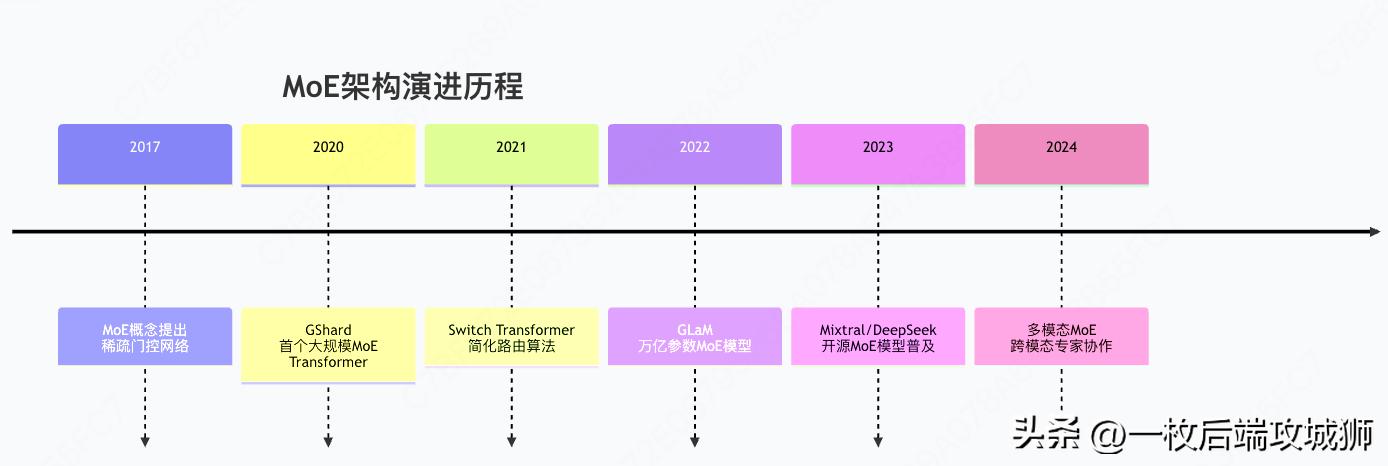
MoE架构的演进趋势
四、MoE实践指南与代码示例
完整的MoE Transformer实现
import torch
import torch.nn as nn
from transformers import GPT2Config, GPT2Model
class MoETransformerBlock(nn.Module):
    """MoE Transformer块"""
    def __init__(self, config, moe_config):
        super().__init__()
        self.config = config
        self.moe_config = moe_config

        # 自注意力层
        self.self_attention = nn.MultiheadAttention(
            config.n_embd, config.n_head, batch_first=True
        )
        self.attention_norm = nn.LayerNorm(config.n_embd)

        # MoE前馈层
        self.moe_ffn = MoEFeedForward(
            config.n_embd,
            config.n_embd * 4,  # 扩展维度
            moe_config.num_experts,
            moe_config.experts_used
        )
        self.ffn_norm = nn.LayerNorm(config.n_embd)

    def forward(self, x, attention_mask=None):
        # 自注意力
        residual = x
        x = self.attention_norm(x)
        attn_output, _ = self.self_attention(x, x, x, attn_mask=attention_mask)
        x = residual + attn_output

        # MoE前馈
        residual = x
        x = self.ffn_norm(x)
        ff_output, expert_usage = self.moe_ffn(x)
        x = residual + ff_output

        return x, expert_usage
class MoEFeedForward(nn.Module):
    """MoE前馈网络"""
    def __init__(self, d_model, d_ff, num_experts, experts_used):
        super().__init__()
        self.num_experts = num_experts
        self.experts_used = experts_used

        # 专家网络
        self.experts = nn.ModuleList([
            nn.Sequential(
                nn.Linear(d_model, d_ff),
                nn.GELU(),
                nn.Linear(d_ff, d_model)
            ) for _ in range(num_experts)
        ])

        # 门控网络
        self.gate = nn.Linear(d_model, num_experts)

        # 负载均衡统计
        self.register_buffer('expert_usage', torch.zeros(num_experts))

    def forward(self, x):
        batch_size, seq_len, d_model = x.shape

        # 门控计算
        gate_logits = self.gate(x)  # [batch_size, seq_len, num_experts]

        # 选择top-k专家
        topk_weights, topk_indices = torch.topk(
            gate_logits, self.experts_used, dim=-1
        )
        topk_weights = torch.softmax(topk_weights, dim=-1)

        # 初始化输出
        output = torch.zeros_like(x)

        # 更新专家使用统计
        expert_usage = torch.zeros(self.num_experts, device=x.device)

        # 对每个位置计算专家输出
        for i in range(self.experts_used):
            # 创建当前专家的mask
            expert_mask = topk_indices == i

            # 计算当前专家的输出
            expert_output = self.experts[i](x)

            # 加权累加
            weight = topk_weights[:, :, i:i+1]
            output += expert_output * weight * expert_mask.float()

            # 更新使用统计
            expert_usage[i] += expert_mask.sum().item()

        # 归一化使用统计
        expert_usage = expert_usage / (batch_size * seq_len)
        self.expert_usage = 0.9 * self.experty_usage + 0.1 * expert_usage

        return output, expert_usage
class MoEGPT2(nn.Module):
    """基于GPT2的MoE模型"""
    def __init__(self, config, moe_config):
        super().__init__()
        self.config = config
        self.moe_config = moe_config

        # 词嵌入
        self.wte = nn.Embedding(config.vocab_size, config.n_embd)
        self.wpe = nn.Embedding(config.n_positions, config.n_embd)

        # MoE Transformer层
        self.layers = nn.ModuleList([
            MoETransformerBlock(config, moe_config)
            for _ in range(config.n_layer)
        ])

        # 输出层
        self.ln_f = nn.LayerNorm(config.n_embd)
        self.head = nn.Linear(config.n_embd, config.vocab_size, bias=False)

    def forward(self, input_ids, attention_mask=None):
        batch_size, seq_len = input_ids.shape

        # 位置编码
        position_ids = torch.arange(seq_len, dtype=torch.long, device=input_ids.device)
        position_ids = position_ids.unsqueeze(0).expand(batch_size, -1)

        # 输入嵌入
        inputs_embeds = self.wte(input_ids)
        position_embeds = self.wpe(position_ids)
        hidden_states = inputs_embeds + position_embeds

        # 通过MoE层
        expert_usage_history = []
        for layer in self.layers:
            hidden_states, expert_usage = layer(hidden_states, attention_mask)
            expert_usage_history.append(expert_usage)

        # 输出投影
        hidden_states = self.ln_f(hidden_states)
        logits = self.head(hidden_states)

        return logits, expert_usage_history
# 配置示例
gpt2_config = GPT2Config(
    vocab_size=50257,
    n_embd=768,
    n_layer=12,
    n_head=12,
    n_positions=1024
)
moe_config = type('MoEConfig', (), {
    'num_experts': 8,
    'experts_used': 2
})()
# 创建MoE模型
model = MoEGPT2(gpt2_config, moe_config)
训练优化技巧
class MoETrainingOptimizer:
    """MoE模型训练优化"""

    def __init__(self, model, learning_rate=1e-4):
        self.model = model
        # 不同部分使用不同学习率
        self.optimizer = torch.optim.AdamW([
            {'params': model.wte.parameters(), 'lr': learning_rate},
            {'params': model.wpe.parameters(), 'lr': learning_rate},
            {'params': [p for n, p in model.named_parameters()
                       if 'experts' in n], 'lr': learning_rate * 2},
            {'params': [p for n, p in model.named_parameters()
                       if 'gate' in n], 'lr': learning_rate * 5},
        ])

    def load_balancing_loss(self, expert_usage_history):
        """计算负载均衡损失"""
        total_loss = 0
        for expert_usage in expert_usage_history:
            # 鼓励均匀使用专家
            usage_mean = expert_usage.mean()
            usage_std = expert_usage.std()
            balance_loss = usage_std / (usage_mean + 1e-6)
            total_loss += balance_loss

        return total_loss

    def training_step(self, batch, balance_weight=0.01):
        input_ids, labels = batch

        # 前向传播
        logits, expert_usage_history = self.model(input_ids)

        # 任务损失
        task_loss = F.cross_entropy(
            logits.view(-1, logits.size(-1)),
            labels.view(-1)
        )

        # 负载均衡损失
        balance_loss = self.load_balancing_loss(expert_usage_history)

        # 总损失
        total_loss = task_loss + balance_weight * balance_loss

        # 反向传播
        self.optimizer.zero_grad()
        total_loss.backward()
        self.optimizer.step()

        return {
            'total_loss': total_loss.item(),
            'task_loss': task_loss.item(),
            'balance_loss': balance_loss.item()
        }
总结:MoE架构的革命性意义
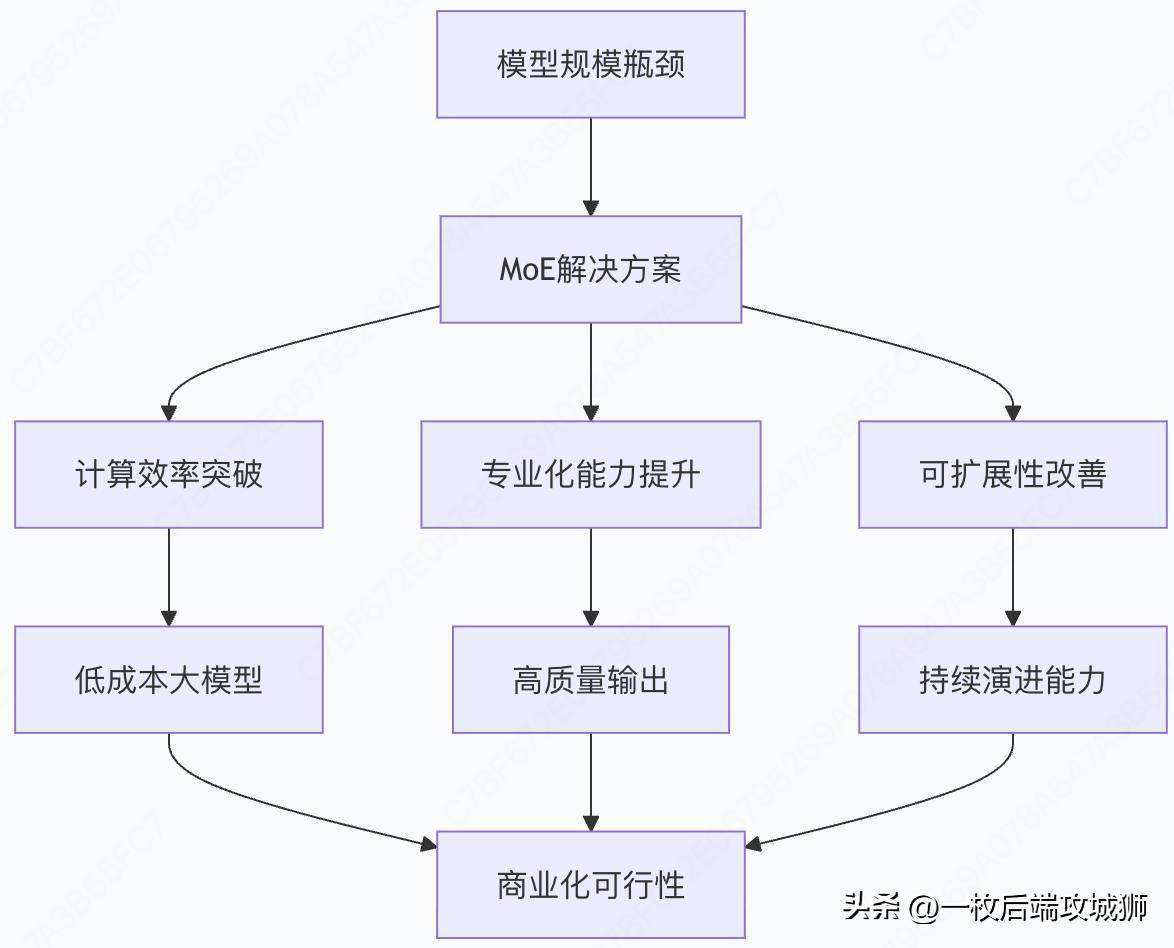
技术突破的核心价值
关键成功因素
- 稀疏激活:保持计算效率的同时大幅增加参数量
- 专家专业化:每个专家专注特定领域,提升整体能力
- 模块化设计:支持灵活扩展和更新
- 智能路由:动态选择最适合的专家组合
未来发展方向
- 更细粒度专家:从层级别到神经元级别的MoE
- 跨模态专家:处理文本、图像、音频的多模态MoE
- 动态专家数量:根据任务复杂度自动调整激活专家数
- 联邦MoE:分布式专家网络,保护数据隐私
实践建议
对于不同场景的MoE采用策略:
|
场景 |
建议 |
理由 |
|
研究实验 |
从小规模MoE开始(4-8专家) |
快速验证,调试路由机制 |
|
生产部署 |
选择成熟开源MoE(Mixtral) |
稳定性验证,社区支持 |
|
资源受限 |
高压缩比MoE(DeepSeek-MoE) |
平衡性能与成本 |
|
前沿探索 |
自定义MoE架构 |
针对特定任务优化 |
MoE架构不仅解决了大模型的规模扩展问题,更重要的是为AI系统提供了一种模块化、专业化、可演进的智能构建范式。这不仅是技术的进步,更是AI工程范式的革命,为构建真正通用、高效、可持续的人工智能系统奠定了坚实基础。





 扫一扫
扫一扫


 480
480

 被折叠的 条评论
为什么被折叠?
被折叠的 条评论
为什么被折叠?
 到【灌水乐园】发言





