



 本文介绍了一种基于Robert Sedgewick《算法》一书的1.1.31题目的解决方案,通过绘制圆周上的N个等距点,并以概率p随机连接这些点,生成随机的灰线网络。
该题目来源于Robert Sedgewick 的《算法》。
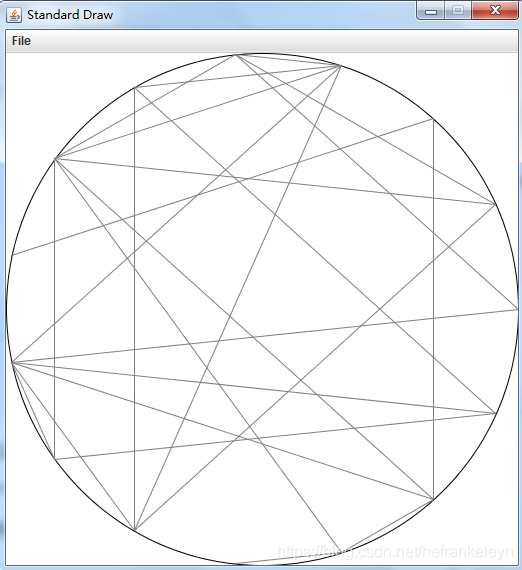
1.1.31 Random connections. Write a program that takes as command-line arguments an integer N and a double value p (between 0 and 1), plots N equally spaced dots of size .05 on the circumference of a circle,and then, with probability p for each pair of points, draws a gray line connecting them.
1.1.31 随机连接。写一个程序从命令行获取一个int类型的参数N和一个double类型的参数p(在0到1之间),在一个圆的圆周上
画出N个大小为0.05且间距相等的点,每对点相连的概率为p,用灰色的线连接它们。
思路:
1、根据“在一个圆周上画出N个大小为0.05且间距相等的点”,可以算出圆周的周长,进而算出圆周的半径:
// N个大小为0.05且间距相等的点,因此可以算出圆周的周长
double circumferenceLen = spaceSize * N;
// 圆周的半径
double radius = circumferenceLen / Math.PI / 2;
2、将一个圆平分成N分,分份的角度为:
// 将圆平分成N份,每一份的角度为
double angle = 360.0 / N;
3、圆上N个点的坐标,可以根据余弦和正弦公式算出:
for (int i = 0; i < N; i++) {
points[i] = new Point(radius + radius * Math.cos(i * angle * Math.PI / 180),
radius + radius * Math.sin(i * angle * Math.PI / 180));
}
4、然后利用StdDraw来画圆、画点、画线
5、使用StdRandom中的bernoulli方法来判断哪两对点可以相连
核心代码如下(详细代码在git上):
/**
 * exercise 1.1.31 的解决方案
 * @param spaceSize
 * @param N
 * @param p
 */
public static void randomConnectionSolution(double spaceSize, int N, double p) {
    // N个大小为0.05且间距相等的点,因此可以算出圆周的周长
    double circumferenceLen = spaceSize * N;
    // 圆周的半径
    double radius = circumferenceLen / Math.PI / 2;
    // 画出坐标系
    StdDraw.setXscale(0, radius * 2);
    StdDraw.setYscale(0, radius * 2);
    // 画一个以(radius,radius) 为圆心,以radius为半径的圆
    StdDraw.circle(radius, radius, radius);

    // 将圆平分成N份,每一份的角度为
    double angle = 360.0 / N;
    // 圆上N个点的坐标,放在一个对象数组中
    Point[] points = new Point[N];
    for (int i = 0; i < N; i++) {
        points[i] = new Point(radius + radius * Math.cos(i * angle * Math.PI / 180),
                radius + radius * Math.sin(i * angle * Math.PI / 180));
        System.out.println("radius:" + radius + "x: "+ Math.cos(i * angle * Math.PI / 180));
        // 在圆周上画点
        StdDraw.point(points[i].x, points[i].y);
    }
    // 遍历点,连接线,画点
    for (int i = 0; i < N-1; i++) {
        for (int j = i+1; j < N; j++) {
            if(StdRandom.bernoulli(p)){
                StdDraw.setPenColor(StdDraw.GRAY);
                StdDraw.line(points[i].x, points[i].y, points[j].x, points[j].y);
            }
        }
    }
}
运行之后,展示出来的结果如下:






 扫一扫
扫一扫


 595
595

 被折叠的 条评论
为什么被折叠?
被折叠的 条评论
为什么被折叠?
 到【灌水乐园】发言





