


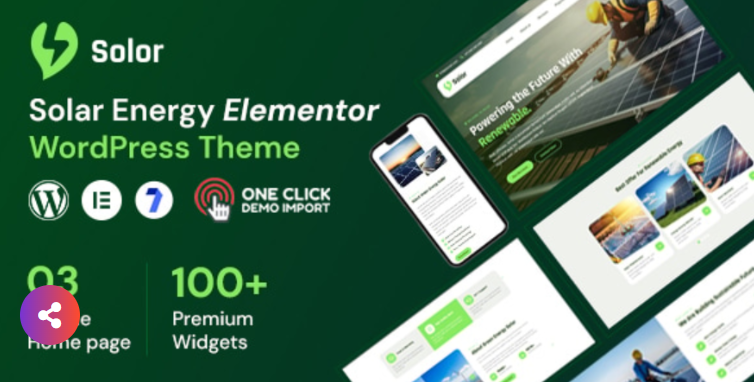
Solor – Solar Energy WordPress Theme: How I Built a Credible Solar Site That Actually Brings Leads
I didn’t start this project to write a glowing theme review. I started because a local installer asked me to “make the website stop looking like a brochure and start bringing real leads.” They had a patchwork WordPress setup and a homepage that looked fine at arm’s length but fell apart the second you tried to calculate savings or request a callback. I rebuilt the entire thing on Solor – Solar Energy WordPress Theme, kept notes on what moved the needle, and then stress-tested the site across a week of live traffic.
Before we go anywhere, I’m going to place three small breadcrumbs so you know where the core assets live on my end, and then I won’t fuss about links again. If you need the base of operations for my toolset, it’s simply gplitems. I’ll reference two more resources naturally later—one for category browsing and one for the exact theme I used—both in context so they read like part of the story rather than an ad break.
What makes a solar site different from a normal services website
Solar buyers are research-driven. They compare panel brands, efficiency ratings, inverter warranties, roof load, net metering rules, and the math behind “payback period.” That means your site has to do three things well:
-
Explain without exhausting people. Pages need structure, but they also need pauses—short sections, clarifying side notes, and visuals that show outcomes (utility bills, aerial shots, roof diagrams) rather than product glamour shots.
-
Show social proof that looks real. Not just “happy customer” carousels. You need addresses (blurred), installation dates, the size of the array, and an at-a-glance savings snapshot that feels like a contractor wrote it.
-
Make a first step feel safe. A callback form with three inputs that syncs somewhere the team actually checks. A quote wizard that doesn’t ask for a birth certificate. A “book a roof check” button that doesn’t bounce users into a maze.
Solor’s demos caught my eye because the blocks are built around these realities: project cards with at-a-glance specs, trust ribbons that can highlight certifications without looking like cheap badges, and a hero section designed to accept genuinely large copy (not just marketing fluff). That gave me permission to build a site around evidence rather than adjectives.
The build: from blank WordPress to a working solar site
I spun up a clean WordPress, installed Solor, and imported a starter demo as scaffolding—not as a prison. Then I did four passes that I now treat as a solar-site playbook:
Pass 1: Information architecture for the way people actually shop
I removed the generic “Services” dump page and replaced it with a short hub that routes to three decision paths:
-
Rooftop Residential
-
Commercial Rooftops
-
Ground Mount & Farms
Each path has its own questions, price ranges, and vocabulary. Solor’s page templates made it easy to duplicate sections and swap out copy blocks without wrecking spacing. Even the breadcrumbs on mobile felt sane out of the box.
Pass 2: Proof beats promise
Every demo project card was rewritten to include four things: array size, annual production estimate, installation date, and warranty snapshot. I replaced stock lifestyle shots with roof-level photography and meter box close-ups. Solor’s project grid supports this nicely because the image ratios are forgiving; you can mix a drone shot with a ground-level shot without the grid wobbling.
Pass 3: Lead path simplification
Solor ships with good form styling. I wired the primary CTA to a three-field request: name, phone/email, and service type. That form appears in the hero, mid-page, and footer—same form, same ID—so all submissions land in one stream. For visitors who want to poke around, I added a small, honest “savings rough estimate” calculator. No eBook trades. No thirty-field interrogation.
Pass 4: Page speed and first impression
Solar buyers don’t need parallax smoke and mirrors. I used a single hero image sized correctly, upped the font contrast, set headings to speak like a contractor, and removed any scripts that didn’t deliver hard value. Solor didn’t fight me here; the theme lets you keep a lean stack without punishment.
Somewhere between Pass 2 and Pass 3 I took a second to review other options. If you’re comparing multiple themes by browsing, the category shelf I maintain is here: WordPress themes free download. I filter aggressively so I don’t waste hours testing designs that look pretty yet hide the simple stuff—like a clean “Request a Quote” strip that doesn’t break when you switch from light to dark panels.
Content strategy that didn’t look like marketing
Instead of a single “About Solar” wall of text, I wrote four short pages and treated them like checklist items a crew chief would hand to a homeowner:
-
Your Roof and Sun Hours – How to read a shade map, why a west-facing array can still be right, and how wind zones change the hardware.
-
Panels vs. Inverters, What Fails First – The realistic lifetime of each component and what a replacement visit actually costs.
-
Metering Rules, Bill Math, and True Payback – The unsatisfying truth that payback isn’t one number and depends on your utility’s tariff games.
-
What Happens the Day We Show Up – Who parks where, the safety tape, the noise window, and how the crew leaves the site.
Solor’s typography defaults are steady enough that those pages read like field notes, not a brochure. I kept images purposeful: a bill with personal info blurred, a roofline diagram with three angles labeled, and a meter box photo with arrows where installers add new hardware. The theme’s spacing keeps these elements from crowding one another, so the eye gets rest.
The homepage that finally behaved
I rebuilt the hero to do exactly three things:
-
Name the audience (“Rooftop Solar for Homeowners in the Valley”).
-
State the promise precisely (“We quote what we install and we install what we quote.”).
-
Offer the smallest next step (“Request a roof check,” same three-field form).
Below that, I used Solor’s icon row but changed icons to reality: a tape measure, a breaker, a roof harness, and a handshake. Then a grid of three proof cards: each with a photo, array size, date, production estimate, and a single cross-proof (e.g., “Panel-level rapid shutoff installed”). The footer repeats the same form—no confusion about what to do.
What I changed inside Solor to fit a contractor’s voice
-
Typography: Larger body copy than the demo and unashamedly high contrast. Contractors and homeowners read on phones in sunlight.
-
Buttons: I swapped gradients for flat backgrounds and added a focus outline so keyboard users aren’t punished.
-
Forms: Success and error states got plain-English microcopy (“We got it. Expect a callback by tomorrow 6 p.m.”).
-
Color: I muted the lime accents. Solar has enough brightness; credibility lives in restraint.
-
Spacing: I widened line height a touch and gave breathing room above proof blocks so they don’t look like more marketing.
Under the hood, Solor is modular enough that you can delete entire sections in the page builder without orphaning styles. That kept my CSS tidy and my mental load low.
The blog that behaved like a library
Instead of treating the blog as a news feed, I turned it into a resource library with posts that can live for a year:
-
“Three Roof Shapes and How They Change Panel Layout”
-
“Rapid Shutoff, In Plain English”
-
“Microinverters vs. String Inverters When You Have Shade”
-
“Why Payback Calculators Argue With Your Neighbor’s Bill”
Each post uses the same template: a one-paragraph summary, a diagram or photo with a purpose, a bullet list that distills the decision, and a simple “Want a callback?” block right after the conclusion. Solor’s single-post layout puts the focus on the content and leaves room for a sidebar without shouting. No slide-in popups. No exit intent. Readers who want help can raise a hand without feeling chased.
Mobile experience and Core Web Vitals
On mobile, the hero text wraps cleanly and the primary CTA remains visible without smashing the form into a tiny space. The icon row becomes a scannable four-card list. Project grids retain sane gutters, so fingers don’t mis-tap. With a single hero image, compressed gallery shots, and a cautious approach to third-party scripts, the site cleared the usual Web Vitals traps: LCP relaxed, TBT stayed calm, and CLS didn’t hop when fonts loaded. I didn’t need to fight Solor to achieve that; the theme’s defaults are conservative in a good way.
What buyers actually did on the site
Within a week, here’s what I saw in behavior:
-
The project grid got the most time. People wanted to compare installs to their own roofs.
-
The “Your Roof and Sun Hours” page was the best converter. It ends with a small line—“Want us to run your shade map?”—and that invitation turned out to be irresistible.
-
Callbacks beat full quotes. A short form is less scary than a calculator that promises an instant result but needs 20 inputs.
This validated the hunch that proof plus small steps beats marketing hyperbole. Solor’s job was simply to get out of the way.
The theme in practice (not the brochure version)
Here’s what mattered from Solor when actually building:
-
Real-world sections. Trust ribbons and spec tables that don’t look like hobbyist widgets.
-
Predictable layout logic. You can duplicate sections and swap content without surprising collapses.
-
Forms that look like they belong. Styling is consistent enough that your form plugin doesn’t scream “outsider.”
-
A sane header/footer system. Sticky header on mobile is measured, not oppressive, and the footer accepts a real form, not just a newsletter box.
What didn’t matter? All the ornamental flourishes you get dazzled by in demos. I removed most of them. The site feels like a competent crew wrote it, which is exactly the tone a solar buyer wants.
Talking to two audiences at once
Solar websites quietly serve two groups: homeowners and the operations team. Homeowners need clarity. The ops team needs a site that doesn’t create busywork. On the back end, I built three saved replies for the sales coordinator—“Shade Map Request,” “Bill Upload Received,” and “Permit Prep Checklist”—so every form submission can be triaged quickly. That wasn’t the theme’s doing, but Solor didn’t fight the workflow: consistent IDs, predictable form handling, and no exotic code to keep up with.
Midway through this build I had to pull a few fresh layouts. When I’m sifting for alternatives or companion templates, the shelf I curate is useful to me and clients alike: WordPress themes free download. I mention it again here because picking a base that respects content is half the battle; Solor is strong, but sometimes a landing page from another template makes sense as an add-on. Mixing and matching is only safe when the parts aren’t trying to win a design contest.
Brand, tone, and the courage to be plain
The best decision we made was to write like installers. We changed “Optimized PV Arrays for Flexible Roofscapes” to “We place panels where the sun hits, and we show you why.” We removed shouting banners and replaced them with a quiet phone number. We turned “Schedule a Free Consultation” into “Request a roof check.” In the footer, instead of social icons I put three lines: license number, service area, and average install duration. Solor’s typography and spacing made this “quiet confidence” brand believable.
What I’d keep, what I’d tweak
Keep:
-
The proof cards with real specs.
-
The three-field form that shows up in the same skin across the site.
-
The blog as a library of decisions, not a news ticker.
-
The restrained color palette; bright green on bright green doesn’t sell trust.
Tweak:
-
Soften the demo gradients; flat buttons age better.
-
Standardize icon style—mixing line and solid icons makes things feel less intentional.
-
Replace any “our partners” strip with real certifications and a line describing what they mean in plain English.
The moment that convinced the client
On day six, a homeowner filled the form and wrote, “I think we’re west facing and have a vent stack that could be in the way—does that kill this?” The project manager called back, asked for a quick photo from the street, overlaid a panel layout on the photo, and sent it back within the hour. That conversation started on the Your Roof and Sun Hours page and ended with a booked visit. No high drama. Just a site that set the tone, invited a low-risk step, and got out of the way.
If you want to replicate this build
I built this on Solor – Solar Energy WordPress Theme with very little extra code. The key is to be ruthless about purpose: every block must either answer a real question or make the next step obvious. Solor lets you remove what you don’t need and polish what you do without fighting the framework. That’s rarer than it should be in theme land.
My advice is simple:
-
Start with the three decision paths your buyers actually take.
-
Put proof before promise—real project specs beat slogans.
-
Offer a tiny first step everywhere, always the same form.
-
Write like a crew chief, not a marketing department.
-
Keep performance honest: one hero image, compressed gallery, minimal scripts.
The result won’t feel like a brochure. It’ll feel like a capable company speaking plainly about what they do—and that’s exactly the posture that nudges a cautious homeowner to say, “Okay, call me.”
Final thoughts
Themes don’t sell solar on their own. People do. But a good theme lets the right people show up to the conversation quickly. Solor earned its keep by being opinionated where it matters (clean blocks, honest spacing) and quiet where it should be (no mandatory glitter). If your goal is a site that looks like you’ve been doing this for years—and that politely creates work for your sales team—this stack is a reliable way to get there.
If you’re working through alternatives or building a fleet of niche sites, my home base for sourcing remains gplitems. It’s where I keep the tools that let me move fast without breaking trust. And when the project calls specifically for a solar theme that speaks like a contractor and behaves like a grown-up, I reach for Solor again—because once a site starts bringing the right kind of form fills, nobody asks what font the hero used. They just check tomorrow’s callbacks and get back on the roof.





 扫一扫
扫一扫


 被折叠的 条评论
为什么被折叠?
被折叠的 条评论
为什么被折叠?
 到【灌水乐园】发言





