



 本文详细介绍了Protobuf的Reflection类,特别是GeneratedMessageReflection的内部实现和应用。Reflection接口提供了动态访问和修改message字段的方法,而GeneratedMessageReflection是针对特定descriptor的实现。内容包括Reflection的内存管理和操作流程,以及在read和write操作中的工作原理。此外,还探讨了内存分布和不同类型的field如何存储。
类Reflection
接口类,提供方法来动态访问/修改message中的field的接口类。调用Message::GetReflection()获得messge对应的reflection。
这个类没有放到Message类中,是从效率角度考虑的。因为绝大多数message的实现共用同一套Reflection(GeneratedMessageReflection),并且一个Message所有的object是共享同一个reflection object的。
注意:
- 针对所有不同的field类型
FieldDescriptor::TYPE_*,需要使用不同的Get*()/Set*()/Add*()接口; - repeated类型需要使用
GetRepeated*()/SetRepeated*()接口,不可以和非repeated类型接口混用; - message对象只可以被由它自身的
reflection(message.GetReflection())来操作;
那么为什么需要针对每种FieldDescriptor::TYPE_*有单独的Get*()/Set*()呢?
因为如果使用抽象的type来解决,需要增加一层处理,这会导致message占用内存变大,也增加了内存泄漏的风险,所以在用这种flat的接口设计。
类GeneratedMessageReflection
类Reflection的子类(也是当前版本中唯一的子类),服务于某一个固定的descriptor(构造GeneratedMessageReflection对象时就确定了对应的descriptor)。反射机制中最为核心的类。
内部实现:
操作任何一个数据时,需要知道2个信息即可:
- 内存地址;
- 类型信息;
GeneratedMessageReflection也是这样设计的。GeneratedMessageReflection通过base_addr + $offset[i] 的方式管理message所有的field,$offset[i]记录了message中每个field在message内存对象中的偏移,并且descriptor中有每个field的类型信息。
需要针对某个(message, field)做处理的时候:
- 直接通过descriptor获取对应field在message中的index
- 再查询offset[$index]获取内存地址
- 然后通过descriptor中type信息
- 做reinterpret_cast就获得对应数据。
构建GeneratedMessageReflection对象时,传入的核心数据是:
- descriptor:被管理的message的descriptor指针;
- offsets:message类的所有成员在message类内存对象的偏移;
has_bits_offset: 用于”记录某个field是否存在的bitmap”的偏移(这个bitmap是message子类内部成员,其实是取这个数组0元素_has_bits_[0]的偏移),这个bitmap最终是用来判断optional类型的field是否存在;unknown_fields_offset: 和has_bits_offset功能类似,用于记录unkown数据;
field有不同的类型,所以需要将
void*转化为相应的类型。
- 对于primitive类型和string类型,直接使用对应primitive类型/string*表示;
- 单个Message类型field,通过Message的指针来保存;
- Enum类型field,通过int来保存,这个int作为EnumDescriptor::FindValueByNumber()的输入;
- Repeated类型field(细节见《repeated字段》一章):
- 其中Strings/Message类型使用RepeatedPtrFields
- 其它primitive类型使用RepeatedFields
应用举例:
在每个.pb.cc文件中,对应每个message都有对应的GeneratedMessageReflection对象。例如针对protobuf/compiler/plugin.proto文件中的message CodeGeneratorRequest,在protobuf/compiler/plugin.pb.cc中:
    namespace {

    const ::google::protobuf::Descriptor* CodeGeneratorRequest_descriptor_ = NULL;
    const ::google::protobuf::internal::GeneratedMessageReflection*
      CodeGeneratorRequest_reflection_ = NULL;

    …… //省略

    }  // namespace

    …… //省略

    void protobuf_AssignDesc_google_2fprotobuf_2fcompiler_2fplugin_2eproto() {

    …… //省略

      // CodeGeneratorRequest包含这3个field
       static const int CodeGeneratorRequest_offsets_[3] = {
        GOOGLE_PROTOBUF_GENERATED_MESSAGE_FIELD_OFFSET(CodeGeneratorRequest, file_to_generate_),
        GOOGLE_PROTOBUF_GENERATED_MESSAGE_FIELD_OFFSET(CodeGeneratorRequest, parameter_),
        GOOGLE_PROTOBUF_GENERATED_MESSAGE_FIELD_OFFSET(CodeGeneratorRequest, proto_file_),
      };

      CodeGeneratorRequest_reflection_ =
        new ::google::protobuf::internal::GeneratedMessageReflection(
          CodeGeneratorRequest_descriptor_,
          CodeGeneratorRequest::default_instance_,
          CodeGeneratorRequest_offsets_,
          GOOGLE_PROTOBUF_GENERATED_MESSAGE_FIELD_OFFSET(CodeGeneratorRequest, _has_bits_[0]),
          GOOGLE_PROTOBUF_GENERATED_MESSAGE_FIELD_OFFSET(CodeGeneratorRequest, _unknown_fields_),
          -1,
          ::google::protobuf::DescriptorPool::generated_pool(),
          ::google::protobuf::MessageFactory::generated_factory(),
          sizeof(CodeGeneratorRequest));

    …… //省略

}GOOGLE_PROTOBUF_GENERATED_MESSAGE_FIELD_OFFSET宏
GOOGLE_PROTOBUF_GENERATED_MESSAGE_FIELD_OFFSET宏作用是找到某个field在所被包含type内存的offset
Q:pb.h定义中,field都是message子类的private成员,这里为什么可以通过”->”访问private成员呢?
A: 函数
protobuf_AssignDesc_google_2fprotobuf_2fcompiler_2fplugin_2eproto()被定义为各个message子类的friend(定义在private部分)
这里代码注释给了很多信息!protobuf针对关键点的注释非常详细,值得学习!
    // Returns the offset of the given field within the given aggregate type.
    // This is equivalent to the ANSI C offsetof() macro.  However, according
    // to the C++ standard, offsetof() only works on POD types, and GCC
    // enforces this requirement with a warning.  In practice, this rule is
    // unnecessarily strict; there is probably no compiler or platform on
    // which the offsets of the direct fields of a class are non-constant.
    // Fields inherited from superclasses *can* have non-constant offsets,
    // but that's not what this macro will be used for.
    //
    // Note that we calculate relative to the pointer value 16 here since if we
    // just use zero, GCC complains about dereferencing a NULL pointer.  We
    // choose 16 rather than some other number just in case the compiler would
    // be confused by an unaligned pointer.
    #define GOOGLE_PROTOBUF_GENERATED_MESSAGE_FIELD_OFFSET(TYPE, FIELD)    \
      static_cast<int>(                                           \
        reinterpret_cast<const char*>(                            \
          &reinterpret_cast<const TYPE*>(16)->FIELD) -            \
        reinterpret_cast<const char*>(16))
举例说明
以primitive类型为例说明GeneratedMessageReflection如何管理各个不同类型的field。
在read一侧:
            // Template implementations of basic accessors.  Inline because each
            // template instance is only called from one location.  These are
            // used for all types except messages.
            template <typename Type>
            inline const Type& GeneratedMessageReflection::GetField(
                const Message& message, const FieldDescriptor* field) const {
              return GetRaw<Type>(message, field);
            }
从message内存起始地址,按照field在message对象内存中的offset偏移之后获取field的内存地址,然后reinterpret_cast为Type类型(primitive的)
            // These simple template accessors obtain pointers (or references) to
            // the given field.
            template <typename Type>
            inline const Type& GeneratedMessageReflection::GetRaw(
                const Message& message, const FieldDescriptor* field) const {
              const void* ptr = reinterpret_cast<const uint8*>(&message) +
                                offsets_[field->index()];
              return *reinterpret_cast<const Type*>(ptr);
            }
这里的offsets_[]就是构造函数GeneratedMessageReflection::GeneratedMessageReflection()传入的,各个field在message中的偏移量数组(也就是上面例子中的 CodeGeneratorRequest_offsets_[3])。field->index()是field在parent的children数组中的pos,实现如下:
            inline int FieldDescriptor::index() const {
                ...... //省略
                return this - containing_type_->fields_;
                ...... //省略
}
在write一侧:
        template <typename Type>
        inline void GeneratedMessageReflection::SetField(
            Message* message, const FieldDescriptor* field, const Type& value) const {
          *MutableRaw<Type>(message, field) = value;
          SetBit(message, field);
       }

        template <typename Type>
        inline Type* GeneratedMessageReflection::MutableRaw(
            Message* message, const FieldDescriptor* field) const {
          void* ptr = reinterpret_cast<uint8*>(message) + offsets_[field->index()];
          return reinterpret_cast<Type*>(ptr);
        }
这里has_bits_offset_为bitmap结构,通过某个bit是否存在,快速判断对应filed是否存在
        inline void GeneratedMessageReflection::SetBit(
            Message* message, const FieldDescriptor* field) const {
          MutableHasBits(message)[field->index() / 32] |= (1 << (field->index() % 32));
        }

        inline uint32* GeneratedMessageReflection::MutableHasBits(
            Message* message) const {
          void* ptr = reinterpret_cast<uint8*>(message) + has_bits_offset_;
          return reinterpret_cast<uint32*>(ptr);
        }
RepeatedPtrFields / RepeatedFields具体实现,见repeated_field.*文件,详情见《repeated字段》一章
内存分布说明
举一个具体的例子来说明offset[]的工作方式吧:
- 从message Student定义到对应class Student
- 再到offset以及Student类对象内存分布说明,请见下图:
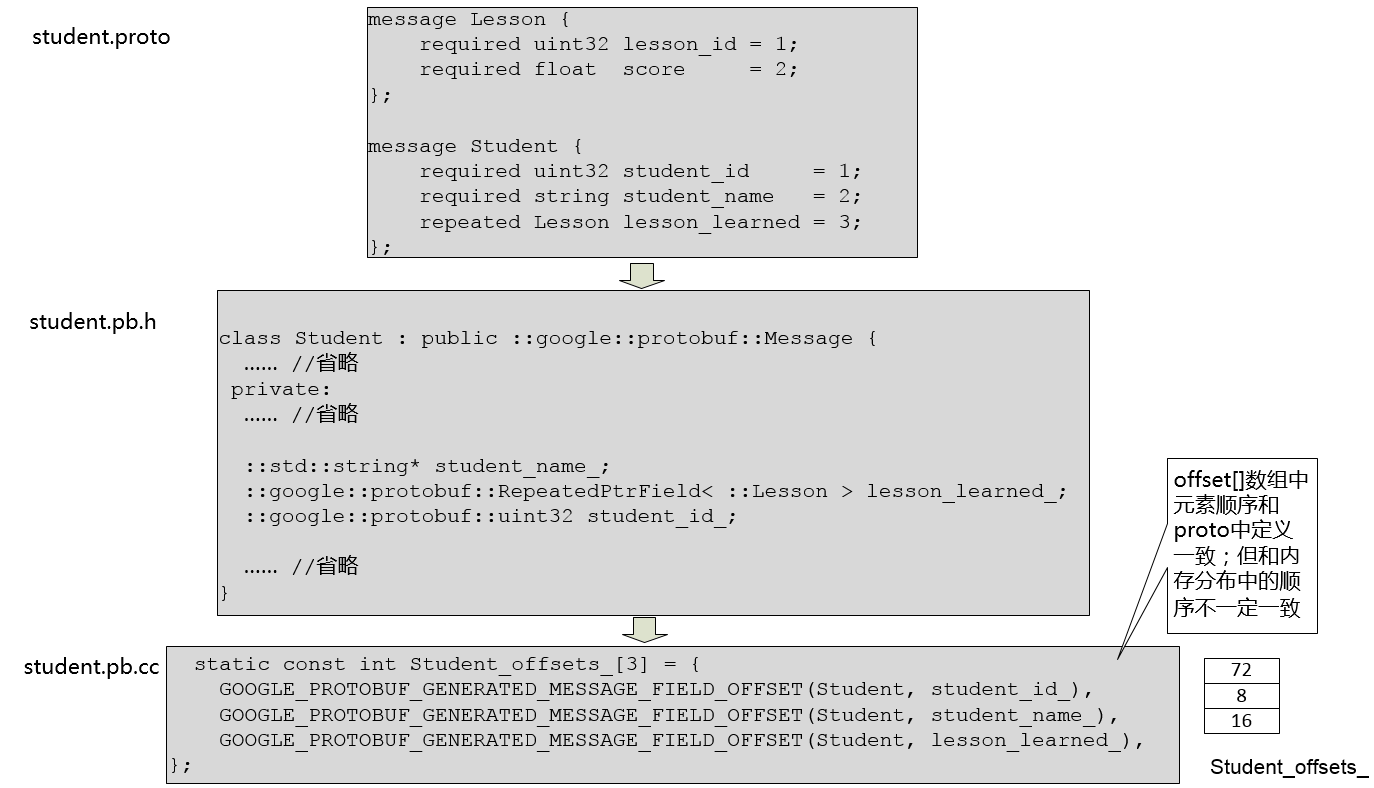
Message类对象内存分布
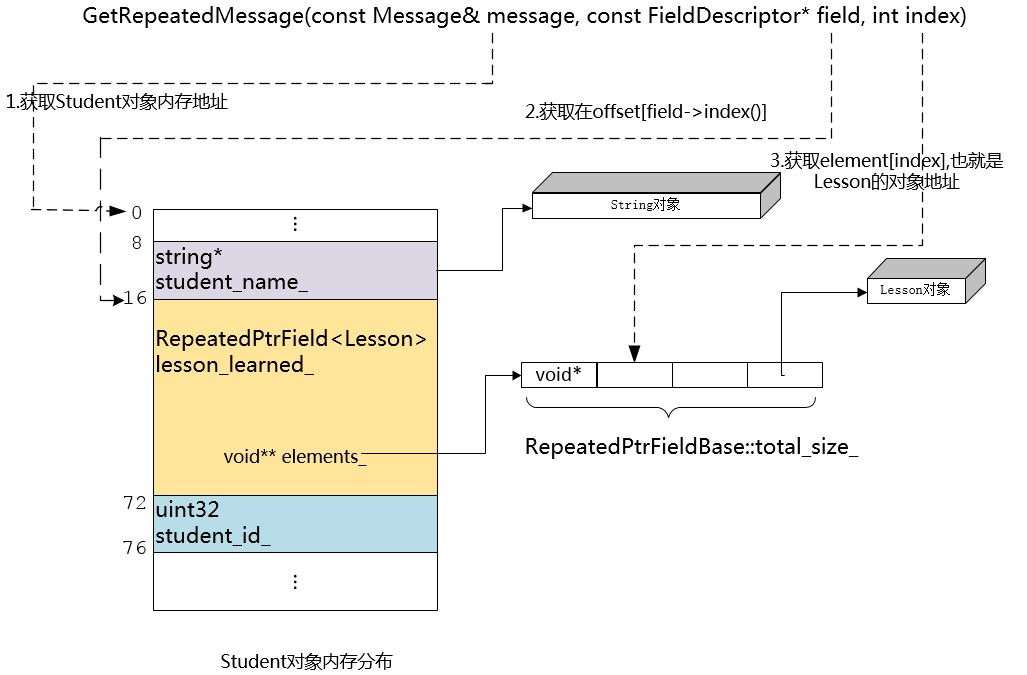
针对不同类型,有不同的内存记录方式:
- primitve类型:直接在内存中保存了对应的value;
- string类型,保存的是string*地址;
repeated<message>类型,保存的是RepeatedPtrField<message>对象,采用2级内存管理,第一级内部数据管理的是array<void*>,void*是真实message对象内存地址repeated<primitive>类型,保存的是RepeatedField<primitive>对象,内部数据管理的是array<primitive数据对象>
Student类中包含了多种类型成员,对应内存查找过程如下图所示:





 扫一扫
扫一扫


 316
316

 被折叠的 条评论
为什么被折叠?
被折叠的 条评论
为什么被折叠?
 到【灌水乐园】发言





