



 本文介绍了剑指Offer中链表反转的经典解法,通过双指针pre和cur,仅需一次遍历即可完成链表的反转,避免了使用栈的空间复杂度。此方法巧妙地调整了链表节点的next指向,确保新链表正确生成。
反转链表是一个很常见的面试题,一般来说,可以借助栈做反转,利用栈先进后出的特点,反转很容易理解,今天要介绍的是剑指Offer名企面试上的一种做法。这种做法是使用两个指针pre,cur,两者相差1个节点的位置,当我们遍历的时候,就把原来next的关系给调转一下,cur.next=pre。这样当链表头部遍历到尾部的时候,新的链表就诞生了,而且链表的关系也切换了。主要的代码如下:
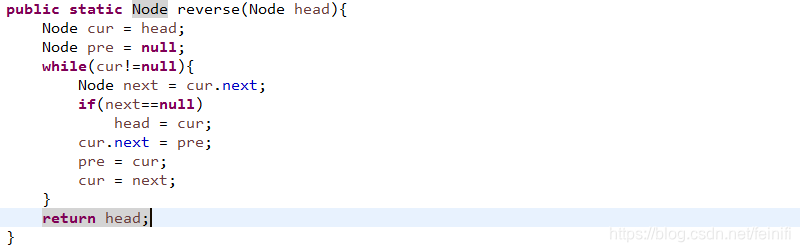
这个做法很精妙,一次遍历就可以搞定,就是需要把握头结点的位置,以及每个节点的next关系。不能简单的将next修改,否则容易形成一个环形链表。
完整代码:
package com.xxx.algorithm.sort;
import java.util.Stack;
public class LinkedListReverse {

	public static Node reverseLinkedList(Node head){
		Stack<Node> stack = new Stack<Node>();
		while(head!=null){
			stack.push(head);
			head = head.next;
		}
		if(!stack.isEmpty())
			head = stack.pop();
		Node cur = head;
		while(!stack.isEmpty()){
			Node node = stack.pop();
			node.next = null;
			cur.next = node;
			cur = node;
		}
		return head;
	}

	public static Node reverse(Node head){
		Node cur = head;
		Node pre = null;
		while(cur!=null){
			Node next = cur.next;
			if(next==null)
				head = cur;
			cur.next = pre;
			pre = cur;
			cur = next;
		}
		return head;
	}

	public static void display(Node head){
		System.out.print("list:");
		Node cur = head;
		while(cur!=null){
			System.out.print(cur+"->");
			cur = cur.next;
		}
		System.out.println();
	}

	public static void main(String[] args) {
		Node a = new Node("a");
		Node b = new Node("b");
		Node c = new Node("c");
		Node d = new Node("d");
		Node e = new Node("e");
		Node f = new Node("f");
		Node g = new Node("g");
		a.next = b;
		b.next = c;
		c.next = d;
		d.next = e;
		e.next = f;
		f.next = g;
		System.out.println("原始链表:");
		display(a);
		Node head = reverse(a);
		System.out.println("反转之后的链表:");
		display(head);
	}
}

class Node{
	String val;
	Node next;
	public Node(String val) {
		this.val = val;
	}
	@Override
	public String toString() {
		return "Node("+this.val+")";
	}
}
运行之后,打印信息如下所示:
原始链表:
list:Node(a)->Node(b)->Node(c)->Node(d)->Node(e)->Node(f)->Node(g)->
反转之后的链表:
list:Node(g)->Node(f)->Node(e)->Node(d)->Node(c)->Node(b)->Node(a)->
这就是剑指Offer面试题16的解决办法的Java实现。





 扫一扫
扫一扫


 389
389

 被折叠的 条评论
为什么被折叠?
被折叠的 条评论
为什么被折叠?
 到【灌水乐园】发言





