# Ultralytics YOLO 🚀, AGPL-3.0 license
import json
import random
from collections import defaultdict
from itertools import repeat
from multiprocessing.pool import ThreadPool
from pathlib import Path
import cv2
import numpy as np
import torch
from PIL import Image
from torch.utils.data import ConcatDataset
from ultralytics.utils import LOCAL_RANK, NUM_THREADS, TQDM, colorstr
from ultralytics.utils.ops import resample_segments
from ultralytics.utils.torch_utils import TORCHVISION_0_18
from .augment import (
Compose,
Format,
LetterBox,
RandomLoadText,
classify_augmentations,
classify_transforms,
v8_transforms,
)
from .base import BaseDataset
from .utils import (
HELP_URL,
LOGGER,
get_hash,
img2label_paths,
load_dataset_cache_file,
save_dataset_cache_file,
verify_image,
verify_image_label,
)
# Ultralytics dataset *.cache version, >= 1.0.0 for YOLOv8
DATASET_CACHE_VERSION = "1.0.3"
# 修复点1: 添加完整的Instances类定义(包含convert_bbox和denormalize方法)
class Instances:
"""Instances class for handling bounding boxes, segments, and keypoints in object detection."""
def __init__(self, bboxes, segments=None, keypoints=None, bbox_format="xywh", normalized=True):
"""
Initialize Instances.
Args:
bboxes (np.ndarray): Bounding boxes array
segments (np.ndarray, optional): Segmentation masks
keypoints (np.ndarray, optional): Keypoints
bbox_format (str): Bounding box format ('xywh', 'xyxy', etc.)
normalized (bool): Whether coordinates are normalized
"""
self.bboxes = bboxes
self.segments = segments
self.keypoints = keypoints
self.bbox_format = bbox_format
self.normalized = normalized
self.cls = None # 添加cls属性占位
def __len__(self):
"""Return the number of instances."""
return len(self.bboxes)
@classmethod
def empty(cls):
"""Return an empty Instances object."""
return cls(np.zeros((0, 4), dtype=np.float32))
@classmethod
def cat(cls, instances_list):
"""Concatenate multiple Instances objects into one."""
bboxes = np.concatenate([inst.bboxes for inst in instances_list], axis=0)
segments = np.concatenate([inst.segments for inst in instances_list], axis=0) if instances_list[0].segments is not None else None
keypoints = np.concatenate([inst.keypoints for inst in instances_list], axis=0) if instances_list[0].keypoints is not None else None
return cls(bboxes, segments, keypoints, bbox_format=instances_list[0].bbox_format, normalized=instances_list[0].normalized)
def convert_bbox(self, format):
"""Convert bounding box format.
Args:
format (str): Target format, either 'xyxy' or 'xywh'.
"""
if self.bbox_format == format:
return
if self.bbox_format == "xywh" and format == "xyxy":
# Convert from xywh to xyxy
x, y, w, h = self.bboxes.T
xyxy = np.array([x - w/2, y - h/2, x + w/2, y + h/2]).T
self.bboxes = xyxy
self.bbox_format = "xyxy"
elif self.bbox_format == "xyxy" and format == "xywh":
# Convert from xyxy to xywh
x1, y1, x2, y2 = self.bboxes.T
xywh = np.array([(x1+x2)/2, (y1+y2)/2, x2-x1, y2-y1]).T
self.bboxes = xywh
self.bbox_format = "xywh"
else:
raise ValueError(f"Conversion from {self.bbox_format} to {format} not supported")
# 添加缺失的denormalize方法
def denormalize(self, w, h):
"""
Denormalize bounding boxes from normalized coordinates to pixel coordinates.
Args:
w (int): Image width
h (int): Image height
"""
if not self.normalized:
return
if self.bboxes is not None and len(self.bboxes) > 0:
if self.bbox_format == "xywh":
# Denormalize xywh format
self.bboxes[:, 0] *= w
self.bboxes[:, 1] *= h
self.bboxes[:, 2] *= w
self.bboxes[:, 3] *= h
elif self.bbox_format == "xyxy":
# Denormalize xyxy format
self.bboxes[:, [0, 2]] *= w
self.bboxes[:, [1, 3]] *= h
# 处理segments(如果存在)
if self.segments is not None and len(self.segments) > 0:
# segments shape: (n, num_points, 2)
self.segments[..., 0] *= w
self.segments[..., 1] *= h
# 处理keypoints(如果存在)
if self.keypoints is not None and len(self.keypoints) > 0:
# keypoints shape: (n, num_keypoints, 2 or 3)
self.keypoints[..., 0] *= w
self.keypoints[..., 1] *= h
self.normalized = False
class Mosaic:
"""Mosaic data augmentation for object detection datasets.
This class combines 4 images into a single mosaic image, adjusting labels accordingly.
"""
def __init__(self, dataset, imgsz=640, p=0.5, border=[-320, -320]):
"""
Initialize Mosaic augmentation.
Args:
dataset (YOLODataset): The dataset object
imgsz (int): Output image size (height and width)
p (float): Probability of applying mosaic augmentation
border (list): Border values for random center placement
"""
self.dataset = dataset
self.imgsz = imgsz
self.p = p
self.border = border
self.mosaic_border = [-imgsz // 2, -imgsz // 2]
def __call__(self, data):
"""Apply mosaic augmentation to a batch of data."""
# Only apply mosaic with given probability
if random.random() > self.p:
return data
# Check if data contains necessary components
if 'img' not in data or 'instances' not in data:
return data
# Get current image and instances
img = data['img']
instances = data['instances']
h0, w0 = img.shape[:2] # original height and width
# Create mosaic image
mosaic_img = np.full((self.imgsz * 2, self.imgsz * 2, img.shape[2]), 114, dtype=np.uint8)
# Random center placement
yc, xc = [int(random.uniform(-x, 2 * self.imgsz + x)) for x in self.mosaic_border]
# Get 3 additional random indices
indices = [random.randint(0, len(self.dataset) - 1) for _ in range(3)]
mosaic_instances = []
# Place 4 images in mosaic
for i, index in enumerate([0] + indices):
if i == 0: # current image
img_i, instances_i = img, instances
else:
# Get other image and instances from dataset
data_i = self.dataset[index]
img_i = data_i['img']
instances_i = data_i['instances']
# Resize image
r = self.imgsz / max(img_i.shape[:2])
img_i = cv2.resize(img_i, (int(w0 * r), int(h0 * r)),
interpolation=cv2.INTER_LINEAR)
h, w = img_i.shape[:2]
# Place image in mosaic
if i == 0: # top left
x1a, y1a, x2a, y2a = max(xc - w, 0), max(yc - h, 0), xc, yc
x1b, y1b, x2b, y2b = w - (x2a - x1a), h - (y2a - y1a), w, h
elif i == 1: # top right
x1a, y1a, x2a, y2a = xc, max(yc - h, 0), min(xc + w, self.imgsz * 2), yc
x1b, y1b, x2b, y2b = 0, h - (y2a - y1a), min(w, x2a - x1a), h
elif i == 2: # bottom left
x1a, y1a, x2a, y2a = max(xc - w, 0), yc, xc, min(self.imgsz * 2, yc + h)
x1b, y1b, x2b, y2b = w - (x2a - x1a), 0, w, min(h, y2a - y1a)
elif i == 3: # bottom right
x1a, y1a, x2a, y2a = xc, yc, min(xc + w, self.imgsz * 2), min(self.imgsz * 2, yc + h)
x1b, y1b, x2b, y2b = 0, 0, min(w, x2a - x1a), min(h, y2a - y1a)
# Place image segment in mosaic
mosaic_img[y1a:y2a, x1a:x2a] = img_i[y1b:y2b, x1b:x2b]
padw, padh = x1a - x1b, y1a - y1b
# Adjust instances if they exist
if instances_i is not None and len(instances_i) > 0:
# 确保使用xyxy格式进行处理
if instances_i.bbox_format != "xyxy":
instances_i.convert_bbox("xyxy")
# 修复点2: 使用copy()代替clone()处理NumPy数组
bboxes_copy = instances_i.bboxes.copy()
segments_copy = instances_i.segments.copy() if instances_i.segments is not None else None
keypoints_copy = instances_i.keypoints.copy() if instances_i.keypoints is not None else None
# Create a copy of instances to avoid modifying original
new_instances = Instances(
bboxes_copy,
segments_copy,
keypoints_copy,
bbox_format=instances_i.bbox_format,
normalized=instances_i.normalized
)
# Adjust bboxes
if new_instances.bboxes is not None and len(new_instances.bboxes) > 0:
bboxes = new_instances.bboxes
if new_instances.normalized:
# Convert normalized coordinates to pixels
bboxes[:, [0, 2]] = bboxes[:, [0, 2]] * w
bboxes[:, [1, 3]] = bboxes[:, [1, 3]] * h
# Adjust coordinates
bboxes[:, [0, 2]] = bboxes[:, [0, 2]] * r + padw
bboxes[:, [1, 3]] = bboxes[:, [1, 3]] * r + padh
# Convert back to normalized coordinates
bboxes[:, [0, 2]] = bboxes[:, [0, 2]] / (self.imgsz * 2)
bboxes[:, [1, 3]] = bboxes[:, [1, 3]] / (self.imgsz * 2)
# Filter boxes that are completely outside the mosaic
valid = (
(bboxes[:, 0] < 1) & (bboxes[:, 1] < 1) &
(bboxes[:, 2] > 0) & (bboxes[:, 3] > 0))
new_instances.bboxes = bboxes[valid]
# Adjust class labels if present
if new_instances.cls is not None:
new_instances.cls = new_instances.cls[valid]
# Add adjusted instances to mosaic
mosaic_instances.append(new_instances)
# Combine all instances
if mosaic_instances:
updated_instances = Instances.cat(mosaic_instances)
else:
updated_instances = Instances.empty()
# Update data dictionary
data['img'] = mosaic_img
data['instances'] = updated_instances
data['mosaic_border'] = self.mosaic_border
return data
class YOLODataset(BaseDataset):
"""
Dataset class for loading object detection and/or segmentation labels in YOLO format.
Args:
data (dict, optional): A dataset YAML dictionary. Defaults to None.
task (str): An explicit arg to point current task, Defaults to 'detect'.
Returns:
(torch.utils.data.Dataset): A PyTorch dataset object that can be used for training an object detection model.
"""
def __init__(self, *args, data=None, task="detect", **kwargs):
"""Initializes the YOLODataset with optional configurations for segments and keypoints."""
self.use_segments = task == "segment"
self.use_keypoints = task == "pose"
self.use_obb = task == "obb"
self.data = data
self.mosaic_enabled = False # Will be enabled in build_transforms if conditions met
assert not (self.use_segments and self.use_keypoints), "Can not use both segments and keypoints."
super().__init__(*args, **kwargs)
def cache_labels(self, path=Path("./labels.cache")):
"""
Cache dataset labels, check images and read shapes.
Args:
path (Path): Path where to save the cache file. Default is Path('./labels.cache').
Returns:
(dict): labels.
"""
x = {"labels": []}
nm, nf, ne, nc, msgs = 0, 0, 0, 0, [] # number missing, found, empty, corrupt, messages
desc = f"{self.prefix}Scanning {path.parent / path.stem}..."
total = len(self.im_files)
nkpt, ndim = self.data.get("kpt_shape", (0, 0))
if self.use_keypoints and (nkpt <= 0 or ndim not in {2, 3}):
raise ValueError(
"'kpt_shape' in data.yaml missing or incorrect. Should be a list with [number of "
"keypoints, number of dims (2 for x,y or 3 for x,y,visible)], i.e. 'kpt_shape: [17, 3]'"
)
with ThreadPool(NUM_THREADS) as pool:
results = pool.imap(
func=verify_image_label,
iterable=zip(
self.im_files,
self.label_files,
repeat(self.prefix),
repeat(self.use_keypoints),
repeat(len(self.data["names"])),
repeat(nkpt),
repeat(ndim),
),
)
pbar = TQDM(results, desc=desc, total=total)
for im_file, lb, shape, segments, keypoint, nm_f, nf_f, ne_f, nc_f, msg in pbar:
nm += nm_f
nf += nf_f
ne += ne_f
nc += nc_f
if im_file:
x["labels"].append(
{
"im_file": im_file,
"shape": shape,
"cls": lb[:, 0:1], # n, 1
"bboxes": lb[:, 1:], # n, 4
"segments": segments,
"keypoints": keypoint,
"normalized": True,
"bbox_format": "xywh",
}
)
if msg:
msgs.append(msg)
pbar.desc = f"{desc} {nf} images, {nm + ne} backgrounds, {nc} corrupt"
pbar.close()
if msgs:
LOGGER.info("\n".join(msgs))
if nf == 0:
LOGGER.warning(f"{self.prefix}WARNING ⚠️ No labels found in {path}. {HELP_URL}")
x["hash"] = get_hash(self.label_files + self.im_files)
x["results"] = nf, nm, ne, nc, len(self.im_files)
x["msgs"] = msgs # warnings
save_dataset_cache_file(self.prefix, path, x, DATASET_CACHE_VERSION)
return x
def get_labels(self):
"""Returns dictionary of labels for YOLO training."""
self.label_files = img2label_paths(self.im_files)
cache_path = Path(self.label_files[0]).parent.with_suffix(".cache")
try:
cache, exists = load_dataset_cache_file(cache_path), True # attempt to load a *.cache file
assert cache["version"] == DATASET_CACHE_VERSION # matches current version
assert cache["hash"] == get_hash(self.label_files + self.im_files) # identical hash
except (FileNotFoundError, AssertionError, AttributeError):
cache, exists = self.cache_labels(cache_path), False # run cache ops
# Display cache
nf, nm, ne, nc, n = cache.pop("results") # found, missing, empty, corrupt, total
if exists and LOCAL_RANK in {-1, 0}:
d = f"Scanning {cache_path}... {nf} images, {nm + ne} backgrounds, {nc} corrupt"
TQDM(None, desc=self.prefix + d, total=n, initial=n) # display results
if cache["msgs"]:
LOGGER.info("\n".join(cache["msgs"])) # display warnings
# Read cache
[cache.pop(k) for k in ("hash", "version", "msgs")] # remove items
labels = cache["labels"]
if not labels:
LOGGER.warning(f"WARNING ⚠️ No images found in {cache_path}, training may not work correctly. {HELP_URL}")
self.im_files = [lb["im_file"] for lb in labels] # update im_files
# Check if the dataset is all boxes or all segments
lengths = ((len(lb["cls"]), len(lb["bboxes"]), len(lb["segments"])) for lb in labels)
len_cls, len_boxes, len_segments = (sum(x) for x in zip(*lengths))
if len_segments and len_boxes != len_segments:
LOGGER.warning(
f"WARNING ⚠️ Box and segment counts should be equal, but got len(segments) = {len_segments}, "
f"len(boxes) = {len_boxes}. To resolve this only boxes will be used and all segments will be removed. "
"To avoid this please supply either a detect or segment dataset, not a detect-segment mixed dataset."
)
for lb in labels:
lb["segments"] = []
if len_cls == 0:
LOGGER.warning(f"WARNING ⚠️ No labels found in {cache_path}, training may not work correctly. {HELP_URL}")
return labels
def build_transforms(self, hyp=None):
"""Builds and appends transforms to the list."""
if self.augment:
# Enable mosaic if specified in hyperparameters
self.mosaic_enabled = hyp.mosaic > 0 if self.augment and not self.rect else False
hyp.mosaic = hyp.mosaic if self.augment and not self.rect else 0.0
hyp.mixup = hyp.mixup if self.augment and not self.rect else 0.0
# Create transforms list
transforms = []
# Add Mosaic transform if enabled
if self.mosaic_enabled:
transforms.append(Mosaic(self, self.imgsz, p=hyp.mosaic))
# Add other standard transforms
transforms.extend(v8_transforms(self, self.imgsz, hyp))
else:
transforms = [Compose(LetterBox(new_shape=(self.imgsz, self.imgsz), scaleup=False))]
# Add format transform
transforms.append(
Format(
bbox_format="xywh",
normalize=True,
return_mask=self.use_segments,
return_keypoint=self.use_keypoints,
return_obb=self.use_obb,
batch_idx=True,
mask_ratio=hyp.mask_ratio,
mask_overlap=hyp.overlap_mask,
bgr=hyp.bgr if self.augment else 0.0, # only affect training.
)
)
# Return as Compose object
return Compose(transforms)
def close_mosaic(self, hyp):
"""Sets mosaic, copy_paste and mixup options to 0.0 and builds transformations."""
hyp.mosaic = 0.0 # set mosaic ratio=0.0
hyp.copy_paste = 0.0 # keep the same behavior as previous v8 close-mosaic
hyp.mixup = 0.0 # keep the same behavior as previous v8 close-mosaic
self.transforms = self.build_transforms(hyp)
def update_labels_info(self, label):
"""
Custom your label format here.
Note:
cls is not with bboxes now, classification and semantic segmentation need an independent cls label
Can also support classification and semantic segmentation by adding or removing dict keys there.
"""
bboxes = label.pop("bboxes")
segments = label.pop("segments", [])
keypoints = label.pop("keypoints", None)
bbox_format = label.pop("bbox_format")
normalized = label.pop("normalized")
# NOTE: do NOT resample oriented boxes
segment_resamples = 100 if self.use_obb else 1000
if len(segments) > 0:
# list[np.array(1000, 2)] * num_samples
# (N, 1000, 2)
segments = np.stack(resample_segments(segments, n=segment_resamples), axis=0)
else:
segments = np.zeros((0, segment_resamples, 2), dtype=np.float32)
label["instances"] = Instances(bboxes, segments, keypoints, bbox_format=bbox_format, normalized=normalized)
return label
@staticmethod
def collate_fn(batch):
"""Collates data samples into batches."""
new_batch = {}
keys = batch[0].keys()
values = list(zip(*[list(b.values()) for b in batch]))
for i, k in enumerate(keys):
value = values[i]
if k == "img":
value = torch.stack(value, 0)
if k in {"masks", "keypoints", "bboxes", "cls", "segments", "obb"}:
value = torch.cat(value, 0)
new_batch[k] = value
new_batch["batch_idx"] = list(new_batch["batch_idx"])
for i in range(len(new_batch["batch_idx"])):
new_batch["batch_idx"][i] += i # add target image index for build_targets()
new_batch["batch_idx"] = torch.cat(new_batch["batch_idx"], 0)
return new_batch
class YOLOMultiModalDataset(YOLODataset):
"""
Dataset class for loading object detection and/or segmentation labels in YOLO format.
Args:
data (dict, optional): A dataset YAML dictionary. Defaults to None.
task (str): An explicit arg to point current task, Defaults to 'detect'.
Returns:
(torch.utils.data.Dataset): A PyTorch dataset object that can be used for training an object detection model.
"""
def __init__(self, *args, data=None, task="detect", **kwargs):
"""Initializes a dataset object for object detection tasks with optional specifications."""
super().__init__(*args, data=data, task=task, **kwargs)
def update_labels_info(self, label):
"""Add texts information for multi-modal model training."""
labels = super().update_labels_info(label)
# NOTE: some categories are concatenated with its synonyms by `/`.
labels["texts"] = [v.split("/") for _, v in self.data["names"].items()]
return labels
def build_transforms(self, hyp=None):
"""Enhances data transformations with optional text augmentation for multi-modal training."""
transforms = super().build_transforms(hyp)
if self.augment:
# NOTE: hard-coded the args for now.
transforms.insert(-1, RandomLoadText(max_samples=min(self.data["nc"], 80), padding=True))
return transforms
class GroundingDataset(YOLODataset):
"""Handles object detection tasks by loading annotations from a specified JSON file, supporting YOLO format."""
def __init__(self, *args, task="detect", json_file, **kwargs):
"""Initializes a GroundingDataset for object detection, loading annotations from a specified JSON file."""
assert task == "detect", "`GroundingDataset` only support `detect` task for now!"
self.json_file = json_file
super().__init__(*args, task=task, data={}, **kwargs)
def get_img_files(self, img_path):
"""The image files would be read in `get_labels` function, return empty list here."""
return []
def get_labels(self):
"""Loads annotations from a JSON file, filters, and normalizes bounding boxes for each image."""
labels = []
LOGGER.info("Loading annotation file...")
with open(self.json_file) as f:
annotations = json.load(f)
images = {f'{x["id"]:d}': x for x in annotations["images"]}
img_to_anns = defaultdict(list)
for ann in annotations["annotations"]:
img_to_anns[ann["image_id"]].append(ann)
for img_id, anns in TQDM(img_to_anns.items(), desc=f"Reading annotations {self.json_file}"):
img = images[f"{img_id:d}"]
h, w, f = img["height"], img["width"], img["file_name"]
im_file = Path(self.img_path) / f
if not im_file.exists():
continue
self.im_files.append(str(im_file))
bboxes = []
cat2id = {}
texts = []
for ann in anns:
if ann["iscrowd"]:
continue
box = np.array(ann["bbox"], dtype=np.float32)
box[:2] += box[2:] / 2
box[[0, 2]] /= float(w)
box[[1, 3]] /= float(h)
if box[2] <= 0 or box[3] <= 0:
continue
cat_name = " ".join([img["caption"][t[0] : t[1]] for t in ann["tokens_positive"]])
if cat_name not in cat2id:
cat2id[cat_name] = len(cat2id)
texts.append([cat_name])
cls = cat2id[cat_name] # class
box = [cls] + box.tolist()
if box not in bboxes:
bboxes.append(box)
lb = np.array(bboxes, dtype=np.float32) if len(bboxes) else np.zeros((0, 5), dtype=np.float32)
labels.append(
{
"im_file": im_file,
"shape": (h, w),
"cls": lb[:, 0:1], # n, 1
"bboxes": lb[:, 1:], # n, 4
"normalized": True,
"bbox_format": "xywh",
"texts": texts,
}
)
return labels
def build_transforms(self, hyp=None):
"""Configures augmentations for training with optional text loading; `hyp` adjusts augmentation intensity."""
transforms = super().build_transforms(hyp)
if self.augment:
# NOTE: hard-coded the args for now.
transforms.insert(-1, RandomLoadText(max_samples=80, padding=True))
return transforms
class YOLOConcatDataset(ConcatDataset):
"""
Dataset as a concatenation of multiple datasets.
This class is useful to assemble different existing datasets.
"""
@staticmethod
def collate_fn(batch):
"""Collates data samples into batches."""
return YOLODataset.collate_fn(batch)
# TODO: support semantic segmentation
class SemanticDataset(BaseDataset):
"""
Semantic Segmentation Dataset.
This class is responsible for handling datasets used for semantic segmentation tasks. It inherits functionalities
from the BaseDataset class.
Note:
This class is currently a placeholder and needs to be populated with methods and attributes for supporting
semantic segmentation tasks.
"""
def __init__(self):
"""Initialize a SemanticDataset object."""
super().__init__()
class ClassificationDataset:
"""
Extends torchvision ImageFolder to support YOLO classification tasks, offering functionalities like image
augmentation, caching, and verification. It's designed to efficiently handle large datasets for training deep
learning models, with optional image transformations and caching mechanisms to speed up training.
This class allows for augmentations using both torchvision and Albumentations libraries, and supports caching images
in RAM or on disk to reduce IO overhead during training. Additionally, it implements a robust verification process
to ensure data integrity and consistency.
Attributes:
cache_ram (bool): Indicates if caching in RAM is enabled.
cache_disk (bool): Indicates if caching on disk is enabled.
samples (list): A list of tuples, each containing the path to an image, its class index, path to its .npy cache
file (if caching on disk), and optionally the loaded image array (if caching in RAM).
torch_transforms (callable): PyTorch transforms to be applied to the images.
"""
def __init__(self, root, args, augment=False, prefix=""):
"""
Initialize YOLO object with root, image size, augmentations, and cache settings.
Args:
root (str): Path to the dataset directory where images are stored in a class-specific folder structure.
args (Namespace): Configuration containing dataset-related settings such as image size, augmentation
parameters, and cache settings. It includes attributes like `imgsz` (image size), `fraction` (fraction
of data to use), `scale`, `fliplr`, `flipud`, `cache` (disk or RAM caching for faster training),
`auto_augment`, `hsv_h`, `hsv_s`, `hsv_v`, and `crop_fraction`.
augment (bool, optional): Whether to apply augmentations to the dataset. Default is False.
prefix (str, optional): Prefix for logging and cache filenames, aiding in dataset identification and
debugging. Default is an empty string.
"""
import torchvision # scope for faster 'import ultralytics'
# Base class assigned as attribute rather than used as base class to allow for scoping slow torchvision import
if TORCHVISION_0_18: # 'allow_empty' argument first introduced in torchvision 0.18
self.base = torchvision.datasets.ImageFolder(root=root, allow_empty=True)
else:
self.base = torchvision.datasets.ImageFolder(root=root)
self.samples = self.base.samples
self.root = self.base.root
# Initialize attributes
if augment and args.fraction < 1.0: # reduce training fraction
self.samples = self.samples[: round(len(self.samples) * args.fraction)]
self.prefix = colorstr(f"{prefix}: ") if prefix else ""
self.cache_ram = args.cache is True or str(args.cache).lower() == "ram" # cache images into RAM
if self.cache_ram:
LOGGER.warning(
"WARNING ⚠️ Classification `cache_ram` training has known memory leak in "
"https://github.com/ultralytics/ultralytics/issues/9824, setting `cache_ram=False`."
)
self.cache_ram = False
self.cache_disk = str(args.cache).lower() == "disk" # cache images on hard drive as uncompressed *.npy files
self.samples = self.verify_images() # filter out bad images
self.samples = [list(x) + [Path(x[0]).with_suffix(".npy"), None] for x in self.samples] # file, index, npy, im
scale = (1.0 - args.scale, 1.0) # (0.08, 1.0)
self.torch_transforms = (
classify_augmentations(
size=args.imgsz,
scale=scale,
hflip=args.fliplr,
vflip=args.flipud,
erasing=args.erasing,
auto_augment=args.auto_augment,
hsv_h=args.hsv_h,
hsv_s=args.hsv_s,
hsv_v=args.hsv_v,
)
if augment
else classify_transforms(size=args.imgsz, crop_fraction=args.crop_fraction)
)
def __getitem__(self, i):
"""Returns subset of data and targets corresponding to given indices."""
f, j, fn, im = self.samples[i] # filename, index, filename.with_suffix('.npy'), image
if self.cache_ram:
if im is None: # Warning: two separate if statements required here, do not combine this with previous line
im = self.samples[i][3] = cv2.imread(f)
elif self.cache_disk:
if not fn.exists(): # load npy
np.save(fn.as_posix(), cv2.imread(f), allow_pickle=False)
im = np.load(fn)
else: # read image
im = cv2.imread(f) # BGR
# Convert NumPy array to PIL image
im = Image.fromarray(cv2.cvtColor(im, cv2.COLOR_BGR2RGB))
sample = self.torch_transforms(im)
return {"img": sample, "cls": j}
def __len__(self) -> int:
"""Return the total number of samples in the dataset."""
return len(self.samples)
def verify_images(self):
"""Verify all images in dataset."""
desc = f"{self.prefix}Scanning {self.root}..."
path = Path(self.root).with_suffix(".cache") # *.cache file path
try:
cache = load_dataset_cache_file(path) # attempt to load a *.cache file
assert cache["version"] == DATASET_CACHE_VERSION # matches current version
assert cache["hash"] == get_hash([x[0] for x in self.samples]) # identical hash
nf, nc, n, samples = cache.pop("results") # found, missing, empty, corrupt, total
if LOCAL_RANK in {-1, 0}:
d = f"{desc} {nf} images, {nc} corrupt"
TQDM(None, desc=d, total=n, initial=n)
if cache["msgs"]:
LOGGER.info("\n".join(cache["msgs"])) # display warnings
return samples
except (FileNotFoundError, AssertionError, AttributeError):
# Run scan if *.cache retrieval failed
nf, nc, msgs, samples, x = 0, 0, [], [], {}
with ThreadPool(NUM_THREADS) as pool:
results = pool.imap(func=verify_image, iterable=zip(self.samples, repeat(self.prefix)))
pbar = TQDM(results, desc=desc, total=len(self.samples))
for sample, nf_f, nc_f, msg in pbar:
if nf_f:
samples.append(sample)
if msg:
msgs.append(msg)
nf += nf_f
nc += nc_f
pbar.desc = f"{desc} {nf} images, {nc} corrupt"
pbar.close()
if msgs:
LOGGER.info("\n".join(msgs))
x["hash"] = get_hash([x[0] for x in self.samples])
x["results"] = nf, nc, len(samples), samples
x["msgs"] = msgs # warnings
save_dataset_cache_file(self.prefix, path, x, DATASET_CACHE_VERSION)
return samples(这是dataset.py代码)
最新发布


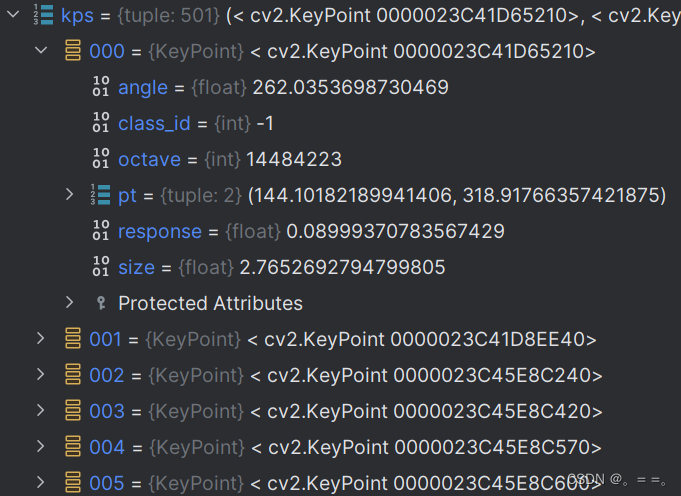
 本文介绍了如何在Python中使用pickle保存OpenCV的KeyPoint对象,由于pickle不能直接保存自定义类型,作者提供了将KeyPoint转换为字典并分别保存为pickle和numpy文件的方法,以及对应的load函数实现数据恢复。






 扫一扫
扫一扫


 3964
3964


 到【灌水乐园】发言



