



 本文详细介绍了C++编程的基础知识,包括数据类型、运算符、流程控制、数组、函数、指针、结构体等内容,通过实例演示了C++编程的实践技巧。
在大一下学期学习了c语言,最近又想学一下c++,想提高一下编程功底,在此记录一下在有c基础(及其拙劣)的情况下,自己的编程进阶之路。
sizeof()
返回字节的大小
short a=10;
cout << sizeof(short)<< endl;//2
cout << sizeof(a) << endl;//2
cout << sizeof(int) << endl;//4
针对不同的操作系统,返回的值不同。
在float后面加 f
	float a = 1.20f;
	double b = 1.222;
创建字符型变量,用单引号,且只能一个字母;
char ch = 'a';
查找ASCII码:
A----65
a-----97
char ch = 'a';
cout << (int)ch<< endl;
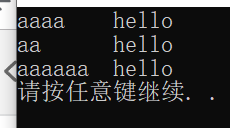
制表符 \t 有对齐的作用
	cout << "aaaa\thello"<< endl;
	cout << "aa\thello" << endl;
	cout << "aaaaaa\thello" << endl;
输出:
	char str[] = "hello world";//c风格字符串
	cout << str << endl;
	string str2 = "hello c++";  //c++风格,
	#include<string>
	cout << str2 << endl;
逻辑与
&&
逻辑或
||
选择结构:
if()
{}
esle if()
{}
else
{}
三目运算符:
( ? : )
它可以进行赋值操作。
	int a, b, c;
	a = 10, b = 30;
	c = (a > b ? a :b);
	cout << "c" << c << endl;
	(a > b ? a : b) = 100;
	cout << b << endl;
switch选择结构。
switch
switch ()
{case x: xxxxxx;break;
case x: xxxxxx;break;
case x: xxxxxx;break;
default : xxxxxx;break;
}
	cout << "输入评分" << endl;
	int a;
	cin >> a;
	switch (a)
	{
	case 10: cout << "超级好" << endl; break;
	case 9: cout<< "hen好" << endl; break;
	case 8: cout<< "好" << endl; break;
	default: cout << "la ji" << endl;
	}
注意:
1.switch 只能对整形或者字符型进行判断。
2.记得写break。
执行效率高于if语句。
循环:
1.while循环
猜数字:
#include<iostream>
using namespace std;
#include<stdlib.h>  //生成随机数  vs下不需要,Dev需要
#include<ctime>//随机数
	srand((unsigned int)time(NULL));//数字种子
	int num,a;
	num = rand() % 100 + 1;//产生1-100的随机数,rand()%100是产生0-99的
	while (1)
	{
		cout << "输入数字" << endl;
		cin >> a;
		if (a > num)
		{
			cout << "输入过大" << endl;
		}
		else if (a < num)
		{
			cout << "输入过小" << endl;
		}
		else
		{
			cout << "对!!!!" << endl;
			break;
		}
	}

	system("pause");
	return 0;

}
do ……while
会先执行一次,示例如下:
do
{
循环语句
}
while(条件);
水仙花数
#include<iostream>
using namemspace std;
int main()
{
	int i = 100, a, b, c;

	do
	{
		a = i % 10;
		c = i / 100;
		b = (i / 10)%10;
		if (a * a*a + b * b*b +c* c * c == i)
		{
			cout << "水仙花数" << i << endl;
		}
		i++;

	} while (i <1000);
	//for循环
		for(i=100;i<1000;i++)
	{
		a = i % 10;
		c = i / 100;
		b = (i / 10) % 10;
		if (a * a * a + b * b * b + c * c * c == i)
		{
			cout << "水仙花数" << i << endl;
		}
	}
	system("pause");
	return 0;

}
镶嵌循环
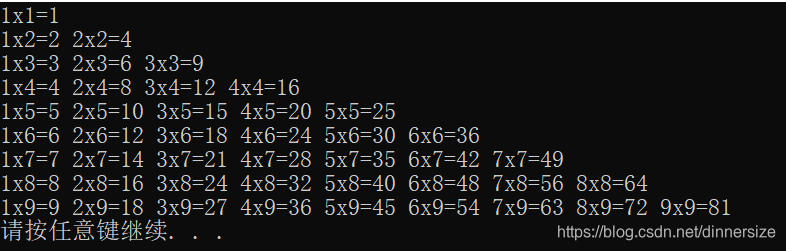
9*9乘法表
#include<iostream>
using namespace std;
int main()
{
	int i,j;
	for (i = 1; i < 10; i++)
	{
		for (j = 1; j <= i; j++)
		{
			cout << j << "x" << i << "=" << j * i <<" ";
		}
		cout << endl;
	}
	system("pause");
	return 0;

}
continue:
跳出本次循环,进行下次循环
break:
跳出循环就不循环了。
##########
goto用法:
注意flag:(是冒号!)
#include<iostream>
using namespace std;
#include<string>
int main()
{

	cout << "11111111" << endl;
	cout << "2222222" << endl;

	goto FLAG;
	cout << "3333333333" << endl;
	cout << "4444444444" << endl;
	cout << "555555" << endl;
	cout << "66666666" << endl;
	FLAG:      //冒号!
	cout << "7777777" << endl;

	system("pause");
	return 0;

}
数组:
注意:数组,连续数据,同种类型的数据。
一。3种方式:
1.数据类型:数组名[长度]
2.数据类型:数组名[数组长度]={10,20,30,。。。。} // 如果后面数据没有出现,会用0替代。
3.数据类型:数组名[]={10,20,30,…} // 自动出现数组
#include<iostream>
using namespace std;
#include<string>
int main()
{
	float arr[] = { 1,2.5,3,4,5 };
	for (int i = 0; i < 5; i++)
		cout << arr[i] << endl;

	system("pause");
	return 0;

}
二.一维数组名的用途:
1.统计数组占用内存的大小。
	float arr[] = { 1,2.5,3,4,5 };
	for (int i = 0; i < 5; i++)
	{
		cout << arr[i] << endl;
	}
	cout<<"占内存"<< sizeof(arr)<<endl;
	cout<<"每个占内存"<<sizeof(arr[0])<<endl;
	int a = sizeof(arr) / sizeof(arr[0]);
	cout <<"数组大小"<< a << endl;//数组大小
2.一维数组名:也代表了数组的首地址。
	cout << "首地址" << int(arr) << endl;//强制转换16进制到10进制。(返回的16进制看不懂)
	cout << "第一个元素的地址" << int(&arr[0]) << endl;
	cout << "第二个元素的地址" << int(&arr[1]) << endl;
输入自定义数字个数,并进行排序。
自己写的,蛮力
#include<iostream>
using namespace std;
#include<string>
int main()
{
	int n,*arr;
	cout << "输入的数字个数" << endl;
	cin >> n;
	arr=new int [n];  //new分配数组
	for (int i = 0; i < n; i++)
	{
		cout << "输入arr[" << i << "]" << endl;
		cin >> arr[i];
	}

	//float arr[] = {5,4,3,4,3,6,0};
	int  temp,b= n - 1;
	for (int a = 0; a < b; a++)
	{
		for (int i = 0; i <b; i++)
		{
			if(arr[i+1]<arr[i])
			{
				temp = arr[i];
				arr[i] = arr[i+1];
				arr[i+1] = temp;

			}
		}
	}
	for (int q = 0; q < b + 1; q++)
	{
		cout << arr[q] << endl;
	}
	cout << "最大数字是" << arr[b] << endl;
	system("pause");
	return 0;

}
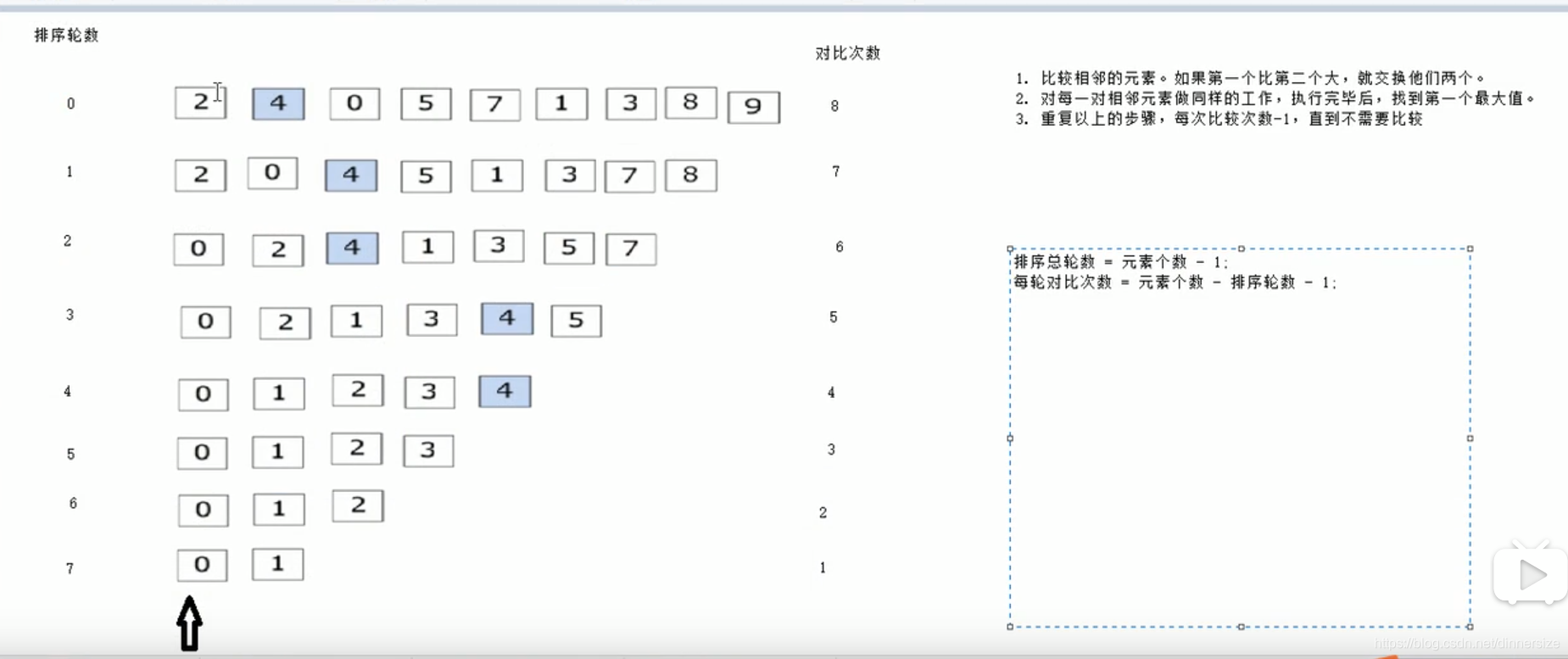
***调整后的冒泡排序***

```cpp
#include<iostream>
using namespace std;
int main()
{
	int n,i,a,j;
	float* p;
	cout << "输入数组个数" << endl;
	cin >> n;
	p = new float [n];
	cout << "输入数组" << endl;
	for (i = 0; i < n; i++)
	{
		cin >> p[i];
	}
	for (i = 0; i < n-1; i++)
	{
		for (j = 0; j < n - i- 1; j++)
		{
			if (p[j] > p[j + 1])
			{
				a = p[j];
				p[j] = p[j + 1];
				p[j + 1] = a;
			}
		}
	}
	cout << "end" << endl;
	for (i = 0; i < n; i++)
	{
		cout << p[i] << " ";
	}
	cout << endl;

	system("pause");
	return 0;
}
数组反转

```cpp
#include<iostream>
using namespace std;
#include<string>
int main()
{
	float* p;
	int i, n;
	cout << "输入数组个数" << endl;
	cin >> n;
	p = new float[n];
	cout << "输入数组的元素,将逆序它" << endl;
	for(i=0;i<n;i++)
	{
		cin >> p[i];
	}
	int start = 0, end = n-1,t;
	while(start < end)
	{
		t = p[start];
		p[start] = p[end];
		p[end] =t;
		end--; start++;
	}
	for (i = 0; i < n; i++)
	{
		cout << p[i] << endl;
	}
	system("pause");
	return 0;

}
二维数组:
四种定义方式:
1.int a[3][5];
2.int a[2][3]={{1,2,3},{1,2,3}};
3.int a[2][3]={1,2,3,4,5,6};
4.int a[][3]={1,2,3,4,5,6}; ##写出列数,就可以了。
二维数组名字:
1.查看所占内存空间
2.查看首地址
int n,i,j;
	int a[][3] = { 1,2,3,4,5,6 };
	cout << sizeof(a) << endl;
	cout << sizeof(a[0])<< endl;
	cout << sizeof(a[1]) << endl;

	cout<<(int)a<<endl;
	cout << (int)a[0] << endl;
	cout << (int)a[1] << endl;
	cout << (int)&a[0][1] << endl;
	int n,i,j;
	int score[3][3] = {
		{102,122,112},
		{142,150,69 },
		{112,123,131}
	};
	string names[3] = { "aa","dsd","dd" };
	for (i = 0; i < 3; i++)
	{
		int sum = 0;
		for (j = 0; j < 3; j++)
		{
			sum = sum + score[i][j];
		}
		cout << names[i] << "的分数是" << sum << endl;
	}
函数:
1.定义
返回值类型 函数名 (参数)
{
语句
return 表达式;
}
2.调用。
**void jiaf(int a, int b)
{
	int c ;
	c = a;
	a = b;
	b = c;
	return ;

}**
值传递时候,形参的改变,不会影响实参。
void 无返回值,写return.结尾。
A.函数常见形式
void text01()
{
	cout << "无参无返回" << endl;
}
void text02(int a)
{
	cout << "有参无返" <<a<< endl;
}
int test03()
{
	cout << "无参有返" << endl;
	return 10000;
}
int test04(int a)
{
	cout << "有参有返" << endl;
	return a;
}
函数的分文件编写:
有一天你编程能力牛逼了,就要分文件来处理大量代码:
1.创建头文件:
里写: 1.框架
2.函数声明
#include<iostream>
using namespace std;
int max(int a, int b);
2.创建源文件。
写 1.函数的定义
2.在前面写上你对应的头文件。
#include"1st.h"
int max(int a, int b)
{
	return (a > b ? a : b);
}
之后就可以快乐的调用了。
在主函数的调用如下:
#include<iostream>
using namespace std;
#include"1st.h"

int main()
{
	int c = max(1, 4);
	cout << c << endl;
	system("pause");
	return 0;
}
————————————————————————————————
指针:
1.指针就是地址
2. * 表示解指针的意思。
int c = 20;
	int* p;
	p = &c;
	前两行等价如下:
	int*p=&c;
指针所占内存:
不管什么类型的指针:
在x86,32位编程下,指针占4个字节。
x64 64位编程下,指针占8个字节。
cout<<sizeof(int *)<< endl;
cout<<sizeof§<< endl;
A.空指针:
1.就是内存中编号为-0 的指针
2. 用途:初始化指针变量
3. 空指针指向的内存不可以访问。
原因是 : 0–255是系统使用的地址,不可使用。
	int*p=NULL;
	*p = 10;

////会报错的
	cout << p<<"  " << *p << endl;
野指针:
指针指向非法的内存空间
随便找了个内存就开始解引用。
会报错。
	int*p=(int*)0x1100;
	cout << p<<"  " << *p << endl;
空指针和野指针都不是我们申请的空间,因此不要访问。
const修饰指针:
	int a = 10, b = 20;
	//指针常量,可修改内容,不可改指向。
	int* const p = &a;
	*p = b;
	cout << *p << endl;
	//常量指针,可修改地址,不可改内容。
	const int* q = &a;
	q = &b;
	cout << *p << endl;
	//既修饰指针,又修饰常量,都不可以改
	const int* const w = &a;
数组指针:
(1) for(int i=0; i<100; i++)a[i]=0;
(2)for(int i=0; i<100; i++) {*b=0; b++;}
从原理上来讲,(1)是间接寻址再赋值,(2)是直接寻址赋值再累加;效率上(2)比(1)要高,速度更快。
int arr[] = { 1,2,3,4,5,6,7,8,9,10 };
	int* p = arr;
	for (int i = 0; i < 10; i++)
	{
		cout << *p << endl;
		p++;
	}
数组和函数:
void swap1(int a, int b)
{
	//值传递,不会改变实参
	int c;
	c = a;
	a = b;
	b = c;
	cout << "实参内部" << a << b<<endl;
}
void swap2(int* p, int* q)
{
	//地址传递,会改变实参
	int temp;
	temp = *p;
	*p = *q;
	*q = temp;
	cout << "实参内部" << *p << *q;
}
指针数组函数结合案例:
将数组进行升序排列:
#include<iostream>
using namespace std;
#include<string>
void Sortarr(int* p, int len)
{
	for (int i = 0; i < len - 1; i++)
	{
		for (int j = 0; j < len - i - 1; j++)
		{
			if (p[j] > p[j + 1])
			{
				int temp;
				temp = p[j];
				p[j] = p[j + 1];
				p[j + 1] = temp;
			}
		}
	}
}
void Printarr(int*p,int len)
{
	for (int i = 0; i < len; i++)
	{
		cout << p[i] << endl;
	}
}
int main()
{
	int arr[10] = { 1,5,3,6,3,6,2,5,7,4 }, len;
	len = sizeof(arr) / sizeof(arr[0]);
	Sortarr(arr, len);
	Printarr(arr, len);
	system("pause");
	return 0;
}
——————————————————————————————————
结构体
1.创建结构体的三种方式:
#include<iostream>
using namespace std;
#include<string>
struct student
{
	string name;
	int score;
	int age;
}s3;
int main()
{
	//3种方式定义结构体
	struct student s1;//stuct可以省略
	s1.name = "发";
	s1.age = 12;
	s1.score = 100;
	cout << s1.name << s1.age << " " << s1.score << endl;

	//第二种
	student s2 = { "sad",142,18 };
	cout << s2.name << s2.age << " " << s2.score << endl;

	//第三种在结构体后面
	s3.name = "sf ";
	s3.age = 14;
	s3.score = 234;
	cout << s3.name << s3.age << " " << s3.score << endl;

	system("pause");
	return 0;
}
2.结构体数组:
#include<iostream>
using namespace std;
#include<string>
#include <cstdlib>//解决system不明确问题。
struct student
{
	string name;
	int score;
	int age;
}s3;
int main()
{
	//结构体数组
	struct student stuArry[3] =
	{
		{"网易",132,15},
		{"消息", 123, 16},
		{"sad ",122,19	}
	};
	stuArry[2].age = 1;
	stuArry[2].name = "adsadw";
	for (int i = 0;i < 3; i++)
	{
		cout << stuArry[i].name << " " << stuArry[i].age
			 << " " << stuArry[i].score << endl;

	}
	system("pause");
	return 0;
}
#include //解决system不明确问题。
3.结构体指针。
//结构体 指针可以通过->访问元素
#include<iostream>
using namespace std;
#include<string>
#include <cstdlib>//解决system不明确问题。
struct student
{
	string name;
	int score;
	int age;
};
int main()
{
	//结构体	指针可以通过->访问元素
	struct student s1 = { "网易",132,15 };
	student* p = &s1;
	p->age = 100000;
	cout << p->age << p->name << p->score << endl;

	system("pause");
	return 0;
}
结构体镶套结构体:
#include<iostream>
using namespace std;
#include<string>
#include <cstdlib>//解决system不明确问题。
struct student
{
	string name;
	int score;
	int age;
};
struct teacher
{
	string name;
	int id;
	struct student s1;
};
int main()
{
	struct teacher t;
	t.id = 1;
	t.name = "老王";
	t.s1={ "网易",132,15 };
	cout << "老师信息"<<t.id <<t.name << t.s1.age<<t.s1.name<<t.s1.score << endl;

	system("pause");
	return 0;
}
结构体做函数参数:
#include<iostream>
using namespace std;
#include<string>
#include <cstdlib>//解决system不明确问题。
struct student
{
	string name;
	int score;
	int age;
};
void y1(struct student s)
{
	s.name = "阿小吉";
	cout << "值传递函数的结果 " << s.name << " " << s.age << " " << s.score << endl;

}
void y2(struct student* s)
{
	s->name = "啊小吉";
	cout << "地址传递的结果 " << s->name << " " << s->age << " " << s->score << endl;
}
int main()
{
	struct student s1 = { "阿吉",685,20 };
	y1(s1);
	cout << "主函数的结果 " << s1.name << " " << s1.age << " " << s1.score << endl;
	y2(& s1);
	cout << "主函数的结果 " << s1.name << " " << s1.age << " " << s1.score << endl;
	system("pause");
	return 0;
}
结果:
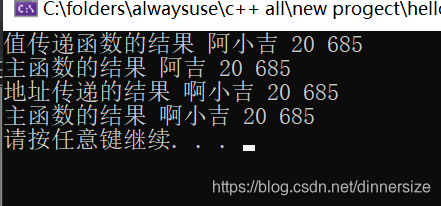
可以再次见证:
函数的值传递不可改变函数的数据,函数的地址传递可以改变函数的数据。
——————————
const 修饰结构体的使用场景
void y2( const student* s) //注意此处的格式,防止程序的误操作。
{
	//使用地址传递可以节省空间,值传递得复制一大串,地址传递就不用,只用4个字节。
	cout << "地址传递的结果 " << s->name << " " << s->age << " " << s->score << endl;
}
结构体案例1
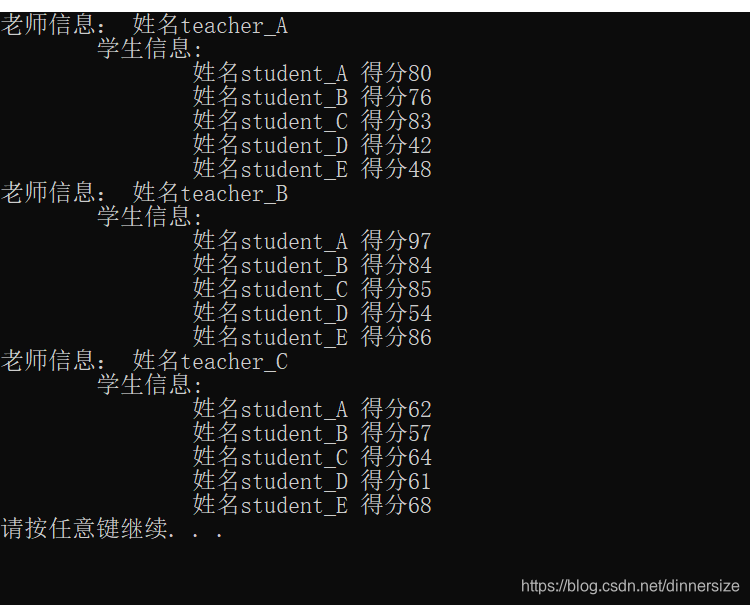
一个老师带5个学生,一共仨老师,定义老师结构体*(姓名,带的学生信息)
学生结构体(姓名,得分),代码如下。
#include<iostream>
using namespace std;
#include<string>
#include <cstdlib>//解决system不明确问题。
#include<ctime>
struct student
{
	string name;
	int score;
};
struct teacher
{
	string name;
	struct student sArry[5];
};
void matchall(struct teacher tArry[], int len)//注意此处tArry[]!!!
{
	string refer = "ABCDE";
	for (int i = 0; i < len; i++)
	{
		tArry[i].name = "teacher_";
		tArry[i].name += refer[i];
		for (int j = 0; j < 5; j++)
		{
			tArry[i].sArry[j].name = "student_";
			tArry[i].sArry[j].name+= refer[j];
			tArry[i].sArry[j].score = rand() % 60 + 1 + 40;
		}
	}
}
void printfall(struct teacher  tArry[], int len)
{
	for (int i = 0; i < len; i++)
	{
		cout << "老师信息: 姓名" << tArry[i].name << endl;
		cout << "\t学生信息: " << endl;
		for (int j = 0; j < 5; j++)
		{
			cout << "\t\t姓名" << tArry[i].sArry[j].name << " 得分"
				<< tArry[i].sArry[j].score<<endl;
		}

	}

}
int main()
{
	srand((unsigned int)time(NULL));
	struct teacher tArry[3];
	int len = sizeof(tArry) / sizeof(tArry[0]);
	matchall(tArry,len);
	printfall(tArry, len);
	system("pause");
	return 0;
}
结果如下:
结构体案例2:
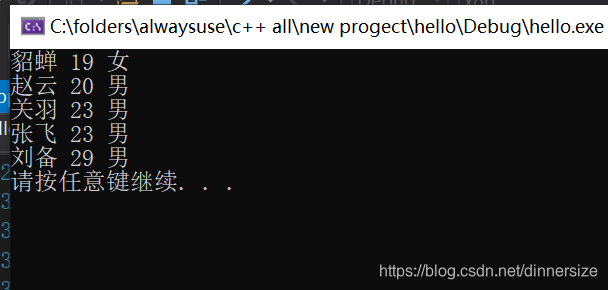
对5个英雄进行按照年龄的冒泡排序。代码如下:
#include<iostream>
using namespace std;
#include<string>
#include <cstdlib>//解决system不明确问题。
#include<ctime>
struct hero
{
	string name;
	int age;
	string sex;
};
void merge(struct hero onehero[])//注意此处tArry[]!!!
{
	for (int i = 0; i < 4; i++)
	{
		for (int j = 0; j < 4-i; j++)
		{
			struct hero temp;
			if (onehero[j].age > onehero[j + 1].age)
			{
				temp = onehero[j];
				onehero[j] = onehero[j + 1];
				onehero[j + 1] = temp;
			}
		}
	}
}
void prints(struct hero sa[])
{
	for (int i = 0; i < 5; i++)
	{
		cout << sa[i].name << " " << sa[i].age << " " << sa[i].sex << endl;
	}
}

int main()
{
	struct hero heros[5] = { {"关羽",23,"男"},{"赵云",20,"男"},{"刘备",29,"男"},
		{"张飞",23,"男"},{"貂蝉",19,"女"} };
	merge(heros);
	prints(heros);
	system("pause");
	return 0;
}
result:





 扫一扫
扫一扫


 被折叠的 条评论
为什么被折叠?
被折叠的 条评论
为什么被折叠?
 到【灌水乐园】发言





