



 这篇博客详细介绍了MIT6_0002F16_ProblemSet4实验,涉及设计并实现一个细菌种群动态模拟,包括无抗生素和有抗生素的情况。实验通过模拟分析了不同治疗方案对细菌传播的影响,观察了抗生素使用前后细菌数量和耐药菌群体的变化。
MIT6_0002F16_ProblemSet4
实验内容:
本次实验旨在设计并实现一个细菌种群动态的随机模拟模型,并根据模拟结果得出各种治疗方案如何影响细菌的传播的结论。
实验流程:
阅读实验pdf,可知实验具体要求,按照要求一步一步解决。
Problem 1: Implementing a Simple Simulation
该部分为最简易的细菌模拟,不添加抗生素,简单模拟细菌的种群增长情况。
主要任务是填写 SimpleBacteria类和Patient类。SimpleBacteria 类表示单个细菌的状态。Patient维护与病人相关的细菌种群的状态。
代码如下:(根据提示较易完成)
class SimpleBacteria(object):
    def __init__(self, birth_prob, death_prob):
        #max出生概率
        self.birth_prob=birth_prob
        #max死亡概率
        self.death_prob=death_prob

    def is_killed(self):
        #利用随机的办法判断是否死亡
        return random.random() <= self.death_prob

    def reproduce(self, pop_density):
        #利用随机的办法判断是否将繁殖,繁殖可能性为self.birth_prob * (1 - pop_density).
        if random.random() < (self.birth_prob * (1 - pop_density)):
            return SimpleBacteria(self.birth_prob, self.death_prob)
        else:
            raise NoChildException
class Patient(object):
    def __init__(self, bacteria, max_pop):
        #病人身上的细菌
        self.bacteria=bacteria
        #最大的细菌种群大小
        self.max_pop=max_pop
    def get_total_pop(self):
        #返回细菌数目
        return len(self.bacteria)
    def update(self):
        #根据提示即可完成
        #判断一下细菌是否死亡或者产生新的细菌
        surviving_bacteria = []
        for bacterium in self.bacteria:
            if not bacterium.is_killed():
                surviving_bacteria.append(bacterium)
        #计算当前种群密度,用细菌数/菌落数
        pop_density = len(surviving_bacteria) / self.max_pop
        #判断存活细菌是否将产生新细菌
        child_bacteria = []
        for bacterium in surviving_bacteria:
            try:
                child_bacteria.append(bacterium.reproduce(pop_density))
            except NoChildException:
                pass
        self.bacteria = surviving_bacteria + child_bacteria
        return len(self.bacteria)
Problem 2: Running and Analyzing a Simple Simulation (No Antibiotic Treatment)
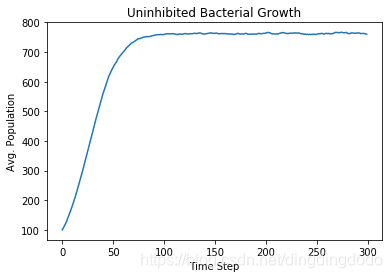
模拟没有抗生素的情况下细菌的生长情况。需要完成两个函数:simulation_without_antibiotic 以及calc_pop_avg,calc_pop_avg用来求第n个时间点的细菌平均数,simulation_without_antibiotic 用来模拟细菌的生长情况。完成代码后,运行populations = simulation_without_antibiotic(100, 1000, 0.1, 0.025, 50) 可得具体生长图像。populations 是一个二维list,用于存取每个菌落与时间相关的性质,每个list元素中的元素表示一个菌落随时间step的变化
代码:
#返回第n步的细菌平均数
def calc_pop_avg(populations, n):
    data=[]
    #取每个菌落的第n步的菌落数
    for i in range(len(populations)):
        data.append(populations[i][n])
    #返回其平均值即可
    return np.mean(data)
def simulation_without_antibiotic(num_bacteria,max_pop,birth_prob,death_prob,num_trials):
    #题目的图中steps达到了300,故这里选取300
    time_steps = 300
    populations = []
    #模拟num_trials个菌落的生存情况,并将具体数据记录
    for trial_i in range(num_trials):
        bacteria = [SimpleBacteria(birth_prob,death_prob) for i in range(num_bacteria)]
        patient = Patient(bacteria, max_pop)
        trial_data = [patient.get_total_pop()]
        for time_step in range(time_steps-1):
            trial_data.append(patient.update())
		#模拟每个菌落n步后,将该list加入到population中
        populations.append(trial_data)

    # 画图
    x_coords = list(range(time_steps))
    y_coords = [calc_pop_avg(populations, n) for n in x_coords]
    make_one_curve_plot(x_coords, y_coords, "Time Step", "Avg. Population", "Uninhibited Bacterial Growth")
    #返回该二维list
    return populations
运行结果:符合预期
test函数也说明函数正确:
`test_calc_pop_avg (__main__.ps4_calc) ... ok`
Problem 3: Calculating a Confidence Interval
这一部分我们需要以问题2模拟中收集到的数据为样本,构建一个95%置信区间,估计在某个时间步长(零索引)下的平均细菌数量。根据数学公式提示较易完成:
def calc_pop_std(populations, t):
    #将第t步的数据记录
    data = [populations[i][t] for i in range(len(populations))]
    #调用库返回std
    return np.std(data)

def calc_95_ci(populations, t):
    #平均数
    mean = calc_pop_avg
    #根据公式求1.96*SEM
    width = calc_pop_std(populations, t)/(len(populations)**0.5) * 1.96
    #返回mean+-SEM
    return (mean, width)
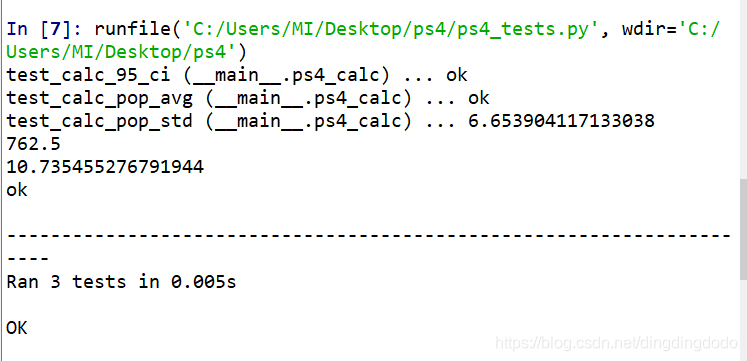
运行test函数:
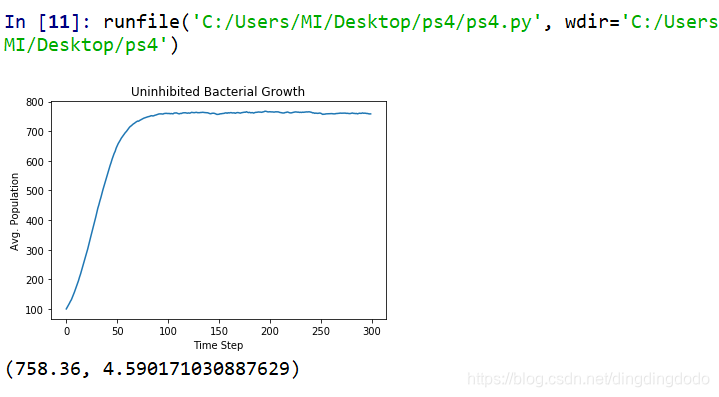
利用上述给的population,运行calc_95_ci(populations,299)并打印结果,如下:
Problem 4: Implementing a Simulation with an Antibiotic
这部分填写ResistantBacteria 抗药性细菌类,是SimpleBacteria 的一个子类。
耐药性细菌有特殊的性质,对抗生素耐药的细菌死亡率固定,没抗生素耐药的细菌死亡率为death_prob/4。
class ResistantBacteria(SimpleBacteria):
    def __init__(self, birth_prob, death_prob, resistant, mut_prob):
        #调用父类初始函数
        SimpleBacteria.__init__(self,birth_prob,death_prob)
        #细菌突变概率,后代获得抗药性的概率
        self.mut_prob = mut_prob
        #是否是抗药性
        self.resistant=resistant

    def get_resistant(self):
        return self.resistant

    def is_killed(self):
        #如果是抗药性的话,以故定概率死亡
        if self.get_resistant():
            return random.random() < self.death_prob
        #否则以death_prob/4概率死亡
        else:
            return random.random() < self.death_prob/4

    def reproduce(self, pop_density):
         #判断是否可以繁殖
         if random.random() < (self.birth_prob * (1 - pop_density)):
            #父代有抗药性,则子代具有抗药性
            if self.get_resistant():
                return ResistantBacteria(self.birth_prob, self.death_prob,
                        self.resistant, self.mut_prob)
            #父代有抗药性,子代有可能有抗药性
            elif random.random() < (self.mut_prob * (1 - pop_density)):
                return ResistantBacteria(self.birth_prob, self.death_prob,
                        True, self.mut_prob)
            #子代没有抗药性
            else:
                return ResistantBacteria(self.birth_prob, self.death_prob,
                        False, self.mut_prob)
TreatedPatient 类,是Patient的子类,表示接受抗生素的病人。
class TreatedPatient(Patient):
    def __init__(self, bacteria, max_pop):
        #调用父类构造函数
        Patient.__init__(self, bacteria, max_pop)
        #默认为未注射抗生素
        self.on_antibiotic = False

    def set_on_antibiotic(self):
        #注射抗生素
        self.on_antibiotic = True

    def get_resist_pop(self):
        #返回细胞数
        counter = 0
        for bacterium in self.bacteria:
            if bacterium.get_resistant():
                counter += 1
        return counter

    def update(self):
         #判断一下细菌是否死亡
        surviving_bacteria = []
        for bacterium in self.bacteria:
            if not bacterium.is_killed():
                surviving_bacteria.append(bacterium)
        #判断在有抗生素情况下细菌生存情况
        if self.on_antibiotic:
            surviving_bacteria = [bacterium for bacterium in
                    surviving_bacteria if bacterium.get_resistant()]
        #细菌繁殖情况
        pop_density = len(surviving_bacteria) / self.max_pop
        child_bacteria = []
        for bacterium in surviving_bacteria:
                child_bacteria.append(bacterium.reproduce(pop_density))
        #总细菌数目=没死的细菌加上繁殖的细菌
        self.bacteria = surviving_bacteria + child_bacteria
        return len(self.bacteria)
Problem 5: Running and Analyzing a Simulation with an Antibiotic
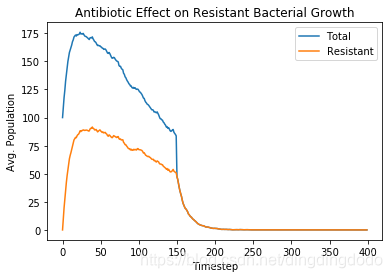
该部分用于模拟研究耐药细菌以及抗生素治疗的效果。
def simulation_with_antibiotic(num_bacteria,max_pop,birth_prob,death_prob,
                               resistant, mut_prob,num_trials):
    #根据注释确定需要的变量
    time_steps_before_antibiotic = 150
    time_steps_after_antibiotic = 250
    populations = []
    resistant_pop = []

    #每过一个时间片
    for trial_i in range(num_trials):
        #实例化相应的细菌以及病人
        bacteria = [ResistantBacteria(birth_prob, death_prob, resistant,
            mut_prob) for i in range(num_bacteria)]
        patient = TreatedPatient(bacteria, max_pop)

        trial_data = [patient.get_total_pop()]
        trial_data_resist = [patient.get_resist_pop()]

        # 加入抗生素治疗
        for time_step in range(time_steps_before_antibiotic - 1):
            trial_data.append(patient.update())
            trial_data_resist.append(patient.get_resist_pop())
        patient.set_on_antibiotic()

        for time_step in range(time_steps_after_antibiotic):
            trial_data.append(patient.update())
            trial_data_resist.append(patient.get_resist_pop())

        populations.append(trial_data)
        resistant_pop.append(trial_data_resist)

    # 作图:
    x_coords=list(range(time_steps_before_antibiotic + time_steps_after_antibiotic))
    y_coords1 = [calc_pop_avg(populations, n) for n in x_coords]
    y_coords2 = [calc_pop_avg(resistant_pop, n) for n in x_coords]
    make_two_curve_plot(x_coords, y_coords1, y_coords2,
                        "Total",
                        "Resistant",
                        "Timestep",
                        "Avg. Population",
                        "Antibiotic Effect on Resistant Bacterial Growth")

    return (populations, resistant_pop)
运行结果: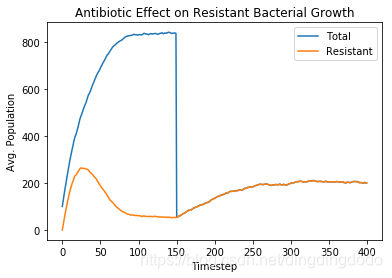
运行程序找对应的置信区间:
4个置信区间:
(196.8, 7.437677056716028)
(196.8, 7.437677056716028)
(0.0, 0.0)
(0.0, 0.0)
Problem 6 Write-up
A和B两种模拟只有一个区别,便是细菌的繁殖率,因此我们可以认为当繁殖率较低时在抗生素条件下很难维持增长,如果繁殖率较高,则随着突变的发生,产生突变的细菌也就越来越多,这样最终导致抗药菌很多,从而实现了增长。
-
What happens to the total population before introducing the antibiotic?
引入抗生素之前,细菌数量增长非常快。
-
What happens to the resistant bacteria population before introducing the antibiotic?
耐药菌数目也是增长迅速,占总菌种一定比例。
-
What happens to the total population after introducing the antibiotic?
A情景引入抗生素后细菌数量迅速下降,但之后恢复。B场景中下降至0
-
What happens to the resistant bacteria population after introducing the antibiotic?
在A情景下引入抗生素菌下降后又开始上升,而B情景则下降至0





 扫一扫
扫一扫


 2405
2405

 被折叠的 条评论
为什么被折叠?
被折叠的 条评论
为什么被折叠?
 到【灌水乐园】发言





