


 本文深入探讨Java编译过程中语法树(Tree)、符号(Symbol)及类型(Type)三者间的关系,详细解析Symbol与Type的属性关联,以及Node、Symbol、Type之间的互动机制。通过具体示例,阐述了访问模式在符号和类型处理中的应用。
每个语法节点Tree都有Type属性,部分的语法节点有Symbol属性,如下:
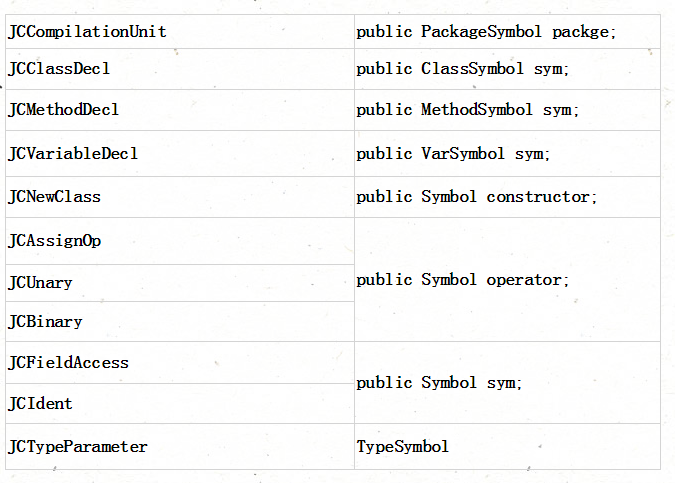
与Symbol类型与Type类型之间的关系如下:
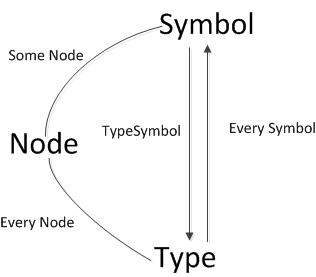
下面是Symbol与Type之间的关系:
(1)MethodSymbol("finalize").type = MethodType("()void").tsym=
ClassSymbol("Method").type=ClassType("Method").tsym=ClassSymbol("Method")
(2)TypeVar("M").tsym=TypeSymbol("M").type=TypeVar("M").tsym
(3)PackageSymbol("java").type = PackageType("java").tsym=PackageSymbol("java")
(4)VarSymbol("length").type=Type("int").tsym=ClassSymbol("int").type=Type("int").tsym=ClassSymbol("int")
下面是Node与Type之间的关系:
class Outer{
	class Inner{}
}

public class Test01 extends Outer.Inner{
	public Test01(Outer o){
		o.super();
	}
}
Outer.Inner是一个树节点,如果这个节点中的type有值,则直接返回即可,不用再进行标注。
关于Node、Symbol与Type举一个例子,如下:
import java.io.FileInputStream;
import java.io.InputStream;

public class TestScope<T1 extends InputStream,T2>{
    public void test(){
    	TestScope<FileInputStream,?> x = null;
    }
}
截图如下:
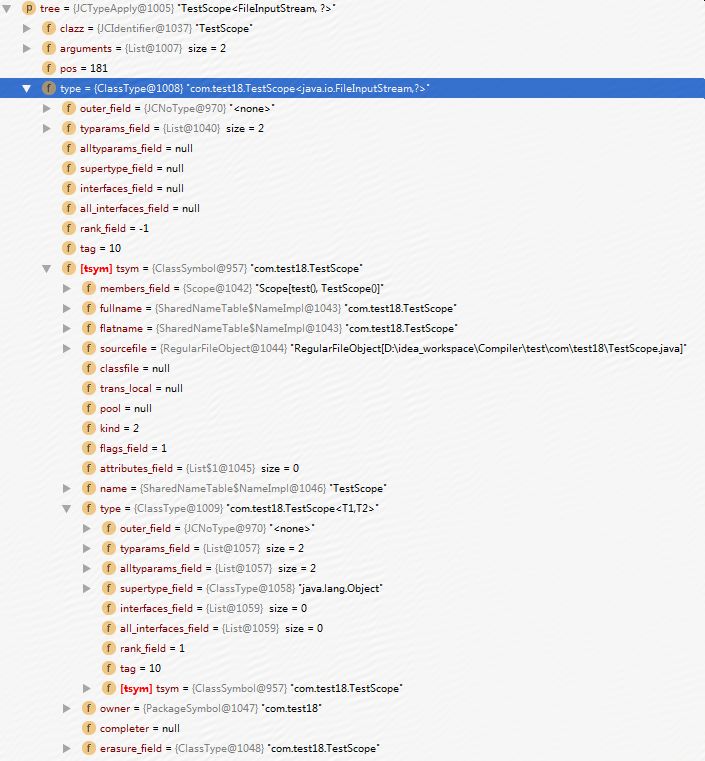
JCTypeApply的Node结点中没有Symbol属性,但是每个Node中都有Type属性,其值如上图蓝色部分。
ClassSymbol的Symbol结点中,由于每个Symbol中都有TypeSymbol类型的属性,这个属性值为com.test18.TestScope<T1,T2>
ClassType的Type结点中,由于每个Type中都有Symbol属性,这个属性的值为com.test18.TestScope
1、Symbol
对于Symbol来说:
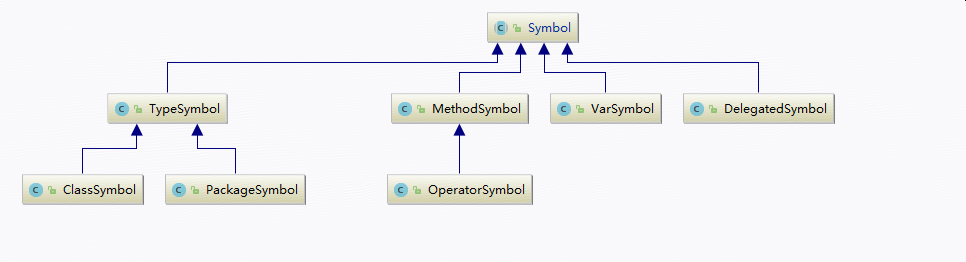
Symbol中既有Symbol类型属性也有Type类型的属性,如下:
   /** The type of this symbol.
     */
    public Type type;

    /** The owner of this symbol.
     */
    public Symbol owner;

    /** The completer of this symbol.
     */
    public Completer completer;

    /** A cache for the type erasure of this symbol.
     */
    public Type erasure_field;
所以每个Symbol类型都有type属性。
而标注Symbol类型的是Kinds枚举类型,代码如下:
/** Internal symbol kinds, which distinguish between elements of
 *  different subclasses of Symbol. Symbol kinds are organized so they can be  or'ed to sets.
 */
public class Kinds {

    private Kinds() {} // uninstantiable

    /** The empty set of kinds.
     */
    public final static int NIL = 0;

    /** The kind of package symbols.
     */
    public final static int PCK = 1 << 0;

    /** The kind of type symbols (classes, interfaces and type variables).
     */
    public final static int TYP = 1 << 1;

    /** The kind of variable symbols.
     */
    public final static int VAR = 1 << 2;

    /** The kind of values (variables or non-variable expressions), includes VAR.
     */
    public final static int VAL = (1 << 3) | VAR;

    /** The kind of methods.
     */
    public final static int MTH = 1 << 4;

    /** The error kind, which includes all other kinds.
     */
    public final static int ERR = (1 << 5) - 1;

    /** The set of all kinds.
     */
    public final static int AllKinds = ERR;

    /** Kinds for erroneous symbols that complement the above
     */
    public static final int ERRONEOUS = 1 << 6;
    public static final int AMBIGUOUS    = ERRONEOUS+1; // ambiguous reference
    public static final int HIDDEN       = ERRONEOUS+2; // hidden method or field
    public static final int STATICERR    = ERRONEOUS+3; // nonstatic member from static context
    public static final int ABSENT_VAR   = ERRONEOUS+4; // missing variable
    public static final int WRONG_MTHS   = ERRONEOUS+5; // methods with wrong arguments
    public static final int WRONG_MTH    = ERRONEOUS+6; // one method with wrong arguments
    public static final int ABSENT_MTH   = ERRONEOUS+7; // missing method
    public static final int ABSENT_TYP   = ERRONEOUS+8; // missing type

    public enum KindName implements Formattable {
        ANNOTATION("kindname.annotation"),
        CONSTRUCTOR("kindname.constructor"),
        INTERFACE("kindname.interface"),
        ENUM("kindname.enum"),
        STATIC("kindname.static"),
        TYPEVAR("kindname.type.variable"),
        BOUND("kindname.type.variable.bound"),
        VAR("kindname.variable"),
        VAL("kindname.value"),
        METHOD("kindname.method"),
        CLASS("kindname.class"),
        STATIC_INIT("kindname.static.init"),
        INSTANCE_INIT("kindname.instance.init"),
        PACKAGE("kindname.package");

        private String name;
        KindName(String name) {
            this.name = name;
        }
        public String toString() {
            return name;
        }
        public String getKind() {
            return "Kindname";
        }
        public String toString(Locale locale, Messages messages) {
            String s = toString();
            return messages.getLocalizedString(locale, "compiler.misc." + s);
        }
    }

    /** A KindName representing a given symbol kind
     */
    public static KindName kindName(int kind) {
        switch (kind) {
        case PCK: return KindName.PACKAGE;
        case TYP: return KindName.CLASS;
        case VAR: return KindName.VAR;
        case VAL: return KindName.VAL;
        case MTH: return KindName.METHOD;
            default : throw new AssertionError("Unexpected kind: "+kind);
        }
    }

    /** A KindName representing a given symbol
     */
    public static KindName kindName(Symbol sym) {
        switch (sym.getKind()) {
        case PACKAGE:
            return KindName.PACKAGE;

        case ENUM:
            return KindName.ENUM;

        case ANNOTATION_TYPE:
        case CLASS:
            return KindName.CLASS;

        case INTERFACE:
            return KindName.INTERFACE;

        case TYPE_PARAMETER:
            return KindName.TYPEVAR;

        case ENUM_CONSTANT:
        case FIELD:
        case PARAMETER:
        case LOCAL_VARIABLE:
        case EXCEPTION_PARAMETER:
        case RESOURCE_VARIABLE:
            return KindName.VAR;

        case CONSTRUCTOR:
            return KindName.CONSTRUCTOR;

        case METHOD:
            return KindName.METHOD;
        case STATIC_INIT:
            return KindName.STATIC_INIT;
        case INSTANCE_INIT:
            return KindName.INSTANCE_INIT;

        default:
            if (sym.kind == VAL)
                // I don't think this can happen but it can't harm
                // playing it safe --ahe
                return KindName.VAL;
            else
                throw new AssertionError("Unexpected kind: "+sym.getKind());
        }
    }

    /** A set of KindName(s) representing a set of symbol's kinds.
     */
    public static EnumSet<KindName> kindNames(int kind) {
        EnumSet<KindName> kinds = EnumSet.noneOf(KindName.class);
        if ((kind & VAL) != 0)
            kinds.add(((kind & VAL) == VAR) ? KindName.VAR : KindName.VAL);
        if ((kind & MTH) != 0) kinds.add(KindName.METHOD);
        if ((kind & TYP) != 0) kinds.add(KindName.CLASS);
        if ((kind & PCK) != 0) kinds.add(KindName.PACKAGE);
        return kinds;
    }

    /** A KindName representing the kind of a given class/interface type.
     */
    public static KindName typeKindName(Type t) {
        if (t.tag == TYPEVAR ||
            t.tag == CLASS && (t.tsym.flags() & COMPOUND) != 0)
            return KindName.BOUND;
        else if (t.tag == PACKAGE)
            return KindName.PACKAGE;
        else if ((t.tsym.flags_field & ANNOTATION) != 0)
            return KindName.ANNOTATION;
        else if ((t.tsym.flags_field & INTERFACE) != 0)
            return KindName.INTERFACE;
        else
            return KindName.CLASS;
    }

    /** A KindName representing the kind of a a missing symbol, given an
     *  error kind.
     * */
    public static KindName absentKind(int kind) {
        switch (kind) {
        case ABSENT_VAR:
            return KindName.VAR;
        case WRONG_MTHS: case WRONG_MTH: case ABSENT_MTH:
            return KindName.METHOD;
        case ABSENT_TYP:
            return KindName.CLASS;
        default:
            throw new AssertionError("Unexpected kind: "+kind);
        }
    }
}
Symbol可以通过访问模式来访问各个结点,定义如下:
(1)Symbol.Visitor<R, P>
符号类中定义的访问者模式接口如下:
/**
     * A visitor for symbols.  A visitor is used to implement operations
     * (or relations) on symbols.  Most common operations on types are
     * binary relations and this interface is designed for binary
     * relations, that is, operations on the form
     * Symbol × P → R.
     * <!-- In plain text: Type x P -> R -->
     *
     * @param <R> the return type of the operation implemented by this
     * visitor; use Void if no return type is needed.
     * @param <P> the type of the second argument (the first being the
     * symbol itself) of the operation implemented by this visitor; use
     * Void if a second argument is not needed.
     */
    public interface Visitor<R,P> {
        R visitClassSymbol(ClassSymbol s, P arg);
        R visitMethodSymbol(MethodSymbol s, P arg);
        R visitPackageSymbol(PackageSymbol s, P arg);
        R visitOperatorSymbol(OperatorSymbol s, P arg);
        R visitVarSymbol(VarSymbol s, P arg);
        R visitTypeSymbol(TypeSymbol s, P arg);
        R visitSymbol(Symbol s, P arg);
    }
(2)Types中的DefaultSymbolVisitor<R,S>
 /**
     * A default visitor for symbols.  All visitor methods except
     * visitSymbol are implemented by delegating to visitSymbol.  Concrete
     * subclasses must provide an implementation of visitSymbol and can
     * override other methods as needed.
     *
     * @param <R> the return type of the operation implemented by this
     * visitor; use Void if no return type is needed.
     * @param <S> the type of the second argument (the first being the
     * symbol itself) of the operation implemented by this visitor; use
     * Void if a second argument is not needed.
     */
    public static abstract class DefaultSymbolVisitor<R,S> implements Symbol.Visitor<R,S> {
        final public R visit(Symbol s, S arg)                   { return s.accept(this, arg); }
        public R visitClassSymbol(ClassSymbol s, S arg)         { return visitSymbol(s, arg); }
        public R visitMethodSymbol(MethodSymbol s, S arg)       { return visitSymbol(s, arg); }
        public R visitOperatorSymbol(OperatorSymbol s, S arg)   { return visitSymbol(s, arg); }
        public R visitPackageSymbol(PackageSymbol s, S arg)     { return visitSymbol(s, arg); }
        public R visitTypeSymbol(TypeSymbol s, S arg)           { return visitSymbol(s, arg); }
        public R visitVarSymbol(VarSymbol s, S arg)             { return visitSymbol(s, arg); }
    }
2、Type
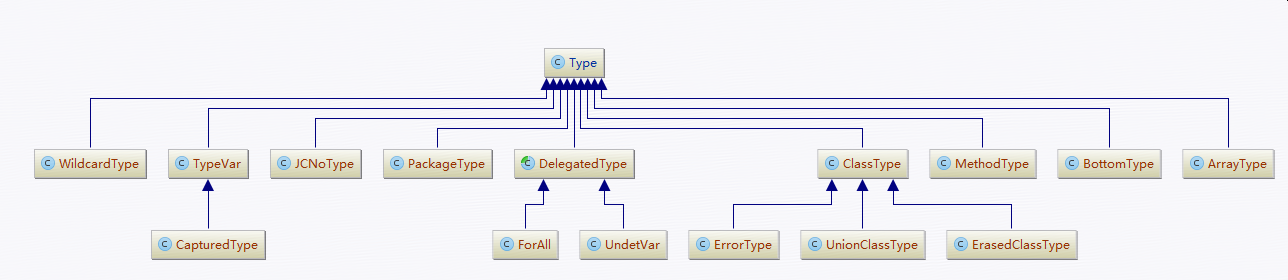
对于每个Type类型来说,只限定有TypeSymbol类型的属性,也就是包、类和类型变量对应的符号。
// The defining class / interface / package / type variable
public TypeSymbol typeSymbol; // 只有ClassSymbol与PackageSymbol继承了TypeSymbol
标注每个Type类型的为TypeTags,代码如下:
/** An interface for type tag values, which distinguish between different  sorts of types.
 */
public class TypeTags {

    private TypeTags() {} // uninstantiable

    /** The tag of the basic type `byte'.
     */
    public static final int BYTE = 1;

    /** The tag of the basic type `char'.
     */
    public static final int CHAR = BYTE+1;

    /** The tag of the basic type `short'.
     */
    public static final int SHORT = CHAR+1;

    /** The tag of the basic type `int'.
     */
    public static final int INT = SHORT+1;

    /** The tag of the basic type `long'.
     */
    public static final int LONG = INT+1;

    /** The tag of the basic type `float'.
     */
    public static final int FLOAT = LONG+1;

    /** The tag of the basic type `double'.
     */
    public static final int DOUBLE = FLOAT+1;

    /** The tag of the basic type `boolean'.
     */
    public static final int BOOLEAN = DOUBLE+1;

    /** The tag of the type `void'.
     */
    public static final int VOID = BOOLEAN+1;

    /** The tag of all class and interface types.
     */
    public static final int CLASS = VOID+1;

    /** The tag of all array types.
     */
    public static final int ARRAY = CLASS+1;

    /** The tag of all (monomorphic 单一同态的) method types.
     */
    public static final int METHOD = ARRAY+1;

    /** The tag of all package "types".
     */
    public static final int PACKAGE = METHOD+1;

    /** The tag of all (source-level) type variables.
     */
    public static final int TYPEVAR = PACKAGE+1;

    /** The tag of all type arguments.
     */
    public static final int WILDCARD = TYPEVAR+1;

    /** The tag of all polymorphic (method-) types.
     */
    public static final int FORALL = WILDCARD+1;

    /** The tag of the bottom type <null>.
     */
    public static final int BOT = FORALL+1;

    /** The tag of a missing type.
     */
    public static final int NONE = BOT+1;

    /** The tag of the error type.
     */
    public static final int ERROR = NONE+1;

    /** The tag of an unknown type
     */
    public static final int UNKNOWN = ERROR+1;

    /** The tag of all instantiatable type variables.
     */
    public static final int UNDETVAR = UNKNOWN+1;

    /** The number of type tags.
     */
    public static final int TypeTagCount = UNDETVAR+1;

    /** The maximum tag of a basic type.
     */
    public static final int lastBaseTag = BOOLEAN;

    /** The minimum tag of a partial type
     */
    public static final int firstPartialTag = ERROR;
}
Javac为Type结果定义了访问者接口,如下:
(1)Type.Visitor<R, S>
类型Type中定义的访问者模式:
 /**
     * A visitor for types.  A visitor is used to implement operations
     * (or relations) on types.  Most common operations on types are
     * binary relations and this interface is designed for binary
     * relations, that is, operations on the form
     * Type × S → R.
     * <!-- In plain text: Type x S -> R -->
     *
     * @param <R> the return type of the operation implemented by this
     * visitor; use Void if no return type is needed.
     * @param <S> the type of the second argument (the first being the
     * type itself) of the operation implemented by this visitor; use
     * Void if a second argument is not needed.
     */
    public interface Visitor<R,S> {
        R visitClassType(ClassType t, S s);
        R visitWildcardType(WildcardType t, S s);
        R visitArrayType(ArrayType t, S s);
        R visitMethodType(MethodType t, S s);
        R visitPackageType(PackageType t, S s);
        R visitTypeVar(TypeVar t, S s);
        R visitCapturedType(CapturedType t, S s);
        R visitForAll(ForAll t, S s);
        R visitUndeterminedVar(UndeterminedVar t, S s);
        R visitErrorType(ErrorType t, S s);
        R visitType(Type t, S s);
    }
(2)Types中的DefaultTypeVisitor<R,S>,SimpleTypeVisitor<R,S>
/**
     * A default visitor for types.  All visitor methods except
     * visitType are implemented by delegating to visitType.  Concrete
     * subclasses must provide an implementation of visitType and can
     * override other methods as needed.
     *
     * @param <R> the return type of the operation implemented by this
     * visitor; use Void if no return type is needed.
     * @param <S> the type of the second argument (the first being the
     * type itself) of the operation implemented by this visitor; use
     * Void if a second argument is not needed.
     */
    public static abstract class DefaultTypeVisitor<R,S> implements Type.Visitor<R,S> {
        final public R visit(Type t, S s)               { return t.accept(this, s); }
        public R visitClassType(ClassType t, S s)       { return visitType(t, s); }
        public R visitWildcardType(WildcardType t, S s) { return visitType(t, s); }
        public R visitArrayType(ArrayType t, S s)       { return visitType(t, s); }
        public R visitMethodType(MethodType t, S s)     { return visitType(t, s); }
        public R visitPackageType(PackageType t, S s)   { return visitType(t, s); }
        public R visitTypeVar(TypeVar t, S s)           { return visitType(t, s); }
        public R visitCapturedType(CapturedType t, S s) { return visitType(t, s); }
        public R visitForAll(ForAll t, S s)             { return visitType(t, s); }
        public R visitUndeterminedVar(UndeterminedVar t, S s)         { return visitType(t, s); }
        public R visitErrorType(ErrorType t, S s)       { return visitType(t, s); }
    }
/**
     * A <em>simple</em> visitor for types.  This visitor is simple as
     * captured wildcards, for-all types (generic methods), and
     * undetermined(未确定的) type variables (part of inference) are hidden.
     * Captured wildcards are hidden by treating them as type
     * variables and the rest are hidden by visiting their qtypes.
     *
     * @param <R> the return type of the operation implemented by this
     * visitor; use Void if no return type is needed.
     * @param <S> the type of the second argument (the first being the
     * type itself) of the operation implemented by this visitor; use
     * Void if a second argument is not needed.
     */
    public static abstract class SimpleTypeVisitor<R,S> extends DefaultTypeVisitor<R,S> {
        @Override
        public R visitCapturedType(CapturedType t, S s) {
            return visitTypeVar(t, s);
        }
        @Override
        public R visitForAll(ForAll t, S s) {
            return visit(t.qtype, s);
        }
        @Override
        public R visitUndeterminedVar(UndeterminedVar t, S s) {
            return visit(t.qtype, s);
        }
    }





 扫一扫
扫一扫


 1616
1616

 被折叠的 条评论
为什么被折叠?
被折叠的 条评论
为什么被折叠?
 到【灌水乐园】发言





