


 该博客探讨了一种特殊的问题:如何仅通过 Swap(0,*) 操作对整数数组进行排序。文章提供了一个示例,展示了如何对给定的未排序数组应用这种操作,并展示了一种算法来计算达到排序所需的最小交换次数。输入和输出规范被详细说明,包括一个具体的测试案例。代码实现部分给出了 C++ 代码,用于计算所需的最小交换次数。
Given any permutation of the numbers {0, 1, 2,..., N−1}, it is easy to sort them in increasing order. But what if Swap(0, *) is the ONLY operation that is allowed to use? For example, to sort {4, 0, 2, 1, 3} we may apply the swap operations in the following way:
Swap(0, 1) => {4, 1, 2, 0, 3}
Swap(0, 3) => {4, 1, 2, 3, 0}
Swap(0, 4) => {0, 1, 2, 3, 4}
Now you are asked to find the minimum number of swaps need to sort the given permutation of the first N nonnegative integers.
Input Specification:
Each input file contains one test case, which gives a positive N (≤105) followed by a permutation sequence of {0, 1, ..., N−1}. All the numbers in a line are separated by a space.
Output Specification:
For each case, simply print in a line the minimum number of swaps need to sort the given permutation.
Sample Input:
10
3 5 7 2 6 4 9 0 8 1
Sample Output:
9
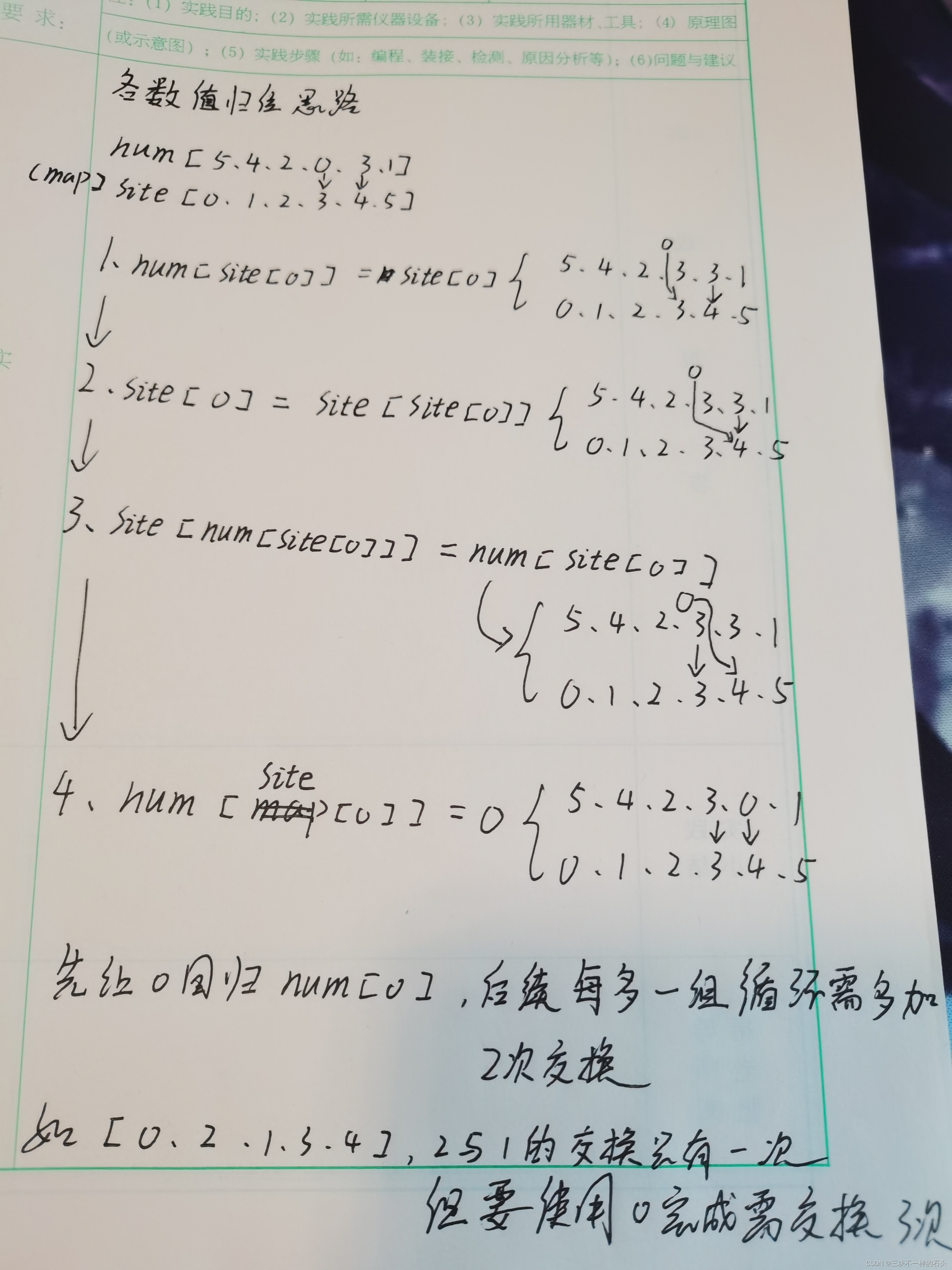
#include<iostream>
#include<map> // 这里为了方便就直接用map了,实际可以全部用数组
using namespace std;
int main()
{
    long N,num[100001],sum=0;
    map<long,long> site;
    cin >> N;
    /*   数据读入并记入对应数组所在的下标   */
    for(long z=0;z<N;z++) {
        cin >> num[z];
        site[num[z]] = z;
    }
    /*   将0回归到0的位置   */
    while (site[0]!=0){
        sum++;
        num[site[0]] = site[0];
        site[0] = site[site[0]];
        site[num[site[0]]] = num[site[0]];
        num[site[0]] = 0;
    }
    /*   开始额外递归   */
    long f = 0;  // 记入需要额外增加的交换次数
    for(long z=1;z<N;z++)
    {
        if(num[z]!=z) // 这里每多递归一次需要额外交换两次
        {
            f+=2;
            while (site[z]!=z){
                sum++;
                long op = site[site[z]];  // 因为z回归过来的数不确定(上面是回归0是确定的),所以需要事先记入他下一个要回归的数
                num[site[z]] = site[z];
                site[z] = site[site[z]];
                site[num[site[z]]] = num[site[z]];
                num[site[z]] = z;
                z = op; // 判断是否刚好符号[0.2.1.3.4] 形式的交换(2和1刚好互相在对方的位置上)
            }
        }
    }
    cout << sum+f;
    return 0;
}





 扫一扫
扫一扫


 843
843

 被折叠的 条评论
为什么被折叠?
被折叠的 条评论
为什么被折叠?
 到【灌水乐园】发言





