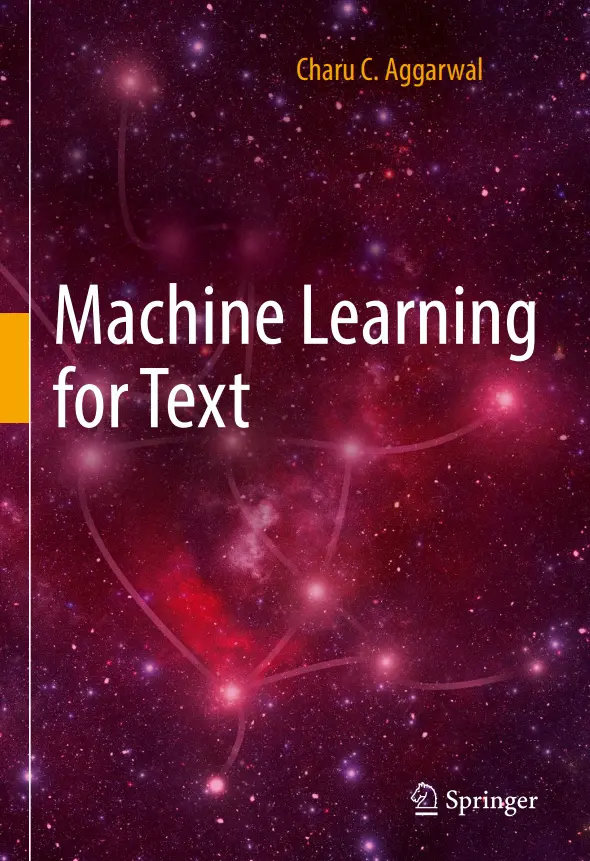
Machine Learning for Text 电子书分享

本书系统地介绍了文本分析领域的核心算法和技术,涵盖信息检索、自然语言处理和机器学习的交叉主题,包括预处理、相似度计算、主题建模、矩阵分解、聚类、分类、回归、深度学习、文本摘要、信息提取、意见挖掘等,适用于计算机科学研究生及研究者。
部署运行你感兴趣的模型镜像

Machine Learning for Text

590

本书介绍

文本分析是一个信息检索、机器学习和自然语言处理界面的领域,本教科书仔细地涵盖了从这些交叉主题中抽取的连贯的组织框架。本教科书的章节分为三类:

基本算法:第一章至第七章讨论了文本机器学习的经典算法,如预处理、相似度计算、主题建模、矩阵分解、聚类、分类、回归和集成分析。

域敏感挖掘:第8章和第9章讨论了结合多媒体和网络等不同领域的文本学习方法,并结合排序和机器学习方法,讨论了信息检索和网络搜索的问题。

以序列为中心的挖掘:第10至14章讨论了各种以序列为中心的语言和自然语言的应用,如特征工程、神经语言模型、深度学习、文本摘要、信息提取、意见挖掘、文本分割和事件检测。

本教材详细介绍了机器学习主题由于内容广泛,根据课程水平,可以从同一本书提供多个课程。尽管演讲以文本为中心,但第3章至第7章涵盖了机器学习算法,这些算法通常在文本数据之外的域内使用。因此,这本书不仅可以用于文本分析,也可以从更广泛的机器学习角度(以文本为背景)提供课程。

本教材以计算机科学研究生以及从事这些相关领域的研究人员、教授和工业从业人员为对象。本教材附有课堂教学解决方案手册。

目录

Chapter 1 Machine Learning For Text: An Introduction

Chapter 2 Text Preparation And Similarity Computation

Chapter 3 Matrix Factorization And Topic Modeling

Chapter 4 Text Clustering

Chapter 5 Text Classification: Basic Models

Chapter 6 Linear Classification And Regression For Text

Chapter 7 Classifier Performance And Evaluation

Chapter 8 Joint Text Mining With Heterogeneous Data

Chapter 9 Information Retrieval And Search Engines

Chapter 10 Text Sequence Modeling And Deep Learning

Chapter 11 Text Summarization

Chapter 12 Information Extraction

Chapter 13 Opinion Mining And Sentiment Analysis

Chapter 14 Text Segmentation And Event Detection
下载地址:Machine Learning for Tex.zip

更多免费电子书,请关注我的简书主页

转载于:https://my.oschina.net/u/3070312/blog/1649396

您可能感兴趣的与本文相关的镜像

TensorFlow-v2.9

TensorFlow-v2.9

TensorFlow

TensorFlow 是由Google Brain 团队开发的开源机器学习框架,广泛应用于深度学习研究和生产环境。 它提供了一个灵活的平台,用于构建和训练各种机器学习模型

Machine Learning for Text By 作者: Charu C. Aggarwal ISBN-10 书号: 3319735306 ISBN-13 书号: 9783319735306 Edition 版本: 1st ed. 出版日期: 2018-03-20 pages 页数: (493 ) Springer 出版超清 $79.99 Text analytics is a field that lies on the interface of information retrieval,machine learning, and natural language processing, and this textbook carefully covers a coherently organized framework drawn from these intersecting topics. The chapters of this textbook is organized into three categories: – Basic algorithms: Chapters 1 through 7 discuss the classical algorithms for machine learning from text such as preprocessing, similarity computation, topic modeling, matrix factorization, clustering, classification, regression, and ensemble analysis. – Domain-sensitive mining: Chapters 8 and 9 discuss the learning methods from text when combined with different domains such as multimedia and the Web. The problem of information retrieval and Web search is also discussed in the context of its relationship with ranking and machine learning methods. – Sequence-centric mining: Chapters 10 through 14 discuss various sequence-centric and natural language applications, such as feature engineering, neural language models, deep learning, text summarization, information extraction, opinion mining, text segmentation, and event detection. This textbook covers machine learning topics for text in detail. Since the coverage is extensive,multiple courses can be offered from the same book, depending on course level. Even though the presentation is text-centric, Chapters 3 to 7 cover machine learning algorithms that are often used indomains beyond text data. Therefore, the book can be used to offer courses not just in text analytics but also from the broader perspective of machine learning (with text as a backdrop). This textbook targets graduate students in computer science, as well as researchers, professors, and industrial practitioners working in these related fields. This textbook is accompanied with a solution
The rich area of text analytics draws ideas from information retrieval, machine learning, and natural language processing. Each of these areas is an active and vibrant field in its own right, and numerous books have been written in each of these different areas. As a result, many of these books have covered some aspects of text analytics, but they have not covered all the areas that a book on learning from text is expected to cover. At this point, a need exists for a focussed book on machine learning from text. This book is a first attempt to integrate all the complexities in the areas of machine learning, information retrieval, and natural language processing in a holistic way, in order to create a coherent and integrated book in the area. Therefore, the chapters are divided into three categories: 1. Fundamental algorithms and models: Many fundamental applications in text analyt- ics, such as matrix factorization, clustering, and classification, have uses in domains beyond text. Nevertheless, these methods need to be tailored to the specialized char- acteristics of text. Chapters 1 through 8 will discuss core analytical methods in the context of machine learning from text. 2. Information retrieval and ranking: Many aspects of information retrieval and rank- ing are closely related to text analytics. For example, ranking SVMs and link-based ranking are often used for learning from text. Chapter 9 will provide an overview of information retrieval methods from the point of view of text mining. 3. Sequence- and natural language-centric text mining: Although multidimensional rep- resentations can be used for basic applications in text analytics, the true richness of the text representation can be leveraged by treating text as sequences. Chapters 10 through 14 will discuss these advanced topics like sequence embedding, deep learning, information extraction, summarization, opinion mining, text segmentation, and event extraction.
评论
添加红包

请填写红包祝福语或标题

红包个数最小为10个

红包金额最低5元

当前余额3.43前往充值 >
需支付:10.00
成就一亿技术人!
领取后你会自动成为博主和红包主的粉丝 规则
hope_wisdom
发出的红包
实付
使用余额支付
点击重新获取
扫码支付
钱包余额 0

抵扣说明:

1.余额是钱包充值的虚拟货币,按照1:1的比例进行支付金额的抵扣。
2.余额无法直接购买下载,可以购买VIP、付费专栏及课程。

余额充值