





 本文详细介绍了Java中阻塞队列的概念、实现方式及应用实例,通过一个简单的生产者-消费者模式模拟,展示了如何利用阻塞队列在多线程环境下进行数据交换与管理。
阻塞队列是Java5线程新特征中的内容,Java定义了阻塞队列的接口java.util.concurrent.BlockingQueue,阻塞队列的概念是:一个指定长度的队列,如果队列满了,添加新元素的操作会被阻塞等待,直到有空位为止。同样,当队列为空时候,请求队列元素的操作同样会阻塞等待,直到有可用元素为止。是一种常用的并发数据结构,常用于生产者-消费者模式。
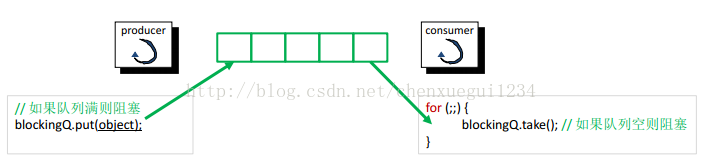
下面我们看一下阻塞队列类结构
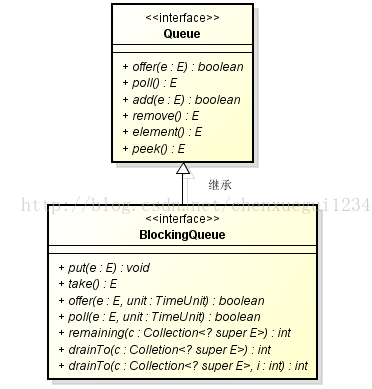
使用BlockingQueue的时候,尽量不要使用Queue继承下来的方法,否则就失去了Blocking的特性了。
在BlockingQueue中,要使用put和take,而非offer和poll。如果要使用offer和poll,也是要使用带等待时间参数的offer和poll。
使用drainTo批量获得其中的内容,能够减少锁的次数。
在Java中,有很多种阻塞队列(BlockingQueue子类):
ArrayBlockingQueue(最常用)
LinkedBlockingQueue
SynchronousQueue
PriorityBlockingQueue
CompletionService(BlockingQueue+ Executor)
TransferQueue(JDK 7中更快的SynchronousQueue)
一个简单阻塞队列模拟
BlockingQueue2类
public class BlockingQ2
	{
		private Object notEmpty = new Object();
		private Object notFull = new Object();
		private Queue<Object> linkedList = new LinkedList<Object>();
		private int maxLength = 10;

		public Object take() throws InterruptedException
		{
			//分别需要对notEmpty和notFull加锁
			synchronized (notEmpty)
			{
				if (linkedList.size() == 0)
				{
					notEmpty.wait();
				}
				synchronized (notFull)
				{
					if (linkedList.size() != maxLength)
					{
						notFull.notifyAll();
					}
					return linkedList.poll();
				}
			}
		}

		public void offer(Object object) throws InterruptedException
		{
			synchronized (notEmpty)
			{
				if (linkedList.size() != 0)
				{
					notEmpty.notifyAll();
				}
				synchronized (notFull)
				{
					if (linkedList.size() == maxLength)
					{
						notFull.wait();
					}
					linkedList.add(object);
				}
			}
		}
	}
MainTest2类
public class MainTest2
	{
		public static void main(String args[])
		{
			BlockingQ2 blockingQ = new BlockingQ2();

			Thread thread1 = new MyThread3(blockingQ,"thread1");
			Thread thread2 = new MyThread4(blockingQ,"thread1");

			thread1.start();
			thread2.start();

		}

	}
class MyThread3 extends Thread
{
	private BlockingQ2 blockingQ;

	public MyThread3(BlockingQ2 blockingQ,String name)
	{
		super(name);
		this.blockingQ = blockingQ;
	}

	public void run()
	{
		for (int i = 0; i < 8; i++)
		{
			try
			{
				this.sleep(300);
				System.out.println("取出元素: " + blockingQ.take());
			}
			catch (InterruptedException e)
			{
				// TODO Auto-generated catch block
				e.printStackTrace();
			}
		}
	}
}

class MyThread4 extends Thread
{
	private BlockingQ2 blockingQ;

	public MyThread4(BlockingQ2 blockingQ,String name)
	{
		super(name);
		this.blockingQ = blockingQ;
	}

	public void run()
	{
		for (int i = 0; i < 10; i++)
		{
			try
			{
				this.sleep(200);
			}
			catch (InterruptedException e)
			{
				// TODO Auto-generated catch block
				e.printStackTrace();
			}
			try
			{
				blockingQ.offer(i);
				System.out.println("插入元素: " + i);
			}
			catch (InterruptedException e)
			{
				e.printStackTrace();
			}

		}

	}
}
运行结果
插入元素: 0
取出元素: 0
插入元素: 1
取出元素: 1
插入元素: 2
插入元素: 3
取出元素: 2
插入元素: 4
取出元素: 3
插入元素: 5
插入元素: 6
取出元素: 4
插入元素: 7
取出元素: 5
插入元素: 8
插入元素: 9
取出元素: 6
取出元素: 7
一个用BlockingQueue实现的生产者-消费者模式;
BlockingQueue4类
public class BlockingQ4
	{
		private BlockingQueue<Integer> queue = new ArrayBlockingQueue<Integer>(10,true);

		public Integer take() throws InterruptedException
		{
			return queue.take();
		}
		public void put(Integer i) throws InterruptedException
		{
			queue.put(i);
		}
	}
MainTest4类
public class MainTest4
	{

		public static void main(String[] args)
		{
			BlockingQ4 blockingQ4 = new BlockingQ4();

			Thread thread7 = new Thread7(blockingQ4);
			Thread thread8 = new Thread8(blockingQ4);

			thread7.start();
			thread8.start();
		}
	}

class Thread7 extends Thread
	{
		private BlockingQ4 blockingQ4;

		public Thread7(BlockingQ4 blockingQ4)
		{
			this.blockingQ4 = blockingQ4;
		}

		public void run()
		{
			try
			{
				for (int i = 0; i < 8; i++)
				{
					System.out.println("tack " + blockingQ4.take());
				}
			}
			catch (InterruptedException e)
			{
				// TODO Auto-generated catch block
				e.printStackTrace();
			}

		}
	}

class Thread8 extends Thread
	{
		private BlockingQ4 blockingQ4;

		public Thread8(BlockingQ4 blockingQ4)
		{
			this.blockingQ4 = blockingQ4;
		}

		public void run()
		{
			try
			{
				for (int i = 0; i < 4; i++)
				{
					blockingQ4.put(i);
					System.out.println("put " + i);
				}
			}
			catch (InterruptedException e)
			{
				// TODO Auto-generated catch block
				e.printStackTrace();
			}

		}
	}
运行结果
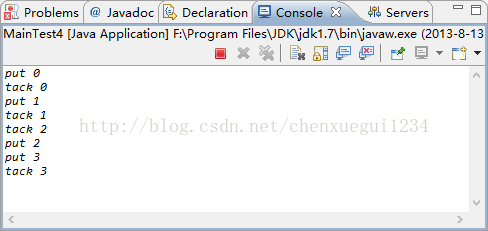
程序中是take8次,可见程序在第五次取的时候发生了阻塞





 扫一扫
扫一扫


 1207
1207

 被折叠的 条评论
为什么被折叠?
被折叠的 条评论
为什么被折叠?
 到【灌水乐园】发言





