 Spring Cache 深入理解 CacheInterceptor



 本文探讨了Spring Cache的核心组件CacheInterceptor,它作为MethodInterceptor实现方法拦截。主要逻辑集中在execute方法中,处理CachePutOperation、CacheableOperation、CacheEvictOperation等缓存操作。@CachePut在满足条件的情况下更新缓存,@Cacheable根据缓存情况决定是否执行方法,@CacheEvict可在方法前后删除缓存。
打开Spring Cache的核心缓存拦截器CacheInterceptor,可以看到具体实现:
public class CacheInterceptor extends CacheAspectSupport implements MethodInterceptor, Serializable {

	@Override
	public Object invoke(final MethodInvocation invocation) throws Throwable {
		Method method = invocation.getMethod();

		CacheOperationInvoker aopAllianceInvoker = new CacheOperationInvoker() {
			@Override
			public Object invoke() {
				try {
					return invocation.proceed();
				}
				catch (Throwable ex) {
					throw new ThrowableWrapper(ex);
				}
			}
		};

		try {
			return execute(aopAllianceInvoker, invocation.getThis(), method, invocation.getArguments());
		}
		catch (CacheOperationInvoker.ThrowableWrapper th) {
			throw th.getOriginal();
		}
	}
}
CacheInterceptor默认实现了Spring aop的MethodInterceptor接口,MethodInterceptor的功能是做方法拦截。拦截的方法都会调用invoke方法,在invoke方法里面主要缓存逻辑是在execute方法里面,该方法是继承了父类CacheAspectSupport。
protected Object execute(CacheOperationInvoker invoker, Object target, Method method, Object[] args) {
		// Check whether aspect is enabled (to cope with cases where the AJ is pulled in automatically)
		if (this.initialized) {
			Class<?> targetClass = getTargetClass(target);
			//获取执行方法上所有的缓存操作集合。如果有缓存操作则执行到execute(...),如果没有就执行invoker.invoke()直接调用执行方法了
			Collection<CacheOperation> operations = getCacheOperationSource().getCacheOperations(method, targetClass);
			if (!CollectionUtils.isEmpty(operations)) {
				return execute(invoker, method, new CacheOperationContexts(operations, method, args, target, targetClass));
			}
		}

		return invoker.invoke();
	}
集合Collection operations中存放了所有的缓存操作CachePutOperation、CacheableOperation、CacheEvictOperation,我们知道spring cache常用的三种缓存操作:
- @CachePut – 执行方法后,将方法返回结果存放到缓存中。不管有没有缓存过,执行方法都会执行,并缓存返回结果(unless可以否决进行缓存)。(当然,这里说的缓存都要满足condition条件)
- @Cacheable – 如果没有缓存过,获取执行方法的返回结果;如果缓存过,则直接从缓存中获取,不再执行方法。
- @CacheEvict – 如果设置了beforeIntercepte则在方法执行前进行缓存删除操作,如果没有,则在执行方法调用完后进行缓存删除操作。
private Object execute(final CacheOperationInvoker invoker, Method method, CacheOperationContexts contexts) {
		// Special handling of synchronized invocation
		if (contexts.isSynchronized()) {
			CacheOperationContext context = contexts.get(CacheableOperation.class).iterator().next();
			if (isConditionPassing(context, CacheOperationExpressionEvaluator.NO_RESULT)) {
				Object key = generateKey(context, CacheOperationExpressionEvaluator.NO_RESULT);
				Cache cache = context.getCaches().iterator().next();
				try {
					return wrapCacheValue(method, cache.get(key, new Callable<Object>() {
						@Override
						public Object call() throws Exception {
							return unwrapReturnValue(invokeOperation(invoker));
						}
					}));
				}
				catch (Cache.ValueRetrievalException ex) {
					// The invoker wraps any Throwable in a ThrowableWrapper instance so we
					// can just make sure that one bubbles up the stack.
					throw (CacheOperationInvoker.ThrowableWrapper) ex.getCause();
				}
			}
			else {
				// No caching required, only call the underlying method
				return invokeOperation(invoker);
			}
		}


		// 处理beforeIntercepte=true的缓存删除操作
		processCacheEvicts(contexts.get(CacheEvictOperation.class), true,
				CacheOperationExpressionEvaluator.NO_RESULT);

		// 从缓存中查找,是否有匹配@Cacheable的缓存数据
		Cache.ValueWrapper cacheHit = findCachedItem(contexts.get(CacheableOperation.class));

		// 如果@Cacheable没有被缓存,那么就需要将数据缓存起来,这里将@Cacheable操作收集成CachePutRequest集合,以便后续做@CachePut缓存数据存放。
		List<CachePutRequest> cachePutRequests = new LinkedList<CachePutRequest>();
		if (cacheHit == null) {
			collectPutRequests(contexts.get(CacheableOperation.class),
					CacheOperationExpressionEvaluator.NO_RESULT, cachePutRequests);
		}

		Object cacheValue;
		Object returnValue;
		//如果没有@CachePut操作,就使用@Cacheable获取的结果(可能也没有@Cableable,所以result可能为空)。
		if (cacheHit != null && cachePutRequests.isEmpty() && !hasCachePut(contexts)) {
			//如果没有@CachePut操作,并且cacheHit不为空,说明命中缓存了,直接返回缓存结果
			cacheValue = cacheHit.get();
			returnValue = wrapCacheValue(method, cacheValue);
		}
		else {
			// 否则执行具体方法内容,返回缓存的结果
			returnValue = invokeOperation(invoker);
			cacheValue = unwrapReturnValue(returnValue);
		}

		// Collect any explicit @CachePuts
		collectPutRequests(contexts.get(CachePutOperation.class), cacheValue, cachePutRequests);

		// Process any collected put requests, either from @CachePut or a @Cacheable miss
		for (CachePutRequest cachePutRequest : cachePutRequests) {
			cachePutRequest.apply(cacheValue);
		}

		// Process any late evictions
		processCacheEvicts(contexts.get(CacheEvictOperation.class), false, cacheValue);

		return returnValue;
	}

	//根据key从缓存中查找,返回的结果是ValueWrapper,它是返回结果的包装器
	private Cache.ValueWrapper findCachedItem(Collection<CacheOperationContext> contexts) {
		Object result = CacheOperationExpressionEvaluator.NO_RESULT;
		for (CacheOperationContext context : contexts) {
			if (isConditionPassing(context, result)) {
				Object key = generateKey(context, result);
				Cache.ValueWrapper cached = findInCaches(context, key);
				if (cached != null) {
					return cached;
				}
				else {
					if (logger.isTraceEnabled()) {
						logger.trace("No cache entry for key '" + key + "' in cache(s) " + context.getCacheNames());
					}
				}
			}
		}
		return null;
	}

	private Cache.ValueWrapper findInCaches(CacheOperationContext context, Object key) {
		for (Cache cache : context.getCaches()) {
			Cache.ValueWrapper wrapper = doGet(cache, key);
			if (wrapper != null) {
				if (logger.isTraceEnabled()) {
					logger.trace("Cache entry for key '" + key + "' found in cache '" + cache.getName() + "'");
				}
				return wrapper;
			}
		}
		return null;
	}
具体整个流程是这样的:
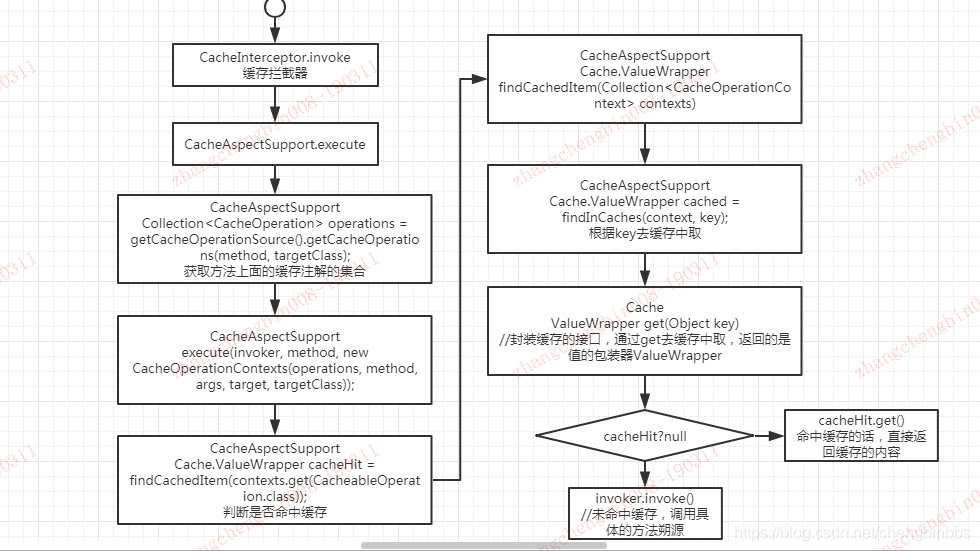
参考:https://my.oschina.net/xiaoqiyiye/blog/1624344





 扫一扫
扫一扫


 784
784

 被折叠的 条评论
为什么被折叠?
被折叠的 条评论
为什么被折叠?
 到【灌水乐园】发言





