



 本文详细介绍了原型设计模式的意图、问题、讨论、结构、示例、检查列表及使用指南,通过C++示例展示了如何在实际场景中应用此模式。模式允许通过复制原型对象来创建新的实例,避免了直接使用new操作符,提供了更灵活的实例化方式。
Prototype Design Pattern
Why read if you can watch?
Watch design patterns video tutorialIntent
01- Specify the kinds of objects to create using a prototypical instance, and create new objects by copying this prototype.
- Co-opt one instance of a class for use as a breeder of all future instances.
- The
newoperator considered harmful.
Problem
02Application “hard wires” the class of object to create in each “new” expression.
Discussion
03 Declare an abstract base class that specifies a pure virtual “clone” method, and, maintains a dictionary of all “cloneable” concrete derived classes. Any class that needs a “polymorphic constructor” capability: derives itself from the abstract base class, registers its prototypical instance, and implements the clone() operation.
The client then, instead of writing code that invokes the “new” operator on a hard-wired class name, calls a “clone” operation on the abstract base class, supplying a string or enumerated data type that designates the particular concrete derived class desired.
Structure
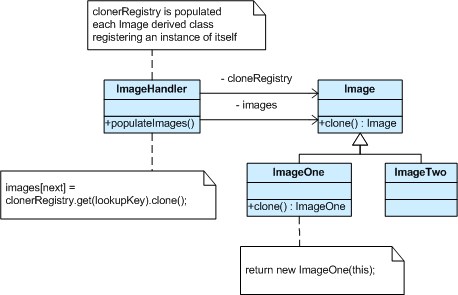
05The Factory knows how to find the correct Prototype, and each Product knows how to spawn new instances of itself.
Example
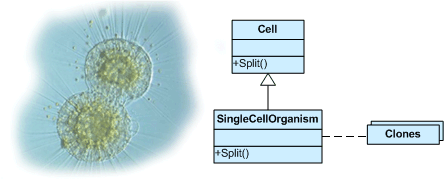
06The Prototype pattern specifies the kind of objects to create using a prototypical instance. Prototypes of new products are often built prior to full production, but in this example, the prototype is passive and does not participate in copying itself. The mitotic division of a cell - resulting in two identical cells - is an example of a prototype that plays an active role in copying itself and thus, demonstrates the Prototype pattern. When a cell splits, two cells of identical genotvpe result. In other words, the cell clones itself.
Check list
07- Add a
clone()method to the existing “product” hierarchy. - Design a “registry” that maintains a cache of prototypical objects. The registry could be encapsulated in a new
Factoryclass, or in the base class of the “product” hierarchy. - Design a factory method that: may (or may not) accept arguments, finds the correct prototype object, calls
clone()on that object, and returns the result. - The client replaces all references to the
newoperator with calls to the factory method.
Rules of thumb
08- Sometimes creational patterns are competitors: there are cases when either Prototype or Abstract Factory could be used properly. At other times they are complementory: Abstract Factory might store a set of Prototypes from which to clone and return product objects. Abstract Factory, Builder, and Prototype can use Singleton in their implementations.
- Abstract Factory classes are often implemented with Factory Methods, but they can be implemented using Prototype.
- Factory Method: creation through inheritance. Protoype: creation through delegation.
- Often, designs start out using Factory Method (less complicated, more customizable, subclasses proliferate) and evolve toward Abstract Factory, Protoype, or Builder (more flexible, more complex) as the designer discovers where more flexibility is needed.
- Prototype doesn’t require subclassing, but it does require an “initialize” operation. Factory Method requires subclassing, but doesn’t require Initialize.
- Designs that make heavy use of the Composite and Decorator patterns often can benefit from Prototype as well.
- Prototype co-opts one instance of a class for use as a breeder of all future instances.
- Prototypes are useful when object initialization is expensive, and you anticipate few variations on the initialization parameters. In this context, Prototype can avoid expensive “creation from scratch”, and support cheap cloning of a pre-initialized prototype.
- Prototype is unique among the other creational patterns in that it doesn’t require a class – only an object. Object-oriented languages like Self and Omega that do away with classes completely rely on prototypes for creating new objects.
Read next
This article is taken from the book Design Patterns - Simply.
ALL design patterns are compiled there. The book is written in a clear and simple language that makes it easy to read and understand (just like this article).
It is a part of our Design Patterns Course. We distribute it in PDF format, so it will be available for downloading in 10 seconds!
Prototype in C++: Before and after
Before
01The architect has done an admirable job of decoupling the client from Stooge concrete derived classes, and, exercising polymorphism. But there remains coupling where instances are actually created.
02class Stooge
{
public:
virtual void slap_stick() = 0;
};
class Larry: public Stooge
{
public:
void slap_stick()
{
cout << "Larry: poke eyes\n";
}
};
class Moe: public Stooge
{
public:
void slap_stick()
{
cout << "Moe: slap head\n";
}
};
class Curly: public Stooge
{
public:
void slap_stick()
{
cout << "Curly: suffer abuse\n";
}
};
int main()
{
vector roles;
int choice;
while (true)
{
cout << "Larry(1) Moe(2) Curly(3) Go(0): ";
cin >> choice;
if (choice == 0)
break;
else if (choice == 1)
roles.push_back(new Larry);
else if (choice == 2)
roles.push_back(new Moe);
else
roles.push_back(new Curly);
}
for (int i = 0; i < roles.size(); i++)
roles[i]->slap_stick();
for (int i = 0; i < roles.size(); i++)
delete roles[i];
}
Larry(1) Moe(2) Curly(3) Go(0): 2Larry(1) Moe(2) Curly(3) Go(0): 1Larry(1) Moe(2) Curly(3) Go(0): 3Larry(1) Moe(2) Curly(3) Go(0): 0Moe: slap headLarry: poke eyesCurly: suffer abuse
After
03 A clone() method has been added to the Stooge hierarchy. Each derived class implements that method by returning an instance of itself. A Factory class has been introduced that main- tains a suite of “breeder” objects (aka proto- types), and knows how to delegate to the correct prototype.
class Stooge {
public:
   virtual Stooge* clone() = 0;
   virtual void slap_stick() = 0;
};

class Factory {
public:
   static Stooge* make_stooge( int choice );
private:
   static Stooge* s_prototypes[4];
};

int main() {
   vector roles;
   int             choice;

   while (true) {
      cout << "Larry(1) Moe(2) Curly(3) Go(0): ";
      cin >> choice;
      if (choice == 0)
         break;
      roles.push_back(
         Factory::make_stooge( choice ) );
   }

   for (int i=0; i < roles.size(); ++i)
      roles[i]->slap_stick();
   for (int i=0; i < roles.size(); ++i)
      delete roles[i];
}

class Larry : public Stooge {
public:
   Stooge*   clone() { return new Larry; }
   void slap_stick() {
      cout << "Larry: poke eyes\n"; }
};
class Moe : public Stooge {
public:
   Stooge*   clone() { return new Moe; }
   void slap_stick() {
      cout << "Moe: slap head\n"; }
};
class Curly : public Stooge {
public:
   Stooge*   clone() { return new Curly; }
   void slap_stick() {
      cout << "Curly: suffer abuse\n"; }
};

Stooge* Factory::s_prototypes[] = {
   0, new Larry, new Moe, new Curly
};
Stooge* Factory::make_stooge( int choice ) {
   return s_prototypes[choice]->clone();
}
http://sourcemaking.com/design_patterns/prototype





 扫一扫
扫一扫


 1436
1436

 被折叠的 条评论
为什么被折叠?
被折叠的 条评论
为什么被折叠?
 到【灌水乐园】发言





