


 本文通过使用Java的BlockingQueue实现生产者消费者模式,详细介绍了如何利用volatile、CAS、AtomicInteger等技术确保线程安全及高效的数据交换。示例代码展示了如何在生产者和消费者线程间进行数据传递,并在特定条件下停止生产过程。
前面有我写了个“传统生产消费者模式例子” 传统版需要自己控制等待,唤醒等操作细节同时需要兼顾效率和线程安全,而并发包下的BlockingQueue我们不需要关心什么时候需要阻塞线程,什么时候需要唤醒线程,因为这一切BlockingQueue都给一手包办了。
本例子所涉及到的知识点volatile/CAS/AtomicInteger/BlockQueue/线程交互/原子引用,需要了解详情可以看下我单独写的这些知识点文章,这里不过多叙述。
下面我们来看下例子:
import java.util.concurrent.ArrayBlockingQueue;
import java.util.concurrent.BlockingQueue;
import java.util.concurrent.TimeUnit;
import java.util.concurrent.atomic.AtomicInteger;

class MyResource{//资源类
    private  volatile boolean FLAG = true;//默认开启,进行生产加消费
    private AtomicInteger atomicInteger = new AtomicInteger();

    BlockingQueue<String> blockingQueue = null;

    public MyResource(BlockingQueue<String> blockingQueue) {
        this.blockingQueue = blockingQueue;
        System.out.println(blockingQueue.getClass().getName());
    }

    /**
     * 生产
     * @throws Exception
     */
    public void myProd() throws Exception {
        String data = null;
        boolean retValue;
        while (FLAG){
            data = atomicInteger.incrementAndGet()+"";
            retValue = blockingQueue.offer(data, 2L, TimeUnit.SECONDS);//保留2秒是为了看到效果
            if(retValue){
                System.out.println(Thread.currentThread().getName()+"\t 插入队列"+data+"成功");
            }else {
                System.out.println(Thread.currentThread().getName()+"\t 插入队列"+data+"失败");
            }
            TimeUnit.SECONDS.sleep(2);//同样是为了方便看效果2秒钟一次
        }
        System.out.println(Thread.currentThread().getName()+"\t 生产结束,表示FLAG = false");
    }

    /**
     * 消费
     * @throws Exception
     */
    public void myConsumer() throws Exception {
        String result = null;
        while (FLAG){
            result = blockingQueue.poll(2l, TimeUnit.SECONDS);//2秒钟取不到就不取了
            if(null == result || result.equalsIgnoreCase("")){
                FLAG = false;
                System.out.println(Thread.currentThread().getName()+"\t 超过2秒没有取到值,消费退出。");
                return;
            }
            System.out.println(Thread.currentThread().getName()+"\t 消费队列"+result+"成功");
        }
    }

    public void stop(){
        this.FLAG = false;
    }

}

public class ConsumerBlockQueueDemo {
    /**
     * 例子所涉及到的知识点volatile/CAS/AtomicInteger/BlockQueue/线程交互/原子引用
     * @param args
     */
    public static void main(String[] args) {
        MyResource myResource = new MyResource(new ArrayBlockingQueue<>(10));

        new Thread(()->{
            System.out.println(Thread.currentThread().getName()+"\t 生产线程启动");
            try {
                myResource.myProd();
            } catch (Exception e) {
                e.printStackTrace();
            }
        },"生产线程").start();

        new Thread(()->{
            System.out.println(Thread.currentThread().getName()+"\t 消费线程启动");
            try {
                myResource.myConsumer();
            } catch (Exception e) {
                e.printStackTrace();
            }
        },"消费线程").start();

        //暂停5秒,后调用暂停生产
        try {
            TimeUnit.SECONDS.sleep(5);
        } catch (InterruptedException e) {
            e.printStackTrace();
        }

        System.out.println("5秒时间到,main线程叫停结束");
        myResource.stop();
    }
}
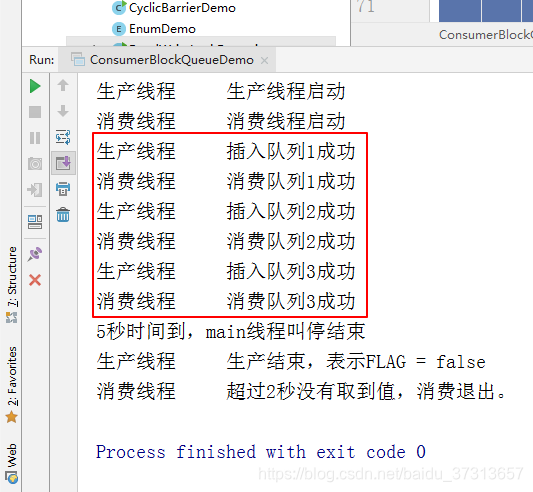
运行结果:





 扫一扫
扫一扫


 2001
2001

 被折叠的 条评论
为什么被折叠?
被折叠的 条评论
为什么被折叠?
 到【灌水乐园】发言





