


2. Pricing Conventions, Discounting, and Arbitrage
2.1 US Treasury
2.1.1 Classification of the U.S. Treasuries
T-Bills: original maturity is one year or shorter.
T-Notes: original maturity is longer than one year and up to 10 years.
T-Bonds: orginal maturity is longer than 10 years.
2.1.2 Day-count Conventions
Actual/Actual: most commonly for government bonds
30/360: most commonly for corporate and municipal bonds
Actual/360: most commonly for money markets(Vary from market to market)
2.1.3 Treasury Bills
Treasury bills are instruments issued by government to finance its short-term funding needs. They last one year or less.
Quotes for U.S. Treasury Bills
- The bid quote gives the price at which a market maker is prepared to buy the Treasury bill.
- The ask quote (or the offer quote) gives the price at which a market maker is prepared to sell the Treasury bill.
- The mid-market price is the average of bid and ask prices.
The quoted price (QQQ) and the cash price (CCC)
C=100−n360×QC=100-\frac{n}{360}\times QC=100−360n×Q
- where nnn is the number of calendar days until the maturity of the Treasury bill, whose face value is USD 100100100.
- The quote QQQ is the interest earned over a 360-day period as a percentage of the face value.
Consider a Treasury bill and there are 90 days until the maturity. The bid quote is 1.640 and the ask quote is 1.630. What is the bid and ask cash price?
The bid cash price =100−90360×1.640=99.5900= 100-\frac{90}{360}\times 1.640=99.5900=100−36090×1.640=99.5900
The ask cash price =100−90360×1.630=99.5925= 100-\frac{90}{360}\times 1.630=99.5925=100−36090×1.630=99.5925
Investors can sell the Treasury bill to the market marker for 99.590099.590099.5900 per USD 100 of face value.
Investors can buy the Treasury bill from the market maker for 99.592599.592599.5925 per USD 100 of face value.
The mid-market price is the average of the bid and ask prices, which is USD 99.59125=(99.5900+99.5925)/299.59125=(99.5900+99.5925)/299.59125=(99.5900+99.5925)/2
2.1.4 Treasury Bonds
Bonds with a maturity lasts more than one year are treasury bond.
Bonds with a maturity between one and ten years are sometimes referred to as treasury notes.
Price Quotes for Treasury Bonds follows “32nds” quotation convention.
If the bond quoted as 83−583-583−5 and par value of the bond is $ 1,000,0001,000,0001,000,000, the price of the bond is (83+532)%×1,000,000=83,156.25(83+\frac{5}{32})\%\times1,000,000=83,156.25(83+325)%×1,000,000=83,156.25
Cash price(Dirty price) = Quoted price(Clean) + accrued interest
Accrued interest(AI) is the interest earned between the most recent coupon date and the settlement date.
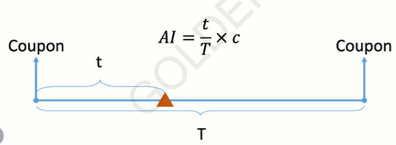
The price of a U.S. Treasury bond is quoted as 98.098.098.0. It is sold in a transaction settled on June 27. Coupons are paid at the rate of 6%6\%6% per year on March 16 and September 15. What is the cash price?
There are 184184184 days between payments and 104104104 days between the last coupon and the settlement date.
Accrued interest: 3×10⁴/184=1.69573\times104/184=1.69573×104/184=1.6957
Cash price: 98+1.6957=99.695798+1.6957=99.695798+1.6957=99.6957
2.1.4 STRIPS
STRIPS is an acronym separate trading of registered interest and principal of securities.
STRIPS are created by investment dealers when a coupon-bearing bond is delivered to the Treasury and exchanged for its principal and coupon components.
- C-STRIPS(or TINTs, INTs): The securities created from the coupon payments.
- P-STRIPS(or TPs, Ps): The securities created from principal payments.
Creation of C-STRIPS and P-STRIPS from the May 15, 2030 6.25%6.25\%6.25% bond on March 9,2018 (Par value is 1 million).
| Date | C-STRIP Face Value | P-STRIP Face Value |
|---|---|---|
| May 15, 2018 | 31,25031,25031,250 | |
| November 15, 2018 | 31,25031,25031,250 | |
| May 15, 2019 | 31,25031,25031,250 | |
| November 15, 2018 | 31,25031,25031,250 | |
| … | … | … |
| November 15, 2029 | 31,25031,25031,250 | |
| May 15, 2030 | 31,25031,25031,250 | 1,000,0001,000,0001,000,000 |
2.2 The Law of One Price
2.2.1 The Law of One Price and Arbitrage
If two portfolios provide the same future cash flows, they should sell for the same price. If the law of one price did not hold, there would be theoretical arbitrage opportunities.
The existence of traders pursuing arbitrage opportunities will usually cause market prices to move until the existence of the arbitrage opportunity is eliminated.
The highly liquid bond have a higher price than the relatively illiquid bond.
A convergence arbitrage: an arbitrageur can buy illiquid bond and sell liquid bond. The prices of two portfolios are expected to converge to the same value because they promise the same cash flow.
2.2.2 Replicating Bond Cash Flows
You can trade bonds lasting 0.50.50.5 years(Bond A) and one year (Bond B) that have coupons of 3%3\%3% and 4%4\%4%, respectively. If these bonds pay their coupons on a semi-annual basis, how could you use them to replicate the cash flows on a one-year bond paying a 5%5\%5% semi-annual coupon(Bond C)?
The cash flow structure is shown below:
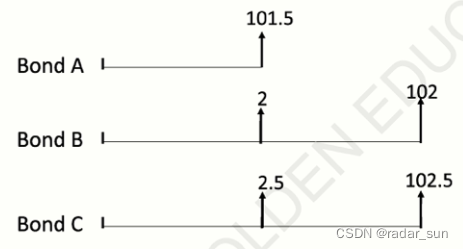
{101.5×A+2×B=2.5102×B=102.5→{A=0.00483B=1.0049 \begin{cases} 101.5\times A +2\times B=2.5 \\ 102\times B=102.5 \end{cases} \to \begin{cases} A=0.00483 \\ B=1.0049\end{cases} {101.5×A+2×B=2.5102×B=102.5→{A=0.00483B=1.0049
If Bond A is trading at USD 99.599.599.5 and Bond B is trading at USD 100.9100.9100.9. Is there any arbitrage opportunities if Bond C is trading at USD 101101101? What should we do?
0.00483×99.5+1.0049×100.9=101.8750.00483\times99.5+1.0049\times100.9=101.8750.00483×99.5+1.0049×100.9=101.875
Bond C is undervalued if trading at USD 101101101, so we can buy Bond C and sell Bond A and Bond B.






 扫一扫
扫一扫


 6351
6351

 被折叠的 条评论
为什么被折叠?
被折叠的 条评论
为什么被折叠?
 到【灌水乐园】发言





