



程序设计之链表2
链表
考查链表的数据结构,需利用指针变量才能实现,一个结点中应包含一个指针变量,用来存放下一个结点的地址。
建立单向链表的一般步骤是:建立头指针 -> 建立第一个结点 -> 头指针指向第一个结点 -> 建立第二个结点 -> 头指针指向第二个结点
-> ··· -> 最后一个结点的指针指向
N
U
L
L
NULL
NULL。
问题2_1
函数 f u n fun fun 的功能是:将不带头结点的单向链表逆置,即若原链表中从头自尾结点数据域依次为 2 、 4 、 6 、 8 、 10 2、4、6、8、10 2、4、6、8、10 ,逆置后,依次为 10 、 8 、 6 、 4 、 2 10、8、6、4、2 10、8、6、4、2 。
代码2_1
#include<stdio.h>
#include<stdlib.h>

#define N 5


typedef struct node{
	int data;
	struct node *next;
}NODE;

NODE *fun(NODE *h){
	NODE *p, *q, *r;
	p = h;
	if(p==NULL)
		return NULL;
	q = p->next;
	p->next = NULL;
	while(q){
		r = q->next;
		q->next = p;
		p = q;
		q = r;
	}
	return p;
}

NODE *creatlist(int a[]){
	NODE *h, *p, *q;
	int i;
	h = NULL;
	for(i=0; i<N; i++){
		q = (NODE*)malloc(sizeof(NODE));
		q->data = a[i];
		q->next = NULL;
		if(h==NULL)
			h = p = q;
		else{
			p->next = q;
			p = q;
		}
	}
	return h;
}

void outlist(NODE *h){
	NODE *p;
	p = h;
	if(p==NULL)
		printf("The list is NULL!\n");
	else{
		printf("\nHead");
		do{
			printf("->%d", p->data);
			p = p->next;
		}while(p!=NULL);
		printf("->End\n");
	}
}

void main(void){
	NODE *head;
	int a[N] = {2, 4, 6, 8, 10};
	head = creatlist(a);
	printf("\nThe original list:\n");
	outlist(head);
	head = fun(head);
	printf("\nThe list after inverting:\n");
	outlist(head);
}
结果2_1

问题2_2
函数 f u n fun fun 的功能是:将不带头结点的单向链表结点数据中的数据从小到大排序。即若原链表中从头自尾结点数据域依次为 10 、 4 、 2 、 8 、 6 10、4、2、8、6 10、4、2、8、6 ,排序后,依次为 2 、 4 、 6 、 8 、 10 2、4、6、8、10 2、4、6、8、10 。
代码2_2
#include<stdio.h>
#include<stdlib.h>

#define N 6
typedef struct node{
	int data;
	struct node *next;
}NODE;

void fun(NODE *h){
	NODE *p, *q;
	int t;
	p = h;
	while(p){
		q = p->next;
		while(q){
			if(p->data>q->data){
				t = p->data;
				p->data = q->data;
				q->data = t;
			}
			q = q->next;
		}
		p = p->next;
	}
}

NODE *creatlist(int a[]){
	NODE *h, *p, *q;
	int i;
	h = NULL;
	for(i=0; i<N; i++){
		q = (NODE*)malloc(sizeof(NODE));
		q->data = a[i];
		q->next = NULL;
		if(h==NULL)
			h = p = q;
		else{
			p->next = q;
			p = q;
		}
	}
	return h;
}

void outlist(NODE *h){
	NODE *p;
	p = h;
	if(p==NULL)
		printf("The list is NULL!\n");
	else{
		printf("\nHead");
		do{
			printf("->%d", p->data);
			p = p->next;
		}
		while(p!=NULL);
		printf("->End\n");
	}
}

void main(void){
	NODE *head;
	int a[N] = {0, 10, 4, 2, 8, 6};
	head = creatlist(a);
	printf("\nThe original list:\n");
	outlist(head);
	fun(head);
	printf("\nThe list after inverting :\n");
	outlist(head);
}
结果2_2

问题2_3
在带头结点的单向链表中,查找数据域中值为 c h ch ch 的结点。找到后通过函数值返回该结点在链表中所处的顺序号;若不存在值为 c h ch ch 的结点,函数返回 0 值。
代码2_3
#include<stdio.h>
#include<stdlib.h>

#define N 8

typedef struct list{
	int data;
	struct list *next;
}SLIST;

SLIST *creatlist(char *);
void ooutlist(SLIST *);

int fun(SLIST *h, char ch){
	SLIST *p;
	int n=0;
	p = h->next;
	while(p!=NULL){
		n++;
		if(p->data==ch)
			return n;
		else
			p = p->next;
	}
	return 0;
}

void main(void){
	SLIST *head;
	int k;
	char ch;
	char a[N] = {'z', 'y', 's', 'd', 'a', 'o'};
	head = creatlist(a);
	outlist(head);
	printf("Enter a letter: ");
	scanf("%c", &ch);
	k = fun(head, ch);
	if(k==0)
		printf("\nNot found!\n");
	else
		printf("The sequence number is : %d\n", k);
}

SLIST *creatlist(char *a){
	SLIST *h, *p, *q;
	int i;
	h = p = (SLIST*)malloc(sizeof(SLIST));
	for(i=0; i<N; i++){
		q = (SLIST*)malloc(sizeof(SLIST));
		q->data = a[i];
		p->next = q;
		p = q;
	}
	p->next = 0;
	return h;
}

void outlist(SLIST *h){
	SLIST *p;
	p = h->next;
	if(p==NULL)
		printf("\nThe list is NULL!\n");
	else{
		printf("\nHead");
		do{
			printf("->%c", p->data);
			p = p->next;
		}while(p!=NULL);
	}
	printf("->End\n");
}
结果2_3

问题2_4
函数 f u n fun fun 的功能是 :统计带头结点的单向链表中结点的个数,并存放在形参 n n n 所指的存储单元中。
代码2_4
#include<stdio.h>
#include<stdlib.h>

#define N 8

typedef struct list{
	int data;
	struct list *next;
}SLIST;

SLIST *creatlist(int *);
void ooutlist(SLIST *);

int fun(SLIST *h, int *n){
	SLIST *p;
	p = h->next;
	while(p!=NULL){
		(*n)++;
		p = p->next;
	}
	return 0;
}

void main(void){
	SLIST *head;
	int a[N] = {12, 87, 45, 32, 91, 16, 20, 48}, num;
	head = creatlist(a);
	outlist(head);
	fun(head, &num);
	printf("\nNumber = %d\n", num);
}

SLIST *creatlist(int *a){
	SLIST *h, *p, *q;
	int i;
	h = p = (SLIST*)malloc(sizeof(SLIST));
	for(i=0; i<N; i++){
		q = (SLIST*)malloc(sizeof(SLIST));
		q->data = a[i];
		p->next = q;
		p = q;
	}
	p->next = 0;
	return h;
}

void outlist(SLIST *h){
	SLIST *p;
	p = h->next;
	if(p==NULL)
		printf("\nThe list is NULL!\n");
	else{
		printf("\nHead");
		do{
			printf("->%d", p->data);
			p = p->next;
		}while(p!=NULL);
	}
	printf("->End\n");
}
结果2_4

问题2_5
函数 f u n fun fun 的功能是 :将链单向链表结点(不包括头结点)数据为偶数的值累加起来,并且作为函数值返回。
代码2_5
#include<stdio.h>
#include<conio.h>
#include<stdlib.h>

typedef struct aa{
	int data;
	struct aa *next;
}NODE;

int fun(NODE * h){
	int sum=0;
	NODE *p;
	p = h->next;
	while(p){
		if(p->data%2==0)
			sum += p->data;
		p = p->next;
	}
	return sum;
}

NODE *creatlink(int n){
	NODE *h, *p, *s;
	int i;
	h = p = (NODE*)malloc(sizeof(NODE));
	for(i=1; i<n; i++){
		s = (NODE*)malloc(sizeof(NODE));
		s->data = rand()%16;
		s->next = p->next;
		p->next = s;
		p = p->next;
	}
	p->next = NULL;
	return h;
}

outlink(NODE *h){
	NODE *p;
	p = h->next;
	printf("\n\nThe list : \n\n HEAD");
	while(p){
		printf("->%d", p->data);
		p = p->next;
	}
	printf("\n");
}

void main(void){
	NODE *head;
	int sum;
	head = creatlink(10);
	outlink(head);
	sum = fun(head);
	printf("\nSum = %d", sum);
}
结果2_5

问题2_6
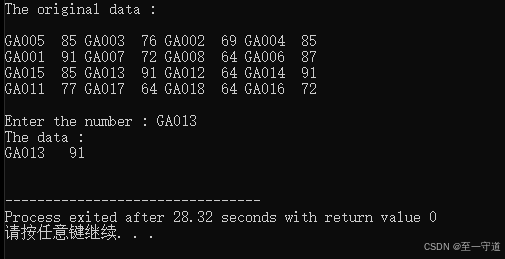
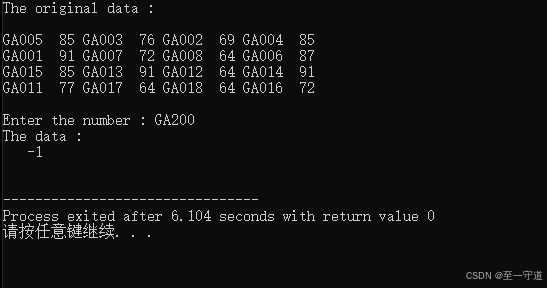
学生的记录由学号和成绩组成,N名学生的数据已放入主函数中的结构体数组 s 中,函数 f u n fun fun 的功能是 :函数返回该学号的学生数据,指定的学号在主函数中输入。若没有找到指定学号,在结构体变量中给学号置空串,给成绩置 -1,作为函数值返回。(用于字符串比较的函数是strcmp)。
代码2_6
#include<stdio.h>
#include<string.h>

#define N 16

typedef struct{
	char num[10];
	int s;
}STREC;

STREC fun(STREC *a, char *b){
	int i;
	STREC str = {"\0", -1}; // 若没有找到指定的学号,在结构体变量中给学号置空串,给成绩置 -1
	for(i=0; i<N; i++){
		if(strcmp(a[i].num, b)==0) // 找到指定学号的学生数据
			str = a[i];
	}
	return str;  // 返回学生记录
}

void main(void){
	STREC s[N] = {{"GA005", 85}, {"GA003", 76}, {"GA002", 69}, {"GA004", 85},
				  {"GA001", 91}, {"GA007", 72}, {"GA008", 64}, {"GA006", 87},
				  {"GA015", 85}, {"GA013", 91}, {"GA012", 64}, {"GA014", 91},
				  {"GA011", 77}, {"GA017", 64}, {"GA018", 64}, {"GA016", 72}};
	STREC h;
	char m[10];
	int i;
	FILE *out;
	printf("The original data : \n");
	for(i=0; i<N; i++){
		if(i%4==0)
			printf("\n");
			printf("%s %3d ", s[i].num, s[i].s);
	}
	printf("\n\nEnter the number : ");
	gets(m);
	h = fun(s, m);
	printf("The data : ");
	printf("\n%s %4d\n", h.num, h.s);
	printf("\n");
	out = fopen("out.dat", "w");
	h = fun(s, "GA013");
	fprintf(out, "%s %4d\n", h.num, h.s);
	fclose(out);
}
结果2_6





 扫一扫
扫一扫


 839
839

 被折叠的 条评论
为什么被折叠?
被折叠的 条评论
为什么被折叠?
 到【灌水乐园】发言





