


#include <stdio.h>
#include <stdlib.h>
#include <string.h>

#define maxLen 1000000
#define F(x, y, z) (((x) & (y)) | ((~x) & (z)))
#define G(x, y, z) (((x) & (z)) | ((y) & (~z)))
#define H(x, y, z) ((x) ^ (y) ^ (z))
#define I(x, y, z) ((y) ^ ((x) | (~z)))

const unsigned int A = 0x67452301;
const unsigned int B = 0xEFCDAB89;
const unsigned int C = 0x98BADCFE;
const unsigned int D = 0x10325476;

const unsigned int T[64] = {
    0xd76aa478, 0xe8c7b756, 0x242070db, 0xc1bdceee,
    0xf57c0faf, 0x4787c62a, 0xa8304613, 0xfd469501,
    0x698098d8, 0x8b44f7af, 0xffff5bb1, 0x895cd7be,
    0x6b901122, 0xfd987193, 0xa679438e, 0x49b40821,
    0xf61e2562, 0xc040b340, 0x265e5a51, 0xe9b6c7aa,
    0xd62f105d, 0x02441453, 0xd8a1e681, 0xe7d3fbc8,
    0x21e1cde6, 0xc33707d6, 0xf4d50d87, 0x455a14ed,
    0xa9e3e905, 0xfcefa3f8, 0x676f02d9, 0x8d2a4c8a,
    0xfffa3942, 0x8771f681, 0x6d9d6122, 0xfde5380c,
    0xa4beea44, 0x4bdecfa9, 0xf6bb4b60, 0xbebfbc70,
    0x289b7ec6, 0xeaa127fa, 0xd4ef3085, 0x04881d05,
    0xd9d4d039, 0xe6db99e5, 0x1fa27cf8, 0xc4ac5665,
    0xf4292244, 0x432aff97, 0xab9423a7, 0xfc93a039,
    0x655b59c3, 0x8f0ccc92, 0xffeff47d, 0x85845dd1,
    0x6fa87e4f, 0xfe2ce6e0, 0xa3014314, 0x4e0811a1,
    0xf7537e82, 0xbd3af235, 0x2ad7d2bb, 0xeb86d391
};

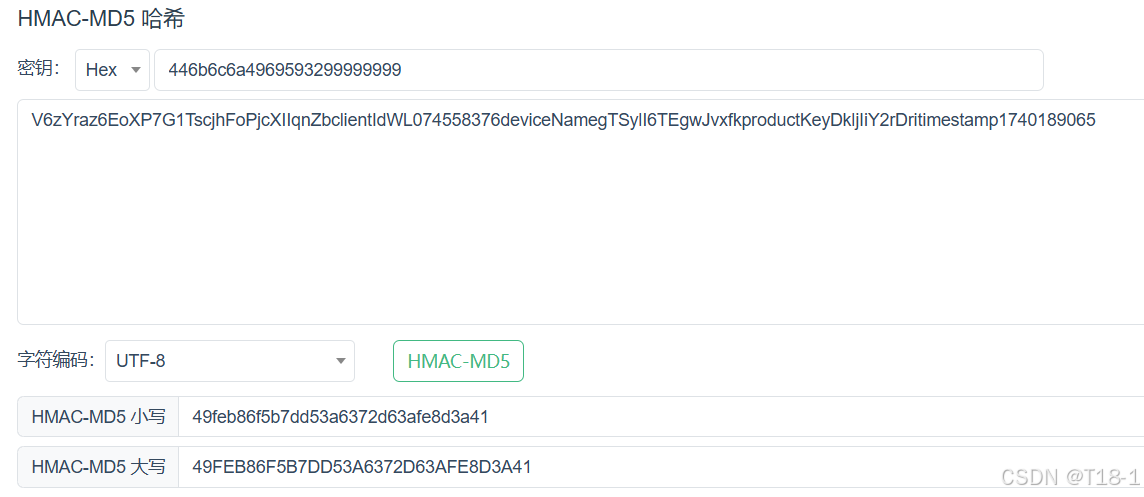
const unsigned int k[3] = {0x446b6c6a, 0x49695932, 0x99999999};

const unsigned int s[64] = {
    7, 12, 17, 22, 7, 12, 17, 22, 7, 12, 17, 22, 7, 12, 17, 22,
    5, 9, 14, 20, 5, 9, 14, 20, 5, 9, 14, 20, 5, 9, 14, 20,
    4, 11, 16, 23, 4, 11, 16, 23, 4, 11, 16, 23, 4, 11, 16, 23,
    6, 10, 15, 21, 6, 10, 15, 21, 6, 10, 15, 21, 6, 10, 15, 21
};

const unsigned int ipad[16] = {
    0x36363636, 0x36363636, 0x36363636, 0x36363636,
    0x36363636, 0x36363636, 0x36363636, 0x36363636,
    0x36363636, 0x36363636, 0x36363636, 0x36363636,
    0x36363636, 0x36363636, 0x36363636, 0x36363636
};

const unsigned int opad[16] = {
    0x5c5c5c5c, 0x5c5c5c5c, 0x5c5c5c5c, 0x5c5c5c5c,
    0x5c5c5c5c, 0x5c5c5c5c, 0x5c5c5c5c, 0x5c5c5c5c,
    0x5c5c5c5c, 0x5c5c5c5c, 0x5c5c5c5c, 0x5c5c5c5c,
    0x5c5c5c5c, 0x5c5c5c5c, 0x5c5c5c5c, 0x5c5c5c5c
};

const unsigned int padding[48] = {
    0x00000080, 0x00000000, 0x00000000, 0x00000000,
    0x00000000, 0x00000000, 0x00000000, 0x00000000,
    0x00000000, 0x00000000, 0x00000280, 0x00000000
};

// 将HMAC-MD5的结果从unsigned int 类型的数组CV_out转成128bits的二进制字符串
void transform(unsigned int CV_out[], int num, int *result) {
    for (int i = 0; i < num; ++i) {
        for (int j = 0; j < 4; ++j) {
            // result[32*i+j] = (CV_out[i] >> (31-j)) & 1;
            for (int k = 0; k < 8; ++k) {
                result[32*i+j*8+k] = (CV_out[i] >> (j*8+7-k)) & 1;
            }
        }
    }
}

// 将字符串输入形式的明文进行填充并转换成unsigned int 类型的二维数组M
void append(const char *input, unsigned int M[][16], int* num, unsigned long long int* inputLen) {
    char *result = (char *)malloc(sizeof(char) * maxLen);
    strcpy(result, input);
    *inputLen = strlen(input) * 8;
    (*num) = (*inputLen) >> 9;
    int index = ((*inputLen) / 8) & 0x3F;
    // printf("index:  %d\n", index);
    unsigned long long int resultLen;

    if (index < 56) {
        unsigned char a[2];
        a[0] = (unsigned char)0x80;
        a[1] = '\0';
        strcat(result, (const char*)a);
        resultLen = (*inputLen) + 64 - index;
        (*num) = (*num) + 1;
    }
    else {
        unsigned char a[2];
        a[0] = (unsigned char)0x80;
        a[1] = '\0';
        strcat(result, (const char*)a);
        (*num) = (*num ) + 2;
        resultLen = (*inputLen) + 128 - index;
    }

    int index1 = 0;

    for (int i = 0; i < (*num); ++i) {
        for (int j = 0; j < 16; ++j) {

            if (index1 + 3 <= (*inputLen)) {
                int word[4];
                word[0] = (unsigned int)((unsigned char)result[index1]);
                word[1] = (unsigned int)((unsigned char)result[index1+1]);
                word[2] = (unsigned int)((unsigned char)result[index1+2]);
                word[3] = (unsigned int)((unsigned char)result[index1+3]);
                // M[i][j] = (word[0] << 24) + (word[1] << 16) + (word[2] << 8) + word[3];
                M[i][j] = (word[3] << 24) + (word[2] << 16) + (word[1] << 8) + word[0];
                index1 = index1 + 4;
            } else if (index1 <= (*inputLen) && index1 + 3 > (*inputLen)) {
               int temp = (*inputLen) - index1;
            //    for (int k = 0; k < temp+1; ++k) {
            //        M[i][j] = (M[i][j] << 8) + (unsigned int)((unsigned char)result[index1+k]);
            //    }
               for (int k = temp; k > -1; --k) {
                   M[i][j] = (M[i][j] << 8) + (unsigned int)((unsigned char)result[index1+k]);
               }

            //    for (int k = temp+1; k < 4; ++k) {
            //        M[i][j] = M[i][j] << 8;
            //    }
               index1 = index1 + 4;
            }

            else {
                M[i][j] = 0;
                index1 = index1 + 4;
            }
        }

    }


    M[(*num)-1][14] = ((*inputLen) & 0xff)  + ((((*inputLen) >> 8) & 0xff) << 8) + ((((*inputLen) >> 16) & 0xff) << 16) + ((((*inputLen) >> 24) & 0xff) << 24);
    M[(*num)-1][15] = (((*inputLen >> 32) & 0xff))  + ((((*inputLen) >> 40) & 0xff) << 8) + ((((*inputLen) >> 48) & 0xff) << 16) + ((((*inputLen) >> 56) & 0xff) << 24);
    // for (int i = 0; i < num; ++i) {
    //     for (int j = 0; j < 16; ++j) {
    //         cout << M[i][j] << endl;
    //         printf("%0x                    ===== %d  %d\n", M[i][j], i, j);
    //     }
    // }


    free(result);
}

// 每轮循环中的一次迭代过程
void iteration_one(unsigned int g, unsigned int input[], unsigned int output[], const unsigned int block[], int* k1, int* k2) {
    // g = F(input[1], input[2], input[3]);
    // printf("g:     %0x\n", g);
    unsigned int temp1 = g + input[0];
    // printf("temp1: %0x\n", temp1);
    unsigned int temp2 = temp1 + block[*k1];
    // printf("temp2: %0x\n", temp2);
    unsigned int temp3 = temp2 + T[*k2];
    // printf("temp3: %0x\n", temp3);
    unsigned int temp4_1 = temp3 << s[*k2];
    unsigned int temp4_2 = temp3 >> (32-s[*k2]);
    unsigned int temp4 = temp4_1 | temp4_2;
    // printf("temp4: %0x\n", temp4);
    unsigned int temp5 = temp4 + input[1];
    // printf("temp5: %0x\n", temp5);
    output[0] = input[3];
    output[1] = temp5;
    output[2] = input[1];
    output[3] = input[2];

    // for (int j = 0; j < 4; ++j) {
    //     printf("%0x   ", output[j]);
    // }
    // printf("\n");
}


// 第一轮循环运算逻辑
void iteration_1(unsigned int CV_0[], unsigned int CV_1[], const unsigned int block[]) {
    unsigned int input[4];
    unsigned int output[4];
    for (int i = 0; i < 4; ++i) {
        input[i] = CV_0[i];
    }

    for (int i = 0; i < 16; ++i) {
        int k1 = i;
        int k2 = i;
        unsigned int g = F(input[1], input[2], input[3]);
        iteration_one(g, input, output, block, &k1, &k2);
        for (int j = 0; j < 4; ++j) {
            input[j] = output[j];
        }
        // printf("first round %d iteration:  ", i);
        // for (int j = 0; j < 4; ++j) {
        //     printf("%0x   ", output[j]);
        // }
        // printf("\n");
    }
    // printf("first round:   ");
    // for (int j = 0; j < 4; ++j) {
    //     printf("%0x   ", output[j]);
    // }
    // printf("\n");

    for (int i = 0; i < 4; ++i) {
        CV_1[i] = output[i];
    }
}

// 第二轮循环运算逻辑
void iteration_2(unsigned int CV_1[], unsigned int CV_2[], const unsigned int block[]) {
    unsigned int input[4];
    unsigned int output[4];
    for (int i = 0; i < 4; ++i) {
        input[i] = CV_1[i];
    }
    for (int i = 0; i < 16; ++i) {
        int k1 = (1 + 5 * i) % 16;
        int k2 = i + 16;
        unsigned int g = G(input[1], input[2], input[3]);
        iteration_one(g, input, output, block, &k1, &k2);
        for (int j = 0; j < 4; ++j) {
            input[j] = output[j];
        }
        // printf("second round %d iteration: ", i);
        // for (int j = 0; j < 4; ++j) {
        //     printf("%0x   ", output[j]);
        // }
        // printf("\n");
    }
    // printf("second round:  ");
    // for (int j = 0; j < 4; ++j) {
    //     printf("%0x   ", output[j]);
    // }
    // printf("\n");

    for (int i = 0; i < 4; ++i) {
        CV_2[i] = output[i];
    }
}

// 第三轮循环运算逻辑
void iteration_3(unsigned int CV_2[], unsigned int CV_3[], const unsigned int block[]) {
    unsigned int input[4];
    unsigned int output[4];
    for (int i = 0; i < 4; ++i) {
        input[i] = CV_2[i];
    }

    for (int i = 0; i < 16; ++i) {
        int k1 = (5 + 3 * i) % 16;
        int k2 = i + 32;
        unsigned int g = H(input[1], input[2], input[3]);
        iteration_one(g, input, output, block, &k1, &k2);
        for (int j = 0; j < 4; ++j) {
            input[j] = output[j];
        }

        // printf("third round %d iteration:  ", i);
        // for (int j = 0; j < 4; ++j) {
        //     printf("%0x   ", output[j]);
        // }
        // printf("\n");
    }
    // printf("third round:   ");
    // for (int j = 0; j < 4; ++j) {
    //     printf("%0x   ", output[j]);
    // }
    // printf("\n");

    for (int i = 0; i < 4; ++i) {
        CV_3[i] = output[i];
    }
}

// 第四轮循环运算逻辑
void iteration_4(unsigned int CV_3[], unsigned int CV_4[], const unsigned int block[]) {
    unsigned int input[4];
    unsigned int output[4];
    for (int i = 0; i < 4; ++i) {
        input[i] = CV_3[i];
    }

    for (int i = 0; i < 16; ++i) {
        int k1 = (7 * i) % 16;
        int k2 = i + 48;
        unsigned int g = I(input[1], input[2], input[3]);
        iteration_one(g, input, output, block, &k1, &k2);
        for (int j = 0; j < 4; ++j) {
            input[j] = output[j];
        }

        // printf("fourth round %d iteration: ", i);
        // for (int j = 0; j < 4; ++j) {
        //     printf("%0x   ", output[j]);
        // }
        // printf("\n");
    }
    // printf("fourth round:  ");
    // for (int j = 0; j < 4; ++j) {
    //     printf("%0x   ", output[j]);
    // }
    // printf("\n");

    for (int i = 0; i < 4; ++i) {
        CV_4[i] = output[i];
    }
}

/*
 * MD5压缩函数H_MD5
 * 输入:128bits的CV 和 512bits的Yq
 * 输出:下一轮输入的128bits的CV
 */
void H_MD5(const unsigned int block[], unsigned int CV_in[], unsigned int CV_out[]) {
    unsigned int CV_0[4];
    for (int i = 0; i < 4; ++i) {
        CV_0[i] = CV_in[i];
    }
    unsigned int CV_1[4];
    unsigned int CV_2[4];
    unsigned int CV_3[4];
    unsigned int CV_4[4];

    iteration_1(CV_0, CV_1, block);
    iteration_2(CV_1, CV_2, block);
    iteration_3(CV_2, CV_3, block);
    iteration_4(CV_3, CV_4, block);


    for (int i = 0; i < 4; ++i) {
        CV_out[i] = CV_4[i] + CV_in[i];
        // printf("CV_out:  %0x\n", CV_out[i]);
    }
}

/*
 * MD5总控函数H_MD5
 * 输入:填充处理后的二维明文数组M
 * 输出: 128bits的信息摘要
 */
 void MD5(unsigned int IV[], unsigned int M[][16], int* num, unsigned int result[]) {
     unsigned int CV_in[4];
     for (int i = 0; i < 4; ++i) {
         CV_in[i] = IV[i];
     }

     unsigned int CV_out[4];

     for (int i = 0; i < (*num); ++i) {
         H_MD5(M[i], CV_in, CV_out);

         for (int j = 0; j < 4; ++j) {
             CV_in[j] = CV_out[j];
         }
     }

    for (int i = 0; i < 4; ++i) {
        result[i] = CV_out[i];
    }
 }

void HMAC(const unsigned int IV[], const unsigned int k[], unsigned int M[][16], int num, unsigned long long int MLen, int result[]) {

    // printf("========================= HMAC ========================\n");

    //K+与 ipad 作 XOR,生成 b 位的 Si
    unsigned int S_i[16];
    unsigned int buf[16];
    for (int i = 0; i < 16; ++i) {
        buf[i] = k[i] ^ ipad[i];
        S_i[i] = ((buf[i] & 0xff) << 24) + (((buf[i] >> 8) & 0xff) << 16) + (((buf[i] >> 16) & 0xff) << 8) + ((buf[i] >> 24) & 0xff);
    }

    //对 (Si ‖ M) 进行 hash 压缩 (例如 MD5),得到 H(Si ‖ M)
    unsigned int CV_in[4];
    for (int i = 0; i < 4; ++i) {
        CV_in[i] = IV[i];
    }

    unsigned int CV_out[4];

    H_MD5(S_i, CV_in, CV_out);

    for (int i = 0; i < 4; ++i) {
        CV_in[i] = CV_out[i];
    }

    unsigned long long int new_MLen = MLen + 512;
    // printf("new_MLen: %d", new_MLen);

    M[num-1][14] = (new_MLen & 0xff)  + (((new_MLen >> 8) & 0xff) << 8) + (((new_MLen >> 16) & 0xff) << 16) + (((new_MLen >> 24) & 0xff) << 24);
    M[num-1][15] = (((new_MLen >> 32) & 0xff))  + (((new_MLen >> 40) & 0xff) << 8) + (((new_MLen >> 48) & 0xff) << 16) + (((new_MLen >> 56) & 0xff) << 24);

    MD5(CV_in, M, &num, CV_out);


    //K+与 opad 作 XOR,生成 b 位的 So
    unsigned int S_o[16];
    unsigned int buf1[16];
    for (int i = 0; i < 16; ++i) {
        buf1[i] = k[i] ^ opad[i];
        S_o[i] = ((buf1[i] & 0xff) << 24) + (((buf1[i] >> 8) & 0xff) << 16) + (((buf1[i] >> 16) & 0xff) << 8) + ((buf1[i] >> 24) & 0xff);
    }

    //对 So ‖ H(Si ‖ M) 进行 hash 压缩 (例如 MD5),得到HMACK = H(So ‖ H(Si ‖ M))
    unsigned int CV_in1[4];
    for (int i = 0; i < 4; ++i) {
        CV_in1[i] = IV[i];
    }

    unsigned int CV_out1[4];

    H_MD5(S_o, CV_in1, CV_out1);

    for (int i = 0; i < 4; ++i) {
        CV_in1[i] = CV_out1[i];
    }

    unsigned int H[16];
    for (int i = 0; i < 4; ++i) {
        H[i] = CV_out[i];
    }

    for (int i = 4; i < 16; ++i) {
        H[i] = padding[i-4];
    }

    H_MD5(H, CV_in1, CV_out1);

    //将结果转换后赋值给result
    transform(CV_out1, 4, result);

}

char* bin_to_hex(const int* bin_array, int len) {
    if (len < 0) return NULL;

    // 处理空数组的特殊情况
    if (len == 0) {
        char* empty_str = malloc(1);
        if (empty_str) empty_str[0] = '\0';
        return empty_str;
    }

    // 计算需要补零的数量
    int pad = (4 - (len % 4)) % 4;
    int total_bits = len + pad;
    int num_groups = total_bits / 4;

    // 创建补零后的临时数组
    int* temp = malloc(total_bits * sizeof(int));
    if (!temp) return NULL;

    // 填充前导零
    for (int i = 0; i < pad; i++)
        temp[i] = 0;

    // 复制原始数据
    for (int i = 0; i < len; i++)
        temp[pad + i] = bin_array[i];

    // 创建结果字符串
    char* hex_str = malloc(num_groups + 1);
    if (!hex_str) {
        free(temp);
        return NULL;
    }

    const char hex_chars[] = "0123456789ABCDEF";

    // 转换每个4位组
    for (int i = 0; i < num_groups; i++) {
        int start = i * 4;
        int value = 0;

        // 将4位二进制转换为数值
        for (int j = 0; j < 4; j++)
            value = (value << 1) | (temp[start + j] ? 1 : 0);

        hex_str[i] = hex_chars[value];
    }
    hex_str[num_groups] = '\0';

    free(temp);
    return hex_str;
}


int main(int argc, char *argv[]) {

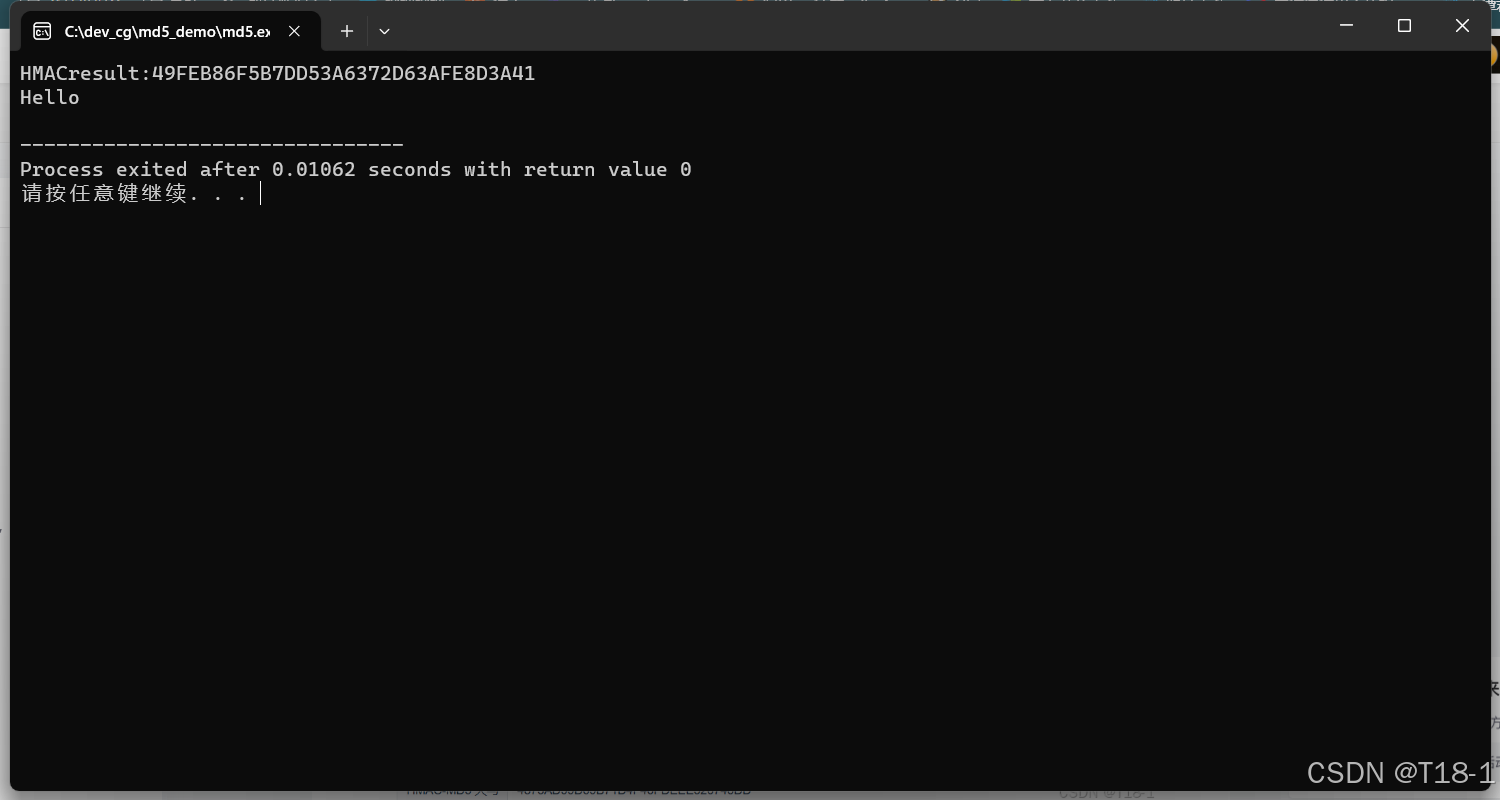
	const char *a = "V6zYraz6EoXP7G1TscjhFoPjcXIIqnZbclientIdWL074558376deviceNamegTSylI6TEgwJvxfkproductKeyDkljIiY2rDritimestamp1740189065";
	int num = 0;
	unsigned long long int inputLen = 0;
	unsigned int block[8][16];

	append(a, block, &num, &inputLen);

	unsigned int CV_in[4];
	CV_in[0] = A;
	CV_in[1] = B;
	CV_in[2] = C;
	CV_in[3] = D;

	int result[128];
	HMAC(CV_in, k, block, num, inputLen, result);
	printf("HMACresult:%s\n",bin_to_hex(result,128));

	printf("Hello\n");

	return 0;
}
该源码为简易修改版本,仅有一个main文件作为demo,可自行按需封装
如需更完整的版本,以及源码说明,请点击下方链接进入代码出处
搬运至以下作者,感谢开源
代码出处:MD5: HMAC-MD5消息认证算法
测试环境:Dev-C++ 5.11
经测试可正常使用





 扫一扫
扫一扫


 4906
4906

 被折叠的 条评论
为什么被折叠?
被折叠的 条评论
为什么被折叠?
 到【灌水乐园】发言





