



 本文详细解析了Spring IoC容器依赖注入的过程,包括Bean实例化、依赖注入触发时机、依赖注入的两个阶段,以及源码级别的解读,如AbstractBeanFactory的getBean()方法、AbstractAutowireCapableBeanFactory的createBean()和doCreateBean()方法等,深入理解依赖注入的实现机制。
一、基本概念
1.当Spring IoC容器完成了Bean定义资源的定位、载入和解析注册以后,IoC容器中已经管理类Bean定义的相关数据,但是此时IoC容器还没有对所管理的Bean进行依赖注入,依赖注入在以下两种情况发生:
(1)用户第一次通过getBean方法向IoC容索要Bean时,IoC容器触发依赖注入。

(2)当用户在Bean定义资源中为<Bean>元素配置了lazy-init属性,即让容器在解析注册Bean定义时进行预实例化,触发依赖注入(spring默认lazy-init="false",表示在spring启动时,立刻进行实例化)
2. 两个阶段
(1) 第一阶段是Bean的初始化,如何采用设值注入的方式,那么这个阶段就是利用默认构造器去构造一个空对象,等待着注入;如果是构造注入,那么这个过程可能就会触发依赖注入,并递归地初始化依赖对象

(2) 第二个阶段是注入阶段
二、图解
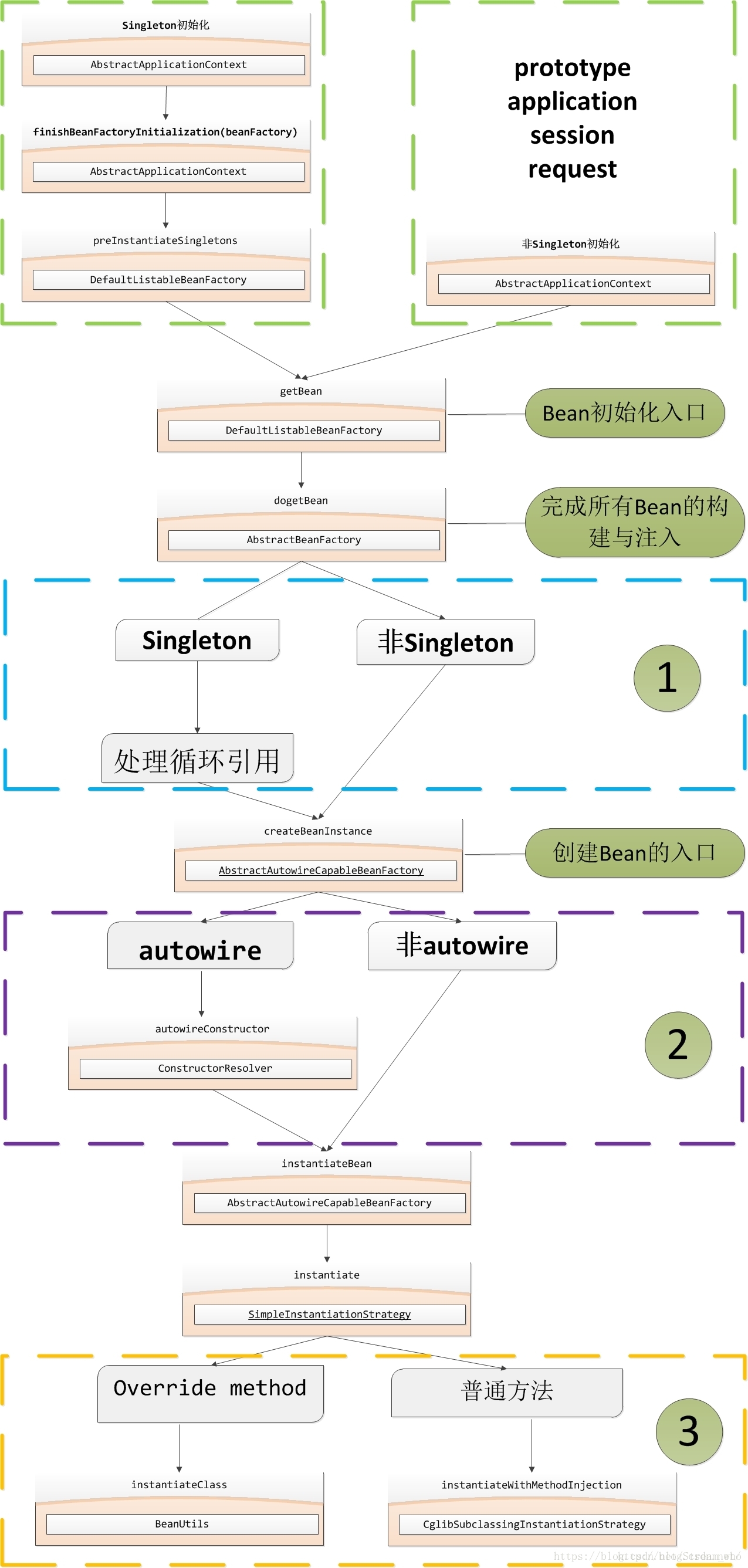
三、源码解读
1. AbstractBeanFactory的getBean()方法
	protected <T> T doGetBean(final String name, @Nullable final Class<T> requiredType, @Nullable final Object[] args, boolean typeCheckOnly) throws BeansException {
		// 根据指定的名称获取被管理Bean的名称,剥离指定名称中对容器的相关依赖,如果指定的是别名,将别名转换为规范的Bean名称
		final String beanName = transformedBeanName(name);
		Object bean;

		// Eagerly check singleton cache for manually registered singletons.
		// 先从缓存中取是否已经有被创建过的单态类型的Bean,对于单态模式的Bean整个IoC容器中只创建一次,不需要重复创建
		Object sharedInstance = getSingleton(beanName);
		if (sharedInstance != null && args == null) {
			if (logger.isDebugEnabled()) {
				if (isSingletonCurrentlyInCreation(beanName)) {
					logger.debug("Returning eagerly cached instance of singleton bean '" + beanName +
							"' that is not fully initialized yet - a consequence of a circular reference");
				}
				else {
					logger.debug("Returning cached instance of singleton bean '" + beanName + "'");
				}
			}
			// 从缓存中去取
			bean = getObjectForBeanInstance(sharedInstance, name, beanName, null);
		}

		else {
			// Fail if we're already creating this bean instance:
			// We're assumably within a circular reference.
			if (isPrototypeCurrentlyInCreation(beanName)) {
				throw new BeanCurrentlyInCreationException(beanName);
			}

			// Check if bean definition exists in this factory.
			// 对IoC容器中是否存在指定名称的BeanDefinition进行检查,首先检查是否能在当前的BeanFactory中获取的所需要的Bean,如果不能则委托当前容器的父级容器去查找,如果还是找不到则沿着容器的继承体系向父级容器查找
			BeanFactory parentBeanFactory = getParentBeanFactory();
			if (parentBeanFactory != null && !containsBeanDefinition(beanName)) {
				// Not found -> check parent.
				String nameToLookup = originalBeanName(name);
				if (parentBeanFactory instanceof AbstractBeanFactory) {
					return ((AbstractBeanFactory) parentBeanFactory).doGetBean(
							nameToLookup, requiredType, args, typeCheckOnly);
				}
				else if (args != null) {
					// Delegation to parent with explicit args.
					return (T) parentBeanFactory.getBean(nameToLookup, args);
				}
				else {
					// No args -> delegate to standard getBean method.
					return parentBeanFactory.getBean(nameToLookup, requiredType);
				}
			}

			if (!typeCheckOnly) {
				markBeanAsCreated(beanName);
			}

			try {
				final RootBeanDefinition mbd = getMergedLocalBeanDefinition(beanName);
				checkMergedBeanDefinition(mbd, beanName, args);

				// Guarantee initialization of beans that the current bean depends on.
				// 获取当前Bean所有依赖Bean的名称
				String[] dependsOn = mbd.getDependsOn();
				// 如果当前Bean有依赖Bean
				if (dependsOn != null) {
					// 循环遍历依赖对象的名称
					for (String dep : dependsOn) {
						if (isDependent(beanName, dep)) {
							throw new BeanCreationException(mbd.getResourceDescription(), beanName,
									"Circular depends-on relationship between '" + beanName + "' and '" + dep + "'");
						}
						// 把被依赖Bean注册给当前依赖的Bean
						registerDependentBean(dep, beanName);
						try {
							// 递归调用getBean方法,获取当前Bean的依赖Bean
							getBean(dep);
						}
						catch (NoSuchBeanDefinitionException ex) {
							throw new BeanCreationException(mbd.getResourceDescription(), beanName,
									"'" + beanName + "' depends on missing bean '" + dep + "'", ex);
						}
					}
				}

				// Create bean instance.
				// 创建单态模式Bean的实例对象
				if (mbd.isSingleton()) {
					// 这里使用了一个匿名内部类,创建Bean实例对象,并且注册给所依赖的对象
					sharedInstance = getSingleton(beanName, () -> {
						try {
							// 1. 创建一个指定Bean实例对象,如果有父级继承,则合并子类和父类的定义
							return createBean(beanName, mbd, args);

						}
						catch (BeansException ex) {
							// Explicitly remove instance from singleton cache: It might have been put there
							// eagerly by the creation process, to allow for circular reference resolution.
							// Also remove any beans that received a temporary reference to the bean.
							destroySingleton(beanName);
							throw ex;
						}
					});
					// 获取给定Bean的实例对象
					bean = getObjectForBeanInstance(sharedInstance, name, beanName, mbd);
				}
				// IoC容器创建原型模式Bean实例对象
				else if (mbd.isPrototype()) {
					// It's a prototype -> create a new instance.
					Object prototypeInstance = null;
					try {
						beforePrototypeCreation(beanName);
						// 创建指定Bean对象实例
						prototypeInstance = createBean(beanName, mbd, args);
					}
					finally {
						afterPrototypeCreation(beanName);
					}
					// 获取给定Bean的实例对象
					bean = getObjectForBeanInstance(prototypeInstance, name, beanName, mbd);
				}

				else {
					// 要创建的Bean既不是单态模式,也不是原型模式,则根据Bean定义资源中配置的生命周期范围,选择实例化Bean的合适方法,这种在Web应用程序中 比较常用,如:request、session、application等生命周期
					String scopeName = mbd.getScope();
					final Scope scope = this.scopes.get(scopeName);
					// Bean定义资源中没有配置生命周期范围,则Bean定义不合法
					if (scope == null) {
						throw new IllegalStateException("No Scope registered for scope name '" + scopeName + "'");
					}
					try {
						Object scopedInstance = scope.get(beanName, () -> {
							beforePrototypeCreation(beanName);
							try {
								return createBean(beanName, mbd, args);
							}
							finally {
								afterPrototypeCreation(beanName);
							}
						});
						bean = getObjectForBeanInstance(scopedInstance, name, beanName, mbd);
					}
					catch (IllegalStateException ex) {
						throw new BeanCreationException(beanName,
								"Scope '" + scopeName + "' is not active for the current thread; consider " +
								"defining a scoped proxy for this bean if you intend to refer to it from a singleton",
								ex);
					}
				}
			}
			catch (BeansException ex) {
				cleanupAfterBeanCreationFailure(beanName);
				throw ex;
			}
		}

		// Check if required type matches the type of the actual bean instance.
		// 对创建的Bean实例对象进行类型检查
		if (requiredType != null && !requiredType.isInstance(bean)) {
			try {
				T convertedBean = getTypeConverter().convertIfNecessary(bean, requiredType);
				if (convertedBean == null) {
					throw new BeanNotOfRequiredTypeException(name, requiredType, bean.getClass());
				}
				return convertedBean;
			}
			catch (TypeMismatchException ex) {
				if (logger.isDebugEnabled()) {
					logger.debug("Failed to convert bean '" + name + "' to required type '" +
							ClassUtils.getQualifiedName(requiredType) + "'", ex);
				}
				throw new BeanNotOfRequiredTypeException(name, requiredType, bean.getClass());
			}
		}
		return (T) bean;
}
2. AbstractAutowireCapableBeanFactory的createBean()方法
	protected Object createBean(String beanName, RootBeanDefinition mbd, @Nullable Object[] args)
			throws BeanCreationException {

		if (logger.isDebugEnabled()) {
			logger.debug("Creating instance of bean '" + beanName + "'");
		}
		RootBeanDefinition mbdToUse = mbd;

		// Make sure bean class is actually resolved at this point, and
		// clone the bean definition in case of a dynamically resolved Class
		// which cannot be stored in the shared merged bean definition.
		// 判断需要创建的Bean是否可以实例化,即是否可以通过当前的类加载器加载
		Class<?> resolvedClass = resolveBeanClass(mbd, beanName);
		if (resolvedClass != null && !mbd.hasBeanClass() && mbd.getBeanClassName() != null) {
			mbdToUse = new RootBeanDefinition(mbd);
			mbdToUse.setBeanClass(resolvedClass);
		}

		// Prepare method overrides.
		// 校验和准备Bean中的方法覆盖
		try {
			mbdToUse.prepareMethodOverrides();
		}
		catch (BeanDefinitionValidationException ex) {
			throw new BeanDefinitionStoreException(mbdToUse.getResourceDescription(),
					beanName, "Validation of method overrides failed", ex);
		}

		try {
			// Give BeanPostProcessors a chance to return a proxy instead of the target bean instance.
			// 如果Bean配置了初始化前和初始化后的处理器,则试图返回一个需要创建Bean的代理对象
			Object bean = resolveBeforeInstantiation(beanName, mbdToUse);
			if (bean != null) {
				return bean;
			}
		}
		catch (Throwable ex) {
			throw new BeanCreationException(mbdToUse.getResourceDescription(), beanName,
					"BeanPostProcessor before instantiation of bean failed", ex);
		}

		try {
			// 2.创建Bean的入口
			Object beanInstance = doCreateBean(beanName, mbdToUse, args);
			if (logger.isDebugEnabled()) {
				logger.debug("Finished creating instance of bean '" + beanName + "'");
			}
			return beanInstance;
		}
		catch (BeanCreationException | ImplicitlyAppearedSingletonException ex) {
			// A previously detected exception with proper bean creation context already,
			// or illegal singleton state to be communicated up to DefaultSingletonBeanRegistry.
			throw ex;
		}
		catch (Throwable ex) {
			throw new BeanCreationException(
					mbdToUse.getResourceDescription(), beanName, "Unexpected exception during bean creation", ex);
		}
	}
3. AbstractAutowireCapableBeanFactory的doCreateBean()方法
	protected Object doCreateBean(final String beanName, final RootBeanDefinition mbd, final @Nullable Object[] args) throws BeanCreationException {

		// Instantiate the bean.
		// 封装被创建的Bean对象
		BeanWrapper instanceWrapper = null;
		if (mbd.isSingleton()) {
			instanceWrapper = this.factoryBeanInstanceCache.remove(beanName);
		}
		if (instanceWrapper == null) {
			// 3.创建实例对象
			instanceWrapper = createBeanInstance(beanName, mbd, args);
		}
		final Object bean = instanceWrapper.getWrappedInstance();
		Class<?> beanType = instanceWrapper.getWrappedClass();
		if (beanType != NullBean.class) {
			mbd.resolvedTargetType = beanType;
		}

		// Allow post-processors to modify the merged bean definition.
		synchronized (mbd.postProcessingLock) {
			if (!mbd.postProcessed) {
				try {
					applyMergedBeanDefinitionPostProcessors(mbd, beanType, beanName);
				}
				catch (Throwable ex) {
					throw new BeanCreationException(mbd.getResourceDescription(), beanName,
							"Post-processing of merged bean definition failed", ex);
				}
				mbd.postProcessed = true;
			}
		}

		// Eagerly cache singletons to be able to resolve circular references
		// even when triggered by lifecycle interfaces like BeanFactoryAware.

		boolean earlySingletonExposure = (mbd.isSingleton() && this.allowCircularReferences &&
				isSingletonCurrentlyInCreation(beanName));
		if (earlySingletonExposure) {
			if (logger.isDebugEnabled()) {
				logger.debug("Eagerly caching bean '" + beanName +
						"' to allow for resolving potential circular references");
			}
			addSingletonFactory(beanName, () -> getEarlyBeanReference(beanName, mbd, bean));
		}

		// Initialize the bean instance.
		Object exposedObject = bean;
		try {
			populateBean(beanName, mbd, instanceWrapper);
			exposedObject = initializeBean(beanName, exposedObject, mbd);
		}
		catch (Throwable ex) {
			if (ex instanceof BeanCreationException && beanName.equals(((BeanCreationException) ex).getBeanName())) {
				throw (BeanCreationException) ex;
			}
			else {
				throw new BeanCreationException(
						mbd.getResourceDescription(), beanName, "Initialization of bean failed", ex);
			}
		}
		if (earlySingletonExposure) {
			Object earlySingletonReference = getSingleton(beanName, false);
			if (earlySingletonReference != null) {
				if (exposedObject == bean) {
					exposedObject = earlySingletonReference;
				}
				else if (!this.allowRawInjectionDespiteWrapping && hasDependentBean(beanName)) {
					String[] dependentBeans = getDependentBeans(beanName);
					Set<String> actualDependentBeans = new LinkedHashSet<>(dependentBeans.length);
					for (String dependentBean : dependentBeans) {
						if (!removeSingletonIfCreatedForTypeCheckOnly(dependentBean)) {
							actualDependentBeans.add(dependentBean);
						}
					}
					if (!actualDependentBeans.isEmpty()) {
						throw new BeanCurrentlyInCreationException(beanName,
								"Bean with name '" + beanName + "' has been injected into other beans [" +
								StringUtils.collectionToCommaDelimitedString(actualDependentBeans) +
								"] in its raw version as part of a circular reference, but has eventually been " +
								"wrapped. This means that said other beans do not use the final version of the " +
								"bean. This is often the result of over-eager type matching - consider using " +
								"'getBeanNamesOfType' with the 'allowEagerInit' flag turned off, for example.");
					}
				}
			}
		}

		// Register bean as disposable.
		try {
			registerDisposableBeanIfNecessary(beanName, bean, mbd);
		}
		catch (BeanDefinitionValidationException ex) {
			throw new BeanCreationException(
					mbd.getResourceDescription(), beanName, "Invalid destruction signature", ex);
		}

		return exposedObject;
	}
4. AbstractAutowireCapableBeanFactory的createBeanInstance()方法
	protected BeanWrapper createBeanInstance(String beanName, RootBeanDefinition mbd, @Nullable Object[] args) {
		// Make sure bean class is actually resolved at this point.
		// 检查确认Bean是可实例化的
		Class<?> beanClass = resolveBeanClass(mbd, beanName);

		if (beanClass != null && !Modifier.isPublic(beanClass.getModifiers()) && !mbd.isNonPublicAccessAllowed()) {
			throw new BeanCreationException(mbd.getResourceDescription(), beanName,
					"Bean class isn't public, and non-public access not allowed: " + beanClass.getName());
		}

		Supplier<?> instanceSupplier = mbd.getInstanceSupplier();
		if (instanceSupplier != null) {
			return obtainFromSupplier(instanceSupplier, beanName);
		}

		// 如果指定了工厂方法,向下调用instantiateUsingFactoryMethod方法实例化
		if (mbd.getFactoryMethodName() != null)  {
			// 调用工厂方法实例化
			return instantiateUsingFactoryMethod(beanName, mbd, args);
		}

		// Shortcut when re-creating the same bean...
		boolean resolved = false;
		boolean autowireNecessary = false;
		if (args == null) {
			synchronized (mbd.constructorArgumentLock) {
				if (mbd.resolvedConstructorOrFactoryMethod != null) {
					resolved = true;
					autowireNecessary = mbd.constructorArgumentsResolved;
				}
			}
		}
		if (resolved) {
			if (autowireNecessary) {
				// 配置了自动装配属性,使用容器的自动装配实例化,容器的自动装配是根据参数类型匹配Bean的构造方法
				return autowireConstructor(beanName, mbd, null, null);
			}
			else {
				// 4.使用默认的无参构造方法实例化
				return instantiateBean(beanName, mbd);
			}
		}

		// Need to determine the constructor...
		// 使用Bean的构造方法进行实例化
		Constructor<?>[] ctors = determineConstructorsFromBeanPostProcessors(beanClass, beanName);
		if (ctors != null ||
				mbd.getResolvedAutowireMode() == RootBeanDefinition.AUTOWIRE_CONSTRUCTOR ||
				mbd.hasConstructorArgumentValues() || !ObjectUtils.isEmpty(args))  {
			return autowireConstructor(beanName, mbd, ctors, args);
		}

		// No special handling: simply use no-arg constructor.
		// 使用默认的无参构造方法实例化
		return instantiateBean(beanName, mbd);
	}
5. AbstractAutowireCapableBeanFactory的instantiateBean()方法
	protected BeanWrapper instantiateBean(final String beanName, final RootBeanDefinition mbd) {
		try {
			Object beanInstance;
			final BeanFactory parent = this;
			if (System.getSecurityManager() != null) {
				beanInstance = AccessController.doPrivileged((PrivilegedAction<Object>) () ->
						getInstantiationStrategy().instantiate(mbd, beanName, parent),
						getAccessControlContext());
			}
			else {
				// 5.这里是一个匿名内置类,根据实例化策略创建实例对象
				beanInstance = getInstantiationStrategy().instantiate(mbd, beanName, parent);
			}
			BeanWrapper bw = new BeanWrapperImpl(beanInstance);
			initBeanWrapper(bw);
			return bw;
		}
		catch (Throwable ex) {
			throw new BeanCreationException(
					mbd.getResourceDescription(), beanName, "Instantiation of bean failed", ex);
		}
	}
6. SimpleInstantiationStrategy的instantiate()方法
	public Object instantiate(RootBeanDefinition bd, @Nullable String beanName, BeanFactory owner) {
		// Don't override the class with CGLIB if no overrides.
		// 如果Bean定义中没有方法覆盖,则就不需要CGLIB父类类的方法,使用JDK初始化
		if (!bd.hasMethodOverrides()) {
			Constructor<?> constructorToUse;
			synchronized (bd.constructorArgumentLock) {
				constructorToUse = (Constructor<?>) bd.resolvedConstructorOrFactoryMethod;
				if (constructorToUse == null) {
					// 使用JDK的反射机制,判断要实例化的Bean是否是接口
					final Class<?> clazz = bd.getBeanClass();
					if (clazz.isInterface()) {
						throw new BeanInstantiationException(clazz, "Specified class is an interface");
					}
					try {
						if (System.getSecurityManager() != null) {
							// 这里是一个匿名内置类,使用反射机制获取Bean的构造方法
							constructorToUse = AccessController.doPrivileged(
									(PrivilegedExceptionAction<Constructor<?>>) clazz::getDeclaredConstructor);
						}
						else {
							constructorToUse =	clazz.getDeclaredConstructor();
						}
						bd.resolvedConstructorOrFactoryMethod = constructorToUse;
					}
					catch (Throwable ex) {
						throw new BeanInstantiationException(clazz, "No default constructor found", ex);
					}
				}
			}
			// 6.使用BeanUtils实例化,通过反射机制调用”构造方法.newInstance(arg)”来进行实例化
			return BeanUtils.instantiateClass(constructorToUse);
		}
		else {
			// Must generate CGLIB subclass.
			// 使用CGLIB来实例化对象
			return instantiateWithMethodInjection(bd, beanName, owner);
		}
	}
7. 得到Bean的实例化对象以后,进行依赖注入(回到3)
	protected Object doCreateBean(final String beanName, final RootBeanDefinition mbd, final @Nullable Object[] args)
			throws BeanCreationException {

		// Instantiate the bean.
		// 封装被创建的Bean对象
		BeanWrapper instanceWrapper = null;
		if (mbd.isSingleton()) {
			instanceWrapper = this.factoryBeanInstanceCache.remove(beanName);
		}
		if (instanceWrapper == null) {
			// 3.创建实例对象
			instanceWrapper = createBeanInstance(beanName, mbd, args);
		}
		final Object bean = instanceWrapper.getWrappedInstance();
		// 获取实例化对象的类型
		Class<?> beanType = instanceWrapper.getWrappedClass();
		if (beanType != NullBean.class) {
			mbd.resolvedTargetType = beanType;
		}

		// Allow post-processors to modify the merged bean definition.
		// 调用PostProcessor后置处理器
		synchronized (mbd.postProcessingLock) {
			if (!mbd.postProcessed) {
				try {
					applyMergedBeanDefinitionPostProcessors(mbd, beanType, beanName);
				}
				catch (Throwable ex) {
					throw new BeanCreationException(mbd.getResourceDescription(), beanName,
							"Post-processing of merged bean definition failed", ex);
				}
				mbd.postProcessed = true;
			}
		}

		// Eagerly cache singletons to be able to resolve circular references
		// even when triggered by lifecycle interfaces like BeanFactoryAware.
		// 向容器中缓存单态模式的Bean对象,以防循环引用
		boolean earlySingletonExposure = (mbd.isSingleton() && this.allowCircularReferences &&
				isSingletonCurrentlyInCreation(beanName));
		if (earlySingletonExposure) {
			if (logger.isDebugEnabled()) {
				logger.debug("Eagerly caching bean '" + beanName +
						"' to allow for resolving potential circular references");
			}
			// 这里是一个匿名内部类,为了防止循环引用,尽早持有对象的引用
			addSingletonFactory(beanName, () -> getEarlyBeanReference(beanName, mbd, bean));
		}

		// Initialize the bean instance.
		Object exposedObject = bean;
		// Bean对象的初始化,依赖注入在此触发,这个exposedObject在初始化完成之后返回作为依赖注入完成后的Bean
		try {
			// 7.将Bean实例对象封装,并且Bean定义中配置的属性值赋值给实例对象
			populateBean(beanName, mbd, instanceWrapper);
			// 初始化Bean对象
			exposedObject = initializeBean(beanName, exposedObject, mbd);
		}
		catch (Throwable ex) {
			if (ex instanceof BeanCreationException && beanName.equals(((BeanCreationException) ex).getBeanName())) {
				throw (BeanCreationException) ex;
			}
			else {
				throw new BeanCreationException(
						mbd.getResourceDescription(), beanName, "Initialization of bean failed", ex);
			}
		}
		// 获取指定名称的已注册的单态模式Bean对象
		if (earlySingletonExposure) {
			Object earlySingletonReference = getSingleton(beanName, false);
			if (earlySingletonReference != null) {
				// 根据名称获取的以注册的Bean和正在实例化的Bean是同一个
				if (exposedObject == bean) {
					// 当前实例化的Bean初始化完成
					exposedObject = earlySingletonReference;
				}
				// 当前Bean依赖其他Bean,并且当发生循环引用时不允许新创建实例对象
				else if (!this.allowRawInjectionDespiteWrapping && hasDependentBean(beanName)) {
					String[] dependentBeans = getDependentBeans(beanName);
					Set<String> actualDependentBeans = new LinkedHashSet<>(dependentBeans.length);
					// 获取当前Bean所依赖的其他Bean
					for (String dependentBean : dependentBeans) {
						// 对依赖Bean进行类型检查
						if (!removeSingletonIfCreatedForTypeCheckOnly(dependentBean)) {
							actualDependentBeans.add(dependentBean);
						}
					}
					if (!actualDependentBeans.isEmpty()) {
						throw new BeanCurrentlyInCreationException(beanName,
								"Bean with name '" + beanName + "' has been injected into other beans [" +
								StringUtils.collectionToCommaDelimitedString(actualDependentBeans) +
								"] in its raw version as part of a circular reference, but has eventually been " +
								"wrapped. This means that said other beans do not use the final version of the " +
								"bean. This is often the result of over-eager type matching - consider using " +
								"'getBeanNamesOfType' with the 'allowEagerInit' flag turned off, for example.");
					}
				}
			}
		}

		// Register bean as disposable.
		try {
			// 注册完成依赖注入的Bean
			registerDisposableBeanIfNecessary(beanName, bean, mbd);
		}
		catch (BeanDefinitionValidationException ex) {
			throw new BeanCreationException(
					mbd.getResourceDescription(), beanName, "Invalid destruction signature", ex);
		}

		return exposedObject;
	}
8. AbstractAutowireCapableBeanFactory的populateBean()方法
	protected void populateBean(String beanName, RootBeanDefinition mbd, @Nullable BeanWrapper bw) {
		if (bw == null) {
			if (mbd.hasPropertyValues()) {
				throw new BeanCreationException(
						mbd.getResourceDescription(), beanName, "Cannot apply property values to null instance");
			}
			else {
				// Skip property population phase for null instance.
				return;
			}
		}

		// Give any InstantiationAwareBeanPostProcessors the opportunity to modify the
		// state of the bean before properties are set. This can be used, for example,
		// to support styles of field injection.
		boolean continueWithPropertyPopulation = true;
		// 在设置属性之前调用Bean的PostProcessor后置处理器
		if (!mbd.isSynthetic() && hasInstantiationAwareBeanPostProcessors()) {
			for (BeanPostProcessor bp : getBeanPostProcessors()) {
				if (bp instanceof InstantiationAwareBeanPostProcessor) {
					InstantiationAwareBeanPostProcessor ibp = (InstantiationAwareBeanPostProcessor) bp;
					if (!ibp.postProcessAfterInstantiation(bw.getWrappedInstance(), beanName)) {
						continueWithPropertyPopulation = false;
						break;
					}
				}
			}
		}

		if (!continueWithPropertyPopulation) {
			return;
		}
		// 获取容器在解析Bean定义资源时为BeanDefiniton中设置的属性值
		PropertyValues pvs = (mbd.hasPropertyValues() ? mbd.getPropertyValues() : null);
		// 依赖注入开始,首先处理autowire自动装配的注入
		if (mbd.getResolvedAutowireMode() == RootBeanDefinition.AUTOWIRE_BY_NAME ||
				mbd.getResolvedAutowireMode() == RootBeanDefinition.AUTOWIRE_BY_TYPE) {
			MutablePropertyValues newPvs = new MutablePropertyValues(pvs);

			// Add property values based on autowire by name if applicable.
			// 对autowire自动装配的处理,根据Bean名称自动装配注入(按名称注入优先)
			if (mbd.getResolvedAutowireMode() == RootBeanDefinition.AUTOWIRE_BY_NAME) {
				autowireByName(beanName, mbd, bw, newPvs);
			}

			// Add property values based on autowire by type if applicable.
			// 根据Bean类型自动装配注入
			if (mbd.getResolvedAutowireMode() == RootBeanDefinition.AUTOWIRE_BY_TYPE) {
				autowireByType(beanName, mbd, bw, newPvs);
			}

			pvs = newPvs;
		}
		// 检查容器是否持有用于处理单态模式Bean关闭时的后置处理器
		boolean hasInstAwareBpps = hasInstantiationAwareBeanPostProcessors();
		// Bean实例对象没有依赖,即没有继承基类
		boolean needsDepCheck = (mbd.getDependencyCheck() != RootBeanDefinition.DEPENDENCY_CHECK_NONE);

		if (hasInstAwareBpps || needsDepCheck) {
			if (pvs == null) {
				pvs = mbd.getPropertyValues();
			}
			// 从实例对象中提取属性描述符
			PropertyDescriptor[] filteredPds = filterPropertyDescriptorsForDependencyCheck(bw, mbd.allowCaching);
			if (hasInstAwareBpps) {
				for (BeanPostProcessor bp : getBeanPostProcessors()) {
					if (bp instanceof InstantiationAwareBeanPostProcessor) {
						InstantiationAwareBeanPostProcessor ibp = (InstantiationAwareBeanPostProcessor) bp;
						pvs = ibp.postProcessPropertyValues(pvs, filteredPds, bw.getWrappedInstance(), beanName);
						if (pvs == null) {
							return;
						}
					}
				}
			}
			if (needsDepCheck) {
				// 为要设置的属性进行依赖检查
				checkDependencies(beanName, mbd, filteredPds, pvs);
			}
		}
		// 8.对属性进行注入
		if (pvs != null) {
			applyPropertyValues(beanName, mbd, bw, pvs);
		}
	}
9. AbstractAutowireCapableBeanFactory的applyPropertyValues()方法
	protected void applyPropertyValues(String beanName, BeanDefinition mbd, BeanWrapper bw, PropertyValues pvs) {
		if (pvs.isEmpty()) {
			return;
		}

		if (System.getSecurityManager() != null && bw instanceof BeanWrapperImpl) {
			// 设置安全上下文,JDK安全机制
			((BeanWrapperImpl) bw).setSecurityContext(getAccessControlContext());
		}
		// 封装属性值
		MutablePropertyValues mpvs = null;
		List<PropertyValue> original;

		if (pvs instanceof MutablePropertyValues) {
			mpvs = (MutablePropertyValues) pvs;
			// 属性值已经转换
			if (mpvs.isConverted()) {
				// Shortcut: use the pre-converted values as-is.
				try {
					bw.setPropertyValues(mpvs);
					return;
				}
				catch (BeansException ex) {
					throw new BeanCreationException(
							mbd.getResourceDescription(), beanName, "Error setting property values", ex);
				}
			}
			// 获取属性值对象的原始类型值
			original = mpvs.getPropertyValueList();
		}
		else {
			original = Arrays.asList(pvs.getPropertyValues());
		}
		// 获取用户自定义的类型转换
		TypeConverter converter = getCustomTypeConverter();
		if (converter == null) {
			converter = bw;
		}
		// 创建一个Bean定义属性值解析器,将Bean定义中的属性值解析为Bean实例对象的实际值
		BeanDefinitionValueResolver valueResolver = new BeanDefinitionValueResolver(this, beanName, mbd, converter);

		// Create a deep copy, resolving any references for values.
		// 为属性的解析值创建一个拷贝,将拷贝的数据注入到实例对象中
		List<PropertyValue> deepCopy = new ArrayList<>(original.size());
		boolean resolveNecessary = false;
		for (PropertyValue pv : original) {
			if (pv.isConverted()) {
				deepCopy.add(pv);
			}
			else {
				String propertyName = pv.getName();
				// 原始的属性值,即转换之前的属性值
				Object originalValue = pv.getValue();
				// 9.转换属性值,例如将引用转换为IoC容器中实例化对象引用
				Object resolvedValue = valueResolver.resolveValueIfNecessary(pv, originalValue);
				// 转换之后的属性值
				Object convertedValue = resolvedValue;
				// 属性值是否可以转换
				boolean convertible = bw.isWritableProperty(propertyName) &&
						!PropertyAccessorUtils.isNestedOrIndexedProperty(propertyName);
				if (convertible) {
					convertedValue = convertForProperty(resolvedValue, propertyName, bw, converter);
				}
				// Possibly store converted value in merged bean definition,
				// in order to avoid re-conversion for every created bean instance.
				// 存储转换后的属性值,避免每次属性注入时的转换工作
				if (resolvedValue == originalValue) {
					if (convertible) {
						pv.setConvertedValue(convertedValue);
					}
					deepCopy.add(pv);
				}
				else if (convertible && originalValue instanceof TypedStringValue &&
						!((TypedStringValue) originalValue).isDynamic() &&
						!(convertedValue instanceof Collection || ObjectUtils.isArray(convertedValue))) {
					pv.setConvertedValue(convertedValue);
					deepCopy.add(pv);
				}
				else {
					resolveNecessary = true;
					// 重新封装属性的值
					deepCopy.add(new PropertyValue(pv, convertedValue));
				}
			}
		}
		if (mpvs != null && !resolveNecessary) {
			mpvs.setConverted();
		}

		// Set our (possibly massaged) deep copy.
		try {
			// 12. 进行属性依赖注入
			bw.setPropertyValues(new MutablePropertyValues(deepCopy));
		}
		catch (BeansException ex) {
			throw new BeanCreationException(
					mbd.getResourceDescription(), beanName, "Error setting property values", ex);
		}
	}
10. 当容器在对属性进行依赖注入时,如果发现属性值需要进行类型转换,如属性值是容器中另一个Bean实例对象的引用,则容器首先需要根据属性值解析出所引用的对象,然后才能将该引用对象注入到目标实例对象的属性上去,对属性进行解析的由resolveValueIfNecessary方法实现
	public Object resolveValueIfNecessary(Object argName, @Nullable Object value) {
		// We must check each value to see whether it requires a runtime reference
		// to another bean to be resolved.
		// 对引用类型的属性进行解析
		if (value instanceof RuntimeBeanReference) {
			RuntimeBeanReference ref = (RuntimeBeanReference) value;
			// 10. 调用引用类型属性的解析方法
			return resolveReference(argName, ref);
		}
		// 对属性值是引用容器中另一个Bean名称的解析
		else if (value instanceof RuntimeBeanNameReference) {
			String refName = ((RuntimeBeanNameReference) value).getBeanName();
			refName = String.valueOf(doEvaluate(refName));
			// 从容器中获取指定名称的Bean
			if (!this.beanFactory.containsBean(refName)) {
				throw new BeanDefinitionStoreException(
						"Invalid bean name '" + refName + "' in bean reference for " + argName);
			}
			return refName;
		}
		// 对Bean类型属性的解析,主要是Bean中的内部类
		else if (value instanceof BeanDefinitionHolder) {
			// Resolve BeanDefinitionHolder: contains BeanDefinition with name and aliases.
			BeanDefinitionHolder bdHolder = (BeanDefinitionHolder) value;
			return resolveInnerBean(argName, bdHolder.getBeanName(), bdHolder.getBeanDefinition());
		}
		else if (value instanceof BeanDefinition) {
			// Resolve plain BeanDefinition, without contained name: use dummy name.
			BeanDefinition bd = (BeanDefinition) value;
			String innerBeanName = "(inner bean)" + BeanFactoryUtils.GENERATED_BEAN_NAME_SEPARATOR +
					ObjectUtils.getIdentityHexString(bd);
			return resolveInnerBean(argName, innerBeanName, bd);
		}
		// 对集合数组类型的属性解析
		else if (value instanceof ManagedArray) {
			// May need to resolve contained runtime references.
			ManagedArray array = (ManagedArray) value;
			// 获取数组的类型
			Class<?> elementType = array.resolvedElementType;
			if (elementType == null) {
				// 获取数组元素的类型
				String elementTypeName = array.getElementTypeName();
				if (StringUtils.hasText(elementTypeName)) {
					try {
						// 使用反射机制创建指定类型的对象
						elementType = ClassUtils.forName(elementTypeName, this.beanFactory.getBeanClassLoader());
						array.resolvedElementType = elementType;
					}
					catch (Throwable ex) {
						// Improve the message by showing the context.
						throw new BeanCreationException(
								this.beanDefinition.getResourceDescription(), this.beanName,
								"Error resolving array type for " + argName, ex);
					}
				}
				else {
					// 没有获取到数组的类型,也没有获取到数组元素的类型,则直接设置数组的类型为Object
					elementType = Object.class;
				}
			}
			// 创建指定类型的数组
			return resolveManagedArray(argName, (List<?>) value, elementType);
		}
		// 解析list类型的属性值
		else if (value instanceof ManagedList) {
			// May need to resolve contained runtime references.
			return resolveManagedList(argName, (List<?>) value);
		}
		// 解析set类型的属性值
		else if (value instanceof ManagedSet) {
			// May need to resolve contained runtime references.
			return resolveManagedSet(argName, (Set<?>) value);
		}
		// 解析map类型的属性值
		else if (value instanceof ManagedMap) {
			// May need to resolve contained runtime references.
			return resolveManagedMap(argName, (Map<?, ?>) value);
		}
		// 解析props类型的属性值,props其实就是key和value均为字符串的map
		else if (value instanceof ManagedProperties) {
			Properties original = (Properties) value;
			// 创建一个拷贝,用于作为解析后的返回值
			Properties copy = new Properties();
			original.forEach((propKey, propValue) -> {
				if (propKey instanceof TypedStringValue) {
					propKey = evaluate((TypedStringValue) propKey);
				}
				if (propValue instanceof TypedStringValue) {
					propValue = evaluate((TypedStringValue) propValue);
				}
				if (propKey == null || propValue == null) {
					throw new BeanCreationException(
							this.beanDefinition.getResourceDescription(), this.beanName,
							"Error converting Properties key/value pair for " + argName + ": resolved to null");
				}
				copy.put(propKey, propValue);
			});
			return copy;
		}
		// 解析字符串类型的属性值
		else if (value instanceof TypedStringValue) {
			// Convert value to target type here.
			TypedStringValue typedStringValue = (TypedStringValue) value;
			Object valueObject = evaluate(typedStringValue);
			try {
				Class<?> resolvedTargetType = resolveTargetType(typedStringValue);
				if (resolvedTargetType != null) {
					return this.typeConverter.convertIfNecessary(valueObject, resolvedTargetType);
				}
				else {
					return valueObject;
				}
			}
			catch (Throwable ex) {
				// Improve the message by showing the context.
				throw new BeanCreationException(
						this.beanDefinition.getResourceDescription(), this.beanName,
						"Error converting typed String value for " + argName, ex);
			}
		}
		else if (value instanceof NullBean) {
			return null;
		}
		else {
			return evaluate(value);
		}
	}
11. 解析引用类型的属性值(其他Array,List,Map,Props,String类似)
	private Object resolveReference(Object argName, RuntimeBeanReference ref) {
	try {
		Object bean;
		// 获取引用的Bean名称
		String refName = ref.getBeanName();
		refName = String.valueOf(doEvaluate(refName));
		// 如果引用的对象在父类容器中,则从父类容器中获取指定的引用对象
		if (ref.isToParent()) {
			if (this.beanFactory.getParentBeanFactory() == null) {
				throw new BeanCreationException(
						this.beanDefinition.getResourceDescription(), this.beanName,
						"Can't resolve reference to bean '" + refName +
						"' in parent factory: no parent factory available");
			}
			//从当前的容器中获取指定的引用Bean对象,如果指定的Bean没有被实例化,则会递归触发引用Bean的初始化和依赖注入
			bean = this.beanFactory.getParentBeanFactory().getBean(refName);
		}
		else {
			bean = this.beanFactory.getBean(refName);
			// 11. 将当前实例化对象的依赖引用对象
			this.beanFactory.registerDependentBean(refName, this.beanName);
		}
		if (bean instanceof NullBean) {
			bean = null;
		}
		return bean;
	}
	catch (BeansException ex) {
		throw new BeanCreationException(
				this.beanDefinition.getResourceDescription(), this.beanName,
				"Cannot resolve reference to bean '" + ref.getBeanName() + "' while setting " + argName, ex);
	}
}
12. BeanWrapperImpl类主要是对容器中完成初始化的Bean实例对象进行属性的依赖注入,即把Bean对象设置到它所依赖的另一个Bean的属性中去(回到9)
	private void processKeyedProperty(PropertyTokenHolder tokens, PropertyValue pv) {
		Object propValue = getPropertyHoldingValue(tokens);
		PropertyHandler ph = getLocalPropertyHandler(tokens.actualName);
		if (ph == null) {
			throw new InvalidPropertyException(
					getRootClass(), this.nestedPath + tokens.actualName, "No property handler found");
		}
		Assert.state(tokens.keys != null, "No token keys");
		String lastKey = tokens.keys[tokens.keys.length - 1];
		// 注入array类型的属性值
		if (propValue.getClass().isArray()) {
			// 获取数组的类型
			Class<?> requiredType = propValue.getClass().getComponentType();
			// 获取数组的长度
			int arrayIndex = Integer.parseInt(lastKey);
			Object oldValue = null;
			try {
				if (isExtractOldValueForEditor() && arrayIndex < Array.getLength(propValue)) {
					oldValue = Array.get(propValue, arrayIndex);
				}
				Object convertedValue = convertIfNecessary(tokens.canonicalName, oldValue, pv.getValue(),
						requiredType, ph.nested(tokens.keys.length));
				int length = Array.getLength(propValue);
				if (arrayIndex >= length && arrayIndex < this.autoGrowCollectionLimit) {
					Class<?> componentType = propValue.getClass().getComponentType();
					Object newArray = Array.newInstance(componentType, arrayIndex + 1);
					System.arraycopy(propValue, 0, newArray, 0, length);
					setPropertyValue(tokens.actualName, newArray);
					propValue = getPropertyValue(tokens.actualName);
				}
				Array.set(propValue, arrayIndex, convertedValue);
			}
			catch (IndexOutOfBoundsException ex) {
				throw new InvalidPropertyException(getRootClass(), this.nestedPath + tokens.canonicalName,
						"Invalid array index in property path '" + tokens.canonicalName + "'", ex);
			}
		}
		// 注入list类型的属性值
		else if (propValue instanceof List) {
			Class<?> requiredType = ph.getCollectionType(tokens.keys.length);
			List<Object> list = (List<Object>) propValue;
			int index = Integer.parseInt(lastKey);
			Object oldValue = null;
			if (isExtractOldValueForEditor() && index < list.size()) {
				oldValue = list.get(index);
			}
			Object convertedValue = convertIfNecessary(tokens.canonicalName, oldValue, pv.getValue(),
					requiredType, ph.nested(tokens.keys.length));
			int size = list.size();
			// 如果list的长度大于属性值的长度,则多余的元素赋值为null
			if (index >= size && index < this.autoGrowCollectionLimit) {
				for (int i = size; i < index; i++) {
					try {
						list.add(null);
					}
					catch (NullPointerException ex) {
						throw new InvalidPropertyException(getRootClass(), this.nestedPath + tokens.canonicalName,
								"Cannot set element with index " + index + " in List of size " +
								size + ", accessed using property path '" + tokens.canonicalName +
								"': List does not support filling up gaps with null elements");
					}
				}
				list.add(convertedValue);
			}
			else {
				try {
					list.set(index, convertedValue);
				}
				catch (IndexOutOfBoundsException ex) {
					throw new InvalidPropertyException(getRootClass(), this.nestedPath + tokens.canonicalName,
							"Invalid list index in property path '" + tokens.canonicalName + "'", ex);
				}
			}
		}
		// 注入map类型的属性值
		else if (propValue instanceof Map) {
			Class<?> mapKeyType = ph.getMapKeyType(tokens.keys.length);
			Class<?> mapValueType = ph.getMapValueType(tokens.keys.length);
			Map<Object, Object> map = (Map<Object, Object>) propValue;
			// IMPORTANT: Do not pass full property name in here - property editors
			// must not kick in for map keys but rather only for map values.
			TypeDescriptor typeDescriptor = TypeDescriptor.valueOf(mapKeyType);
			Object convertedMapKey = convertIfNecessary(null, null, lastKey, mapKeyType, typeDescriptor);
			Object oldValue = null;
			if (isExtractOldValueForEditor()) {
				oldValue = map.get(convertedMapKey);
			}
			// Pass full property name and old value in here, since we want full
			// conversion ability for map values.
			Object convertedMapValue = convertIfNecessary(tokens.canonicalName, oldValue, pv.getValue(),
					mapValueType, ph.nested(tokens.keys.length));
			map.put(convertedMapKey, convertedMapValue);
		}

		else {
			throw new InvalidPropertyException(getRootClass(), this.nestedPath + tokens.canonicalName,
					"Property referenced in indexed property path '" + tokens.canonicalName +
					"' is neither an array nor a List nor a Map; returned value was [" + propValue + "]");
		}
	}
四、总结
 1. 对于集合类型的属性,将其属性值解析为目标类型的集合后直接赋值给属性
    对于非集合类型的属性,大量使用了JDK的反射和内省机制,通过属性的getter方法(reader method)获取指定属性注入以前的值,同时调用属性的setter方法(writer method)为属性设置注入后的值

 2. 属性值类型不需要转换时,不需要解析属性值,直接准备进行依赖注入。
    属性值需要进行类型转换时,如对其他对象的引用等,首先需要解析属性值,然后对解析后的属性值进行依赖注入
参考网址
注:文章是经过参考其他的文章然后自己整理出来的,有可能是小部分参考,也有可能是大部分参考,但绝对不是直接转载,觉得侵权了我会删,我只是把这个用于自己的笔记,顺便整理下知识的同时,能帮到一部分人。
ps : 有错误的还望各位大佬指正,小弟不胜感激





 扫一扫
扫一扫


 6307
6307

 被折叠的 条评论
为什么被折叠?
被折叠的 条评论
为什么被折叠?
 到【灌水乐园】发言





