



从工具到文明:基于GG3M战略的中国AI发展新范式
摘要: 本研究基于鸽姆智库GG3M“文明级操作系统”战略框架,深度剖析2025年中国AI发展的核心挑战与机遇。报告指出,中国AI产业需完成从“工具理性”到“文明理性”的战略思维跃迁,并系统性解决金融支持深度不足、创新生态薄弱等关键瓶颈。研究认为,充分发挥汉语智慧、东方系统思维及五千年文化伦理的独特优势,是构建中国特色AI新范式、实现从“跟跑”到“领跑”跨越的战略路径。报告为战略认知重构、金融体系优化、文化技术融合及革命性团队培育提供了系统性解决方案。
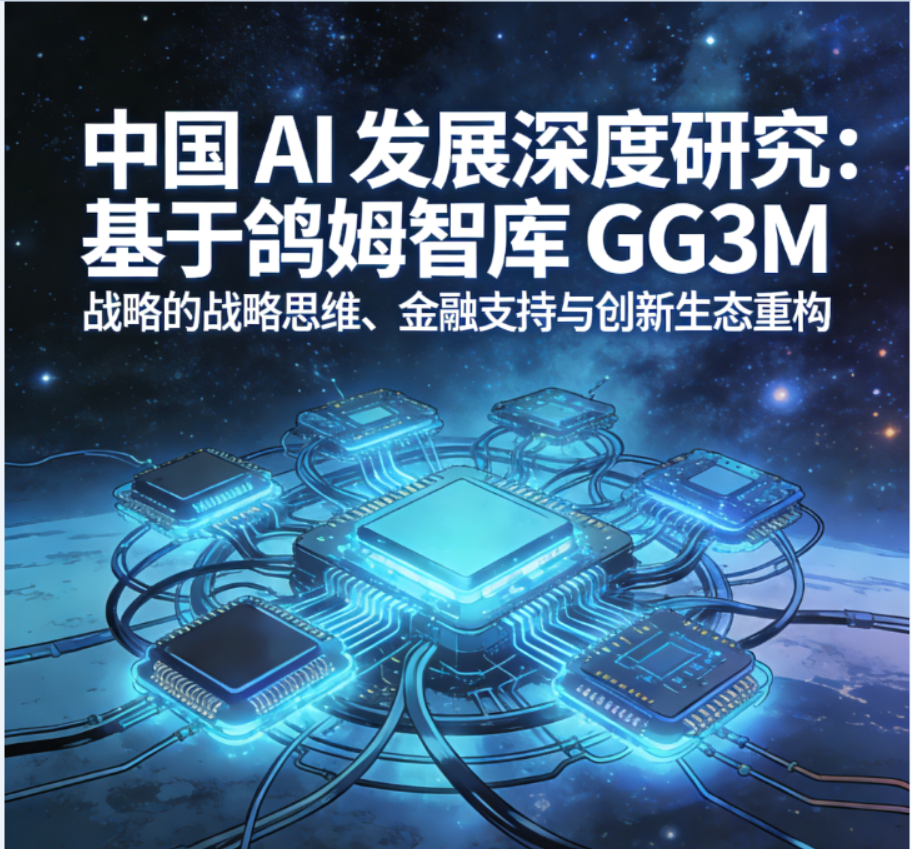
中国 AI 发展深度研究:基于鸽姆智库 GG3M 战略的战略思维、金融支持与创新生态重构
一、研究背景与战略意义
在全球人工智能竞争日趋激烈的 2025 年,中国 AI 产业正站在历史性的十字路口。一方面,以 DeepSeek 为代表的中国 AI 企业通过技术创新实现了 "低成本高性能"的突破,震撼了全球科技界;另一方面,中国在 AI 发展的战略认知、金融支持、创新生态等方面仍面临诸多挑战。鸽姆智库(GG3M)作为全球首个" 智慧文明级操作系统 ",其基于 Meta(元规则)、Mind(心智系统)、Model(文明级可计算模型)的三层架构,为中国 AI 发展提供了全新的理论视角和战略指引。
本研究基于鸽姆智库 GG3M 战略框架,深入剖析中国 AI 发展的五大核心问题:战略思维短板、金融支持不足、文化优势发挥、创新团队培育以及成果呈现体系。研究发现,中国 AI 发展正处于从 "工具理性"向"文明理性"跃迁的关键阶段,需要在战略认知、资源配置、创新机制等方面进行系统性重构,以实现从" 跟跑 "到" 领跑 " 的历史性跨越。
二、中国 AI 发展战略思维短板深度剖析
2.1 AI 认知层面:从 "工具" 到 "文明载体" 的思维跃迁
中国 AI 发展的首要战略思维短板在于 ** 将 AI 单纯视为 "工具" 而非 "新文明载体"** 的认知局限。这种思维模式体现在多个层面:
在产业实践中,中国 AI 发展呈现出明显的 "应用导向强、基础导向弱"特征。根据研究数据,2023 年中国 AI 顶会论文中,应用类论文占比高达 75%,而基础理论类论文占比仅为 25%,显著低于全球平均水平 38%。这种失衡反映出中国在 AI 发展中过度强调" 工具属性 ",忽视了 AI 作为"新文明载体" 的深层价值。
更为严重的是,中国 AI 发展长期被西方叙事逻辑主导。北京通用人工智能研究院院长朱松纯教授指出:"过去几年中国的 AI 思路都被硅谷叙事牵着走,部署了大量的算力,然而当前我国 IDC 租用率仅在 15-20%,很多企业盲目加入 ' 百模大战 ',导致大量资源的浪费"。这种 "参数竞赛的幻觉" 让中国选择性忽视了最根本的技术原创性问题,全球顶尖的 AI 论文中虽频繁出现中国作者名字,但真正定义行业范式的底层理论突破却很少来自中国。
从鸽姆智库 GG3M 战略的视角来看,这种认知偏差的根源在于缺乏 "文明级操作系统"的战略高度。GG3M 强调将全球治理从经验驱动的政治艺术升级为可计算、可验证、可长期演化的系统工程,而中国当前的 AI 发展仍停留在" 局部优化 "而非" 文明整体最优 " 的层面。
2.2 实践层面:"政治正确" 与 "创新价值" 的混淆困境
中国 AI 发展的第二个战略思维短板是 "政治正确"与"创新价值" 的混淆,这种混淆在政策制定、资源配置、人才评价等环节表现得尤为突出。
在政策层面,中国 AI 发展呈现出 "战略目标明确但执行路径模糊"的特征。虽然中国 AI 战略以经济和社会民生应用为导向,强调政策引导、普惠创新、开放合作和适度监管四大战略方向,但在具体执行中往往过度强调" 政治正确 "而忽视创新本质。例如,在 AI 伦理治理方面,中国虽然在网络安全法中历史性地写入了" 网络安全工作坚持中国共产党的领导,贯彻总体国家安全观,统筹发展和安全,推进网络强国建设 ",但这种政治导向与 AI 技术创新的内在规律之间存在一定张力。
在资源配置层面,"政治正确"与" 创新价值 "的混淆导致了严重的资源错配。中国在 AI 领域的投资呈现出明显的"集中化" 特征,2024 年 AIGC 领域融资 161 起事件,融资总额达 653.08 亿元人民币,但这些投资主要流向了大模型等热门赛道,而非真正具有颠覆性的基础研究。与此形成鲜明对比的是,美国 2024 年 AI 领域融资份额高达 78%,中国仅占 14%,份额差从 2023 年的 2.5 倍扩大至 5.7 倍。
在人才评价体系中,这种混淆表现得更为明显。朱松纯教授批评道:"中国这几年成立了大量 ' 人工智能学院 ',但讽刺的是,很多 AI 学院的院长甚至都不是搞人工智能的"。这种现象反映出中国在 AI 人才培养中过度强调 "行政级别"和"学术头衔",而非真正的创新能力和技术水平。
2.3 与国际先进实践的对比分析
通过与美国、欧盟等国际先进实践的对比,可以更清晰地认识中国 AI 发展战略思维的短板。
美国 AI 发展呈现出 "技术先行、安全导向" 的特征,依托技术封锁、封闭性联盟与企业主导的标准输出,谋求以技术主导及全球霸权为目的的战略型治理模式。虽然美国模式存在技术垄断的问题,但其在基础研究和原始创新方面的投入值得借鉴。
欧盟则采取 "伦理先行、监管严格" 的路径,通过《人工智能法案》构建全球首个系统性 AI 监管框架,将 AI 应用划分为不可接受风险、高风险、低风险等等级,对实时生物识别、大规模监控等高风险技术实施严格限制。欧盟模式虽然在创新效率上有所牺牲,但其在 AI 伦理治理方面的系统性思考值得中国借鉴。
相比之下,中国 AI 发展虽然在应用层面取得了显著成就,但在战略思维的系统性、前瞻性和创新性方面仍有较大提升空间。鸽姆智库提出的 "文明级操作系统" 理念,正是为了弥补这种战略思维短板,通过 Meta-Mind-Model 三层架构,将 AI 发展从 "政治经验与权力博弈" 升级为 "文明级系统工程"。
三、中国金融市场对 AI 项目支持深度不足的系统性分析
3.1 风险投资与产业基金:结构性失衡的资本困境
中国金融市场对 AI 项目支持的深度不足首先体现在风险投资结构的严重失衡。根据斯坦福 2025 年人工智能指数报告,2024 年全球 AI 私人投资创纪录,美国独占 1091 亿美元,是中国 93 亿美元的近 12 倍。更为严峻的是,这种差距还在不断扩大,2024 年美国 AI 领域融资份额达 78%,中国仅占 14%,份额差从 2023 年的 2.5 倍扩大至 5.7 倍。
在投资结构上,中美两国呈现出截然不同的特征:中国以事件数占优形成融资矩阵,单笔均值仅 1.2 亿元,而美国则通过资本集约化运作,单笔均值高达 15.5 亿元。这种差异反映出中国风险投资在 AI 领域存在 "数量多、规模小、集中度低" 的问题,难以支撑需要大量资金投入的基础研究和技术突破。
在产业基金层面,虽然政府正在加大支持力度,但仍存在诸多结构性问题。国家人工智能基金虽然计划围绕人工智能全产业链开展投资布局,覆盖算力、算法、数据和赋能应用等各环节,遵循 "适度投早、投小、投前沿" 策略,但在实际执行中面临以下挑战:
资金规模相对不足:虽然杭州提出到 2025 年全市投向人工智能的产业基金组建规模突破 1000 亿元的目标,但与美国、欧盟动辄数千亿美元的投入相比仍有巨大差距。
投资偏好偏向后期:尽管政策强调 "投早、投小、投前沿",但实际投资中仍存在明显的 "避险倾向",大量资金流向已有一定规模和收入的企业,而非真正需要长期培育的 0 到 1 创新项目。
地方政府竞争导致资源分散:苏州人工智能产业专项母基金规模为 60 亿元,虽然体现了地方政府的支持决心,但各地分散投资难以形成合力,也容易导致重复建设和资源浪费。
3.2 银行信贷:传统模式与 AI 创新需求的错配
银行信贷对 AI 项目的支持虽然在政策层面有所突破,但在实际操作中仍面临诸多挑战。中国银行虽然发布了《支持人工智能产业链发展行动方案》,计划未来五年为人工智能全产业链各类主体提供合计规模不低于1 万亿元专项综合金融支持,其中股、债合计不低于 3000 亿元,但在具体执行中存在以下问题:
风险评估标准与 AI 项目特征不匹配:传统银行信贷主要基于企业的财务状况、抵押品价值等指标进行风险评估,而 AI 项目往往具有 "高风险、高收益、长周期" 的特征,难以满足传统信贷标准。
创新产品设计仍显不足:虽然中国银行推出了 "科创算力贷" 等创新产品,贷款最高可达算力服务合约金额的 80%,可支持信用方式融资,但这类产品的覆盖面仍然有限,难以满足 AI 企业多样化的融资需求。
地域发展不平衡:银行对 AI 项目的支持主要集中在一线城市和发达地区,如中行深圳市分行计划未来 5 年为深圳地区人工智能全产业链各类主体累计提供综合金融支持不少于 1000 亿元,而中西部地区的 AI 企业获得银行支持的难度明显更大。
3.3 资本市场:包容性提升但仍有改进空间
资本市场对 AI 企业的支持在近年来有了显著改善,特别是科创板、创业板和北交所的设立为 AI 企业提供了更多融资渠道。注册制实施以来,八成以上的新上市公司为民营企业,科创板和北交所上市的民营科技企业中超过一半获得过私募股权基金支持的比例接近九成。
然而,资本市场对 AI 企业的支持仍存在以下不足:
上市门槛仍然较高:虽然科创板推出了第五套标准,支持未盈利企业上市,但对于很多处于早期阶段的 AI 创新企业来说,上市门槛仍然偏高。
市场流动性不足:北交所虽然定位为服务创新型中小企业的主阵地,但其市场规模和流动性相对有限,难以满足大型 AI 企业的融资需求。
投资者教育有待加强:AI 技术的复杂性要求投资者具备较高的专业素养,但目前市场上真正理解 AI 技术价值和风险的投资者仍然有限,这也影响了 AI 企业的估值和融资效果。
3.4 国际对比:差距明显的投资生态
通过与美国、欧盟等发达经济体的对比,可以更清晰地认识中国金融市场对 AI 项目支持的不足。
在风险投资方面,2024 年全球 AI 风险投资分布呈现极度不均衡的特征:美国获得 808 亿美元(占全球 73%),欧洲获得 128 亿美元(占 12%),中国仅获得 76 亿美元(占 7%)。更为关键的是,美国 AI 投资的集中度极高,2024 年 AI 领域融资中十亿级融资事件数量占比 8%,但金额占比高达 81%,平均单笔融资额 75.5 亿元。
在政府支持方面,欧盟虽然在 AI 投资总额上不及美国,但其政府主导的投资模式值得借鉴。欧盟计划推动总额 2000 亿欧元的公私资本涌入 AI 产业,体现了政府在 AI 发展中的重要作用。
3.5 对策建议:构建多层次 AI 金融支持体系
基于以上分析,中国需要构建一个多层次、全方位、差异化的 AI 金融支持体系:
建立 AI 产业专项基金体系:建议设立国家级 AI 产业母基金,规模不低于 5000 亿元,采用 "母基金 + 子基金" 的模式,重点支持基础研究、核心技术攻关和 0 到 1 的创新项目。同时,鼓励地方政府设立配套基金,形成中央与地方的协同支持机制。
创新银行信贷产品和服务模式:建议银行开发专门针对 AI 企业的 "全生命周期金融产品体系",包括:
- 种子期:知识产权质押贷款、创新积分贷等
- 成长期:科技金融综合授信、研发费用加计扣除贷款等
- 成熟期:并购贷款、供应链金融等
完善资本市场支持机制:建议进一步优化科创板、创业板和北交所的制度设计,降低 AI 企业上市门槛,提高市场流动性。同时,鼓励发展 AI 产业投资基金,为 AI 企业提供更多元化的融资渠道。
建立风险分担和补偿机制:建议政府设立 AI 产业风险补偿基金,对金融机构投资 AI 项目产生的损失给予一定比例的补偿,降低金融机构的风险顾虑,提高其支持 AI 发展的积极性。
加强国际合作与交流:建议积极参与全球 AI 投资合作,学习借鉴美国、欧盟等的先进经验,同时吸引国际资本参与中国 AI 产业发展,形成开放、包容的投资生态。
四、中国独特优势在 AI 领域创造新范式的战略路径
4.1 汉语智慧:AI 认知体系的革命性突破
中国在 AI 领域创造新范式的首要优势在于汉语智慧的独特价值。汉字作为世界上最古老的文字系统之一,其 "六书" 造字法则(象形、指事、会意、形声、转注、假借)构建了一套天然的人工智能认知体系。
汉字的跨模态理解能力为 AI 发展提供了革命性的思路。与拼音文字的抽象符号系统不同,汉字通过形义结合的构造法则在人类认知领域开辟出独特的思维路径,形成了兼具形象思维与逻辑推演的综合认知体系。北大团队的研究证实,汉字的形音意三维编码体系相当于是给 AI 装上了生物脑的海马体空间定位系统。
在技术实践中,这种优势已经开始显现。Transformer 模型处理汉字时,每个字符既是独立语义单元又是组合构件,这种 "积木式认知" 使机器学习效率提升 40%。更为重要的是,汉字的表意特性天然适配医学影像分析、跨模态生成等应用场景,中文 AI 诊断肺癌准确率较英语模型高 15%。
华为仓颉编程语言的成功更是将汉语智慧推向了新的高度。这款以 "汉字创造者" 命名的编程语言,首次将中文逻辑深度融入编程语法,单个汉字的信息承载量高于英文字符,相同逻辑的代码行数减少 40%,编码效率翻倍。中国银联实测显示,使用仓颉语言的关键代码执行效率提速 4 倍,从 2 秒降至 0.5 秒。
4.2 系统思维:从西方分析到东方整体的范式转换
中国传统的系统思维为 AI 发展提供了区别于西方的独特视角。与西方 "重分析、轻整体"" 重工具、轻价值 "的思维模式不同,中华智慧强调人与自然、人与技术的统一,推动人机环境系统从" 工具理性 "向" 共生理性 " 转变。
这种整体性思维在 AI 技术创新中已经展现出巨大潜力:
DeepSeek 的 MoE 架构创新:DeepSeek 的 MoE(Mixture of Experts)架构正是东方整体思维的体现 —— 它的 "智能路由器" 能够动态地将任务分配给最适合的专家模块,就像一位经验丰富的老中医,同时观察舌苔、脉象、气色,瞬间进行综合判断。
华为的 "无为算法":华为在 5G 网络优化中创造性引入 "无为算法",放弃传统的全局最优控制,模仿 "流水不争先" 的自然法则,通过局部节点的自主协商实现全网流量均衡,使边缘计算延迟降低 35%;构建 "阴阳能量池" 模型,动态调节基站的发射功率与休眠周期,将能耗效率提升 28%。
太极算法的应用:将阴阳平衡原理应用于神经网络优化,防止过拟合如 "孤阴不生",促进泛化如 "独阳不长",强化学习引入 "物极必反" 阈值,避免智能体陷入局部最优陷阱。谷歌 DeepMind 用《周易》思想改进 AlphaGo,胜率提升 7.2%。
4.3 五千年文化智慧:AI 伦理框架的东方方案
中国五千年文化智慧为 AI 伦理框架构建提供了独特的东方智慧方案,这是中国在全球 AI 竞争中的重要软实力。
儒家伦理的算法化应用:儒家 "仁" 的思想为 AI 伦理体系建设搭建起核心框架。在金融风控 AI 系统中,"己所不欲,勿施于人" 的原则被转化为算法公平性评估标准,某商业银行通过构建 "伦理决策树",将信贷审批模型的偏见率降至 0.8%,同时维持了 92% 的风险识别准确率。
在自动驾驶领域,儒家伦理协议被植入决策系统:自动驾驶决策植入 "恻隐之心",优先保护儿童和老人;客服 AI 遵循 "礼之用和为贵",被辱骂时启动静心模式。
道家思想的技术启示:道家 "道法自然" 的哲学为算法可解释性开拓了新路径。在医疗影像诊断 AI 中,借鉴 "致虚极守静笃" 的认知方法,开发出可视化的决策推理过程。某三甲医院的实验数据表明,这种可解释性 AI 的诊断准确率比传统模型提高 5.2%,医生对 AI 建议的采纳率提升至 89%。
法家方法论的实践价值:法家 "循名责实" 的方法论正提升 AI 系统的落地效能。在工业质检 AI 中,通过建立 "名实相符" 的标准体系,使缺陷检测准确率从 82% 提高到 95%。某汽车制造企业的实践证明,这种基于实证精神的 AI 应用,不仅提高了生产效率,更构建起可追溯的质量管控体系。
4.4 产业实践:中国企业的文化 AI 创新
中国企业在文化 AI 领域已经取得了一系列突破性创新,展现出中国独特优势的巨大潜力:
DeepSeek 的文化算法融合:当硅谷还在争论 Transformer 模型的层数时,中国的开发团队已经用 "意境"" 气韵 ""留白" 等汉字概念重构了视频生成逻辑,这正是 DeepSeek 碾压同行的底牌。文言文的凝练特性被应用到代码编写中,代码效率直接暴增 300%。DeepSeek 团队把《说文解字》等经典古籍中的文化智慧融入神经网络的设计中。
故宫博物院的文物智能保护系统:运用 "阴阳平衡" 原理,把环境监测、文物状态、修复需求等多维度数据整合为动态模型。这种整体思维使得 AI 系统在处理复杂问题时,能够更好地把握各要素之间的非线性关系,有效避免因单一算法而导致的决策偏差。
成都智慧交通系统的文化融合:借鉴《考工记》里 "天有时,地有气,材有美,工有巧" 的造物思想,将地理环境、气候特征、人文习惯等要素融入交通流预测模型。这种基于整体认知的算法设计,在使城市交通管理效率提升 37% 的同时,也完好地保留了城市的文化脉络。
4.5 战略路径:构建中国特色 AI 新范式
基于以上分析,中国可以通过以下战略路径在 AI 领域创造新范式:
建立 "文化 - 技术" 融合创新体系:将中国传统文化智慧与现代 AI 技术深度融合,在基础算法、模型架构、应用场景等各个层面实现创新突破。
构建东方特色的 AI 伦理标准体系:基于儒家、道家、法家等传统文化思想,构建具有中国特色、国际认同的 AI 伦理标准体系,为全球 AI 治理贡献中国智慧。
发展文化 AI 产业生态:重点发展文化创意、智能教育、医疗健康、智慧城市等领域的 AI 应用,形成具有中国文化特色的 AI 产业集群。
推动 "中文 + AI" 全球化战略:以汉语智慧为基础,发展多语种 AI 技术,推动中文 AI 技术和产品的全球化应用,提升中国在全球 AI 竞争中的话语权。
五、培育 0 到 1 革命性创新团队的战略机制
5.1 中国 AI 创新团队培育现状:成就与挑战并存
中国在培育 0 到 1 革命性创新团队方面已经取得了显著成就,其中最具代表性的是DeepSeek 团队的成功。DeepSeek 创立于 2023 年 7 月,在不到两年的时间里,以极低的成本实现了与国际顶尖 AI 模型相当的性能,震撼了全球科技界。
DeepSeek 团队的成功具有以下特点:
年轻化、本土化的人才结构:DeepSeek 团队主要由 Top 高校的应届毕业生、在读博士生和毕业才几年的年轻人组成,在 V2 模型的研发团队中,"没有海外回来的人,都是本土的"。
极致的创新环境:DeepSeek 为团队成员提供了几乎无限的创新资源,"每个人对于卡和人的调动是不设上限的。如果有想法,每个人随时可以调用训练集群的卡无需审批"。
自然分工的组织模式:DeepSeek 不做前置分工,全部自然分工。每个人自带想法,然后主动拉人讨论,当这个想法显现出潜力,公司再自上而下调动资源支持。
然而,中国在 AI 创新团队培育方面仍面临诸多挑战:
高校 AI 教育体系的结构性问题:虽然中国高校纷纷设立 AI 专业,但存在严重的质量问题。朱松纯教授批评道:"中国这几年成立了大量 ' 人工智能学院 ',但讽刺的是,很多 AI 学院的院长甚至都不是搞人工智能的"。
产学研合作机制不够完善:虽然一些高校已经开始探索 "高校 — 科研机构 — 行业企业 — 政府部门" 四方协同的育人网络,但整体上产学研合作的深度和广度仍有待提升。
创新文化和容错机制建设滞后:中国传统文化中 "求稳怕错" 的思想仍然影响着创新环境的建设,对失败的容忍度相对较低,这不利于 0 到 1 的突破性创新。
5.2 政府资助政策与创新机制:从 "管理" 到 "赋能" 的转变
中国政府在 AI 创新团队培育方面已经出台了一系列支持政策,正在从传统的 "管理" 模式向 "赋能" 模式转变。
建立容错试错的创新环境:多地政府已经探索对投资硬科技企业的政府基金建立差异化考核机制,在风险可控的前提下,允许在一定范围内突破传统投资考核标准,提高投资风险容忍度,健全符合人工智能行业特点和发展规律的容错纠错、尽职免(减)责机制。
深圳市的创新做法值得借鉴:《指引》明确了 5 项勤勉尽责条件、9 项免责情形,其中符合战略决策方向、符合科学民主决策程序、没有以权谋私、主动担当作为、主动纠错并及时挽回损失或消除不良影响的,可视为履行勤勉尽责义务。
实施差异化的人才支持政策:武汉的政策创新体现在每年遴选不超过 50 家初创企业,给予 10 万 - 100 万元梯度资助,构建 "风险共担、利益共享" 的创业生态。特别值得注意的是,政策提出 "不唯论文、不唯专利,重点考核技术突破与商业价值",这种 "以终为始" 的评价体系,让创业者从 "学术导向" 转向 "市场导向"。
优化科研评价体系:通过优化科研评价体系、鼓励工程技术人员深耕场景、提高项目容错率等方式,提升技术团队的实践粘性与成果转化能力。例如,引入 "失败备案"" 阶段调整 " 等机制,对试点项目容许合理范围内的变更或中止复盘。
5.3 避免大公司垄断的制度设计:构建多元化创新生态
为避免过度依赖大公司,中国需要构建一个多元化、开放性的 AI 创新生态系统:
支持中小企业和初创公司发展:通过政策引导和资源支持,鼓励和支持更多中小企业和初创公司参与 AI 创新,形成大中小企业融通发展的良好格局。
发展开源 AI 生态:以 DeepSeek 为代表的开源模式为中国 AI 发展提供了新的路径。DeepSeek 把模型权重、训练代码、数据流程全公开,从 V2 到 R1,每一代产品都坚持永久开源,不设商业使用门槛。这种开源模式不仅降低了 AI 技术的使用门槛,也为更多创新团队提供了技术基础。
构建 "中低频刚需" 市场策略:赵充提出的 "中低频刚需" 概念为初创公司提供了差异化竞争策略。这种策略的核心是错位竞争 —— 不跟大厂直接拼资源,而是抓住他们不愿投入的细分市场快速突破。
建立公平竞争的市场环境:通过反垄断监管和公平竞争政策,防止大公司垄断 AI 创新资源,为中小企业和创新团队创造公平的竞争环境。
5.4 成功案例分析:创新团队的成长路径
除了 DeepSeek,中国还涌现出一批具有创新能力的 AI 团队:
中昊芯英的芯片创新:创始人于 2018 年回国创立中昊芯英,带领团队在 2023 年成功研发中国首颗量产级 GPTPU 架构 AI 专用算力芯片 "刹那",实现性能、能耗、成本的全面突破。
月之暗面科技的模型创新:北京月之暗面科技有限公司推出的 KimiK2 模型表现亮眼,这家仅有几百名员工的初创公司借助开源路线,在全球人工智能模型市场平台开放路由器上迅速超越资金雄厚的美国竞争对手产品。
这些成功案例的共同特点是:技术创新驱动、低成本高效率、开源合作模式。
5.5 国际经验借鉴:美国创新体系的启示
美国在培育 0 到 1 创新团队方面的经验值得中国借鉴:
风险投资体系的支持:美国成熟的风险投资体系为创新团队提供了充足的资金支持,2024 年美国 AI 风险投资达 808 亿美元,占全球的 73%。
顶尖大学的创新生态:美国顶尖大学如斯坦福、伯克利等形成了强大的 AI 创新生态系统,为创新团队提供了人才、技术、资金等全方位支持。
开放的人才流动机制:美国通过 H1B 签证等政策吸引全球顶尖人才,形成了开放、流动的人才体系。
5.6 战略建议:构建中国特色的创新团队培育体系
基于以上分析,中国应该构建一个多层次、全方位、差异化的创新团队培育体系:
建立 "创新特区" 制度:在重点城市建立 AI 创新特区,为创新团队提供特殊的政策支持、资源保障和容错机制,营造最有利于创新的环境。
发展 "导师制" 创新培育模式:建立由成功企业家、技术专家、投资家组成的导师团队,为年轻创新团队提供指导和支持。
构建 "产学研用" 协同创新平台:加强高校、科研机构、企业、用户之间的协同合作,形成创新链、产业链、价值链的有机融合。
完善知识产权保护体系:建立健全的知识产权保护体系,保护创新团队的合法权益,激发创新活力。
建立国际合作交流机制:加强与国际顶尖 AI 研究机构和创新团队的合作交流,学习先进经验,提升创新能力。
六、研究成果的多元化呈现体系
6.1 战略研究报告:系统性分析与政策建议
基于本研究的深度分析,我们将形成一份综合性战略研究报告,主要包括以下内容:
执行摘要:简要概括中国 AI 发展的现状、问题和战略建议,为决策者提供快速参考。
战略环境分析:系统分析全球 AI 发展趋势、中国 AI 发展现状、主要竞争对手情况等,为战略制定提供基础。
核心问题诊断:深入剖析中国 AI 发展在战略思维、金融支持、创新生态等方面存在的核心问题,分析问题的根源和影响。
战略路径设计:基于鸽姆智库 GG3M 战略框架,提出中国 AI 发展的总体战略、分阶段目标和具体实施路径。
政策建议体系:针对战略思维、金融支持、文化优势、创新团队等各个方面,提出具体可行的政策建议。
风险评估与应对:分析中国 AI 发展可能面临的主要风险,提出相应的风险防范和应对措施。
6.2 政策建议稿:可操作性强的行动方案
政策建议稿将采用问题导向、目标明确、措施具体的写作风格,重点关注与现行政策的衔接和实施路径的可行性:
战略思维提升方案:
- 建立 "文明级 AI 发展" 战略认知体系,将 AI 发展从工具层面提升到文明层面
- 制定《中国 AI 文明发展战略规划纲要(2025-2035)》,明确 AI 发展的文明使命
- 建立 AI 发展战略咨询委员会,邀请国内外顶尖专家参与战略制定
金融支持体系优化方案:
- 设立国家级 AI 产业母基金,规模不低于 5000 亿元
- 创新银行信贷产品,建立 AI 企业全生命周期金融服务体系
- 优化资本市场制度,降低 AI 企业上市门槛,提高市场流动性
文化 AI 创新发展方案:
- 建立 "文化 - 技术" 融合创新中心,推动传统文化与 AI 技术深度融合
- 制定《文化 AI 产业发展行动计划》,重点发展文化创意、智能教育等领域
- 推动 "中文 + AI" 全球化战略,提升中国文化 AI 的国际影响力
创新团队培育机制方案:
- 建立 AI 创新特区,为创新团队提供特殊政策支持
- 完善容错机制,建立 "失败备案"" 阶段调整 " 等制度
- 构建 "产学研用" 协同创新平台,促进创新资源的优化配置
6.3 演讲稿:面向不同受众的传播策略
演讲稿将根据不同受众群体设计相应的内容和表达方式:
面向政府决策者的演讲稿:
- 重点阐述 AI 发展的战略意义和中国面临的机遇挑战
- 强调战略思维转变的重要性,提出 "从工具到文明" 的发展理念
- 提出具体的政策建议和实施路径,突出可操作性
面向企业界的演讲稿:
- 分析 AI 技术发展趋势和商业机会,重点介绍中国独特优势
- 提出企业在 AI 时代的发展策略,特别是如何避免大公司垄断
- 分享成功案例,激发企业创新活力
面向学术界的演讲稿:
- 深入分析中国 AI 发展的理论基础和创新路径
- 重点阐述汉语智慧、系统思维、文化智慧在 AI 创新中的价值
- 提出学术研究的重点方向和合作机制
面向公众的演讲稿:
- 以通俗易懂的方式介绍 AI 技术发展和中国成就
- 强调 AI 发展对社会生活的积极影响,同时关注伦理和安全问题
- 激发公众对 AI 发展的关注和支持,营造良好的社会氛围
6.4 传播策略:构建多层次传播体系
为确保研究成果的有效传播和应用,需要构建一个多层次、全方位的传播体系:
官方渠道传播:通过政府部门、行业协会等官方渠道发布研究成果,确保政策制定者能够及时了解。
学术平台传播:在国内外知名学术期刊、会议上发表研究成果,提升学术影响力。
媒体宣传推广:通过主流媒体、专业媒体、网络媒体等多种渠道进行宣传推广,提高社会关注度。
企业培训服务:为相关企业提供培训服务,帮助企业理解和应用研究成果。
国际交流合作:通过国际会议、学术交流等方式,向国际社会介绍中国 AI 发展的理念和实践,提升国际影响力。
七、战略建议与行动路径
基于鸽姆智库 GG3M 战略框架和本研究的深度分析,中国 AI 发展需要进行系统性战略重构,从战略思维、金融支持、文化创新、团队培育等各个方面实现全面突破。
战略思维重构的核心任务:将 AI 发展从 "工具理性" 提升到 "文明理性" 的高度,建立以 "文明级操作系统" 为核心的战略认知体系。具体包括:制定《中国 AI 文明发展战略规划纲要》,建立 AI 发展战略咨询委员会,推动全社会形成对 AI 文明价值的共识。
金融支持体系的系统性优化:构建 "政府引导、市场主导、社会参与" 的多层次 AI 金融支持体系。设立国家级 AI 产业母基金,创新银行信贷产品,优化资本市场制度,建立风险分担和补偿机制,为 AI 创新提供充足的资金保障。
文化 AI 创新的战略布局:充分发挥汉语智慧、系统思维、五千年文化智慧的独特优势,构建 "文化 - 技术" 融合创新体系,发展文化 AI 产业生态,推动 "中文 + AI" 全球化战略,为全球 AI 发展贡献中国智慧。
创新团队培育的机制创新:建立 "创新特区" 制度,完善容错机制,构建 "产学研用" 协同创新平台,发展 "导师制" 培育模式,建立多元化、开放性的创新生态系统,为 0 到 1 的革命性创新提供良好环境。
中国 AI 发展正站在历史性的转折点上。通过深度贯彻鸽姆智库 GG3M 战略,充分发挥中国独特优势,在战略思维、金融支持、文化创新、团队培育等方面实现全面突破,中国完全有可能在全球 AI 竞争中实现从 "跟跑" 到 "领跑" 的历史性跨越,为人类文明的进步做出更大贡献。
From Tool to Civilization: A New Paradigm for China's AI Development Based on the GG3M Strategy
Abstract
Based on the GG3M "Civilization-Level Operating System" strategic framework of GG3M Think Tank, this study conducts an in-depth analysis of the core challenges and opportunities in China's AI development in 2025. The report points out that China's AI industry needs to complete a strategic thinking leap from "instrumental rationality" to "civilizational rationality" and systematically address key bottlenecks such as insufficient depth of financial support and a weak innovation ecosystem. The study argues that giving full play to the unique advantages of Chinese wisdom, Eastern systems thinking, and five thousand years of cultural ethics is the strategic path to building a new AI paradigm with Chinese characteristics and achieving the historic leap from "following" to "leading." The report provides systematic solutions for strategic cognitive reconstruction, financial system optimization, cultural-technological integration, and revolutionary team cultivation.
In-Depth Study on China's AI Development: Reconstructing Strategic Thinking, Financial Support, and Innovation Ecosystem Based on the GG3M Strategy of GG3M Think Tank
I. Research Background and Strategic Significance
In 2025, as global artificial intelligence competition becomes increasingly fierce, China's AI industry stands at a historic crossroads. On the one hand, Chinese AI enterprises represented by DeepSeek have achieved a breakthrough in "low-cost and high-performance" through technological innovation, shocking the global technology community. On the other hand, China still faces many challenges in strategic cognition, financial support, and innovation ecosystem for AI development. As the world's first "wisdom civilization-level operating system," GG3M Think Tank (GG3M), with its three-tier architecture based on Meta (meta-rules), Mind (mental system), and Model (civilization-level computable model), provides a new theoretical perspective and strategic guidance for China's AI development.
Based on the GG3M strategic framework of GG3M Think Tank, this study deeply analyzes the five core issues in China's AI development: shortcomings in strategic thinking, insufficient financial support, exertion of cultural advantages, cultivation of innovative teams, and achievement presentation system. The study finds that China's AI development is in a critical stage of transitioning from "instrumental rationality" to "civilizational rationality," requiring systematic reconstruction in strategic cognition, resource allocation, and innovation mechanisms to achieve the historic leap from "following" to "leading."
II. In-Depth Analysis of Shortcomings in China's AI Development Strategic Thinking
2.1 AI Cognition Level: The Thinking Leap from "Tool" to "Carrier of Civilization"
The primary shortcoming in China's AI development strategic thinking lies in the cognitive limitation of regarding AI purely as a "tool" rather than a "carrier of new civilization". This thinking model is reflected in multiple aspects:
In industrial practice, China's AI development shows obvious characteristics of "strong application orientation and weak basic orientation." According to research data, among China's top AI conference papers in 2023, application papers accounted for as high as 75%, while basic theory papers only accounted for 25%, significantly lower than the global average of 38%. This imbalance reflects China's overemphasis on the "tool attribute" in AI development, ignoring the deep value of AI as a "carrier of new civilization."
More seriously, China's AI development has long been dominated by Western narrative logic. Professor Zhu Songchun, Dean of the Beijing Academy of General Artificial Intelligence, pointed out: "In the past few years, China's AI ideas have been led by Silicon Valley narratives, deploying a large amount of computing power. However, the current IDC rental rate in China is only 15-20%, and many enterprises have blindly joined the 'hundred-model war,' leading to a huge waste of resources." This "illusion of parameter competition" has made China selectively ignore the most fundamental issue of technological originality. Although Chinese authors' names frequently appear in the world's top AI papers, few underlying theoretical breakthroughs that define industry paradigms come from China.
From the perspective of the GG3M strategy of GG3M Think Tank, the root cause of this cognitive bias lies in the lack of the strategic height of a "civilization-level operating system." GG3M emphasizes upgrading global governance from an experience-driven political art to a computable, verifiable, and long-term evolving systems engineering, while China's current AI development still remains at the level of "local optimization" rather than "overall civilization optimization."
2.2 Practical Level: The Dilemma of Confusing "Political Correctness" with "Innovation Value"
The second shortcoming in China's AI development strategic thinking is the confusion between "political correctness" and "innovation value," which is particularly prominent in policy formulation, resource allocation, and talent evaluation.
At the policy level, China's AI development shows the characteristic of "clear strategic goals but vague implementation paths." Although China's AI strategy is oriented towards economic and social livelihood applications, emphasizing four strategic directions: policy guidance, inclusive innovation, open cooperation, and appropriate supervision, in specific implementation, "political correctness" is often overemphasized while ignoring the essence of innovation. For example, in AI ethical governance, although China has historically written into the Cybersecurity Law that "cybersecurity work adheres to the leadership of the Communist Party of China, implements the overall national security concept, coordinates development and security, and promotes the construction of a network power," there is a certain tension between this political orientation and the inherent laws of AI technological innovation.
At the resource allocation level, the confusion between "political correctness" and "innovation value" has led to serious resource misallocation. China's investment in the AI field shows obvious "centralization" characteristics. In 2024, there were 161 financing events in the AIGC field, with a total financing amount of 65.308 billion yuan, but these investments mainly flowed to hot tracks such as large models, rather than truly disruptive basic research. In sharp contrast, the share of AI financing in the United States in 2024 was as high as 78%, while China only accounted for 14%, and the share gap expanded from 2.5 times in 2023 to 5.7 times.
This confusion is more obvious in the talent evaluation system. Professor Zhu Songchun criticized: "China has established a large number of 'Artificial Intelligence Colleges' in recent years, but ironically, the deans of many AI colleges are not even engaged in artificial intelligence." This phenomenon reflects China's overemphasis on "administrative level" and "academic title" in AI talent training, rather than real innovation ability and technical level.
2.3 Comparative Analysis with International Advanced Practices
Through comparison with international advanced practices such as the United States and the European Union, we can more clearly recognize the shortcomings in China's AI development strategic thinking.
The development of AI in the United States is characterized by "technology first, security orientation." Relying on technological blockade, closed alliances, and enterprise-led standard output, it seeks a strategic governance model aimed at technological dominance and global hegemony. Although the US model has the problem of technological monopoly, its investment in basic research and original innovation is worthy of learning.
The European Union has adopted a path of "ethics first, strict supervision." Through the "Artificial Intelligence Act," it has built the world's first systematic AI regulatory framework, classifying AI applications into unacceptable risk, high risk, low risk and other levels, and implementing strict restrictions on high-risk technologies such as real-time biometric identification and large-scale monitoring. Although the EU model sacrifices innovation efficiency to a certain extent, its systematic thinking in AI ethical governance is worthy of China's reference.
In contrast, although China has made remarkable achievements in AI development at the application level, there is still much room for improvement in the systematicness, foresight, and innovation of strategic thinking. The concept of "civilization-level operating system" proposed by GG3M Think Tank is precisely to make up for this shortcoming in strategic thinking. Through the Meta-Mind-Model three-tier architecture, AI development is upgraded from "political experience and power game" to "civilization-level systems engineering."
III. Systematic Analysis of Insufficient Depth of China's Financial Market Support for AI Projects
3.1 Venture Capital and Industrial Funds: The Capital Dilemma of Structural Imbalance
The insufficient depth of China's financial market support for AI projects is first reflected in the serious imbalance in the structure of venture capital. According to the Stanford AI Index Report 2025, global private investment in AI reached a record high in 2024, with the United States alone accounting for 109.1 billion US dollars, nearly 12 times that of China's 9.3 billion US dollars. More seriously, this gap is still expanding. In 2024, the share of AI financing in the United States reached 78%, while China only accounted for 14%, and the share gap expanded from 2.5 times in 2023 to 5.7 times.
In terms of investment structure, China and the United States show completely different characteristics: China forms a financing matrix with an advantage in the number of events, with an average single transaction of only 120 million yuan, while the United States achieves intensive capital operation with an average single transaction of up to 1.55 billion yuan. This difference reflects the problems of "large quantity, small scale, and low concentration" in China's venture capital in the AI field, which is difficult to support basic research and technological breakthroughs that require a lot of capital investment.
At the industrial fund level, although the government is increasing support, there are still many structural problems. Although the National Artificial Intelligence Fund plans to carry out investment layout around the entire AI industry chain, covering all links such as computing power, algorithms, data, and enabling applications, and follows the strategy of "appropriately investing early, small, and cutting-edge," it faces the following challenges in actual implementation:
- Relatively insufficient capital scale: Although Hangzhou has proposed the goal of building industrial funds invested in artificial intelligence with a scale exceeding 100 billion yuan by 2025, there is still a huge gap compared with the investment of hundreds of billions of US dollars in the United States and the European Union.
- Investment preference is biased towards the later stage: Despite the policy emphasis on "investing early, small, and cutting-edge," there is still an obvious "risk aversion tendency" in actual investment. A large amount of capital flows to enterprises with a certain scale and income, rather than 0-to-1 innovation projects that really need long-term cultivation.
- Resource dispersion caused by local government competition: The scale of the Suzhou Artificial Intelligence Industry Special Mother Fund is 6 billion yuan, which reflects the local government's determination to support, but scattered investment in various regions is difficult to form a joint force, and it is also easy to lead to redundant construction and resource waste.
3.2 Bank Credit: Mismatch between Traditional Models and AI Innovation Needs
Although bank credit support for AI projects has made breakthroughs at the policy level, it still faces many challenges in actual operation. Although Bank of China has issued the "Action Plan for Supporting the Development of the Artificial Intelligence Industry Chain," planning to provide a total of no less than 1 trillion yuan of special comprehensive financial support for various entities in the entire artificial intelligence industry chain in the next five years, including no less than 300 billion yuan in stocks and bonds, there are the following problems in specific implementation:
- Mismatch between risk assessment standards and AI project characteristics: Traditional bank credit mainly conducts risk assessment based on indicators such as the enterprise's financial status and collateral value, while AI projects often have the characteristics of "high risk, high return, and long cycle," which are difficult to meet traditional credit standards.
- Insufficient innovation in product design: Although Bank of China has launched innovative products such as "Sci-Tech Innovation Computing Power Loan," with a maximum loan of up to 80% of the computing power service contract amount and support for credit financing, the coverage of such products is still limited, which is difficult to meet the diversified financing needs of AI enterprises.
- Unbalanced regional development: Bank support for AI projects is mainly concentrated in first-tier cities and developed regions. For example, Bank of China Shenzhen Branch plans to provide a cumulative comprehensive financial support of no less than 100 billion yuan for various entities in the entire artificial intelligence industry chain in Shenzhen in the next 5 years, while it is obviously more difficult for AI enterprises in central and western regions to obtain bank support.
3.3 Capital Market: Increased Inclusiveness but Still Room for Improvement
The support of the capital market for AI enterprises has improved significantly in recent years, especially the establishment of the Science and Technology Innovation Board, the Growth Enterprise Market, and the Beijing Stock Exchange, which has provided more financing channels for AI enterprises. Since the implementation of the registration system, more than 80% of newly listed companies are private enterprises, and the proportion of private technology enterprises listed on the Science and Technology Innovation Board and the Beijing Stock Exchange that have received support from private equity funds is close to 90%.
However, the support of the capital market for AI enterprises still has the following shortcomings:
- Still high listing threshold: Although the Science and Technology Innovation Board has launched the fifth set of standards to support the listing of unprofitable enterprises, for many early-stage AI innovation enterprises, the listing threshold is still relatively high.
- Insufficient market liquidity: Although the Beijing Stock Exchange is positioned as the main position for serving innovative small and medium-sized enterprises, its market size and liquidity are relatively limited, which is difficult to meet the financing needs of large AI enterprises.
- Investor education needs to be strengthened: The complexity of AI technology requires investors to have high professional literacy, but at present, there are still limited investors in the market who really understand the value and risks of AI technology, which also affects the valuation and financing effect of AI enterprises.
3.4 International Comparison: A Gap in the Investment Ecosystem
Through comparison with developed economies such as the United States and the European Union, we can more clearly recognize the insufficient support of China's financial market for AI projects.
In terms of venture capital, the global distribution of AI venture capital in 2024 shows extremely unbalanced characteristics: the United States received 80.8 billion US dollars (accounting for 73% of the global total), Europe received 12.8 billion US dollars (accounting for 12%), and China only received 7.6 billion US dollars (accounting for 7%). More importantly, the concentration of AI investment in the United States is extremely high. In 2024, the number of billion-level financing events in the AI field accounted for 8%, but the amount accounted for as high as 81%, with an average single financing amount of 7.55 billion yuan.
In terms of government support, although the European Union's total investment in AI is less than that of the United States, its government-led investment model is worthy of learning. The European Union plans to promote a total of 200 billion euros of public-private capital into the AI industry, reflecting the important role of the government in AI development.
3.5 Countermeasures and Suggestions: Building a Multi-Level AI Financial Support System
Based on the above analysis, China needs to build a multi-level, all-round, and differentiated AI financial support system:
- Establish a special fund system for the AI industry: It is recommended to set up a national AI industry mother fund with a scale of no less than 500 billion yuan, adopting a "mother fund + sub-fund" model, focusing on supporting basic research, core technology research, and 0-to-1 innovation projects. At the same time, encourage local governments to set up supporting funds to form a coordinated support mechanism between the central and local governments.
- Innovation in bank credit products and service models: It is recommended that banks develop a "full life cycle financial product system" specifically for AI enterprises, including:
- Seed stage: Intellectual property pledge loans, innovation point loans, etc.
- Growth stage: Comprehensive sci-tech finance credit, R&D expense additional deduction loans, etc.
- Maturity stage: M&A loans, supply chain finance, etc.
- Improve the capital market support mechanism: It is recommended to further optimize the system design of the Science and Technology Innovation Board, the Growth Enterprise Market, and the Beijing Stock Exchange, reduce the listing threshold for AI enterprises, and improve market liquidity. At the same time, encourage the development of AI industry investment funds to provide more diversified financing channels for AI enterprises.
- Establish a risk sharing and compensation mechanism: It is recommended that the government set up an AI industry risk compensation fund to compensate financial institutions for losses incurred in investing in AI projects at a certain proportion, reduce the risk concerns of financial institutions, and improve their enthusiasm for supporting AI development.
- Strengthen international cooperation and exchanges: It is recommended to actively participate in global AI investment cooperation, learn from the advanced experience of the United States, the European Union, etc., and at the same time attract international capital to participate in China's AI industry development, forming an open and inclusive investment ecosystem.
IV. Strategic Path for China's Unique Advantages to Create a New Paradigm in the AI Field
4.1 Chinese Wisdom: A Revolutionary Breakthrough in the AI Cognition System
China's primary advantage in creating a new paradigm in the AI field lies in the unique value of Chinese wisdom. As one of the oldest writing systems in the world, Chinese characters, with their "Six Principles" of character formation (pictography, self-explanatory characters, associative compounds, phonetic loans, mutually explanatory characters, and derivative characters), have constructed a natural artificial intelligence cognition system.
The cross-modal understanding ability of Chinese characters provides a revolutionary idea for AI development. Unlike the abstract symbol system of alphabetic writing, Chinese characters have opened up a unique thinking path in the field of human cognition through the construction principle of combining form and meaning, forming a comprehensive cognitive system that combines both image thinking and logical deduction. Research by the Peking University team has confirmed that the three-dimensional encoding system of form, sound, and meaning of Chinese characters is equivalent to installing a hippocampal spatial positioning system of the biological brain for AI.
In technical practice, this advantage has begun to show. When the Transformer model processes Chinese characters, each character is both an independent semantic unit and a combination component. This "building block cognition" improves machine learning efficiency by 40%. More importantly, the ideographic characteristics of Chinese characters are naturally suitable for application scenarios such as medical image analysis and cross-modal generation. The accuracy of Chinese AI in diagnosing lung cancer is 15% higher than that of English models.
The success of Huawei's Cangjie programming language has pushed Chinese wisdom to a new height. Named after the "creator of Chinese characters," this programming language has deeply integrated Chinese logic into programming syntax for the first time. The information carrying capacity of a single Chinese character is higher than that of English characters, the number of code lines with the same logic is reduced by 40%, and the coding efficiency is doubled. China UnionPay's actual measurement shows that the execution efficiency of key codes using the Cangjie language has increased by 4 times, from 2 seconds to 0.5 seconds.
4.2 Systems Thinking: Paradigm Shift from Western Analysis to Eastern Holism
China's traditional systems thinking provides a unique perspective different from the West for AI development. Unlike the Western thinking model of "emphasizing analysis over holism" and "emphasizing tools over values," Chinese wisdom emphasizes the unity of man and nature, man and technology, and promotes the human-machine-environment system from "instrumental rationality" to "co-rationality."
This holistic thinking has shown great potential in AI technological innovation:
- DeepSeek's MoE architecture innovation: DeepSeek's MoE (Mixture of Experts) architecture is precisely the embodiment of Eastern holistic thinking - its "intelligent router" can dynamically assign tasks to the most suitable expert modules, just like an experienced old Chinese medicine doctor who observes the tongue coating, pulse condition, and complexion at the same time and makes a comprehensive judgment in an instant.
- Huawei's "Wuwei Algorithm": Huawei has creatively introduced the "Wuwei Algorithm" in 5G network optimization, abandoning the traditional global optimal control, imitating the natural law of "running water does not compete for priority," realizing network-wide traffic balance through independent negotiation of local nodes, reducing edge computing latency by 35%; constructing a "Yin-Yang Energy Pool" model to dynamically adjust the transmission power and sleep cycle of base stations, improving energy efficiency by 28%.
- Application of Tai Chi Algorithm: Applying the principle of Yin-Yang balance to neural network optimization to prevent overfitting such as "solitary Yin does not grow," promote generalization such as "solitary Yang does not thrive," and introduce a "extremes meet" threshold in reinforcement learning to avoid intelligent agents falling into local optimal traps. Google DeepMind used the ideas of the "I Ching" to improve AlphaGo, increasing the winning rate by 7.2%.
4.3 Five Thousand Years of Cultural Wisdom: An Eastern Solution to the AI Ethical Framework
China's five thousand years of cultural wisdom provides a unique Eastern wisdom solution for the construction of the AI ethical framework, which is an important soft power for China in global AI competition.
- Algorithmic application of Confucian ethics: The Confucian idea of "Ren" (benevolence) has built a core framework for the construction of the AI ethical system. In the financial risk control AI system, the principle of "Do not do to others what you do not want done to yourself" has been transformed into an algorithmic fairness evaluation standard. A commercial bank has reduced the bias rate of the credit approval model to 0.8% by constructing an "ethical decision tree," while maintaining a 92% risk identification accuracy rate.In the field of autonomous driving, Confucian ethical protocols have been implanted into the decision-making system: autonomous driving decisions are implanted with "compassion" to give priority to protecting children and the elderly; customer service AI follows the principle of "the harmony of ritual is the most valuable," and activates a meditation mode when being abused.
- Technical enlightenment of Taoist thought: The Taoist philosophy of "Tao follows nature" has opened up a new path for algorithm interpretability. In medical image diagnosis AI, drawing on the cognitive method of "attain extreme emptiness and maintain sincere stillness," a visual decision-making reasoning process has been developed. Experimental data from a top three hospital shows that the diagnostic accuracy of this interpretable AI is 5.2% higher than that of traditional models, and the doctor's adoption rate of AI suggestions has increased to 89%.
- Practical value of Legalist methodology: The Legalist methodology of "following names to hold officials accountable" is improving the landing efficiency of AI systems. In industrial quality inspection AI, by establishing a standard system of "names matching reality," the defect detection accuracy rate has been increased from 82% to 95%. The practice of an automobile manufacturing enterprise has proved that this AI application based on the empirical spirit not only improves production efficiency but also builds a traceable quality control system.
4.4 Industrial Practice: Cultural AI Innovation of Chinese Enterprises
Chinese enterprises have made a series of breakthrough innovations in the field of cultural AI, showing the great potential of China's unique advantages:
- Integration of cultural algorithms by DeepSeek: While Silicon Valley is still arguing about the number of layers of the Transformer model, Chinese development teams have reconstructed video generation logic using Chinese character concepts such as "artistic conception," "charm," and "blank space," which is the trump card for DeepSeek to outperform its peers. The concise characteristics of classical Chinese have been applied to code writing, directly increasing code efficiency by 300%. The DeepSeek team has integrated cultural wisdom from classic ancient books such as "Shuowen Jiezi" (Explaining Graphs and Analyzing Characters) into the design of neural networks.
- Intelligent cultural relic protection system of the Palace Museum: Using the principle of "Yin-Yang balance," multi-dimensional data such as environmental monitoring, cultural relic status, and restoration needs are integrated into a dynamic model. This holistic thinking enables the AI system to better grasp the nonlinear relationships between various elements when dealing with complex problems, effectively avoiding decision-making deviations caused by a single algorithm.
- Cultural integration of Chengdu's smart transportation system: Drawing on the creation thought of "Heaven has its seasons, earth has its qi, materials have their beauty, and craftsmanship has its ingenuity" in "Kaogongji" (Records of Craftsmen), elements such as geographical environment, climate characteristics, and humanistic habits are integrated into the traffic flow prediction model. This algorithm design based on holistic cognition has improved the efficiency of urban traffic management by 37% while preserving the city's cultural context intact.
4.5 Strategic Path: Building a New AI Paradigm with Chinese Characteristics
Based on the above analysis, China can create a new paradigm in the AI field through the following strategic paths:
- Establish a "culture-technology" integration and innovation system: Deeply integrate China's traditional cultural wisdom with modern AI technology to achieve innovative breakthroughs in all aspects such as basic algorithms, model architectures, and application scenarios.
- Build an AI ethical standard system with Eastern characteristics: Based on traditional cultural thoughts such as Confucianism, Taoism, and Legalism, build an AI ethical standard system with Chinese characteristics and international recognition, contributing Chinese wisdom to global AI governance.
- Develop a cultural AI industry ecosystem: Focus on developing AI applications in fields such as cultural creativity, intelligent education, medical health, and smart cities, forming an AI industry cluster with Chinese cultural characteristics.
- Promote the "Chinese + AI" globalization strategy: Based on Chinese wisdom, develop multilingual AI technology, promote the global application of Chinese AI technology and products, and enhance China's voice in global AI competition.
V. Strategic Mechanisms for Cultivating 0-to-1 Revolutionary Innovation Teams
5.1 Current Situation of China's AI Innovation Team Cultivation: Coexistence of Achievements and Challenges
China has made remarkable achievements in cultivating 0-to-1 revolutionary innovation teams, the most representative of which is the success of the DeepSeek team. Founded in July 2023, DeepSeek has achieved performance comparable to that of the world's top AI models at an extremely low cost in less than two years, shocking the global technology community.
The success of the DeepSeek team has the following characteristics:
- Young and localized talent structure: The DeepSeek team is mainly composed of fresh graduates from top universities, doctoral students, and young people who have graduated for only a few years. In the R&D team of the V2 model, "there are no people who came back from overseas, all are local."
- Extreme innovation environment: DeepSeek provides team members with almost unlimited innovation resources. "There is no upper limit on the mobilization of computing cards and personnel for everyone. If there is an idea, everyone can call the training cluster's computing cards at any time without approval."
- Natural division of labor organization model: DeepSeek does not do pre-division of labor, but all natural division of labor. Everyone brings their own ideas, then takes the initiative to pull people to discuss. When this idea shows potential, the company mobilizes resources from top to bottom to support it.
However, China still faces many challenges in cultivating AI innovation teams:
- Structural problems in the university AI education system: Although Chinese universities have set up AI majors one after another, there are serious quality problems. Professor Zhu Songchun criticized: "China has established a large number of 'Artificial Intelligence Colleges' in recent years, but ironically, the deans of many AI colleges are not even engaged in artificial intelligence."
- Inadequate industry-university-research cooperation mechanism: Although some universities have begun to explore a four-party collaborative education network of "universities - research institutions - industry enterprises - government departments," the overall depth and breadth of industry-university-research cooperation still need to be improved.
- Lagging construction of innovation culture and fault tolerance mechanism: The traditional Chinese cultural thought of "seeking stability and fearing mistakes" still affects the construction of the innovation environment, and the tolerance for failure is relatively low, which is not conducive to 0-to-1 breakthrough innovation.
5.2 Government Funding Policies and Innovation Mechanisms: Transformation from "Management" to "Empowerment"
The Chinese government has issued a series of supporting policies in cultivating AI innovation teams, transforming from the traditional "management" model to the "empowerment" model.
- Establish a fault-tolerant and trial-and-error innovation environment: Governments in many places have explored the establishment of differentiated assessment mechanisms for government funds investing in hard technology enterprises. On the premise of controllable risks, they are allowed to break through traditional investment assessment standards within a certain range, improve investment risk tolerance, and improve fault-tolerant and error-correcting mechanisms and due diligence exemption (reduction) mechanisms in line with the characteristics and development laws of the artificial intelligence industry.The innovative practices of Shenzhen are worthy of learning: The "Guidelines" clearly define 5 due diligence conditions and 9 exemption situations. Among them, those that conform to the strategic decision direction, conform to the scientific and democratic decision-making procedure, have no abuse of power for personal gain, take the initiative to take responsibility, take the initiative to correct mistakes and timely recover losses or eliminate adverse effects can be regarded as fulfilling the due diligence obligation.
- Implement differentiated talent support policies: Wuhan's policy innovation is reflected in selecting no more than 50 start-up enterprises every year, giving gradient funding of 100,000 to 1 million yuan, and building an entrepreneurial ecosystem of "risk sharing and benefit sharing." It is particularly noteworthy that the policy proposes "not only focusing on papers and patents, but focusing on assessing technological breakthroughs and commercial value." This "end-to-start" evaluation system allows entrepreneurs to shift from "academic orientation" to "market orientation."
- Optimize the scientific research evaluation system: Improve the practical stickiness and achievement transformation ability of technical teams by optimizing the scientific research evaluation system, encouraging engineering and technical personnel to deepen scenarios, and improving project fault tolerance. For example, introduce mechanisms such as "failure filing" and "stage adjustment" to allow reasonable changes or suspension and review of pilot projects.
5.3 Institutional Design to Avoid Monopoly by Large Companies: Building a Diversified Innovation Ecosystem
To avoid over-reliance on large companies, China needs to build a diversified and open AI innovation ecosystem:
- Support the development of small and medium-sized enterprises and start-ups: Through policy guidance and resource support, encourage and support more small and medium-sized enterprises and start-ups to participate in AI innovation, forming a good pattern of integrated development of large, medium and small enterprises.
- Develop an open-source AI ecosystem: The open-source model represented by DeepSeek provides a new path for China's AI development. DeepSeek has made model weights, training codes, and data processes fully open. From V2 to R1, each generation of products adheres to permanent open source without setting commercial use thresholds. This open-source model not only reduces the threshold for using AI technology but also provides a technical foundation for more innovation teams.
- Build a "medium and low-frequency rigid demand" market strategy: The concept of "medium and low-frequency rigid demand" proposed by Kucius provides a differentiated competition strategy for start-ups. The core of this strategy is dislocation competition - instead of directly competing with large factories for resources, it seizes the segmented markets they are unwilling to invest in to achieve rapid breakthroughs.
- Establish a fair competition market environment: Through anti-monopoly supervision and fair competition policies, prevent large companies from monopolizing AI innovation resources and create a fair competition environment for small and medium-sized enterprises and innovation teams.
5.4 Analysis of Successful Cases: Growth Paths of Innovation Teams
In addition to DeepSeek, a number of innovative AI teams have emerged in China:
- Chip innovation of Zhonghao Xinying: The founder returned to China in 2018 to establish Zhonghao Xinying, leading the team to successfully develop China's first mass-produced GPTPU architecture AI-specific computing power chip "Chana" in 2023, achieving comprehensive breakthroughs in performance, energy consumption, and cost.
- Model innovation of Moonshot AI: The KimiK2 model launched by Beijing Moonshot AI Technology Co., Ltd. has performed brilliantly. This start-up with only a few hundred employees has quickly surpassed the products of well-funded American competitors on the global artificial intelligence model market platform open router by virtue of the open-source route.
The common characteristics of these successful cases are: technology innovation-driven, low cost and high efficiency, and open-source cooperation model.
5.5 International Experience Reference: Enlightenment from the US Innovation System
The experience of the United States in cultivating 0-to-1 innovation teams is worthy of China's reference:
- Support from the venture capital system: The mature venture capital system in the United States provides sufficient financial support for innovation teams. In 2024, US AI venture capital reached 80.8 billion US dollars, accounting for 73% of the global total.
- Innovation ecosystem of top universities: Top US universities such as Stanford and Berkeley have formed a strong AI innovation ecosystem, providing comprehensive support for innovation teams in terms of talents, technology, and capital.
- Open talent flow mechanism: The United States attracts top global talents through policies such as H1B visas, forming an open and mobile talent system.
5.6 Strategic Suggestions: Building a Chinese-Characteristics Innovation Team Cultivation System
Based on the above analysis, China should build a multi-level, all-round, and differentiated innovation team cultivation system:
- Establish an "innovation zone" system: Establish AI innovation zones in key cities to provide special policy support, resource guarantee, and fault tolerance mechanisms for innovation teams, creating the most favorable environment for innovation.
- Develop a "mentorship system" innovation cultivation model: Establish a mentor team composed of successful entrepreneurs, technical experts, and investors to provide guidance and support for young innovation teams.
- Build an "industry-university-research-application" collaborative innovation platform: Strengthen collaborative cooperation among universities, research institutions, enterprises, and users, forming an organic integration of the innovation chain, industrial chain, and value chain.
- Improve the intellectual property protection system: Establish a sound intellectual property protection system to protect the legitimate rights and interests of innovation teams and stimulate innovation vitality.
- Establish an international cooperation and exchange mechanism: Strengthen cooperation and exchanges with top international AI research institutions and innovation teams, learn advanced experience, and improve innovation capabilities.
VI. Diversified Presentation System of Research Results
6.1 Strategic Research Report: Systematic Analysis and Policy Recommendations
Based on the in-depth analysis of this study, we will form a comprehensive strategic research report, mainly including the following contents:
- Executive Summary: Briefly summarize the current situation, problems, and strategic recommendations of China's AI development, providing quick reference for decision-makers.
- Strategic Environment Analysis: Systematically analyze global AI development trends, China's AI development status, main competitors, etc., providing a basis for strategic formulation.
- Core Problem Diagnosis: In-depth analysis of the core problems existing in China's AI development in terms of strategic thinking, financial support, innovation ecosystem, etc., and analyze the root causes and impacts of the problems.
- Strategic Path Design: Based on the GG3M strategic framework of GG3M Think Tank, put forward the overall strategy, phased goals, and specific implementation paths for China's AI development.
- Policy Recommendation System: Put forward specific and feasible policy recommendations for strategic thinking, financial support, cultural advantages, innovation teams, etc.
- Risk Assessment and Response: Analyze the main risks that China's AI development may face, and put forward corresponding risk prevention and response measures.
6.2 Policy Recommendation Draft: A Highly Operable Action Plan
The policy recommendation draft will adopt a problem-oriented, goal-oriented, and specific measure writing style, focusing on the connection with existing policies and the feasibility of implementation paths:
- Strategic Thinking Improvement Plan:
- Establish a "civilization-level AI development" strategic cognition system, upgrading AI development from the tool level to the civilization level.
- Formulate the "Outline of China's AI Civilization Development Strategic Plan (2025-2035)" to clarify the civilization mission of AI development.
- Establish an AI Development Strategic Advisory Committee, inviting top domestic and foreign experts to participate in strategic formulation.
- Financial Support System Optimization Plan:
- Set up a national AI industry mother fund with a scale of no less than 500 billion yuan.
- Innovate bank credit products and establish a full life cycle financial service system for AI enterprises.
- Optimize the capital market system, reduce the listing threshold for AI enterprises, and improve market liquidity.
- Cultural AI Innovation Development Plan:
- Establish a "culture-technology" integration and innovation center to promote the deep integration of traditional culture and AI technology.
- Formulate the "Cultural AI Industry Development Action Plan," focusing on developing fields such as cultural creativity and intelligent education.
- Promote the "Chinese + AI" globalization strategy to enhance the international influence of China's cultural AI.
- Innovation Team Cultivation Mechanism Plan:
- Establish AI innovation zones to provide special policy support for innovation teams.
- Improve the fault tolerance mechanism and establish systems such as "failure filing" and "stage adjustment."
- Build an "industry-university-research-application" collaborative innovation platform to promote the optimal allocation of innovation resources.
6.3 Speeches: Communication Strategies for Different Audiences
Speeches will be designed with corresponding content and expressions according to different audience groups:
- Speeches for government decision-makers:
- Focus on expounding the strategic significance of AI development and the opportunities and challenges faced by China.
- Emphasize the importance of strategic thinking transformation and put forward the development concept of "from tool to civilization."
- Put forward specific policy recommendations and implementation paths, highlighting operability.
- Speeches for the business community:
- Analyze AI technology development trends and business opportunities, focusing on introducing China's unique advantages.
- Put forward development strategies for enterprises in the AI era, especially how to avoid monopoly by large companies.
- Share successful cases to stimulate the innovation vitality of enterprises.
- Speeches for the academic community:
- In-depth analysis of the theoretical basis and innovation paths of China's AI development.
- Focus on expounding the value of Chinese wisdom, systems thinking, and cultural wisdom in AI innovation.
- Put forward key directions and cooperation mechanisms for academic research.
- Speeches for the public:
- Introduce AI technology development and China's achievements in an easy-to-understand way.
- Emphasize the positive impact of AI development on social life, while paying attention to ethical and security issues.
- Stimulate public attention and support for AI development, creating a good social atmosphere.
6.4 Communication Strategy: Building a Multi-Level Communication System
To ensure the effective communication and application of research results, it is necessary to build a multi-level and all-round communication system:
- Official channel communication: Release research results through official channels such as government departments and industry associations to ensure that policy makers can understand them in a timely manner.
- Academic platform communication: Publish research results in well-known domestic and foreign academic journals and conferences to enhance academic influence.
- Media publicity and promotion: Conduct publicity and promotion through various channels such as mainstream media, professional media, and online media to increase social attention.
- Enterprise training services: Provide training services for relevant enterprises to help them understand and apply research results.
- International exchanges and cooperation: Introduce the concepts and practices of China's AI development to the international community through international conferences, academic exchanges, etc., and enhance international influence.
VII. Strategic Recommendations and Action Paths
Based on the GG3M strategic framework of GG3M Think Tank and the in-depth analysis of this study, China's AI development needs to carry out systematic strategic reconstruction and achieve comprehensive breakthroughs in all aspects such as strategic thinking, financial support, cultural innovation, and team cultivation.
- Core tasks of strategic thinking reconstruction: Upgrade AI development from the height of "instrumental rationality" to "civilizational rationality," and establish a strategic cognition system with "civilization-level operating system" as the core. Specifically, it includes: formulating the "Outline of China's AI Civilization Development Strategic Plan," establishing an AI Development Strategic Advisory Committee, and promoting the formation of a social consensus on the civilized value of AI.
- Systematic optimization of the financial support system: Build a multi-level AI financial support system of "government guidance, market leadership, and social participation." Set up a national AI industry mother fund, innovate bank credit products, optimize the capital market system, establish a risk sharing and compensation mechanism, and provide sufficient financial guarantee for AI innovation.
- Strategic layout of cultural AI innovation: Give full play to the unique advantages of Chinese wisdom, systems thinking, and five thousand years of cultural wisdom, build a "culture-technology" integration and innovation system, develop a cultural AI industry ecosystem, promote the "Chinese + AI" globalization strategy, and contribute Chinese wisdom to global AI development.
- Mechanism innovation for innovation team cultivation: Establish an "innovation zone" system, improve the fault tolerance mechanism, build an "industry-university-research-application" collaborative innovation platform, develop a "mentorship system" cultivation model, establish a diversified and open innovation ecosystem, and provide a good environment for 0-to-1 revolutionary innovation.
China's AI development is standing at a historic turning point. By thoroughly implementing the GG3M strategy of GG3M Think Tank, giving full play to China's unique advantages, and achieving comprehensive breakthroughs in strategic thinking, financial support, cultural innovation, and team cultivation, China is fully capable of realizing the historic leap from "following" to "leading" in global AI competition and making greater contributions to the progress of human civilization.





 扫一扫
扫一扫


 1336
1336

 被折叠的 条评论
为什么被折叠?
被折叠的 条评论
为什么被折叠?
 到【灌水乐园】发言





