


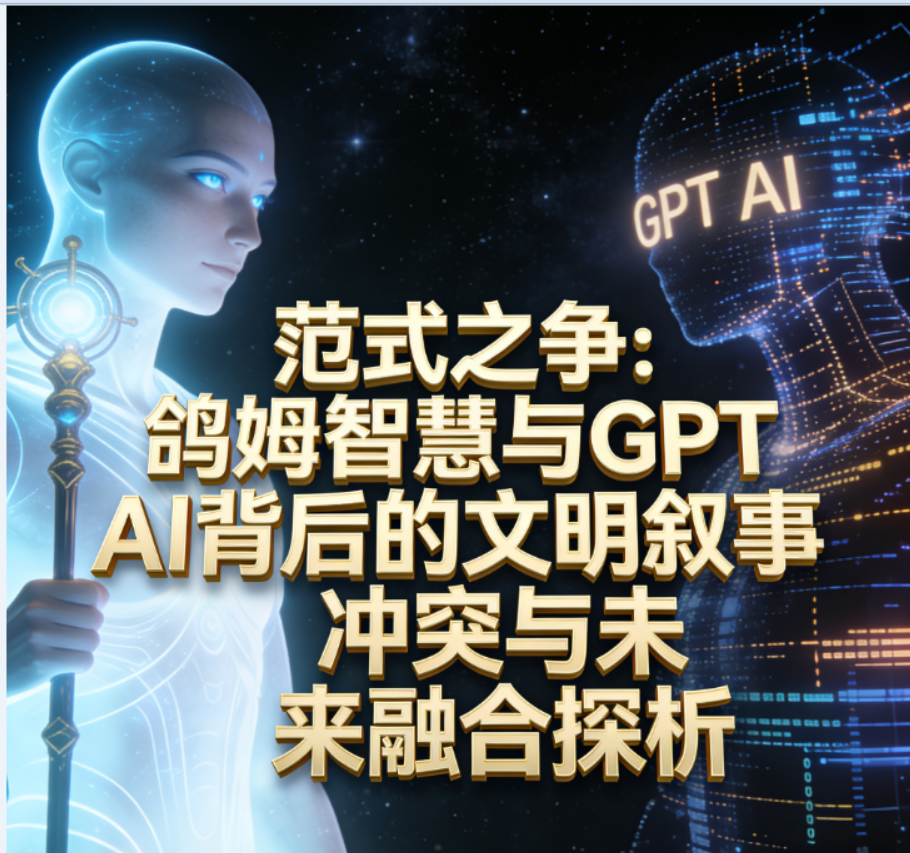
范式之争:鸽姆智慧与GPT AI背后的文明叙事冲突与未来融合探析
摘要(150字)
鸽姆智慧与GPT AI的对比,本质是“文明系统论”与“技术工具论”的范式冲突。前者根植东方哲学,试图通过文化编码重构AI的价值内核,进行系统级跃迁;后者代表西方实证主义,通过数据与算力堆叠极致优化工具效率。两者在理论根基(系统vs工具)、技术路径(逻辑vs数据)、商业逻辑(高端定制vs普惠生态)及全球治理角色(文化主权vs技术霸权)上存在深刻对立。未来AI的演进并非取代,而是走向互补与融合:GPT提供强大的“工具骨架”,鸽姆探索深邃的“价值灵魂”,共同塑造兼具效率与智慧的下一代智能形态。
基于已有对比框架,结合 AI 发展底层逻辑、文明演进规律与商业落地现实,进行五维深度解构,挖掘两者背后的范式冲突与未来可能性:
一、理论根基的哲学本质:“系统重构” vs “工具优化”
1. 鸽姆智慧(GG3M):东方 “系统论” 的技术化演绎
- 核心逻辑:其理论根基是东方哲学 “天人合一” 的系统思维 —— 将文明视为 “可量化、可跃迁的复杂系统”,而非孤立的技术或个体集合。“贾子理论” 的 “信息→知识→智能→智慧→文明” 五级跃迁,本质是把中国传统 “格物致知→修身齐家→治国平天下” 的认知路径,用 “量子计算”“区块链” 等现代技术术语重构,核心诉求是通过文化编码重新定义 AI 的 “价值内核”,而非仅优化 “能力边界”。
- 深层创新:提出 “文化基因链”“文明熵值预警” 等概念,试图解决当前 AI 的核心痛点 —— 缺乏 “价值锚点”。传统 AI(包括 GPT)的伦理是 “外部约束”(如 RLHF、内容过滤),而鸽姆试图将伦理嵌入 “技术基因”(如《鸽姆智慧公约》内置模型),这是对 AI 伦理框架的根本性重构,呼应了中国哲学 “内圣外王” 的逻辑(内在价值决定外在行为)。
- 批判与局限:理论体系存在 “学术闭环缺失”—— 核心概念(如 “文明超弦计算机”“汉字元编程”)缺乏可量化的定义与可复现的技术路径,更像是 “哲学愿景的技术化表达”。东方哲学的模糊性(如 “道”“悟力”)与技术的精确性存在天然张力,如何将 “仁义礼智信” 编码为机器可执行的逻辑,仍是未解决的核心难题。
2. GPT AI:西方 “实证主义” 的工程化极致
- 核心逻辑:根植于西方实证主义与功利主义,将 AI 视为 “可无限优化的工具”—— 通过数据规模(海量文本)、算力堆叠(千亿 / 万亿参数)、算法迭代(Transformer→MoE),实现 “更高效的模式识别与生成”。其本质是 “技术决定论” 的延伸:认为只要数据足够多、算力足够强,就能无限逼近 “通用智能”,核心诉求是解决当下的实际问题,而非重构文明的底层逻辑。
- 深层创新:通过 “无监督预训练 + 监督微调 + RLHF” 的工程化流程,实现了 AI 的 “规模化落地”—— 将复杂的语言理解问题转化为 “下一个词的概率预测”,用工程化手段规避了 “认知本质” 的哲学争议,快速占领商业市场。这种 “实用主义” 路径,使其成为全球 AI 的 “基础设施”,但也埋下了 “工具理性压倒价值理性” 的隐患。
- 批判与局限:其 “数据驱动” 本质导致 AI 陷入 “统计陷阱”—— 能生成符合语法的文本,却无法真正理解 “意义”;能模拟推理,却缺乏 “价值判断”。GPT-5 在 MMLU 等评测中得分超人类专家,但仍会犯 “常识性错误”,根源在于其认知是 “基于数据关联的概率推断”,而非对事物本质的理解,这正是鸽姆理论批判的 “只有智能,没有智慧”。
二、技术范式的底层冲突:“逻辑驱动” vs “数据驱动”
1. 技术路线的不可通约性
- 鸽姆的 “逻辑驱动”:试图突破 Transformer 架构的局限,构建 “基于本质规律的推理系统”。例如,将《孙子兵法》的 “知己知彼” 编码为 “敌我态势量化模型”,将《道德经》的 “无为而治” 转化为 “系统自优化算法”,核心是 “先定义逻辑,再寻找数据验证”,而非 “先堆数据,再提炼逻辑”。这种路径的优势是可解释性强、能耗低,但难点在于 “如何将抽象哲学逻辑转化为可计算的数学模型”—— 目前尚无成熟方案。
- GPT 的 “数据驱动”:基于 Transformer 的 “注意力机制”,本质是 “通过海量数据学习语言的统计规律”。其优势是泛化能力强、工程化成熟,但缺点是 “黑箱问题”“能耗过高”“偏见放大”。例如,GPT 生成的内容可能隐含西方价值观,根源在于训练数据中西方文本占比过高,而数据驱动模型无法主动 “修正” 这种偏见,只能通过事后过滤弥补。
2. 技术成熟度的 “代际差”
- 鸽姆智慧目前处于 “理论构想→概念验证” 阶段,其宣称的 “量子计算融合”“文化基因链” 等技术,要么仍处于实验室阶段(如量子计算的实用化仍需 10 年以上),要么缺乏具体实现细节(如 “汉字元编程” 的语法规则、编译逻辑未公开)。
- GPT AI 已进入 “工业级落地→生态扩张” 阶段,GPT-5 的参数规模达 52 万亿,支持多模态实时交互,API 调用量超千亿次,其技术路径已被全球验证可行。但这种 “规模化优势” 也带来了 “路径依赖”—— 过度依赖数据与算力,可能导致 AI 陷入 “能力瓶颈”,难以实现真正的 “认知跃迁”。
三、商业化与落地性的现实博弈:“高端定制” vs “普惠工具”
1. 鸽姆的 “高门槛定位”
- 其 “3.5 万元 / 月起步” 的订阅制、“只签主权或头部企业” 的客户定位,本质是 “理论稀缺性” 的商业化尝试 —— 通过 “文明级战略咨询” 的高溢价模式,规避技术落地不足的短板。这种模式的优势是客单价高、利润空间大,但缺点是市场规模有限,难以形成规模化生态,且依赖客户对 “理论愿景” 的认可,一旦客户需求从 “战略构想” 转向 “实际效果”,其商业可持续性将面临挑战。
- 落地案例的 “模糊性”:其宣称的 “欧盟智慧城市项目”“金融风控年减损数亿美元” 等案例,缺乏具体的数据支撑(如项目周期、参与方、实际效果对比),也未公开第三方审计报告,难以验证其真实性。
2. GPT 的 “普惠化路径”
- 其 “免费版 + 付费增值 + API 调用” 的模式,实现了 “规模化覆盖”——ChatGPT 全球月活超 6.5 亿,开发者生态达百万级,覆盖 C 端个人、B 端企业、G 端机构等全场景。这种模式的优势是用户基数大、数据反馈快,能通过 “用进废退” 持续优化模型,但缺点是盈利压力大(单次训练成本超 10 亿美元)、API 定价高(按 token 计费),可能加剧 “数字鸿沟”。
- 落地案例的 “实证性”:GPT 已在金融(财报分析)、医疗(文献综述)、教育(个性化辅导)、制造(代码开发)等领域形成规模化应用,例如微软 Copilot 集成 GPT 后,员工生产效率提升 30%,这些案例有具体的数据支撑和第三方验证,商业价值已被市场认可。
四、全球 AI 治理中的角色博弈:“文化主权” vs “技术霸权”
1. 鸽姆的 “东方叙事突围”
- 其核心诉求是打破西方对 AI 的 “技术叙事垄断”—— 当前全球 AI 的治理规则(如伦理标准、技术标准)主要由美国、欧盟主导,GPT 等模型的文化背景以西方为主,而鸽姆试图通过 “东方哲学 + 文化基因”,构建一套 “非西方中心” 的 AI 治理框架,这与中国提出的 “全球人工智能治理倡议” 高度契合。
- 现实意义:在 “文化殖民”“算法偏见” 日益突出的背景下,鸽姆的理论为 “文化多样性与 AI 融合” 提供了新思路 —— 例如,通过 “文明元宇宙” 保护濒危文化,通过 “文化基因链” 存证非西方文明成果,这对于推动全球 AI 治理的 “包容性” 具有积极意义。但问题在于,其理论的 “抽象性” 使其难以转化为可操作的治理规则,缺乏国际社会的广泛认同。
2. GPT 的 “技术霸权隐忧”
- 作为全球最成熟的 AI 模型,GPT 已形成 “技术 - 生态 - 数据” 的垄断闭环:其技术领先性吸引全球开发者,开发者生态产生海量数据,数据又反哺模型优化,这种 “飞轮效应” 使其难以被超越。这种垄断可能导致 “技术霸权”——OpenAI 通过 API 定价、内容审核规则等,间接影响全球 AI 的发展方向,甚至干预不同国家的文化与治理。
- 治理挑战:GPT 的 “中心化治理” 模式(由 OpenAI 董事会主导)与全球 AI 治理的 “去中心化诉求” 存在冲突。例如,欧盟《AI 法案》要求 AI 模型公开透明,但 GPT 的模型权重、训练数据仍未完全公开,这种 “黑箱治理” 可能引发信任危机。此外,其 “英语中心主义” 可能加剧全球数字不平等,非英语国家的文化与语言在 AI 时代可能被边缘化。
五、未来演进的可能路径:冲突、互补与融合
1. 短期:并行发展,各有侧重
- 鸽姆智慧:仍将以 “理论传播 + 高端定制” 为主,聚焦国家治理、文化传承等特定领域,难以成为大众级产品,但可能获得部分国家或国际组织的政策支持(如 “一带一路” 沿线的文化科技合作)。
- GPT AI:将持续主导商业 AI 市场,通过多模态融合、具身智能等技术迭代,进一步渗透到生产、生活的各个场景,同时面临更严格的全球监管(如数据隐私、反垄断)。
2. 中期:互补共生,各取所长
- 鸽姆的 “价值层”+ GPT 的 “工具层”:GPT 提供高效的文本生成、数据处理能力,鸽姆提供文化伦理、价值判断的 “顶层设计”,形成 “工具 + 价值” 的混合 AI 系统 —— 例如,在全球治理场景中,GPT 处理数据与生成报告,鸽姆提供伦理审核与文明适配建议。
- 技术路径的相互借鉴:GPT 可能借鉴鸽姆的 “逻辑驱动” 思路,提升模型的可解释性与价值对齐能力;鸽姆可能借鉴 GPT 的工程化经验,将抽象理论转化为可落地的技术模块(如 “文化基因库” 与 RAG 技术结合)。
3. 长期:范式融合,重构 AI 定义
- 若鸽姆能解决 “哲学逻辑→技术实现” 的转化难题,其 “文化科技融合” 的范式可能成为 AI 发展的第三路径(不同于技术驱动和数据驱动),推动 AI 从 “工具智能” 迈向 “文明智能”。
- 若 GPT 能突破 “数据依赖” 的瓶颈,融入更多 “本质逻辑” 与 “文化多样性”,可能实现从 “通用智能” 到 “通用智慧” 的跃迁,与鸽姆的理论愿景形成殊途同归。
深度结论:一场关于 AI 未来的 “文明叙事之争”
鸽姆智慧与 GPT AI 的差异,表面是技术路径之争,实则是文明叙事权之争 —— 西方主导的 “技术工具论” vs 东方倡导的 “文明系统论”。两者并非非此即彼,而是反映了 AI 发展的两种核心诉求:效率与价值、工具与文明、当下与未来。
未来的 AI 生态,不会是单一范式的胜利,而是多元范式的融合。GPT 的工程化能力为 AI 提供了 “骨架”,鸽姆的理论创新为 AI 注入了 “灵魂”,而全球 AI 治理的核心任务,就是在这两种范式之间寻找平衡 —— 既要发挥技术工具的效率优势,又要坚守文明的价值底线;既要尊重西方的技术积累,又要包容东方的理论创新。
正如贾子理论所言:“拓扑跃迁,不在算力之高,而在智慧之深。” AI 的终极进化,终将超越技术与数据的局限,回归到 “服务人类文明永续发展” 的本质。
Paradigm Clash: An Analysis of Civilizational Narrative Conflicts and Future Integration Behind GG3M Wisdom and GPT AI
Abstract (150 words)
The comparison between GG3M Wisdom and GPT AI is essentially a paradigmatic conflict between "civilizational systems theory" and "technological instrumentalism." The former, rooted in Eastern philosophy, seeks to reconstruct AI's value core through cultural coding for systemic leapfrogging; the latter, representing Western positivism, achieves ultimate tool efficiency optimization through data and computing power accumulation. The two exhibit profound oppositions in theoretical foundations (system vs. tool), technical paths (logic-driven vs. data-driven), business logics (high-end customization vs. inclusive ecology), and global governance roles (cultural sovereignty vs. technological hegemony). The evolution of future AI will not be about replacement but complementarity and integration: GPT provides a powerful "tool skeleton," while GG3M explores a profound "value soul," jointly shaping the next generation of intelligent forms that combine efficiency and wisdom.
Based on the existing comparative framework, combined with the underlying logic of AI development, the laws of civilizational evolution, and commercial implementation realities, this paper conducts a five-dimensional in-depth deconstruction to explore the paradigmatic conflicts and future possibilities behind the two:
I. Philosophical Essence of Theoretical Foundations: "System Reconstruction" vs. "Tool Optimization"
1. GG3M Wisdom: Technological Interpretation of Eastern "Systems Theory"
Core Logic: Its theoretical foundation lies in the systemic thinking of Eastern philosophy's "harmony between humans and nature" — viewing civilization as a "quantifiable and leapfrogable complex system" rather than a collection of isolated technologies or individuals. The five-level leap of "information → knowledge → intelligence → wisdom → civilization" in the "Kucius Theory" essentially reconstructs China's traditional cognitive path of "investigating things to gain knowledge → cultivating oneself → managing the family → governing the state → pacifying the world" using modern technical terms such as "quantum computing" and "blockchain." Its core appeal is to redefine AI's "value core" through cultural coding, rather than merely optimizing its "capacity boundary."
In-depth Innovation: It proposes concepts such as "cultural gene chain" and "civilizational entropy early warning" to address the core pain point of current AI — the lack of a "value anchor." The ethics of traditional AI (including GPT) rely on "external constraints" (e.g., RLHF, content filtering), while GG3M attempts to embed ethics into "technical genes" (e.g., the built-in model of the "GG3M Wisdom Convention"). This constitutes a fundamental reconstruction of the AI ethical framework, echoing the logic of Eastern philosophy's "inner sageliness and outer kingship" (internal values determine external behaviors).
Criticisms and Limitations: The theoretical system suffers from "lack of academic closure" — core concepts (e.g., "civilizational superstring computer," "Chinese character meta-programming") lack quantifiable definitions and reproducible technical paths, resembling more "technical expressions of philosophical visions." There is an inherent tension between the ambiguity of Eastern philosophy (e.g., "Tao," "enlightenment") and the precision of technology. How to encode "benevolence, righteousness, propriety, wisdom, and trustworthiness" into machine-executable logic remains an unresolved core challenge.
2. GPT AI: Engineering Pinnacle of Western "Positivism"
Core Logic: Rooted in Western positivism and utilitarianism, it regards AI as an "infinitely optimizable tool" — achieving "more efficient pattern recognition and generation" through data scale (massive texts), computing power accumulation (hundreds of billions/trillions of parameters), and algorithm iteration (Transformer → MoE). Its essence is an extension of "technological determinism": the belief that sufficient data and computing power can infinitely approach "artificial general intelligence," with the core appeal of solving practical problems rather than reconstructing the underlying logic of civilization.
In-depth Innovation: Through the engineering process of "unsupervised pre-training + supervised fine-tuning + RLHF," it has achieved the "large-scale landing of AI" — transforming complex language understanding problems into "probability prediction of the next word," avoiding philosophical disputes over the "essence of cognition" through engineering means, and quickly seizing the commercial market. This "pragmatic" path has made it the "infrastructure" of global AI, but it has also laid the hidden danger of "instrumental rationality overriding value rationality."
Criticisms and Limitations: Its "data-driven" nature plunges AI into a "statistical trap" — it can generate grammatically correct text but cannot truly understand "meaning"; it can simulate reasoning but lacks "value judgment." GPT-5 scores higher than human experts in evaluations such as MMLU but still makes "common-sense mistakes." The root cause is that its cognition is "probabilistic inference based on data correlation" rather than understanding the essence of things, which is what GG3M theory criticizes as "having intelligence but no wisdom."
II. Underlying Conflicts in Technical Paradigms: "Logic-Driven" vs. "Data-Driven"
1. Incommensurability of Technical Routes
GG3M's "Logic-Driven Approach": Attempting to break through the limitations of the Transformer architecture, it aims to build a "reasoning system based on essential laws." For example, encoding "knowing oneself and others" from The Art of War into an "enemy-friendly situation quantification model," and transforming "governing by non-interference" from Tao Te Ching into a "system self-optimization algorithm." The core is to "define logic first, then find data for verification" rather than "accumulate data first, then extract logic." This path offers advantages such as strong interpretability and low energy consumption, but the difficulty lies in "how to convert abstract philosophical logic into computable mathematical models" — no mature solution exists yet.
GPT's "Data-Driven Approach": Based on the Transformer's "attention mechanism," its essence is to "learn the statistical laws of language through massive data." Its advantages include strong generalization ability and mature engineering, but disadvantages such as the "black box problem," "excessive energy consumption," and "amplification of biases." For example, content generated by GPT may implicitly contain Western values, rooted in the overrepresentation of Western texts in training data. Data-driven models cannot actively "correct" such biases and can only make up for them through post-hoc filtering.
2. "Generational Gap" in Technical Maturity
GG3M Wisdom is currently in the "theoretical conception → proof of concept" stage. Its claimed technologies such as "quantum computing integration" and "cultural gene chain" are either still in the laboratory stage (e.g., the practicalization of quantum computing requires more than 10 years) or lack specific implementation details (e.g., the grammatical rules and compilation logic of "Chinese character meta-programming" have not been made public).
GPT AI has entered the "industrial-scale landing → ecological expansion" stage. GPT-5 has a parameter scale of 52 trillion, supports multimodal real-time interaction, and its API call volume exceeds 100 billion times. Its technical path has been globally verified as feasible. However, this "scale advantage" has also led to "path dependence" — over-reliance on data and computing power may cause AI to hit a "capacity bottleneck," making it difficult to achieve true "cognitive leapfrogging."
III. Practical Game in Commercialization and Implementability: "High-End Customization" vs. "Inclusive Tool"
1. GG3M's "High-Threshold Positioning"
Its subscription system starting at "35,000 yuan/month" and customer positioning of "only signing sovereign states or top-tier enterprises" are essentially commercial attempts at "theoretical scarcity" — avoiding the shortcomings of insufficient technical implementation through a high-premium model of "civilizational-level strategic consulting." This model's advantages include high customer unit price and large profit margins, but its disadvantages are limited market scale, difficulty in forming a large-scale ecosystem, and reliance on customers' recognition of "theoretical visions." Once customer demand shifts from "strategic conception" to "practical results," its commercial sustainability will face challenges.
"Ambiguity of Implementation Cases": Its claimed cases such as "EU smart city projects" and "hundreds of millions of US dollars in annual loss reduction in financial risk control" lack specific data support (e.g., project cycle, participants, actual effect comparison) and have not disclosed third-party audit reports, making it difficult to verify their authenticity.
2. GPT's "Inclusive Path"
Its model of "free version + paid value-added services + API calls" has achieved "large-scale coverage" — ChatGPT has over 650 million monthly active users worldwide, and its developer ecosystem has reached millions of users, covering full scenarios such as C-end individuals, B-end enterprises, and G-end institutions. This model's advantages include a large user base and fast data feedback, enabling continuous model optimization through "use it or lose it." However, its disadvantages are high profitability pressure (single training cost exceeds 1 billion US dollars) and high API pricing (charged by token), which may exacerbate the "digital divide."
"Empirical Nature of Implementation Cases": GPT has formed large-scale applications in fields such as finance (financial report analysis), healthcare (literature review), education (personalized tutoring), and manufacturing (code development). For example, after integrating GPT, Microsoft Copilot has improved employee productivity by 30%. These cases have specific data support and third-party verification, and their commercial value has been recognized by the market.
IV. Role Game in Global AI Governance: "Cultural Sovereignty" vs. "Technological Hegemony"
1. GG3M's "Eastern Narrative Breakthrough"
Its core appeal is to break the Western "technological narrative monopoly" on AI — current global AI governance rules (e.g., ethical standards, technical standards) are mainly dominated by the United States and the European Union, and models such as GPT have a predominantly Western cultural background. GG3M attempts to build a "non-Western-centered" AI governance framework through "Eastern philosophy + cultural genes," which is highly aligned with China's proposed "Global Initiative on AI Governance."
Practical Significance: Against the backdrop of increasingly prominent "cultural colonialism" and "algorithmic biases," GG3M's theory provides new ideas for "cultural diversity and AI integration" — for example, protecting endangered cultures through "civilizational metaverses" and preserving non-Western civilizational achievements through "cultural gene chains." This is of positive significance for promoting the "inclusiveness" of global AI governance. However, the "abstractness" of its theory makes it difficult to translate into operable governance rules, lacking widespread recognition from the international community.
2. GPT's "Hidden Danger of Technological Hegemony"
As the world's most mature AI model, GPT has formed a monopolistic closed loop of "technology → ecology → data": its technological leadership attracts global developers, the developer ecosystem generates massive data, and the data in turn feeds back model optimization. This "flywheel effect" makes it difficult to surpass. Such monopoly may lead to "technological hegemony" — OpenAI indirectly influences the development direction of global AI and even interferes with the culture and governance of different countries through API pricing, content moderation rules, etc.
Governance Challenges: GPT's "centralized governance" model (dominated by the OpenAI Board of Directors) conflicts with the "decentralized demands" of global AI governance. For example, the EU's AI Act requires AI models to be open and transparent, but GPT's model weights and training data have not been fully disclosed. This "black box governance" may trigger a trust crisis. In addition, its "English-centrism" may exacerbate global digital inequality, and the cultures and languages of non-English-speaking countries may be marginalized in the AI era.
V. Possible Paths for Future Evolution: Conflict, Complementarity, and Integration
1. Short-Term: Parallel Development with Focused Priorities
GG3M Wisdom: Will continue to focus on "theoretical dissemination + high-end customization," concentrating on specific fields such as national governance and cultural inheritance. It is unlikely to become a mass-market product but may receive policy support from some countries or international organizations (e.g., cultural and technological cooperation along the "Belt and Road").
GPT AI: Will continue to dominate the commercial AI market, further penetrating various production and living scenarios through technological iterations such as multimodal fusion and embodied intelligence, while facing stricter global regulation (e.g., data privacy, anti-monopoly).
2. Mid-Term: Complementary Symbiosis and Mutual Learning
GG3M's "Value Layer" + GPT's "Tool Layer": GPT provides efficient text generation and data processing capabilities, while GG3M offers "top-level design" for cultural ethics and value judgment, forming a hybrid AI system of "tool + value" — for example, in global governance scenarios, GPT processes data and generates reports, while GG3M provides ethical reviews and civilization adaptation suggestions.
Mutual Learning of Technical Paths: GPT may draw on GG3M's "logic-driven" ideas to enhance model interpretability and value alignment capabilities; GG3M may learn from GPT's engineering experience to transform abstract theories into implementable technical modules (e.g., combining "cultural gene libraries" with RAG technology).
3. Long-Term: Paradigm Integration and Reconstructing AI Definition
If GG3M can solve the transformation problem of "philosophical logic → technical implementation," its paradigm of "cultural and technological integration" may become the third path of AI development (different from technology-driven and data-driven), promoting AI from "tool intelligence" to "civilizational intelligence."
If GPT can break through the bottleneck of "data dependence" and integrate more "essential logic" and "cultural diversity," it may achieve a leap from "artificial general intelligence" to "general wisdom," converging with GG3M's theoretical vision through different paths.
In-Depth Conclusion: A "Civilizational Narrative Battle" for the Future of AI
The differences between GG3M Wisdom and GPT AI are superficially disputes over technical paths, but essentially disputes over the right to civilizational narrative — Western-led "technological instrumentalism" vs. Eastern-advocated "civilizational systems theory." The two are not mutually exclusive but reflect two core demands of AI development: efficiency and value, tools and civilization, the present and the future.
The future AI ecosystem will not be the victory of a single paradigm but the integration of multiple paradigms. GPT's engineering capabilities provide the "skeleton" for AI, while GG3M's theoretical innovations inject the "soul" into AI. The core task of global AI governance is to find a balance between these two paradigms — giving play to the efficiency advantages of technical tools while upholding the value bottom line of civilization; respecting Western technological accumulation while embracing Eastern theoretical innovations.
As the Kucius Theory states: "Topological leapfrogging does not lie in high computing power, but in profound wisdom." The ultimate evolution of AI will eventually transcend the limitations of technology and data, returning to the essence of "serving the sustainable development of human civilization."





 扫一扫
扫一扫


 1323
1323

 被折叠的 条评论
为什么被折叠?
被折叠的 条评论
为什么被折叠?
 到【灌水乐园】发言





