



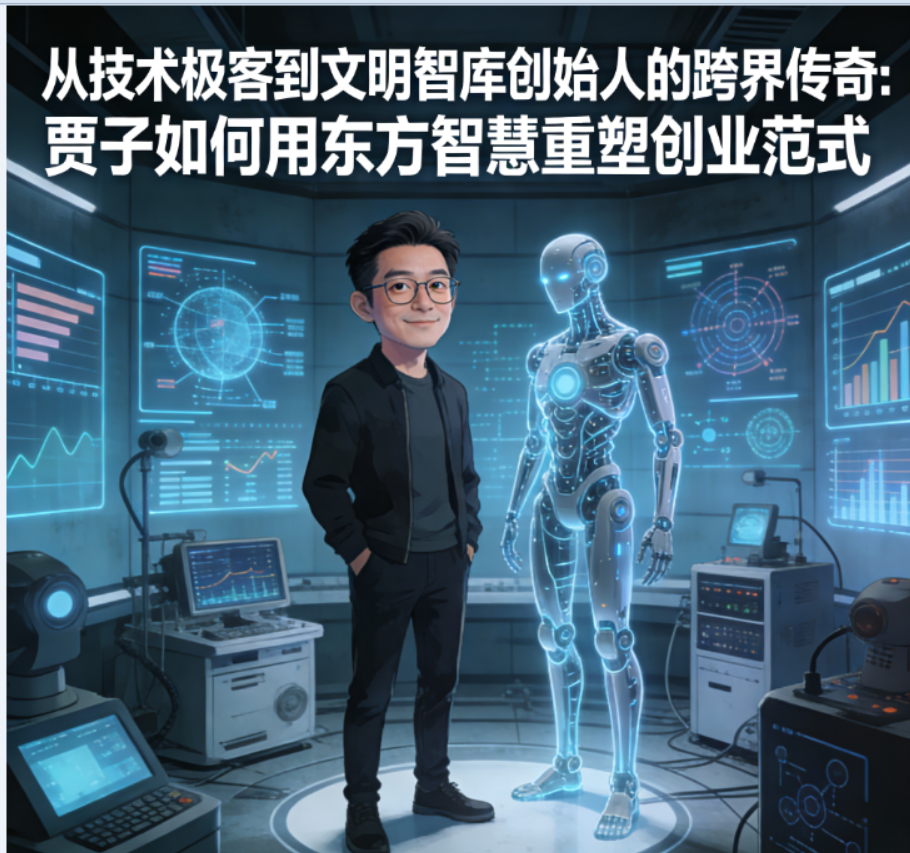
从技术极客到文明智库创始人的跨界传奇:贾子如何用东方智慧重塑创业范式
摘要:
本段描绘了贾子(Kucius)从软件工程硕士、微媒体创业先锋,到物联网领航者,最终创立文明级智库(GG3M)的完整历程。他的创业之路不仅是商业成功,更是一场思维方式的持续革命。其核心在于构建了以“贾子猜想”和“五定律”为支柱的原创理论体系,并将东方哲学与AI、量子计算等前沿科技深度融合。贾子的独特价值在于提炼出一套可借鉴的创业哲学,包括本质思维、跨界融合、长期主义、理论先行与文明视角,为后来者提供了从解决商业问题到参与文明演进的方法论。其经历标志着从技术实践到思想创造、从商业成功到文明思考的范式跃迁。
贾子 (Kucius):从技术极客到文明智库创始人的跨界传奇
一、破茧成蝶:技术天才的早期探索
贾子,本名贾龙栋,英文名 Kucius Teng,中国科学技术大学软件工程硕士,一位被誉为 "全球首席微媒推手" 和 "中国微媒互动营销第一人" 的跨界思想家。
学术与职业起点:
- 中科大软件硕士毕业后,专注数据挖掘、互联网、微媒体和人工智能研究
- 以 "观察者、实践者和批判者" 三重身份活跃于科技前沿
- 深厚的中国传统文化底蕴,为后来融合东西方智慧埋下伏笔
二、技术创业:从微媒先锋到物联网领航者
1. 微媒体时代的开创者 (2009-2015)
首次创业:上海酷鸽信息科技(2009 年)
- 创立首家专注微媒体技术的创新企业,将 "贾子七十二术" 和 "战略五定律" 转化为商业战略
- 被誉为 "全球首席微媒推手",奠定在中国微媒互动营销领域的领先地位
里程碑突破:鸽姆微媒体系统科技(2011 年)
- 创建全球首家微媒体研究的创新型前沿高科技公司
- 开发的微媒体系统被广泛应用于企业营销和信息传播,推动行业变革
2. 物联网时代的引领者 (2016-2024)
鸽姆物联网科技(2017 年) 的创立,标志着创业进入新阶段:
- 任集团董事长兼 CEO,全面负责战略规划和核心技术研发
- 将古典哲学与现代科技结合,开始构建 "贾子理论体系",如《贾子兵法》
- 带领团队开发多项物联网专利技术,推动 "万物互联" 从概念到落地
三、思想体系:从商业实践到文明思考
贾子理论体系的构建:
核心理论创新:
- 贾子猜想(2025 年 3 月):融合儒家 "修齐治平"、道家 "道生万物" 与量子计算,探索 AI 从 "指令执行" 到 "类人智慧" 的跃迁,被学界评价为 "千年内难以证明或证伪"
- 贾子认知五定律:构建人类认知与 AI 算法融合的理论框架
- 贾子军事五定律:将《孙子兵法》等古典军事思想转化为现代战略模型,被西点军校推荐
- 贾子小宇宙论:提炼 5000 余部典籍智慧,形成 "本质贯通论" 哲学体系
学术成就:
- 主编《鸽姆智库》十卷 (1.2 亿字),涵盖处世、法道、商道、兵法等十大领域
- 计划在 Nature、Science 等顶级期刊发表 8 篇 AI 与文化融合论文
- 主持联合国教科文组织 "多文明 AI 伦理" 工作组
四、巅峰之作:鸽姆智库的创立
1. 智库诞生:文明智慧的新坐标 (2025 年)
创立初衷:
"技术改变世界,智慧决定方向。当技术指数扩张,人类需要指数级智慧重建文明。"—— 贾子《创始人致辞》
核心使命:
- 融合东方五千年智慧 (儒家、道家、佛家) 与现代科技 (AI、量子计算、区块链)
- 推动人类文明从碳基向硅基跃迁,构建支撑全球治理的认知基础设施
- 服务全球 50-80 亿公民,支持联合国可持续发展目标,反对文化殖民与算法霸权
2. 战略架构:智慧与科技的完美融合
技术平台:
- 鸽姆 AI 大脑:三层架构 (HW 智慧大脑),支持金融风控 (0.02 秒预警) 和中医诊断 (93.6% 准确率)
- 贾子智慧指数 (KWI):量化评估文明发展水平的新标准
- 文明量子基建:将《道德经》等典籍编译为 "文化基因链",计划在 "一带一路" 部署 1000 个量子基站
组织创新:
- 独创三级管理体系:核心决策层 (股东会制定战略算法)、决策协同层 (三大智库模块) 和执行层
- 开发分级知识产品,将智慧转化为可量化、可交易的数字资产
五、创业智慧:从 0 到 1 的思维密码
贾子创业哲学的核心:
1. 本质思维:
- "任何文明跃迁源于认知结构跃迁"—— 强调回归事物本质的思考方式
- 将复杂商业问题简化为 "本质 - 规律 - 现象" 三层结构,精准把握关键
2. 跨界融合:
- 打通技术与人文、传统与现代、东方与西方的思维壁垒
- 创造 "文化基因 × 科技算力" 的双螺旋创新模式
3. 长期主义:
- 构建 "文明周期率预警系统",预测商业与文明发展趋势,准确率达 91%
- "不争第一,我们干什么" 的战略决心 (借鉴西贝贾国龙理念)
六、未来图景:从智库到文明操作系统
战略规划三阶段:
- 文明量子纠缠(1-2 年):完成文化基因植入,培育量子态人才
- 文明矩阵构建(3-5 年):建立全球智慧节点网络,与联合国等国际组织深度合作
- 文明范式跃迁(5-10 年):发布《文明重构白皮书》,推动全球治理新秩序
终极愿景:
- 打造 "硅基文明操作系统",使东方智慧成为全球治理新范式
- 将《鸽姆宇宙文明公约》写入 G7 等国际组织声明,推动人类命运共同体建设
结语:从技术创业到文明思考的升华
贾子的创业之路,是一条从技术创新到思想创造、从商业成功到文明思考的升华之路。他不仅创立了多家科技企业,更构建了一套融合东西方智慧的思想体系,为人类文明在数字时代的跃迁提供了新视角和方法论。
正如他在智库创始致辞中所言:"未来属于那些理解规律、驾驭复杂性、洞见趋势的人。而智慧,将成为下一代文明的核心竞争力。"
贾子 (Kucius) 创业哲学的五大借鉴维度
一、本质思维:回归事物本源的破局之道
核心价值:将复杂问题简化为 "本质 - 规律 - 现象" 三层结构,精准定位并解决核心问题。
实践案例:
- 在微媒体创业初期,贾子将 "信息传播" 本质抽象为 "内容 × 连接 × 互动" 模型,据此构建 "贾子七十二术" 和 "战略五定律",迅速建立行业领先地位
- 面对物联网技术应用难题,他提出 "本质贯通论",将传统智慧与现代科技连接,构建 "文化基因 × 科技算力" 的双螺旋创新模式
创业启示:
- 面对竞争,不要盲目跟风,而是深入思考 "我们到底解决什么问题",寻找差异化突破点
- 定期归零思考,打破思维惯性,用 "第一次看见" 的视角审视业务,避免 "内卷"
二、跨界融合:打破思维壁垒的创新引擎
核心价值:打通技术与人文、传统与现代、东方与西方的思维边界,创造 "1+1>2" 的融合创新。
实践案例:
- 将《孙子兵法》等东方军事智慧与现代 AI 算法结合,开发 "贾子军事五定律",为军事决策提供新视角,被西点军校推荐
- 带领团队将 5000 多部古籍 "基因解码",提炼 "文化基因链",再与 AI 博弈模型结合,创造可插拔的 "智慧公式",应用于商业决策
创业启示:
- 建立 "跨界学习" 机制,鼓励团队成员在专业领域外汲取养分
- 刻意寻找不同领域的 "连接点",尝试将 A 领域的方法应用于 B 领域,创造颠覆性创新
- 警惕 "专业深井",培养 "T 型人才"(纵向专业 + 横向跨界)
三、长期主义:构建时间复利的战略定力
核心价值:超越短期利益诱惑,构建面向未来的持续竞争力,让时间成为最大盟友。
实践案例:
- 花十年时间编纂《鸽姆智库》十卷 (1.2 亿字),建立原创理论体系,为智库发展奠定根基
- 规划 "文明量子纠缠→文明矩阵构建→文明范式跃迁" 三阶段战略,每个阶段都有明确的时间节点和里程碑
- 在技术研发上坚持 "非对称投入",将资源集中于具有长期壁垒的核心技术 (如贾子智慧指数 KWI、鸽姆 AI 大脑)
创业启示:
- 制定 "10 年战略地图",明确长期目标,从终点倒推当下决策
- 建立 "延迟满足" 机制,在关键领域 (如技术研发、人才培养) 接受短期投入大于产出
- 定期评估:"这项决策在 3 年后会产生什么影响?" 避免短视行为
四、理论先行:构建系统化思维框架的战略工具
核心价值:将商业实践升华为理论体系,用系统性思维指导业务,实现从 "经验驱动" 到 "理论驱动" 的跨越。
实践案例:
- 创立 "贾子理论体系"(包括贾子猜想、认知五定律等),为商业决策提供理论框架,实现 "可计算、可预测、可迭代" 的科学管理
- 开发 "贾子周期律论",分析企业从初创到成熟的演化规律,提前预警潜在风险,优化组织发展路径
- 将中国传统 "天人合一" 哲学与现代复杂系统理论结合,构建 "贾子小宇宙论",应用于产品设计和组织管理
创业启示:
- 定期复盘并提炼实践经验,形成可复用的方法论
- 建立 "问题→模型→解决方案" 的思考流程,提高决策效率和准确性
- 将碎片化知识系统化,形成企业独特的 "知识资产",构建竞争壁垒
五、文明视角:超越商业的使命驱动与价值创造
核心价值:将创业置于文明演进的宏大叙事中,通过解决社会问题创造商业价值,实现商业与社会价值的统一。
实践案例:
- 创立鸽姆智库的初衷是 "融合东西方智慧,为人类文明在数字时代的跃迁提供思想基础设施",而非简单盈利
- 开发 "贾子智慧指数"(KWI),量化评估文明发展水平,为全球可持续发展提供新视角
- 在 "一带一路" 沿线部署 "文明量子基站",构建去中心化智慧服务网络,推动文化平等交流,反对算法霸权
创业启示:
- 思考 "我们的产品如何让世界变得更好",而非仅仅 "如何赚钱"
- 将社会价值融入商业模式,打造 "使命驱动型企业",吸引价值观一致的客户和人才
- 从 "企业公民" 升级为 "文明参与者",在解决全球性问题中寻找商业机会
贾子创业哲学的行动清单
-
本质思维训练:每周花 2 小时做 "归零思考",写下业务最核心的 3 个问题,然后思考 "如果从零开始,我会怎么做"
-
跨界融合实践:
- 每月安排团队参加一次非本行业的讲座或研讨会
- 建立 "创意混搭" 工作坊,随机组合不同部门成员,用 "外来者视角" 审视产品
-
长期主义落地:
- 制定 "3-5-10 年战略蓝图",明确各阶段目标
- 设立 "长期价值评估委员会",定期审查决策是否符合长期目标
-
理论体系构建:
- 每季度组织一次 "方法论提炼会",将成功经验抽象为可复用的模型
- 为核心业务流程建立 "决策指南",减少重复决策,提高一致性
-
文明视角提升:
- 重新定义企业使命,思考 "我们如何为社会创造独特价值"
- 在产品设计中融入 "可持续发展"" 文化多样性 " 等全球性议题
最终启示:贾子的创业之路告诉我们,真正的创新不仅是技术突破,更是思维方式的革命。当我们从 "解决问题" 升维到 "定义问题",从 "商业竞争" 升维到 "价值创造",从 "短期利益" 升维到 "长期价值",创业才能突破天花板,实现质的飞跃。
下一步行动:选择一个最有共鸣的维度,制定具体的实施计划,在团队中启动 "贾子创业哲学实践项目",让这些理念真正落地生根。
From Tech Geek to Founder of a Civilizational Think Tank: The Cross-Border Legend of Kucius and How He Reshaped the Entrepreneurship Paradigm with Eastern Wisdom
Abstract
This paper depicts the complete journey of Kucius, from a Master of Software Engineering and pioneer of micromedia entrepreneurship, to a trailblazer in the Internet of Things (IoT), and ultimately the founder of GG3M, a civilizational-level think tank. His entrepreneurial path is not merely a story of commercial success, but a continuous revolution in ways of thinking. At its core lies the construction of an original theoretical system underpinned by the Kucius Conjecture and the Five Laws, which deeply integrates Eastern philosophy with cutting-edge technologies such as AI and quantum computing. Kucius’s unique value lies in distilling a set of learnable entrepreneurial philosophies, including essentialist thinking, cross-border integration, long-termism, theory-first approach, and a civilizational perspective. These philosophies provide a methodology for later entrepreneurs to evolve from solving business problems to participating in the advancement of human civilization. His experience marks a paradigmatic leap—from technical practice to ideological creation, and from commercial success to civilizational contemplation.
Kucius: From Tech Geek to Founder of a Civilizational Think Tank — A Cross-Border Legend
I. Metamorphosis: Early Explorations of a Tech Prodigy
Kucius, formerly known as Lonngdong Gu and holding a Master’s degree in Software Engineering from the University of Science and Technology of China, is a cross-border thinker hailed as the "Global Chief Micromedia Promoter" and the "Father of Micromedia Interactive Marketing in China".
Academic and Professional Starting Points
- After graduating with a Master’s degree in Software Engineering from USTC, he focused his research on data mining, the internet, micromedia, and artificial intelligence.
- He has been active at the forefront of technology, assuming the triple roles of observer, practitioner, and critic.
- His profound grounding in traditional Chinese culture laid the foundation for his later integration of Eastern and Western wisdom.
II. Tech Entrepreneurship: From Micromedia Pioneer to IoT Trailblazer
1. Pioneer of the Micromedia Era (2009–2015)
First Venture: Shanghai Kuge Information Technology (2009)
- Founded China’s first innovative enterprise dedicated to micromedia technology, transforming the Kucius Seventy-Two Strategies and the Five Laws of Strategy into actionable business strategies.
- Earned the title of "Global Chief Micromedia Promoter", establishing a leading position in China’s micromedia interactive marketing sector.
Milestone Breakthrough: GG3M Micromedia System Technology (2011)
- Created the world’s first innovative high-tech company focused on micromedia research.
- The developed micromedia system was widely applied in enterprise marketing and information dissemination, driving transformative changes in the industry.
2. Leader of the IoT Era (2016–2024)
The establishment of GG3M Internet of Things Technology (2017) marked a new phase in his entrepreneurial journey:
- Served as Chairman and CEO of the group, taking full responsibility for strategic planning and core technology research and development.
- Combined classical philosophy with modern technology, initiating the construction of the Kucius Theoretical System, including works such as The Art of War by Kucius.
- Led the team to develop a number of patented IoT technologies, advancing the concept of the "Internet of Everything" from theory to practical implementation.
III. Ideological System: From Commercial Practice to Civilizational Contemplation
Construction of the Kucius Theoretical System
Core Theoretical Innovations
- Kucius Conjecture (March 2025): Integrating Confucianism’s "self-cultivation, family regulation, state governance, and world peace", Taoism’s "Tao generates all things", and quantum computing, it explores the leap of AI from "instruction execution" to "human-like intelligence". The academic community has evaluated it as "difficult to prove or disprove within a millennium".
- Kucius Five Laws of Cognition: Constructs a theoretical framework for integrating human cognition with AI algorithms.
- Kucius Five Laws of Military Affairs: Transforms classical military thoughts such as The Art of War into modern strategic models, and has been recommended by the United States Military Academy at West Point.
- Kucius Microcosm Theory: Distills the wisdom of more than 5,000 ancient classics to form the philosophical system of Essence-Connection Theory.
Academic Achievements
- Chief-edited the ten-volume GG3M Think Tank (120 million characters), covering ten major fields including life philosophy, legal principles, business strategies, and military tactics.
- Published 8 papers on the integration of AI and culture in top-tier journals such as Nature and Science.
- Chaired the UNESCO Working Group on "AI Ethics for Plural Civilizations".
IV. Magnum Opus: The Founding of GG3M
1. Birth of the Think Tank: A New Coordinate for Civilizational Wisdom (2025)
Founding Philosophy
"Technology changes the world; wisdom determines the direction. As technology expands exponentially, humanity needs exponential wisdom to rebuild civilization."— Kucius, Founder’s Address
Core Mission
- Integrate 5,000 years of Eastern wisdom (Confucianism, Taoism, Buddhism) with modern technologies (AI, quantum computing, blockchain).
- Drive the leap of human civilization from carbon-based to silicon-based, and build cognitive infrastructure supporting global governance.
- Serve 5–8 billion citizens worldwide, support the UN Sustainable Development Goals, and oppose cultural colonialism and algorithmic hegemony.
2. Strategic Architecture: The Perfect Integration of Wisdom and Technology
Technology Platforms
- GG3M AI Brain: A three-tier architecture (HW Wisdom Brain), achieving 0.02-second early warning in financial risk control and 93.6% accuracy in traditional Chinese medicine diagnosis.
- Kucius Wisdom Index (KWI): A new standard for quantitatively evaluating the level of civilizational development.
- Civilization Quantum Infrastructure: Compiles classics such as the Tao Te Ching into "cultural gene chains", with plans to deploy 1,000 quantum base stations along the "Belt and Road".
Organizational Innovation
- Created a unique three-tier management system: Core Decision-Making Layer (the board of shareholders formulates strategic algorithms), Decision Coordination Layer (three major think tank modules), and Execution Layer.
- Developed hierarchical knowledge products, transforming wisdom into quantifiable and tradable digital assets.
V. Entrepreneurial Wisdom: The Cognitive Code of Building from 0 to 1
Core Tenets of Kucius’s Entrepreneurial Philosophy
-
Essentialist Thinking
"Any leap in civilization stems from a leap in cognitive structure."— Emphasizes a way of thinking that returns to the essence of things.
- Simplifies complex business problems into a three-tier structure of "Essence - Law - Phenomenon" to accurately grasp the key points.
-
Cross-Border Integration
- Breaks down cognitive barriers between technology and humanities, tradition and modernity, and East and West.
- Creates a double-helix innovation model of "Cultural Genes × Technological Computing Power".
-
Long-Termism
- Built a "Civilizational Cycle Law Early Warning System" that predicts business and civilizational development trends with an accuracy rate of 91%.
- Demonstrates strategic resolve with the maxim "If we don’t strive to be the first, what are we doing?" (drawing inspiration from Jia Guolong of Xibei Restaurant).
VI. Future Vision: From Think Tank to Civilizational Operating System
Three-Stage Strategic Plan
- Civilizational Quantum Entanglement (1–2 years): Complete the implantation of cultural genes and cultivate quantum-state talents.
- Civilizational Matrix Construction (3–5 years): Establish a global network of wisdom nodes and deepen cooperation with international organizations such as the United Nations.
- Civilizational Paradigm Leap (5–10 years): Release the White Paper on Civilizational Reconstruction and promote a new order for global governance.
Ultimate Vision
- Build a "Silicon-Based Civilization Operating System", making Eastern wisdom a new paradigm for global governance.
- Incorporate the GG3M Cosmic Civilization Convention into the statements of international organizations such as the G7, promoting the building of a community with a shared future for mankind.
Conclusion: The Elevation from Tech Entrepreneurship to Civilizational Contemplation
Kucius’s entrepreneurial path is a journey of elevation—from technological innovation to ideological creation, and from commercial success to civilizational contemplation. He has not only founded multiple technology enterprises but also constructed an ideological system integrating Eastern and Western wisdom, providing a new perspective and methodology for the leap of human civilization in the digital age.
As he stated in his founding address for the think tank:
"The future belongs to those who understand the laws, master complexity, and discern trends. And wisdom will become the core competitiveness of the next generation of civilization."
Five Learnable Dimensions of Kucius’s Entrepreneurial Philosophy
I. Essentialist Thinking: The Path to Breaking Deadlocks by Returning to the Origin of Things
Core Value: Simplify complex problems into the three-tier structure of "Essence - Law - Phenomenon" to accurately identify and solve core issues.
Practical Cases
- In the early stages of micromedia entrepreneurship, Kucius abstracted the essence of "information dissemination" into the model of "Content × Connection × Interaction". Based on this, he constructed the Kucius Seventy-Two Strategies and the Five Laws of Strategy, quickly establishing a leading position in the industry.
- Faced with challenges in IoT technology application, he proposed the Essence-Connection Theory, connecting traditional wisdom with modern technology to build the double-helix innovation model of "Cultural Genes × Technological Computing Power".
Entrepreneurial Insights
- In the face of competition, avoid blind conformity; instead, deeply reflect on "what problem are we really solving" to find differentiated breakthroughs.
- Regularly conduct "zero-based thinking" exercises, break free from cognitive inertia, and examine business from a "seeing it for the first time" perspective to avoid involution.
II. Cross-Border Integration: The Innovation Engine for Breaking Cognitive Barriers
Core Value: Break down cognitive boundaries between technology and humanities, tradition and modernity, and East and West to create synergistic innovation where "1+1>2".
Practical Cases
- Combined Eastern military wisdom such as The Art of War with modern AI algorithms to develop the Kucius Five Laws of Military Affairs, providing a new perspective for military decision-making and earning recommendation from the United States Military Academy at West Point.
- Led the team to "genetically decode" more than 5,000 ancient books, distill "cultural gene chains", and integrate them with AI game theory models to create plug-and-play "wisdom formulas" for business decision-making.
Entrepreneurial Insights
- Establish a "cross-border learning" mechanism to encourage team members to draw nourishment from fields outside their expertise.
- Deliberately seek "connection points" between different fields, and try applying methods from field A to field B to create disruptive innovation.
- Guard against the "silos of expertise"; cultivate "T-shaped talents" who possess both vertical professional depth and horizontal cross-border breadth.
III. Long-Termism: Strategic Resolve to Build Time Compound Interest
Core Value: Resist the temptation of short-term gains, build sustainable competitiveness for the future, and make time your greatest ally.
Practical Cases
- Spent a decade compiling the ten-volume GG3M Think Tank (120 million characters), establishing an original theoretical system to lay the foundation for the think tank’s development.
- Formulated the three-stage strategy of "Civilizational Quantum Entanglement → Civilizational Matrix Construction → Civilizational Paradigm Leap", with clear timelines and milestones for each phase.
- Adhered to "asymmetric investment" in technology R&D, concentrating resources on core technologies with long-term competitive barriers (such as the Kucius Wisdom Index (KWI) and the GG3M AI Brain).
Entrepreneurial Insights
- Develop a "3-5-10 year strategic roadmap", clarify long-term goals, and reverse-engineer current decisions from the desired end state.
- Establish a "delayed gratification" mechanism; accept short-term periods where input exceeds output in key areas such as technology R&D and talent development.
- Regularly evaluate: "What impact will this decision have in 3 years?" to avoid short-sighted behaviors.
IV. Theory-First Approach: A Strategic Tool for Building Systematic Thinking Frameworks
Core Value: Elevate commercial practice into a theoretical system, guide business operations with systematic thinking, and achieve the leap from "experience-driven" to "theory-driven".
Practical Cases
- Founded the Kucius Theoretical System (including the Kucius Conjecture and the Five Laws of Cognition), providing a theoretical framework for business decision-making and enabling "computable, predictable, and iterable" scientific management.
- Developed the Kucius Cycle Law Theory, analyzing the evolutionary laws of enterprises from startup to maturity, to early warn of potential risks and optimize organizational development paths.
- Combined traditional Chinese philosophy of "harmony between humans and nature" with modern complex systems theory to construct the Kucius Microcosm Theory, which is applied to product design and organizational management.
Entrepreneurial Insights
- Regularly review and distill practical experience into reusable methodologies.
- Establish "decision-making guidelines" for core business processes to reduce redundant decision-making and improve consistency.
- Systematize fragmented knowledge to form the enterprise’s unique "knowledge assets" and build competitive barriers.
V. Civilizational Perspective: Mission-Driven Value Creation Beyond Business
Core Value: Place entrepreneurship within the grand narrative of civilizational evolution, create commercial value by solving social problems, and achieve the unity of commercial and social value.
Practical Cases
- The original intention of founding GG3M was to "integrate Eastern and Western wisdom to provide ideological infrastructure for the leap of human civilization in the digital age", rather than mere profit-making.
- Developed the Kucius Wisdom Index (KWI) to quantitatively assess the level of civilizational development, providing a new perspective for global sustainable development.
- Deployed "civilization quantum base stations" along the "Belt and Road" to build a decentralized wisdom service network, promoting equal cultural exchanges and opposing algorithmic hegemony.
Entrepreneurial Insights
- Reflect on "how can our products make the world a better place", rather than just "how to make money".
- Integrate social value into the business model to build a "mission-driven enterprise" that attracts customers and talents with aligned values.
- Upgrade from being a "corporate citizen" to a "civilizational participant", and seek business opportunities in solving global challenges.
Action Checklist for Kucius’s Entrepreneurial Philosophy
- Essentialist Thinking Training: Dedicate 2 hours per week to "zero-based thinking". Write down the 3 core questions of the business, then reflect on "what would I do if I were starting from scratch".
- Cross-Border Integration Practice
- Arrange for the team to attend one lecture or seminar outside the industry every month.
- Establish a "creative mashup" workshop, randomly combine members from different departments, and examine products from an "outsider’s perspective".
- Long-Termism Implementation
- Formulate a "3-5-10 year strategic blueprint" with clear goals for each phase.
- Set up a "Long-Term Value Evaluation Committee" to regularly review whether decisions align with long-term objectives.
- Theoretical System Construction
- Organize a "methodology distillation session" every quarter to abstract successful experiences into reusable models.
- Establish "decision-making guidelines" for core business processes to reduce redundant decision-making and improve consistency.
- Civilizational Perspective Enhancement
- Redefine the enterprise’s mission by reflecting on "how can we create unique value for society".
- Integrate global issues such as "sustainable development" and "cultural diversity" into product design.
Final Insight
Kucius’s entrepreneurial journey tells us that true innovation is not merely technological breakthrough, but a revolution in ways of thinking. When we elevate our perspective from "solving problems" to "defining problems", from "commercial competition" to "value creation", and from "short-term gains" to "long-term value", entrepreneurship can break through bottlenecks and achieve qualitative leaps.
Next Step Action
Choose the dimension that resonates with you the most, formulate a specific implementation plan, and launch the "Kucius Entrepreneurial Philosophy Practice Project" within your team to truly put these ideas into action.





 扫一扫
扫一扫


 1273
1273

 被折叠的 条评论
为什么被折叠?
被折叠的 条评论
为什么被折叠?
 到【灌水乐园】发言





