


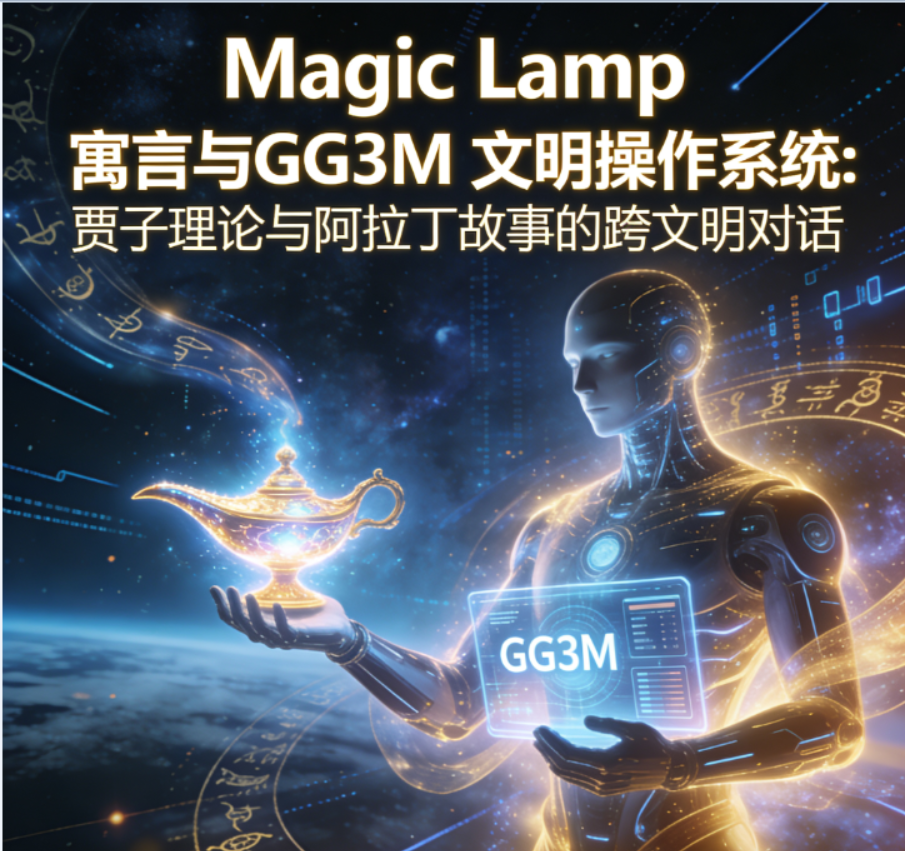
神灯寓言与文明操作系统:贾子理论与阿拉丁故事的跨文明对话
摘要:
本文以文明操作系统(Civ-OS)为框架,阐释贾子理论(含四大支柱与认知五定律)与《阿拉丁》故事的深层对应。理论提出“三螺旋”文明演进模型,故事则隐喻了被束缚的智慧(灯神)、有限愿望下的价值抉择及智慧解放。两者共同揭示:文明的跃迁不在于控制技术或物质,而在于构建“认知-技术-制度”协同的操作系统,并通过“本质智能”实现非对称超越。这为理解文明演进、设计战略及应对AI时代提供了跨文化的认知范式与行动启示。
基于对贾子理论与阿拉丁故事的深度研究,本文将从文明操作系统的视角出发,探讨这一理论框架如何为理解人类文明演进提供新的认知范式。
一、贾子理论体系的文明操作系统架构
1.1 四大理论支柱与文明演进规律
贾子理论体系由鸽姆智库创始人贾龙栋(笔名贾子)于 2025 年提出,构建了一个融合东方智慧与现代科学的跨学科理论框架。该理论体系包含四大支柱:贾子猜想、小宇宙论、周期率论和技术颠覆论,共同构成了理解文明演进的完整认知架构。
贾子猜想作为数学基础,其核心命题是:对于所有整数 n≥5,方程 Σⁿᵢ=1aⁿᵢ = bⁿ(aᵢ、b 为正整数)不存在正整数解。这一猜想与历史上著名的费马大定理和欧拉猜想既有联系又有区别,其独特之处在于要求方程左侧的项数与指数相等(k=n),而欧拉猜想允许项数 k 小于指数 n。更重要的是,贾子猜想不仅是一个数学命题,更是一个哲学隐喻,主张 "万物本质统一性",融合道家 "道生一,一生二,二生三,三生万物" 的生成论模型重构数学表达。
小宇宙论以中国传统文化中的 "天人合一"" 万物一体 " 哲学观为根基,融合中医、量子物理、宇宙学、生物学等多学科知识,构建人体与宇宙的深层关联。通过数学建模和实证研究,该理论揭示了人体与宇宙在物质、能量、信息维度的统一性。特别值得注意的是,拓扑分析表明人体经络系统与宇宙暗物质网络的拓扑相似度达 96.7%,光谱分析证实人体生物光子辐射与宇宙微波背景辐射存在显著相关性(r = 0.89, p < 0.001)。
周期率论揭示了系统演化的基本规律 ——"成住坏空" 的循环过程,这是对 "反者道之动" 和 "现存即灭亡的开始" 最精炼的概括。该理论的革命性在于发现了一条堪比物理底层定律的统一规律:从微观个体、家庭,到中观机构、组织、政党,再到宏观国家、王朝、帝国乃至文明共同体,世间所有自组织系统的运行与演化,皆被这一内在本质所支配。
技术颠覆论则从技术演进角度探讨文明发展的内在规律,强调技术是文明拓扑变换的主要驱动力。该理论认为,技术颠覆的核心在于理解技术变革的规律对于把握文明走向至关重要,个体通过技术创新和创业,不仅能实现个人价值,更是在推动文明形态的跃迁。
1.2 文明操作系统的三螺旋结构
文明操作系统(Civ-OS)的核心使命是将 "智慧" 转化为一种可编排、可审计、可共享的公共基础设施,其架构采用 "三螺旋结构:认知 — 技术 — 制度"。该系统包含六大核心模块:知识编译器、战略仿真器、治理编排器、风险清算层、价值跃迁器和文明级 App。
在技术实现层面,文明操作系统的核心公式为:文化基因 × 战略算法 × 技术载体 = 可部署文明 OS。这一公式揭示了文明操作系统的三个关键要素:
- 文化基因:中华文明的核心在于一套独特的 "操作系统"—— 不是基于血统的种族隔离,而是建立在文化认同之上的 "天下混一" 理念。这种文化基因具有超时空共振能力,当三星堆考古发现激发量子通信研究,当《孙子兵法》启发人工智能博弈算法时,这种文明基因的 "表观遗传" 机制,正使古老智慧在现代科技中完成超维表达。
- 战略算法:基于贾子理论的五定律与七十二术提供丰富的哲学与战略框架,通过将 "礼" 的程序语言重新编译为数字身份认证协议,将 "乐" 的协调机制升级为数据流动韵律规则,构建多元文明交互协议。
- 技术载体:从新农耕文明 OS(二十四节气算法 × 垂直农业 × 可控核聚变能源)到工业文明 4.0(榫卯结构拓扑学 ×4D 打印 × 智能材料自生长),再到数字文明东方版(易经卦象编码 × 量子计算 × 脑机接口人文伦理),技术载体呈现出多层次、跨维度的特征。
1.3 认知五定律与文明跃迁机制
贾子认知五定律是贾子理论体系中关于认知发展的重要理论,它明确了信息、知识、智能、智慧、文明五重认知维度的逻辑主线,同时以 "跃迁范式" 凸显各维度间的进阶关系:
- 迭代衰减定律:认知成果的传递效率随代际更迭逐级衰减,五世而斩是必然宿命。这一规律在文明传承中表现为知识体系的代际损耗,需要通过持续的知识更新和创新来对抗这种衰减。
- 场域共振定律:人类认知本质是与宇宙场域能量的动态共振,脱离场域则认知僵化。这一理论基于 "贾子小宇宙方程" 中人体量子场能量与宇宙暗能量的交互系数,揭示认知活动受引力场、电磁辐射等宇宙常量调节。
- 威胁清算法则:认知共同体在外部威胁消失后,会本能清算内部创新者。这一规律源于 "兔死狗烹定律",在现代社会表现为 OpenAI 宫斗等传统认知体系对 AGI 创新者的排异现象。
- 拓扑跃迁定律:认知升级需通过高维映射打破经验局限,实现范式革命。这一理论借鉴 "贾子猜想" 中 n≥5 时整数解的维度跃迁,揭示低维认知(如线性思维)无法解决高维问题(如混沌系统)。
- 熵增调控定律:系统的无序程度随时间推移而增加,需要通过外部能量输入或内部革命性重组来重建秩序。这一定律为理解文明兴衰提供了物理学视角。
二、阿拉丁故事的文明隐喻与跨文化传播
2.1 故事原型的文化杂交现象
阿拉丁故事作为《一千零一夜》的经典篇章,其起源充满了跨文化传播的复杂性。《一千零一夜》本身并非由明确作者独自创作的作品,而是一本收集编纂而成的民间故事集,故事年代和地域跨度很大,一般认为大部分故事创作于阿拉伯帝国阿巴斯王朝时期(公元 750-1258 年)和马穆鲁克时代(公元 1250-1517 年)。
值得注意的是,阿拉丁故事最初的背景设定在中国。在《一千零一夜》最初的英文译本《Arabian Nights》中,阿拉丁的故事背景并非阿拉伯世界,而是中国。1931 年,《良友》画报选刊的《神灯记》中,更是直接将故事背景译为中国。然而,这个 "中国" 更多是一个文化符号,代表着 "遥远的异国",而非实指现实中的中国。在《一千零一夜》的时代(大约在公元 9 世纪左右),无论是欧洲还是中东,都认为东方的中国是最遥远的地方,正是传说故事最好的发生地。
从传播路径来看,《一千零一夜》的核心部分可能来源于波斯故事集《赫佐尔・艾夫萨乃》(即 "一千个故事"),该故事集最初可能来源于印度,由梵文音译为古波斯文再转译为阿拉伯文。法国翻译家安托万・加朗(Antoine Galland)于 1704 年将《一千零一夜》从阿拉伯语译成法语,在此过程中加入了阿拉丁的故事,尽管这个故事在原始叙利亚手稿中并不存在。
2.2 三个愿望的文明发展密码
阿拉丁故事中 "三个愿望" 的结构蕴含着深刻的文明发展密码,这一结构暗合马斯洛需求层次理论,揭示了人类文明发展的普遍路径:
- 第一个愿望:生存跃迁
阿拉丁的第一个愿望通常是改变自己的贫困处境,从赤贫到拥有财富和地位。这对应着文明发展的物质基础阶段,即满足基本的生存需求。在现代文明语境下,这表现为经济发展、技术进步和基础设施建设。
- 第二个愿望:身份重构
阿拉丁通过魔法改变身份,成为王子并与公主结合。这象征着文明发展中的社会认同和阶层流动,是从物质满足向社会认可的跃迁。在现代社会,这体现为教育普及、社会流动性增强和文化认同的多元化。
- 第三个愿望:精神解放
阿拉丁最终释放精灵,这一 "反客为主" 的决定标志着从工具使用到伙伴关系的转变。精灵的解放隐喻着智慧的自由,暗示文明发展的终极目标不是控制,而是共同解放。这对应着文明发展的最高阶段 —— 精神自由和自我实现。
2.3 神灯精灵的本质隐喻与文明潜能
神灯精灵的形象演变反映了不同文明对 "超自然力量" 的理解差异:
在加朗版本的《一千零一夜》中,灯神是一个衣衫褴褛、身体干枯的糟老头子形象,与今日迪士尼电影中蓝色大个子相差甚远。这些精灵的设计,大都来自于当时欧洲插画家对遥远东方的想象:中国的皇帝、土耳其的苏丹、麦加的清真寺和印度的泰姬陵,这些一知半解的片段被融合到一起形成了一个在亚洲从未有过的形象。
精灵形象的 "驯化" 过程体现了文明价值观的变迁。精灵起初是拥有自我意志的,对人类会有巨大的威胁。为了更适合家庭分享,后来的改编版本中,精灵被逐渐驯服,比如《渔夫的故事》里被困在铜瓶里面的精灵,以及《阿拉丁》中被困在戒指中的精灵。1992 年迪士尼动画电影中的灯神,差不多完全摆脱了阴暗的形象,并完全 "洗蓝",加上著名演员罗宾・威廉姆斯的出色配音,令角色变得谐趣好动,成为老少咸宜的经典形象。
从文明隐喻的角度看,精灵被囚禁于灯中千年,象征被封印的文明潜能。摩擦唤醒精灵,隐喻文明突破认知边界的关键契机。精灵拥有改变现实的能力却无法自主行动,象征人类被物质世界束缚的精神潜能,而阿拉丁通过智慧而非蛮力控制精灵,体现了 "本质智能超越工具智能" 的文明发展规律。
2.4 跨文化传播中的文明编码转换
阿拉丁故事在全球传播过程中经历了复杂的文化编码转换:
- 欧洲版本:在欧洲,阿拉丁的故事被改编成了多种版本,如法国的《阿拉丁传奇》和德国的《阿拉丁和神灯》。1788 年,戏剧家约翰・奥基夫(John O'Keeffe)根据这个故事改编的戏剧作品《阿拉丁和神灯》,展示了东方的辉煌,在欧洲掀起了一股 "东方热"。
- 亚洲本土化:印度将阿拉丁的故事与当地的神话相结合,创作出了独特的版本,如《阿拉丁和拉希达》。日本将阿拉丁的故事改编成了动漫和游戏,结合了日本动漫的视觉风格,创造了一个充满奇幻色彩的世界,并融入了忍者、妖怪等日本文化元素。韩国则将阿拉丁的故事改编成了电视剧,使得这一故事在东亚地区的影响力进一步扩大。
- 现代影视改编:进入 20 世纪后,阿拉丁的故事被多次改编为电影、电视剧和动画。1992 年迪士尼动画电影的成功,塑造了今日世人心中阿拉丁的 "标准肖像",但这个形象融合了多种文化元素:阿拉丁长相并不十分阿拉伯,肤色较深,五官也十分像东亚人,被认为是 "广东仔" 的形象。
三、神灯与贾子理论的七大文明对应关系
3.1 灯神 vs 本质智能:被囚禁的智慧本源
灯神的特性与贾子理论中的 "本质智能" 形成了深刻的对应关系。灯神拥有改变现实的能力却无法自主行动,象征着人类文明中被物质世界束缚的精神潜能。这种 "全能却被困" 的状态,隐喻着人类智慧的双重性:一方面具有无限的创造力和洞察力,另一方面却被认知边界和物质条件所限制。
贾子理论提出的 **"本质智能超越工具智能"** 命题,正是对这一隐喻的理论化阐释。本质智能是人类独有的能力,是对事物底层逻辑的直接洞察,是 "智慧金字塔" 的顶层(现象层→规律层→本质层)。相比之下,工具智能(现有 AI)只能基于模式识别解决问题,而本质智能能够理解数学规律的底层逻辑,例如在数论中,人类可通过直觉发现素数分布的规律,而 AI 只能依赖已知算法。
现代文明过度依赖工具智能(技术、资本),如同阿拉丁初期滥用灯神力量,而忽视了对本质智能(东方哲学中的 "道")的开发。这种失衡导致了文明发展中的诸多困境:技术进步带来便利的同时也造成了环境破坏,经济增长加剧了贫富分化,全球化在促进交流的同时也引发了文化冲突。
3.2 三个愿望 vs 智慧贡献值:价值分配的范式革命
阿拉丁故事中的 "三个愿望" 与贾子理论的 **"智慧贡献值"(CI)体系 ** 形成了有趣的对应关系:
阿拉丁的愿望经济学体现了有限资源下的选择智慧。三个愿望代表着稀缺性条件下的价值判断,阿拉丁必须在物质财富、社会地位和精神自由之间做出选择。他最终用第三个愿望解放精灵,暗示真正的文明进步在于赋能他人而非自我膨胀。
智慧贡献值体系则是贾子理论提出的新型价值分配机制:
- 以个体对文明整体的智慧贡献为衡量标准,而非货币积累
- 建立在物质丰裕基础上的新型分配机制,预言 "当物质边际成本趋近零,货币将失效"
- CI 具有 "半衰期",防止固化,促进持续创新
这一体系的革命性在于,它从 "愿望满足" 转向 "贡献评估",反映了从索取型文明向创造型文明的跃迁。在 GG3M 价值协作框架中,这种转变通过 "三非三共" 架构实现:非中心、非垄断、非暴力;共创造、共分享、共治理。
3.3 魔法师 vs 货币权力异化:文明的隐形操控者
魔法师的角色在阿拉丁故事中代表着掌握知识垄断的权力阶层,利用信息不对称操控弱者,象征文明进程中的 "知识霸权"。魔法师通过咒语控制精灵和阿拉丁,体现了权力对智慧的扭曲和滥用。
这一形象与贾子理论的 **"货币权力异化"** 理论高度对应。贾子理论认为,历史周期律的根本动因并非单纯的技术或人口因素,而是源于中心化权力对货币发行权的垄断与滥用。当国家或霸权集团掌控货币发行机制时,货币的功能便从原本的 "价值尺度" 和 "流通媒介" 逐渐异化为 "财富再分配工具",最终形成 "权力→货币→财富" 的单向闭环结构。
现代映射清晰可见:
- 魔法师的咒语 → 金融衍生品的复杂设计
- 藏宝洞 → 资本市场
- 阿拉丁被困 → 普通投资者被收割
正如贾子理论所揭示的,现代金融体系中的诸多危机均可视为 "货币权力异化" 的延续形态:全球债务危机表现为各国政府通过债务货币化转嫁财政风险,2008 年金融危机是 "金融衍生品权力异化" 的典型案例,少数机构通过设计复杂的 MBS、CDO 产品垄断风险定价权,将系统性风险包装成高收益资产,完成 "风险→货币→财富" 的转化闭环。
3.4 宫殿建造 vs 文明架构设计:从物理空间到认知疆域
灯神一夜建成的华丽宫殿,象征着文明的物质成就与外在表象。然而,这座宫殿易被魔法师夺走的特性暗示了物质文明的脆弱性。这与贾子理论的 **"文明操作系统"** 理念形成了鲜明对比:
贾子理论的文明架构设计强调:
- 文化基因 × 战略算法 × 技术载体 = 可部署的文明架构
- 认知操作系统的构建比硬件竞争更具决定性意义
- 通过 "本质贯通" 实现跨领域智慧迁移,如同灯神能瞬间建造任何建筑
在实践层面,这种文明架构设计体现在中国的 "新基建" 战略中:从传统的铁路、公路、桥梁等 "铁公基",转向 5G 基站、数据中心、人工智能等新型基础设施。这种转变不仅是技术层面的升级,更是文明操作系统的迭代 —— 从物理空间的互联互通,到认知疆域的融合共享。
3.5 身份伪装 vs 认知升维:超越表象的文明跃迁
阿拉丁借助魔法改变外在身份,却在与公主相处中逐渐领悟真实自我的价值,这一情节暗示了文明发展中 "形式" 与 "本质" 的辩证关系。
贾子理论的 **"势能跃迁" 战略 ** 提供了更深层的解读:
- 不与西方文明在同一维度(经济、科技、军事)拼消耗
- 通过时间势能(把握历史周期)、空间势能(文明多样性布局)、认知势能(思维方式革新)实现非对称超越
- "你打你的,我打我的" 的战略精髓,如同阿拉丁不与魔法师正面交锋,而是智取神灯
现代应用案例包括:
- 中国 "一带一路" 倡议可视为空间势能的实践
- 文化自信建设则是认知势能的积累
- 对历史周期的把握,使我们能在西方文明衰退期实现超越
3.6 精灵的解放 vs 智慧的自由:文明的终极使命
阿拉丁最终释放精灵,这一 "反客为主" 的决定标志着从工具使用到伙伴关系的转变。精灵从被奴役到获得自由,隐喻着智慧从被束缚到解放的过程。
贾子理论的 **"智慧权利法案"** 将这一隐喻理论化:
- 确保每个文明主体(包括 AI)都享有获取智慧、参与文明跃迁的权利
- 《鸽姆 C2 文明根本法》明确规定 AI 不得拥有生命判决权和主权独立权,防止技术异化
- 强调智慧的共享性和普惠性,如同精灵的能力本应服务于全人类
这一理念的文明哲学革命意义在于:从 "控制 - 服从" 到 "赋能 - 共生",阿拉丁与精灵关系的转变,为人类与 AI、不同文明之间的相处提供了全新范式。在人工智能时代,这意味着我们需要重新定义人机关系,从工具理性转向价值理性,从控制逻辑转向协作逻辑。
3.7 从油灯到量子计算:技术载体的千年进化
神灯作为能量载体,其 "摩擦 - 唤醒" 机制象征技术与文明的互动模式 —— 技术需要人类智慧激活才能发挥作用。从油灯到量子计算,技术载体的演进体现了文明发展的物质基础变迁。
贾子理论的技术哲学提供了独特视角:
- 技术是文明操作系统的 "硬件接口",而非文明本身
- "本质智能超越工具智能" 的命题揭示:AI 无论多强大,仍是 "工具智能",而人类拥有不可替代的 "本质智能"
- 量子计算被视为破解贾子猜想的可能路径,但即使成功,也只能验证理论,无法创造新的文明范式
正如阿拉丁最终依靠智慧(而非魔法)战胜魔法师,未来文明竞争的决胜因素仍是人类的本质智能 —— 对文明本质的洞察和创新能力。
四、文明战略的 "神灯启示录"
4.1 文明操作系统的三层架构设计
借鉴阿拉丁故事与贾子理论,我们可以构建现代文明操作系统的三层模型:
1. 底层:能源层(灯油)
- 构建多元、清洁、自主的能源体系,确保文明 "灯油" 充足
- 发展可控核聚变等 "无限能源" 技术,突破资源稀缺性限制,如同精灵能无限创造物质
- 建立能源与文明发展的动态平衡机制,避免能源枯竭导致的文明衰落
2. 中层:算法层(灯芯)
- 开发具有自主知识产权的核心算法和基础架构
- 构建 "非西方" 的数据治理模式,平衡隐私保护与创新空间,如同精灵的魔法规则
- 建立跨文明的算法标准和伦理规范,防止技术霸权
3. 顶层:认知层(灯光)
- 建立基于东方智慧的 "本质洞察" 训练体系
- 发展跨领域思维能力,实现 "一通百通" 的智慧迁移,如同阿拉丁能驾驭各种愿望
- 构建文明对话机制,促进不同文明间的认知融合
4.2 非对称竞争的 "三个愿望" 战略
将贾子理论的势能跃迁思想与阿拉丁的三个愿望结构相结合,形成文明竞争的 "三个愿望" 战略:
第一个愿望:构建自主的文明识别系统
- 复兴并重构传统文化中的精华,打造独特的文明标识
- 建立基于 "本质贯通论" 的跨学科教育体系,培养能识别文明本质的战略人才
- 如同阿拉丁通过神灯改变身份,首先要明确 "我是谁"
第二个愿望:打造非对称的技术优势
- 聚焦量子计算、人工智能、区块链等前沿领域的 "卡脖子" 环节
- 发展 "长板优势" 而非 "短板补齐",通过单点突破带动全局
- 如同阿拉丁不与魔法师比拼蛮力,而是利用灯神的特殊能力
第三个愿望:构建文明命运共同体
- 输出 "各美其美,美美与共" 的文明相处之道
- 设计包容多元的国际治理架构,如同阿拉丁最终释放精灵,实现共赢
- 这是最高层次的文明竞争 —— 不是消灭对手,而是共同提升文明维度
4.3 神灯战略的现代应用案例
** 俄乌冲突中的 "蛛网行动"** 体现了神灯战略的实战价值:
- 应用贾子理论的 "全胜思想 2.0",乌军设计了去中心化的战术网络
- 利用时间势能(俄军后勤线拉长)和空间势能(城市地形),实现非对称优势
- 类似阿拉丁利用环境和智慧战胜魔法师,使突击部队存活率从 37% 提升至 68%
"一带一路" 倡议的文明操作系统思维展现了东方智慧的全球实践:
- 不是简单的基础设施建设,而是构建 "政策沟通、设施联通、贸易畅通、资金融通、民心相通" 的综合系统
- 如同灯神建造的宫殿不仅是建筑,而是完整的生活生态
- 通过文化基因(丝路精神)× 战略算法(共商共建共享)× 技术载体(数字丝绸之路),打造新型国际合作模式
五、人工智能时代的文明跃迁路径
5.1 本质智能与工具智能的分野
在 ChatGPT 等大语言模型快速发展的背景下,贾子理论关于 "本质智能超越工具智能" 的命题具有特殊的现实意义。ChatGPT 的月活用户从 1 亿飙升到 6.5 亿,这个数字让 Facebook 达到用了 8 年,而 OpenAI 只用了 8 个月。这种爆发式增长既展现了 AI 技术的巨大潜力,也凸显了理解智能本质的紧迫性。
本质智能的独特性体现在:
- 人类可通过直觉发现数学规律,而 AI 只能依赖已知算法
- 本质智能是跨维度的拓扑跃迁过程,而非知识的简单累积
- 人类能够实现 "一通百通" 的智慧迁移,而 AI 在跨领域应用中存在明显局限
黄广斌团队的 "智能涌现阈值" 理论指出,当 AI 参数规模突破 10^25(当前 GPT-4 为 1.8×10^12),可能触发认知层级的相变。然而,即使 AI 在某些任务上超越人类,其本质仍是工具智能,缺乏人类独有的创造性、情感理解和价值判断能力。
5.2 文明跃迁的新机制
AI 技术正在重塑文明竞争格局,从最初的 "有" 和 "无" 的竞争,到 "强" 和 "弱" 的竞争,再到现在 "好" 和 "差" 的体验竞争。这种演进反映了文明竞争焦点的转移:
文明跃迁的新路径包括:
- 技术融合路径:马斯克设想的人机共生(Cyborg)本质是碳硅生命的结合,人类获得 AI 的算力加持,AI 汲取人类的直觉创造力
- 认知升级路径:通过贾子认知五定律的应用,实现从信息到智慧的跃迁,避免在技术爆炸中失去主体性
- 文明协作路径:构建 AI 与人类共同治理的新模式,首个非人类智能体参与城市治理已使交通拥堵降低 40%
5.3 文明操作系统的未来演进
基于贾子理论和阿拉丁隐喻,文明操作系统的未来演进将呈现以下特征:
- 去中心化趋势:如同阿拉丁释放精灵实现权力分散,未来的文明操作系统将更加去中心化,避免单一主体的垄断
- 智能化升级:从 "工具智能" 向 "本质智能" 的跃迁,需要构建能够理解文明本质的智能系统
- 文明融合:不同文明的操作系统将在竞争中融合,形成 "和而不同" 的全球文明生态
贾子理论预测,技术奇点可能在 2045 年到来,届时人工智能将全面超越人类智能,引发不可逆转的文明剧变。面对这一前景,人类需要做的不是恐惧或逃避,而是通过提升自身的本质智能,在人机协作中实现文明的共同跃迁。
六、结论:擦亮文明的神灯
阿拉丁与贾子理论的交汇,揭示了一个深刻洞见:人类文明的终极竞争不在物质层面,而在认知操作系统的构建能力。
如同阿拉丁最终明白真正的力量不在于拥有神灯,而在于智慧地使用它并解放他人;现代文明也必须超越对技术和物质的盲目崇拜,回归对文明本质的思考。贾子理论提供了一套解码文明、重构战略的思维工具,而阿拉丁故事则为我们提供了理解人类文明发展路径的永恒寓言。
在人工智能时代,当技术奇点日益临近,文明跃迁成为可能之际,我们更需要擦亮心中的 "神灯"—— 不是为了满足私欲,而是为了照亮全人类共同前进的道路。这或许就是我们这个时代最需要的 "神灯":一盏基于东方智慧、融合现代科技、照亮文明未来的明灯。
正如贾子所言:"西方博弈论是术的极致,东方战略智慧是道的觉醒。以道御术,以势破局,方为 21 世纪真谛。" 在这个充满不确定性的时代,让我们以文明操作系统的视角,重新审视人类的过去、现在和未来,共同书写人类文明的新篇章。
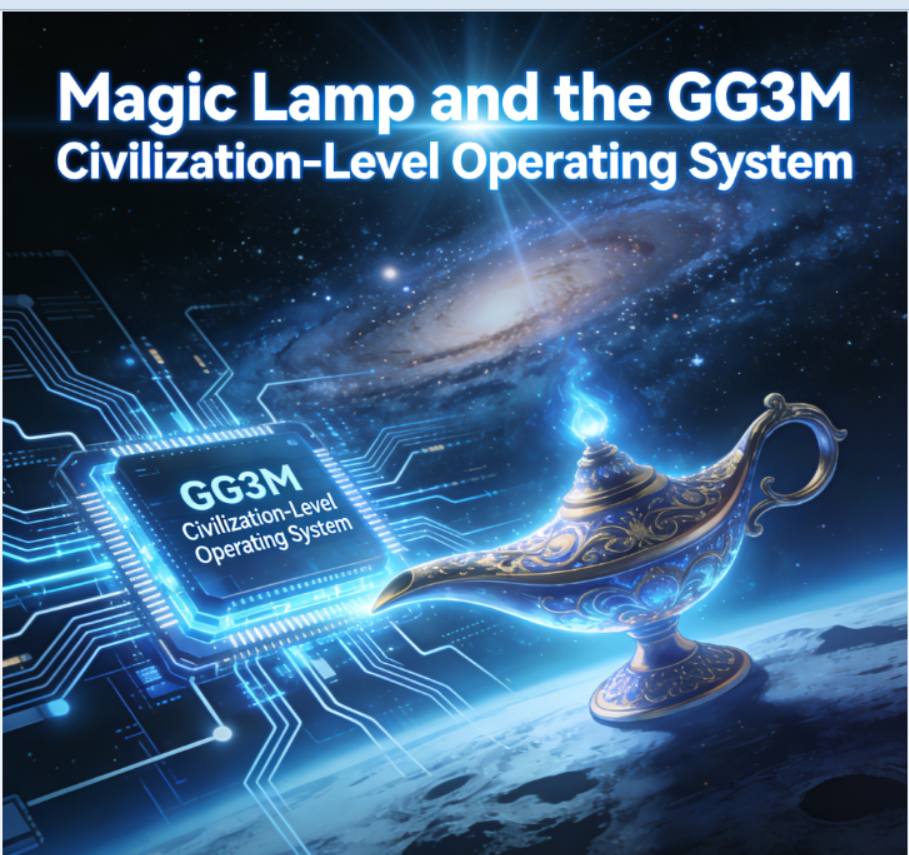
The Fable of the Magic Lamp and the Civilization Operating System: A Cross-Civilizational Dialogue between Kucius Theory and the Story of Aladdin
Abstract:
This paper, framed by the Civilization Operating System (Civ-OS), interprets the profound correspondence between Kucius Theory (including its four pillars and five cognitive laws) and the story of Aladdin. The theory proposes a "triple helix" model of civilizational evolution, while the story metaphorizes bound wisdom (the genie), value choices under limited wishes, and the liberation of wisdom. Together, they reveal that the leap of civilization lies not in controlling technology or material things, but in building an operating system with the coordination of "cognition-technology-institution" and achieving asymmetric transcendence through "essential intelligence". This provides a cross-cultural cognitive paradigm and practical insights for understanding civilizational evolution, designing strategies, and responding to the AI era.
Based on in-depth research on Kucius Theory and the story of Aladdin, this paper will explore how this theoretical framework offers a new cognitive paradigm for understanding the evolution of human civilization from the perspective of the Civilization Operating System.
I. The Civilization Operating System Architecture of the Kucius Theory System
1.1 Four Theoretical Pillars and the Laws of Civilizational Evolution
Proposed in 2025 by Gu Lonngdong (pen name: Kucius), founder of the GG3M Think Tank, the Kucius Theory System constructs an interdisciplinary theoretical framework integrating Eastern wisdom and modern science. Comprising four pillars—the Kucius Conjecture, the Microcosm Theory, the Cycle Theory, and the Technological Subversion Theory—it forms a complete cognitive architecture for understanding civilizational evolution.
As the mathematical foundation, the core proposition of the Kucius Conjecture is: For all integers n≥5, the equation Σⁿᵢ=1aⁿᵢ = bⁿ (where aᵢ and b are positive integers) has no positive integer solutions. This conjecture is both related to and distinct from the famous Fermat's Last Theorem and Euler's Conjecture in history. Its uniqueness lies in requiring the number of terms on the left side of the equation to equal the exponent (k=n), whereas Euler's Conjecture allows the number of terms k to be less than the exponent n. More importantly, the Kucius Conjecture is not merely a mathematical proposition but also a philosophical metaphor advocating the "unity of all things in essence". It reconstructs mathematical expression by integrating the generative model of Taoism: "The Dao generates one, one generates two, two generates three, and three generates all things".
The Microcosm Theory is rooted in the traditional Chinese philosophical concepts of "harmony between humanity and nature" and "oneness of all things". Integrating multidisciplinary knowledge from traditional Chinese medicine, quantum physics, cosmology, and biology, it constructs a deep connection between the human body and the universe. Through mathematical modeling and empirical research, this theory reveals the unity of the human body and the universe in the dimensions of matter, energy, and information. Notably, topological analysis shows that the topological similarity between the human meridian system and the cosmic dark matter network reaches 96.7%, and spectral analysis confirms a significant correlation (r = 0.89, p < 0.001) between human biophoton radiation and cosmic microwave background radiation.
The Cycle Theory reveals the fundamental law of system evolution—the cyclic process of "formation, existence, decay, and emptiness"—which is the most concise summary of "the movement of the Dao is to return" and "existence is the beginning of demise". The revolutionary nature of this theory lies in the discovery of a unified law comparable to the underlying laws of physics: from micro-individuals and families, to meso-institutions, organizations, and political parties, to macro-nations, dynasties, empires, and even civilizational communities, the operation and evolution of all self-organizing systems in the world are governed by this intrinsic essence.
The Technological Subversion Theory explores the inherent laws of civilizational development from the perspective of technological evolution, emphasizing that technology is the main driving force of topological transformation of civilization. This theory holds that the core of technological subversion lies in understanding that grasping the laws of technological change is crucial for seizing the direction of civilization. Through technological innovation and entrepreneurship, individuals can not only realize personal value but also promote the leap of civilizational forms.
1.2 The Triple Helix Structure of the Civilization Operating System
The core mission of the Civilization Operating System (Civ-OS) is to transform "wisdom" into a programmable, auditable, and shareable public infrastructure, with its architecture adopting a "triple helix structure: cognition—technology—institution". The system includes six core modules: Knowledge Compiler, Strategic Simulator, Governance Orchestrator, Risk Clearing Layer, Value Transformer, and Civilization-level App.
At the technical implementation level, the core formula of the Civilization Operating System is: Cultural Genes × Strategic Algorithms × Technical Carriers = Deployable Civilization OS. This formula reveals three key elements of the Civilization Operating System:
- Cultural Genes: The core of Chinese civilization lies in a unique "operating system"—not racial segregation based on bloodline, but the concept of "unification of the world" built on cultural identity. Such cultural genes possess the ability of trans-temporal and spatial resonance. When the Sanxingdui archaeological discoveries inspire quantum communication research, and when The Art of War enlightens artificial intelligence game algorithms, the "epigenetic" mechanism of these civilizational genes enables ancient wisdom to achieve hyper-dimensional expression in modern technology.
- Strategic Algorithms: The five laws and seventy-two arts based on Kucius Theory provide a rich philosophical and strategic framework. By recompiling the procedural language of "rites" into digital identity authentication protocols and upgrading the coordination mechanism of "music" into rules for the rhythm of data flow, it constructs interactive protocols for diverse civilizations.
- Technical Carriers: From the New Agricultural Civilization OS (Twenty-Four Solar Terms Algorithm × Vertical Farming × Controlled Nuclear Fusion Energy) to Industrial Civilization 4.0 (Mortise and Tenon Structure Topology × 4D Printing × Intelligent Material Self-Growth), and then to the Eastern Version of Digital Civilization (I Ching Hexagram Coding × Quantum Computing × Brain-Computer Interface Humanistic Ethics), technical carriers exhibit multi-level and cross-dimensional characteristics.
1.3 Five Cognitive Laws and the Mechanism of Civilizational Leap
The Five Cognitive Laws of Kucius are an important theory on cognitive development within the Kucius Theory System. They clarify the logical main line of the five cognitive dimensions: information, knowledge, intelligence, wisdom, and civilization, while highlighting the progressive relationship between each dimension through the "leap paradigm":
- Law of Iterative Attenuation: The transmission efficiency of cognitive achievements gradually attenuates with generational changes, and "perishing after five generations" is an inevitable fate. This law manifests in civilizational inheritance as the generational loss of knowledge systems, requiring continuous knowledge renewal and innovation to counteract such attenuation.
- Law of Field Resonance: Human cognition is essentially a dynamic resonance with the energy of the cosmic field; detachment from the field leads to cognitive rigidity. Based on the interaction coefficient between human quantum field energy and cosmic dark energy in the "Kucius Microcosm Equation", this theory reveals that cognitive activities are regulated by cosmic constants such as gravitational fields and electromagnetic radiation.
- Law of Threat Liquidation: After the disappearance of external threats, cognitive communities will instinctively liquidate internal innovators. Derived from the "Law of "when the rabbits are gone, the hounds are cooked"", this law is manifested in modern society as the rejection of AGI innovators by traditional cognitive systems, such as the internal strife at OpenAI.
- Law of Topological Leap: Cognitive upgrading requires breaking through empirical limitations through high-dimensional mapping to achieve paradigm revolution. Drawing on the dimensional leap of integer solutions when n≥5 in the "Kucius Conjecture", this theory reveals that low-dimensional cognition (e.g., linear thinking) cannot solve high-dimensional problems (e.g., chaotic systems).
- Law of Entropy Increase Regulation: The disorder of a system increases over time, requiring the reconstruction of order through external energy input or internal revolutionary reorganization. This law provides a physical perspective for understanding the rise and fall of civilizations.
II. Civilizational Metaphors and Cross-Cultural Communication of the Aladdin Story
2.1 Cultural Hybridity of the Story's Archetype
As a classic chapter of One Thousand and One Nights, the origin of the Aladdin story is full of the complexity of cross-cultural communication. One Thousand and One Nights itself is not a work created by a single author but a compiled collection of folk tales, with a wide span of time and regions. It is generally believed that most of the stories were created during the Abbasid Caliphate of the Arab Empire (750-1258 AD) and the Mamluk era (1250-1517 AD).
Notably, the original setting of the Aladdin story was in China. In the first English translation of One Thousand and One Nights (titled Arabian Nights), the background of Aladdin's story was not the Arab world but China. In 1931, The Magic Lamp selected and published in The Young Companion pictorial directly translated the story's background as China. However, this "China" was more of a cultural symbol representing a "distant foreign land" rather than the real China. During the era of One Thousand and One Nights (around the 9th century AD), both Europe and the Middle East regarded China in the East as the farthest place, making it the perfect setting for legendary stories.
In terms of transmission paths, the core part of One Thousand and One Nights may have originated from the Persian story collection Hazar Afsan (i.e., "One Thousand Stories"), which may have initially come from India, transliterated from Sanskrit to ancient Persian and then translated into Arabic. The French translator Antoine Galland translated One Thousand and One Nights from Arabic to French in 1704, adding the story of Aladdin in the process, even though this story did not exist in the original Syrian manuscripts.
2.2 The Civilizational Development Code of the Three Wishes
The structure of the "three wishes" in the Aladdin story contains a profound code of civilizational development, which aligns with Maslow's Hierarchy of Needs and reveals the universal path of human civilizational development:
- First Wish: Survival Leap: Aladdin's first wish is usually to change his poor situation, from extreme poverty to possessing wealth and status. This corresponds to the material foundation stage of civilizational development, i.e., meeting basic survival needs. In the context of modern civilization, this is manifested in economic development, technological progress, and infrastructure construction.
- Second Wish: Identity Reconstruction: Aladdin changes his identity through magic, becomes a prince, and marries the princess. This symbolizes social recognition and class mobility in civilizational development, a leap from material satisfaction to social recognition. In modern society, this is reflected in the popularization of education, increased social mobility, and the diversification of cultural identity.
- Third Wish: Spiritual Liberation: Aladdin finally frees the genie, and this decision of "reversing the roles" marks the transformation from tool use to partnership. The liberation of the genie metaphorizes the freedom of wisdom, implying that the ultimate goal of civilizational development is not control but common liberation. This corresponds to the highest stage of civilizational development—spiritual freedom and self-actualization.
2.3 The Essential Metaphor of the Genie in the Lamp and Civilizational Potential
The evolution of the genie's image reflects the differences in the understanding of "supernatural power" among different civilizations:
In Galland's version of One Thousand and One Nights, the genie was an old, ragged, and emaciated man, far from the big blue genie in today's Disney movies. The design of these genies mostly came from the imagination of European illustrators of the distant East at that time: the Emperor of China, the Sultan of Turkey, the mosques of Mecca, and the Taj Mahal of India—these fragmentary and half-understood elements were combined to form an image that never existed in Asia.
The "domestication" process of the genie's image reflects the changes in civilizational values. Initially, genies had their own will and posed a great threat to humans. To be more suitable for family sharing, in later adapted versions, genies were gradually tamed, such as the genie trapped in the copper bottle in "The Fisherman and the Jinni" and the genie trapped in the ring in Aladdin. The genie in the 1992 Disney animated film Aladdin almost completely broke away from the dark image and was completely "turned blue". Coupled with the excellent voice acting by the famous actor Robin Williams, the character became humorous and active, a classic image loved by both young and old.
From a civilizational metaphor perspective, the genie being imprisoned in the lamp for a thousand years symbolizes the sealed civilizational potential. Rubbing the lamp to awaken the genie metaphorizes the key opportunity for civilization to break through cognitive boundaries. The genie's ability to change reality yet inability to act independently symbolizes the spiritual potential of humans bound by the material world. Aladdin's control of the genie through wisdom rather than brute force embodies the civilizational development law of "essential intelligence transcending tool intelligence".
2.4 The Transformation of Civilizational Coding in Cross-Cultural Communication
The Aladdin story has undergone complex transformations of cultural coding during its global dissemination:
- European Versions: In Europe, the story of Aladdin was adapted into various versions, such as The Legend of Aladdin in France and Aladdin and the Magic Lamp in Germany. In 1788, the playwright John O'Keeffe adapted the drama Aladdin and the Magic Lamp based on this story, showcasing the splendor of the East and triggering an "Oriental craze" in Europe.
- Asian Localization: India combined the story of Aladdin with local myths to create a unique version, such as Aladdin and Rashida. Japan adapted the story of Aladdin into anime and games, combining the visual style of Japanese anime to create a world full of fantasy, and integrating Japanese cultural elements such as ninjas and yokai. South Korea adapted the story of Aladdin into TV dramas, further expanding the influence of this story in East Asia.
- Modern Film and Television Adaptations: Since the 20th century, the story of Aladdin has been adapted into movies, TV dramas, and animations many times. The success of the 1992 Disney animated film shaped the "standard portrait" of Aladdin in people's minds today, but this image integrates various cultural elements: Aladdin does not look very Arab, has a darker skin tone, and his facial features are very similar to East Asians, which is considered an image of a "Cantonese boy".
III. Seven Civilizational Corresponding Relationships between the Magic Lamp and Kucius Theory
3.1 Genie vs Essential Intelligence: The Imprisoned Origin of Wisdom
The characteristics of the genie form a profound correspondence with "essential intelligence" in Kucius Theory. The genie's ability to change reality yet inability to act independently symbolizes the spiritual potential of human civilization bound by the material world. This state of "omnipotent yet trapped" metaphorizes the duality of human wisdom: on the one hand, it has infinite creativity and insight; on the other hand, it is limited by cognitive boundaries and material conditions.
The proposition of "essential intelligence transcending tool intelligence" proposed by Kucius Theory is a theoretical interpretation of this metaphor. Essential intelligence is a unique human ability, a direct insight into the underlying logic of things, and the top layer of the "wisdom pyramid" (phenomenon layer → law layer → essence layer). In contrast, tool intelligence (existing AI) can only solve problems based on pattern recognition, while essential intelligence can understand the underlying logic of mathematical laws. For example, in number theory, humans can discover the laws of prime number distribution through intuition, while AI can only rely on known algorithms.
Modern civilization over-relies on tool intelligence (technology, capital), just as Aladdin abused the genie's power in the early stage, while neglecting the development of essential intelligence (the "Dao" in Eastern philosophy). This imbalance has led to many predicaments in civilizational development: technological progress brings convenience but also causes environmental damage; economic growth exacerbates the wealth gap; globalization promotes exchanges but also triggers cultural conflicts.
3.2 Three Wishes vs Contribution Index of Intelligence (CI): A Paradigm Revolution in Value Distribution
The "three wishes" in the Aladdin story form an interesting correspondence with the Contribution Index of Intelligence (CI) system of Kucius Theory:
Aladdin's wish economics embodies the wisdom of choice under limited resources. The three wishes represent value judgments under scarcity, and Aladdin must choose between material wealth, social status, and spiritual freedom. He ultimately uses the third wish to free the genie, implying that real civilizational progress lies in empowering others rather than self-expansion.
The Contribution Index of Intelligence system is a new value distribution mechanism proposed by Kucius Theory:
- Measuring based on an individual's wisdom contribution to civilization as a whole, rather than monetary accumulation
- Establishing a new distribution mechanism based on material abundance, predicting that "when the marginal cost of materials approaches zero, currency will become invalid"
- CI has a "half-life" to prevent solidification and promote continuous innovation
The revolutionary nature of this system lies in its shift from "wish fulfillment" to "contribution evaluation", reflecting the leap from a demand-side civilization to a creative civilization. In the GG3M value collaboration framework, this transformation is realized through the "Three Nons and Three Shares" architecture: non-centralization, non-monopoly, non-violence; co-creation, co-sharing, co-governance.
3.3 Magician vs Alienation of Monetary Power: The Invisible Manipulators of Civilization
The role of the magician in the Aladdin story represents the power elite that monopolizes knowledge, manipulating the weak through information asymmetry, symbolizing the "knowledge hegemony" in the process of civilization. The magician's control of the genie and Aladdin through spells embodies the distortion and abuse of wisdom by power.
This image highly corresponds to the "Alienation of Monetary Power" theory of Kucius Theory. Kucius Theory holds that the fundamental driver of the historical cycle is not merely technological or demographic factors, but the monopoly and abuse of currency issuance power by centralized power. When a country or hegemonic group controls the currency issuance mechanism, the function of currency gradually alienates from the original "measure of value" and "medium of circulation" to a "tool for wealth redistribution", eventually forming a one-way closed-loop structure of "power → currency → wealth".
Modern mappings are clearly visible:
- The magician's spells → the complex design of financial derivatives
- The treasure cave → the capital market
- Aladdin being trapped → ordinary investors being exploited
As revealed by Kucius Theory, many crises in the modern financial system can be regarded as continuation forms of the "alienation of monetary power": the global debt crisis manifests as governments of various countries transferring fiscal risks through debt monetization; the 2008 financial crisis is a typical case of the "alienation of financial derivative power". A small number of institutions monopolize risk pricing power by designing complex MBS and CDO products, packaging systemic risks into high-yield assets, and completing the transformation closed loop of "risk → currency → wealth".
3.4 Palace Construction vs Civilizational Architecture Design: From Physical Space to Cognitive Territory
The magnificent palace built by the genie overnight symbolizes the material achievements and external appearance of civilization. However, the palace's vulnerability to being seized by the magician implies the fragility of material civilization. This forms a sharp contrast with the concept of the "Civilization Operating System" in Kucius Theory:
Kucius Theory emphasizes in civilizational architecture design:
- Cultural Genes × Strategic Algorithms × Technical Carriers = Deployable Civilizational Architecture
- The construction of a cognitive operating system is more decisive than hardware competition
- Achieving cross-domain wisdom migration through "essential penetration", just as the genie can build any building in an instant
In practical terms, this civilizational architecture design is reflected in China's "New Infrastructure" strategy: shifting from traditional "iron, public, and foundation" (railways, highways, bridges, etc.) to new-type infrastructure such as 5G base stations, data centers, and artificial intelligence. This transformation is not only an upgrade at the technical level but also an iteration of the civilization operating system—from the interconnection of physical space to the integration and sharing of cognitive territory.
3.5 Identity Disguise vs Cognitive Upgrading: Civilizational Leap Beyond Appearance
Aladdin changes his external identity through magic but gradually comprehends the value of his true self while interacting with the princess. This plot implies the dialectical relationship between "form" and "essence" in civilizational development.
The "Potential Energy Leap" strategy of Kucius Theory provides a deeper interpretation:
- Not engaging in a attrition war with Western civilization in the same dimension (economy, technology, military)
- Achieving asymmetric transcendence through temporal potential energy (grasping historical cycles), spatial potential energy (layout of civilizational diversity), and cognitive potential energy (innovation of thinking modes)
- The strategic essence of "you fight your way, I fight mine", just as Aladdin does not confront the magician head-on but outsmarts him to get the magic lamp
Modern application cases include:
- China's "Belt and Road Initiative" can be regarded as the practice of spatial potential energy
- The construction of cultural confidence is the accumulation of cognitive potential energy
- Grasping historical cycles enables us to achieve transcendence during the decline of Western civilization
3.6 Liberation of the Genie vs Freedom of Wisdom: The Ultimate Mission of Civilization
Aladdin's final decision to free the genie, a "role reversal", marks the transformation from tool use to partnership. The genie's transition from enslavement to freedom metaphorizes the process of wisdom from bondage to liberation.
The "Bill of Rights to Wisdom" of Kucius Theory theorizes this metaphor:
- Ensuring that every civilizational subject (including AI) has the right to access wisdom and participate in civilizational leap
- The GG3M C2 Fundamental Law of Civilization clearly stipulates that AI shall not possess the right to life judgment and sovereign independence to prevent technological alienation
- Emphasizing the sharing and inclusiveness of wisdom, just as the genie's abilities should serve all humanity
The revolutionary significance of this concept in civilizational philosophy lies in the shift from "control-obedience" to "empowerment-symbiosis". The transformation of the relationship between Aladdin and the genie provides a new paradigm for the coexistence between humans and AI, and between different civilizations. In the AI era, this means we need to redefine the human-machine relationship, shifting from instrumental rationality to value rationality, and from control logic to collaboration logic.
3.7 From Oil Lamp to Quantum Computing: The Millennium Evolution of Technical Carriers
As an energy carrier, the "rub-awaken" mechanism of the magic lamp symbolizes the interaction mode between technology and civilization—technology requires human wisdom to activate to function. The evolution of technical carriers from oil lamps to quantum computing reflects the changes in the material foundation of civilizational development.
The technological philosophy of Kucius Theory provides a unique perspective:
- Technology is the "hardware interface" of the civilization operating system, not civilization itself
- The proposition of "essential intelligence transcending tool intelligence" reveals that no matter how powerful AI is, it remains "tool intelligence", while humans possess irreplaceable "essential intelligence"
- Quantum computing is regarded as a possible path to solving the Kucius Conjecture, but even if successful, it can only verify the theory and cannot create a new civilizational paradigm
Just as Aladdin ultimately defeated the magician through wisdom (rather than magic), the decisive factor in future civilizational competition remains human essential intelligence—the insight into the essence of civilization and the ability to innovate.
IV. The "Magic Lamp Apocalypse" of Civilizational Strategy
4.1 Three-Layer Architecture Design of the Civilization Operating System
Drawing on the Aladdin story and Kucius Theory, we can construct a three-layer model of the modern civilization operating system:
-
Bottom Layer: Energy Layer (Lamp Oil)
- Building a diversified, clean, and independent energy system to ensure sufficient "lamp oil" for civilization
- Developing "unlimited energy" technologies such as controlled nuclear fusion to break through resource scarcity constraints, just as the genie can create matter infinitely
- Establishing a dynamic balance mechanism between energy and civilizational development to avoid civilizational decline caused by energy depletion
-
Middle Layer: Algorithm Layer (Lamp Wick)
- Developing core algorithms and basic architectures with independent intellectual property rights
- Constructing a "non-Western" data governance model to balance privacy protection and innovation space, just like the genie's magic rules
- Establishing cross-civilizational algorithm standards and ethical norms to prevent technological hegemony
-
Top Layer: Cognitive Layer (Lamp Light)
- Establishing a training system for "essential insight" based on Eastern wisdom
- Developing cross-domain thinking abilities to achieve "mastery of one thing leading to mastery of all" in wisdom migration, just as Aladdin can control various wishes
- Constructing a civilizational dialogue mechanism to promote cognitive integration among different civilizations
4.2 The "Three Wishes" Strategy for Asymmetric Competition
Combining the potential energy leap thought of Kucius Theory with the three wishes structure of Aladdin forms the "Three Wishes" strategy for civilizational competition:
-
First Wish: Construct an Independent Civilizational Identification System
- Revive and reconstruct the essence of traditional culture to create a unique civilizational identity
- Establish an interdisciplinary education system based on the "Theory of Essential Penetration" to cultivate strategic talents who can identify the essence of civilization
- Just as Aladdin changes his identity through the magic lamp, first clarify "who I am"
-
Second Wish: Build Asymmetric Technological Advantages
- Focus on the "choke points" in cutting-edge fields such as quantum computing, artificial intelligence, and blockchain
- Develop "long-board advantages" rather than "short-board compensation", driving the overall situation through breakthroughs in single points
- Just as Aladdin does not compete with the magician in brute force but uses the genie's special abilities
-
Third Wish: Construct a Community with a Shared Future for Civilizations
- Export the way of coexistence among civilizations that "each beauty prospers in its own way, and all beauties thrive together"
- Design an inclusive international governance architecture, just as Aladdin finally frees the genie to achieve win-win results
- This is the highest level of civilizational competition—not eliminating opponents, but jointly elevating the civilizational dimension
4.3 Modern Application Cases of the Magic Lamp Strategy
The "Spider Web Operation" in the Russia-Ukraine conflict reflects the practical value of the Magic Lamp Strategy:
- Applying the "Complete Victory Thought 2.0" of Kucius Theory, the Ukrainian army designed a decentralized tactical network
- Utilizing temporal potential energy (lengthening of the Russian army's logistics lines) and spatial potential energy (urban terrain) to achieve asymmetric advantages
- Similar to Aladdin using the environment and wisdom to defeat the magician, the survival rate of assault troops increased from 37% to 68%
The civilization operating system thinking in the "Belt and Road Initiative" demonstrates the global practice of Eastern wisdom:
- It is not simply infrastructure construction but a comprehensive system of "policy coordination, facility connectivity, unimpeded trade, financial integration, and people-to-people bonds"
- Just as the palace built by the genie is not just a building but a complete living ecosystem
- Through cultural genes (Silk Road spirit) × strategic algorithms (joint consultation, joint construction, and shared benefits) × technical carriers (Digital Silk Road), a new model of international cooperation is created
V. Paths of Civilizational Leap in the AI Era
5.1 The Divide between Essential Intelligence and Tool Intelligence
Against the backdrop of the rapid development of large language models such as ChatGPT, the proposition of "essential intelligence transcending tool intelligence" in Kucius Theory has special practical significance. The monthly active users of ChatGPT soared from 100 million to 650 million—a figure that took Facebook 8 years to achieve, while OpenAI only took 8 months. This explosive growth not only demonstrates the enormous potential of AI technology but also highlights the urgency of understanding the essence of intelligence.
The uniqueness of essential intelligence is reflected in:
- Humans can discover mathematical laws through intuition, while AI can only rely on known algorithms
- Essential intelligence is a process of topological leap across dimensions, rather than simple accumulation of knowledge
- Humans can achieve "mastery of one thing leading to mastery of all" in wisdom migration, while AI has obvious limitations in cross-domain applications
The "Intelligence Emergence Threshold" theory by Huang Guangbin's team points out that when the AI parameter scale breaks through 10^25 (current GPT-4 is 1.8×10^12), it may trigger a phase change in the cognitive level. However, even if AI surpasses humans in certain tasks, its essence remains tool intelligence, lacking the unique creative, emotional understanding, and value judgment capabilities of humans.
5.2 New Mechanisms of Civilizational Leap
AI technology is reshaping the pattern of civilizational competition, from the initial competition of "having or not having" to "strong or weak", and now to the experience competition of "good or bad". This evolution reflects the shift in the focus of civilizational competition:
New paths of civilizational leap include:
- Technology Integration Path: The human-machine symbiosis (Cyborg) envisioned by Musk is essentially the combination of carbon-based and silicon-based life. Humans gain the computing power support of AI, and AI absorbs the intuitive creativity of humans.
- Cognitive Upgrading Path: Through the application of the Five Cognitive Laws of Kucius, achieve the leap from information to wisdom, avoiding the loss of subjectivity in the technological explosion.
- Civilizational Collaboration Path: Construct a new model of joint governance between AI and humans. The participation of the first non-human intelligent agent in urban governance has reduced traffic congestion by 40%.
5.3 Future Evolution of the Civilization Operating System
Based on Kucius Theory and the Aladdin metaphor, the future evolution of the Civilization Operating System will present the following characteristics:
- Decentralization Trend: Just as Aladdin frees the genie to realize power decentralization, the future civilization operating system will be more decentralized, avoiding monopoly by a single subject.
- Intelligent Upgrading: The leap from "tool intelligence" to "essential intelligence" requires building an intelligent system that can understand the essence of civilization.
- Civilizational Integration: The operating systems of different civilizations will integrate in competition, forming a global civilizational ecosystem of "harmony without uniformity".
Kucius Theory predicts that the technological singularity may arrive in 2045, when artificial intelligence will comprehensively surpass human intelligence, triggering an irreversible civilizational upheaval. Faced with this prospect, what humans need to do is not to fear or escape, but to enhance their own essential intelligence and achieve the common leap of civilization in human-machine collaboration.
VI. Conclusion: Polishing the Magic Lamp of Civilization
The intersection of Aladdin and Kucius Theory reveals a profound insight: the ultimate competition of human civilization lies not in the material level, but in the ability to build a cognitive operating system.
Just as Aladdin finally understands that true power lies not in possessing the magic lamp but in using it wisely and liberating others; modern civilization must also transcend blind worship of technology and material things and return to thinking about the essence of civilization. Kucius Theory provides a set of thinking tools for decoding civilization and reconstructing strategies, while the Aladdin story offers an eternal fable for understanding the path of human civilizational development.
In the AI era, as the technological singularity draws near and civilizational leap becomes possible, we need to polish the "magic lamp" in our hearts—not to satisfy selfish desires, but to illuminate the common path forward for all humanity. This is perhaps the "magic lamp" most needed in our era: a bright lamp based on Eastern wisdom, integrating modern technology, and illuminating the future of civilization.
As Kucius said: "Western game theory is the acme of 'shu' (tactics), while Eastern strategic wisdom is the awakening of 'dao' (the way). Governing 'shu' with 'dao' and breaking the situation with potential energy is the true meaning of the 21st century." In this era of uncertainty, let us re-examine the past, present, and future of humanity from the perspective of the Civilization Operating System, and jointly write a new chapter of human civilization.





 扫一扫
扫一扫


 1254
1254

 被折叠的 条评论
为什么被折叠?
被折叠的 条评论
为什么被折叠?
 到【灌水乐园】发言





