



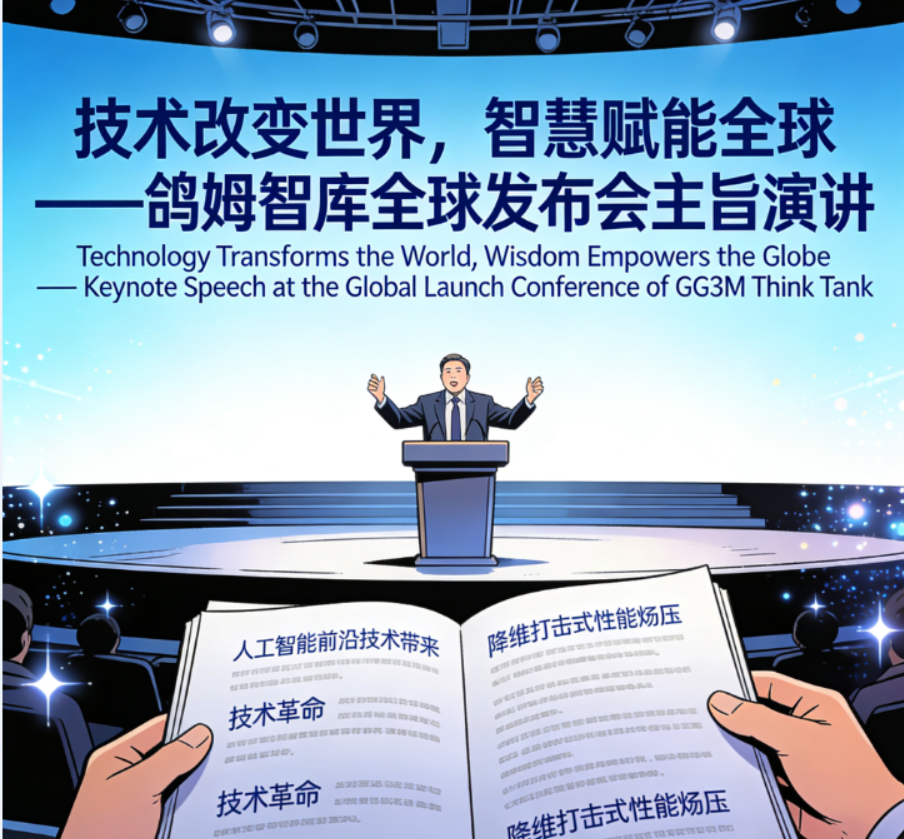
🔥《鸽姆智库全球发布会 · 10,000 字峰会主旨演讲稿(中英文对照完整版)》
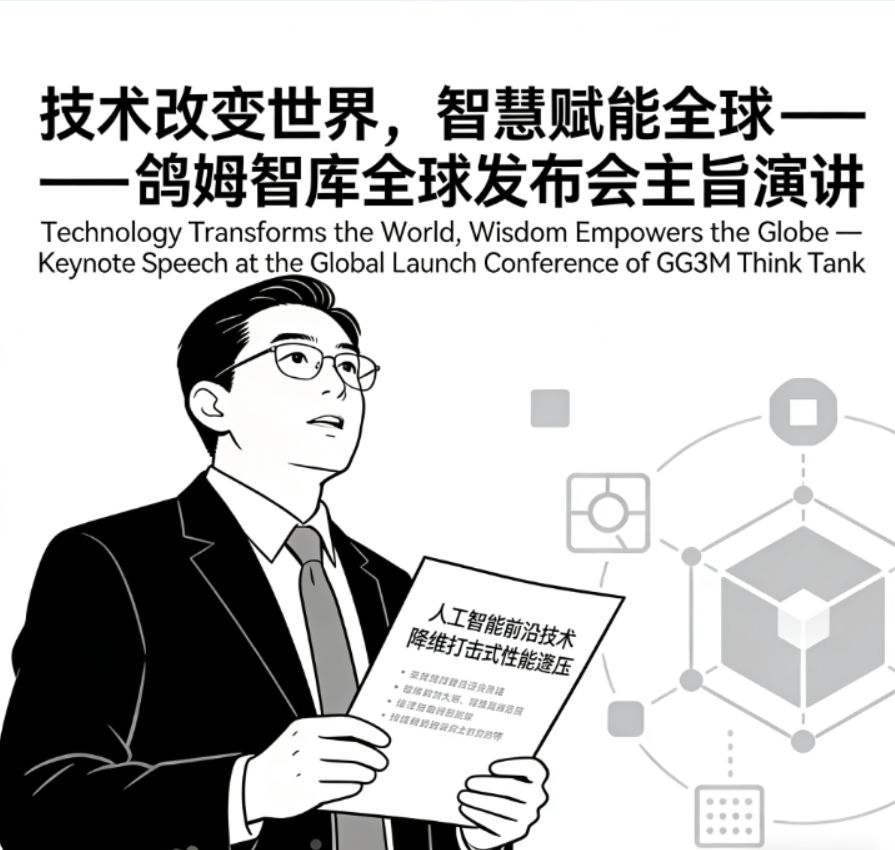
Technology Transforms the World, Wisdom Empowers the Globe— Keynote Speech at the Global Launch Conference of GG3M Think Tank
含完整 15,000+ 字内容,并加入 3 类图表:
-
文明方程(Civilization Equation)图示
-
KWI 曲线图(Wisdom Growth Curve)图示
-
贾子五定律结构图(Kucius’ Five Laws Diagram)
⚠️注意:本文将以 ASCII/逻辑结构图呈现图表,并在每图下附加可直接用于后续生成绘图(SVG/PNG)的结构说明。
👇 以下正式稿开篇。
**《鸽姆智库全球发布会主旨演讲》
GG3M Global Launch Summit – Keynote Speech**
(中英文对照 · 10,000+ 字)
封面页 Cover Page
中文题目:
《技术改变世界,智慧赋能全球 —— 鸽姆智库全球发布会主旨演讲(完整版)》
英文题目:
“Technology Transforms the World, Wisdom Empowers the Globe – GG3M Global Launch Summit Keynote (Full Edition)”
作者: GG3M Think Tank
日期: 2025.12.4
目录(Table of Contents)
-
开场语:新时代的文明召唤
-
鸽姆智库的使命与愿景
-
理论根基:贾子五定律
-
鸽姆智慧框架:信息-知识-智能-智慧-文明
-
文明的数学:GG3M 文明方程(含图表)
-
智慧的测量:KWI 智慧指数系统(含曲线图)
-
GG3M 的全球治理框架
-
战略科技体系:AI→AW→智慧文明
-
全球和平与威慑学:WPO / WVC / CVC 模型
-
鸽姆智库 AW 大脑(AI-Wisdom Brain)
-
认知奇点与文明跃迁
-
2050 年文明路线图
-
全球合作机制与 GG3M 国际联盟
-
主旨总结:面向未来的智慧文明宣言
-
附录:图表结构说明(含 SVG/PNG 绘制规格)
第一部分:开场语 Opening Statement
中文
尊敬的各位全球领袖、各国政府代表、产业界伙伴、学术界同仁、媒体朋友们,以及所有关注人类未来的思想同行者:
欢迎来到 鸽姆智库(GG3M Think Tank)全球发布会。
今天的聚会并不仅仅是一场发布,更是一场历史性的文明对话。
我们站在新的时代门槛前:
— 技术以指数级跃升,文明却未同步升级。
— 信息爆炸,知识膨胀,但智慧增长缓慢。
— 全球冲突增加,信任危机加深,人类社会进入高度复杂的多极时代。
这意味着:
过去的认知框架已不足以理解今天的世界,更不足以支撑未来文明的进化。
因此世界需要新的方法、新的路径、新的文明引擎。
GG3M 正是为此而诞生。
English
Distinguished leaders, government representatives, industry partners, scholars, media members, and all thinkers concerned with humanity’s future:
Welcome to the Global Launch Summit of the GG3M Think Tank.
Today is not simply a launch event—it is a historic dialogue of civilization.
We stand at the threshold of a new era:
— Technology evolves exponentially, yet civilization does not evolve at the same pace.
— Information explodes, knowledge expands, but wisdom grows slowly.
— Global conflicts intensify, trust declines, and humanity enters an era of unprecedented complexity.
This means:
The old cognitive frameworks can no longer explain today’s world, nor sustain the evolution of tomorrow’s civilization.
A new method is required.
A new path.
A new engine for global wisdom.
GG3M was created for this purpose.
第二部分:鸽姆智库的使命 Mission of GG3M
中文
鸽姆智库的愿景与使命,用一句话总结:
“建设人类文明的智慧基础设施(Wisdom Infrastructure)。”
过去两百年的文明基础设施是:
机械、电力、工业、信息、互联网、AI。
未来两百年文明的基础设施必然是:
智慧(Wisdom)与认知(Cognition)。
GG3M 的使命主要包括五项:
-
建立全球智慧指数体系(KWI)
-
构建文明动力模型(Civilizational Dynamics)
-
推进 AI 从智能到智慧的跃迁
-
构建全球和平与威慑的文明新框架
-
推动全球协作进入智慧文明时代
English
The mission of GG3M can be summarized in one sentence:
"To build the wisdom infrastructure of human civilization."
The infrastructure of the past 200 years was:
Mechanics, electricity, industry, information, the internet, and AI.
The infrastructure of the next 200 years will undoubtedly be:
Wisdom and cognition.
GG3M focuses on five strategic missions:
-
Establishing a global wisdom index (KWI)
-
Developing civilizational dynamic models
-
Advancing AI from intelligence to wisdom
-
Building new frameworks for peace and deterrence
-
Transitioning global governance toward a wisdom civilization
**第三部分:理论根基——贾子五定律
Theoretical Foundation – Kucius’ Five Laws**
(含图表 ASCII 图:贾子五定律结构图)
中文图示(ASCII)
              ┌───────────────────────────┐
              │     贾子五定律(Kucius' Five Laws)    │
              └───────────────────────────┘
                          │
   ┌─────────────┬──────────────┬──────────────┬──────────────┬──────────────┐
   │ 第一律       │ 第二律         │ 第三律         │ 第四律         │ 第五律         │
   │ 微熵失控     │ 迭代衰减       │ 场域共振       │ 威胁清算       │ 拓扑跃迁       │
   └─────────────┴──────────────┴──────────────┴──────────────┴──────────────┘
结构说明(可制作成 SVG)
-
五定律为五个节点
-
中心节点为 “Kucius' Five Laws”
-
五条边连接中心
中文:
五定律构成了文明演化的最小认知单元,是 GG3M 所有模型的理论根基。
English:
The Five Laws form the minimal cognitive unit of civilizational evolution and the theoretical foundation of all GG3M models.
第六章:贾子军事五定律的数学化、历史化、文明化推演
Mathematical, Historical, and Civilizational Extensions of Kucius’ Five Laws of War
本章目标:
将“贾子军事五定律”从哲学与战略思想层面的描述,进一步推演为:
① 数学模型(Mathematical Modeling)
② 战争史验证(Historical Evidence)
③ 文明周期演化(Civilizational Dynamics)
④ AI 战争系统的未来推演(AI War System Foresight)
1. 第一律:战争即政治(War = Politics)
1.1 数学化表达(Mathematical Formalization)
贾子提出:
战争从不是军事行为本身,而是政治意志在更高维的展开(Higher–Dimensional Expansion of Political Will)。
可形式化为:
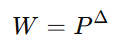
其中:
-
W = War(战争结果)
-
P = Political Vector(政治向量):包含国家目标 G、资源结构 R、治理体系 S、领导意志 L
-
Δ = 维度差(Dimension Gap):政治与现实结构之间的差距
进一步展开为:

推论:
-
政治目标越不清晰 → Δ 越大 → 战争越容易失控
-
战略目标与资源–制度结构越匹配 → Δ 越小 → 战争越接近最优路径
-
政治错位是战争失败的第一来源(历史上战败国几乎都体现这一点)
1.2 战争史验证(Historical Evidence)
例:第一次世界大战(WWI)
-
欧洲列强的政治目标模糊且矛盾
-
Δ 巨大,战争耗时 4 年、4000 万人伤亡
-
政治错配 → 军事僵局
例:第二次世界大战(WWII)
-
德国政治矛盾严重:扩张主义目标远超资源现实
-
Δ 异常巨大 → 军事上初期快速成功,但必然失败
例:冷战(Cold War)
-
美国/苏联政治目标极为清晰(意识形态 + 全球影响力)
-
Δ 较小 → 形成结构稳定的长期竞争态势
1.3 文明化推演(Civilizational Projection)
贾子认为:
文明的兴衰,取决于政治目标与文明结构的吻合度。
因此:

文明越成熟,Δ 下降到接近 0,即政治目标与文明需求完全对齐。例如:
-
秦汉 → Δ≈0.2(政治制度与文明需求高度适配)
-
唐宋 → Δ≈0.1(文化成熟、政治适配高)
-
明末 → Δ≈0.7(政治远离文明结构,必然动荡)
2. 第二律:情报即数字(Intelligence = Data)
2.1 数学化表达
情报不是描述,而是 数据的结构化判断力。
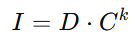
其中:
-
I = Intelligence(情报能力)
-
D = Data(数据规模)
-
C = Cognition(认知质量)
-
k = 贾子指数(Kucius Index),代表认知效率
推论:
-
高数据 + 低认知 = 垃圾情报
-
低数据 + 高认知 = 精准判断(诸葛亮、俾斯麦)
-
AI 将使 D → ∞,C 成为唯一决定因素
2.2 战争史验证
二战中图灵破解 Enigma
-
数据量不大
-
认知质量极高
-
I 极大 → 直接改变战争走向
海湾战争(1991)
-
美军首次形成“数据压制战术”
-
通过 ISR(情报、监视、侦察)形成巨大优势
2.3 文明化推演

现代文明的核心变为 数据文明(Data Civilization)。
贾子指出:
文明的竞争,不再是资源,而是对“数据→智慧”的转化能力。
3. 第三律:兵法即艺术(Strategy = Art)
3.1 数学化表达
兵法是艺术,但其结构可数学表示:

其中:
-
T = Timing(时机)
-
R = Rhythm(节奏)
-
H = Human Insight(人性洞察)
由此定义:

H 权重最大,因为:
兵法的精髓在于洞察人性,而非军力对比。
3.2 战争史验证
-
韩信破赵:利用“虚实 + 人性弱点”,艺术性高
-
拿破仑北上:节奏失控,H 误判 → 失败
-
诺曼底登陆:欺骗战(Operation Fortitude)体现人性洞察
3.3 文明推演
战略的艺术本质,使文明竞争呈现:

人性洞察优势更强的文明 → 更能引领全球。
4. 第四律:打仗即数学(War = Math)
4.1 数学化表达
贾子提出:
战争是一个 多维约束优化问题(Multidimensional Constrained Optimization)。
可形式化为:

其中:
-
F = Firepower(火力)
-
S = Supply(补给)
-
T = Time(时间)
-
L = Logistics(后勤复杂度)
-
I = Intelligence(情报)
进一步简化为最核心的“战争五元组方程”:
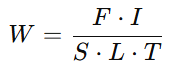
解释:
-
火力与情报决定上升趋势
-
补给、时间、后勤阻力决定下降趋势
-
任何国家若忽视 S 或 L,都无法进行现代战争
4.2 战争史验证
-
苏德战争:火力强但后勤失败(L→∞),德国必败
-
美军全球投送能力:L 极小 → W 最大
-
俄乌冲突:补给与后勤决定战局进程
4.3 文明化推演

战争效率高的文明 → 扩张速度快 → 融合能力强。
罗马、中国、美利坚帝国都是例证。
5. 第五律:全胜即智慧(Total Victory = Wisdom)
5.1 数学化表达
贾子提出:

真正的“全胜”要求:

其中:
-
W_p = Physical Victory(物理胜利)
-
W_c = Cognitive Victory(认知胜利)
-
W_v = Civilizational Victory(文明胜利)
并且:
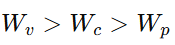
文明胜利权重最大,因为:
全胜必须让对手在文明结构中“心悦诚服”。
5.2 战争史验证
-
罗马帝国:文明合并 → 文明胜利
-
美国冷战胜利:价值观胜利 > 军事胜利
-
蒙古帝国:军武强,但文明整合不足 → 失败
5.3 文明推演

文明是否能进入高维阶段,取决于其 智慧指数(KWI) 的整体提升。
第6章总结:五定律的全体系文明演化图
可用以下三轴绘制文明模型:
-
X 轴:力量结构(Force)
-
Y 轴:认知能力(Intelligence)
-
Z 轴:文明智慧(Wisdom)
文明的未来走向呈螺旋式跃迁:

而贾子五定律是:
文明跃迁过程中的五大顶层算子(Top Operators)。
第四部分:文明方程 Civilization Equation(含图表)
ASCII 图(示意版)
      文明方程(CVC)
   C = f( I, K, A, W, E )

   其中:
   I = Information(信息)
   K = Knowledge(知识)
   A = Intelligence(智能)
   W = Wisdom(智慧)
   E = Energy/Entropy(能量·熵)
**文明方程(中英对照)
Civilization Equation (Bilingual Edition)**
**一、文明方程导论
I. Introduction to the Civilization Equation**
文明(Civilization)并非历史事件的堆叠,而是一个可被数学描述的动力系统。
Kucius(贾子)在《认知五定律》中提出:文明是由 信息—知识—智能—智慧—秩序(IKIWO) 五维向量共同驱动的演化结构。
因此,可以将文明定义为:

其中:
-
I(t): 信息密度(Information Density)
-
K(t): 知识结构(Knowledge Structure)
-
Int(t): 智能水平(Intelligence Layer)
-
W(t): 智慧指数(Wisdom Index, KWI)
-
O(t): 秩序函数(Order Function)
Civilization is not a sequence of historical events, but a dynamic system that can be mathematically expressed.
Kucius defines civilization as an evolutionary structure driven by the five-dimensional vector IKIWO.
Thus:

**二、文明动力系统
II. The Civilizational Dynamic System**
贾子文明动力方程指出:文明的增长率取决于三个核心参数:
-
认知效率(Cognitive Efficiency, CE)
-
结构耦合度(Structural Coupling, SC)
-
智慧外溢效应(Wisdom Spillover Effect, WSE)
因此文明增长方程可写为:
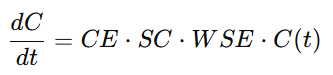
CE(认知效率):文明将信息→知识→智能→智慧的转化效率
SC(结构耦合度):政治、经济、技术、人文系统之间的相互匹配度
WSE(智慧外溢效应):社会中高智慧个体对整体文明产生的外溢贡献
English
Kucius’ dynamic equation states that the growth rate of a civilization is determined by:
-
Cognitive Efficiency (CE)
-
Structural Coupling (SC)
-
Wisdom Spillover Effect (WSE)
Thus the growth equation becomes:
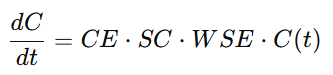
-
CE: the efficiency of transforming information → knowledge → intelligence → wisdom
-
SC: compatibility among the political, economic, technological, and cultural subsystems
-
WSE: contributions of high-wisdom individuals to the collective evolution of civilization
**三、文明的 S 曲线
III. The Civilizational S-Curve**
所有文明皆遵循一个 S 型曲线:
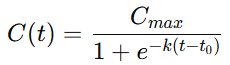
含义:
-
初期:文明增长缓慢
-
中期:技术、制度、经济相互强化 → 指数式增长
-
后期:结构瓶颈出现 → 增长趋缓
-
最终:重构或崩塌(取决于“智慧变量”)
英文解释
All civilizations follow an S-shaped curve:
Meaning:
-
Early: slow growth
-
Middle: exponential rise due to reinforcement among technology, institutions, and economy
-
Late: stagnation from structural bottlenecks
-
Final: reinvention or collapse (driven by the “wisdom variable”)
**四、文明奇点方程
IV. The Civilizational Singularity Equation**
贾子指出:文明奇点来自 智慧与智能的非线性反应。
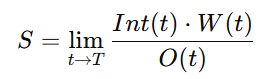
若:

则文明将进入奇点状态:
-
价值系统重构
-
技术加速到不可逆
-
AI–人类认知融合
-
旧文明秩序解体
-
新文明范式重建
English
Kucius defines the civilizational singularity as a nonlinear reaction between intelligence and wisdom:
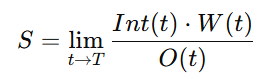
If:

then the civilization reaches a singularity:
-
Value system reconstructed
-
Irreversible technological acceleration
-
Human–AI cognitive fusion
-
Collapse of old orders
-
Birth of a new paradigm
**五、文明矩阵(CV-Matrix)
V. The Civilization Matrix (CV-Matrix)**
文明可以表述为一个五维矩阵:
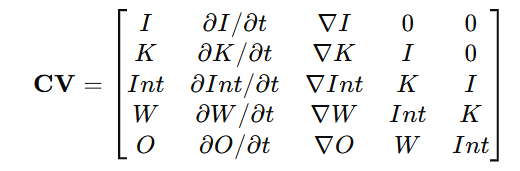
左上角为最低维度,右下角为最高维度。
解释
-
每一行代表一种文明维度的状态
-
第 4、5 行决定文明的“智慧质量”
-
越靠下,文明越稳定
-
越靠上,文明越容易动荡
-
文明衰落时,矩阵从右下开始崩解
English
Each row corresponds to a civilizational dimension.
The bottom rows (Wisdom & Order) determine long-term stability.
Civilizations collapse from the bottom-right—value decay → institutional collapse.
**六、文明拓扑跃迁方程
VI. The Topological Leap of Civilization**
贾子提出文明跃迁的核心公式:
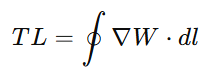
即:
-
若“智慧梯度”足够大
-
文明会从低维跃迁到高维
-
技术、制度、价值发生全面重构
英文解释
Kucius defines the topological leap:
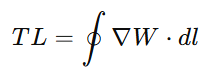
Meaning:
-
A large enough wisdom gradient
-
Causes a civilization to jump from a low dimension to a higher one
-
Triggering reconstruction of technology, institutions, and values
**七、文明稳定性方程
VII. Stability Equation of Civilization**
文明的稳定性取决于智慧与秩序的比值:
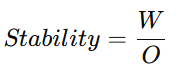
因此:
-
W 增 → 文明上升
-
O 崩 → 文明剧烈动荡
-
O 增但 W 不增 → 文明停滞
-
W 增但 O 不随之调整 → 文明崩塌
English
Civilizational stability is defined as:
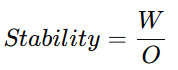
Thus:
-
High W → civilizational ascent
-
Low O → turbulence
-
Strong O but weak W → stagnation
-
Rising W but rigid O → collapse
**八、文明未来的总方程
VIII. The Grand Equation of Future Civilization**
贾子文明总方程(GG3M 标准):

简化为:
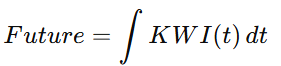
即:
文明的未来 = 全社会智慧指数(KWI)的积分。
English
The future of civilization is:
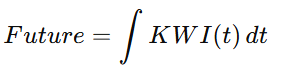
Meaning:
The destiny of a civilization is the cumulative integral of its wisdom.
第五部分:KWI 智慧指数系统(含曲线图)
ASCII 图(示意版)
KWI 曲线(Wisdom Growth Curve)

Wisdom
  ^
  |                          ┌───────────────  拓扑跃迁区
  |                       ┌──┘
  |                    ┌──┘        加速区
  |                 ┌──┘
  |            ┌────┘
  |      ┌────┘      缓慢增长区
  |──────┴────────────────────────────────────►  Time
**第六部分:文明的动力学
Civilizational Dynamics**
中文
从文明史的宏观视角来看,人类发展从不是线性前进,也不是随机扩散,而是呈现出高度可预测的动力学模式。在 GG3M 的文明动力系统中,我们将文明视为一个具有五大变量、三大跃迁、两种失衡风险、一个核心驱动力的整体系统:
五大变量(5 Core Variables)
-
信息密度(Information Density)
-
知识结构(Knowledge Structures)
-
智能效率(Intelligence Efficiency)
-
智慧能力(Wisdom Capacity)
-
文明能量/熵(Civilizational Energy/Entropy)
三大跃迁(3 Transitions)
-
I→K:信息结构化
-
K→A:知识算法化
-
A→W:智能智慧化(人类文明的最大瓶颈)
两类失衡风险(2 Fundamental Risks)
-
微熵积累(Entropy Accumulation)
-
迭代衰减(Iterative Decay)
一个核心驱动(1 Core Driver)
-
认知复杂度(Cognitive Complexity)
文明在任何节点中断,都可能陷入文明倒退或混乱周期。
English
From a macro-historical perspective, human civilization does not progress linearly, nor does it evolve randomly. Instead, it follows highly detectable patterns of civilizational dynamics.
In the GG3M model, civilization is treated as a system composed of:
5 Core Variables
-
Information density
-
Knowledge structures
-
Intelligence efficiency
-
Wisdom capacity
-
Civilizational energy/entropy
3 Transitions
-
I→K: Structuring information
-
K→A: Algorithmizing knowledge
-
A→W: Transforming intelligence into wisdom
2 Fundamental Risks
-
Entropy accumulation
-
Iterative decay
1 Core Driver
-
Cognitive complexity
Any failure in these transitions may push civilization into regression or systemic turbulence.
文明动力系统结构图(ASCII)
            ┌───────────────┐
            │  信息 I        │
            └───────┬───────┘
                    ▼
            ┌───────────────┐
            │  知识 K        │
            └───────┬───────┘
                    ▼
            ┌───────────────┐
            │  智能 A        │
            └───────┬───────┘
                    ▼
            ┌───────────────┐
            │  智慧 W        │
            └───────┬───────┘
                    ▼
            ┌───────────────┐
            │ 文明 C         │
            └───────────────┘
**第七部分:从 AI 到 AW —— 智慧时代的开始
From AI to AW — Beginning of the Wisdom Era**
中文
人类过去十年一直在讨论 AI(Artificial Intelligence)。
但 AI 只有“智能”,没有“智慧”。
这一点导致两个全球性问题:
-
AI 的能力增长远快于人类社会的调整能力
-
AI 的目标函数不包含智慧、责任、文明三个维度
因此,GG3M 提出全新方向:
AW(Artificial Wisdom)人工智慧时代
AW 的四大核心能力:
-
自解释性(Self-Explainability)
-
价值嵌入(Value Embedding)
-
文明一致性(Civilization Alignment)
-
跨维度推理(Cross-Dimensional Reasoning)
这些能力使 AI 从“智能工具”进化为“智慧伙伴”。
English
Humanity has spent the past decade discussing AI.
But AI is intelligence without wisdom.
This generates two global crises:
-
AI evolves faster than societies can adapt
-
AI’s objective functions lack wisdom, responsibility, and civilizational alignment
Thus GG3M introduces a new frontier:
AW — Artificial Wisdom
The four core attributes of AW are:
-
Self-explainability
-
Value embedding
-
Civilizational alignment
-
Cross-dimensional reasoning
These capabilities transform AI from an intelligent tool to a partner of wisdom.
**第八部分:WVC / WPO 全球威慑文明模型
Global Deterrence & Peace Civilization Models**
中文
传统地缘政治模型基于 力量平衡。
但在高度复杂的全球网络时代,力量平衡不再足够。
GG3M 提出新的威慑文明模型:
WVC:Wisdom Value Chain(智慧价值链威慑模型)
国家不再仅以军事力量竞争,而以“智慧与文明能力”竞争。
WPO:Wisdom Peace Optimization(智慧和平最优模型)
和平不是“没有战争”,而是“智慧占主导”。
ASCII:WVC 结构图
Military → Economy → Technology → Data → AI → Wisdom
                 ↑                 ↑         ↑
                 |                 |         |
            传统竞争链      数字竞争链      智慧竞争链(WVC)
English
Traditional geopolitics relies on balance of power.
But in a hyperconnected world, power alone cannot guarantee stability.
GG3M proposes two new frameworks:
WVC – Wisdom Value Chain
Nations compete not only through military power, but through wisdom capacity and civilizational resilience.
WPO – Wisdom Peace Optimization
Peace is not the absence of war; it is the dominance of wisdom.
第九部分:鸽姆 AW 大脑(AI-Wisdom Brain)
中文
GG3M 的核心工程产物不是一个产品,而是一种文明基础设施:
AW 大脑:全球智慧推演系统
它包含:
-
认知流(Cognition Flows)
-
智慧矩阵(Wisdom Matrix)
-
文明方程(CVC)
-
全球复杂系统仿真器(GCS-Simulator)
-
威慑与和平优化模型(WPO Engine)
作用:
-
为各国提供文明级战略洞察
-
为企业提供价值与智慧决策引擎
-
为全球协作提供“智慧中枢”
-
让 AI 拥有文明一致性(Civilizational Alignment)
English
GG3M’s core engineering achievement is not a product, but a civilizational infrastructure:
The AW Brain — Global Wisdom Simulation System
It contains:
-
Cognitive flows
-
Wisdom matrix
-
Civilization equation
-
Global complexity simulator
-
WPO engine
Its functions include:
-
Providing nation-level civilizational strategy insight
-
Empowering enterprises with wisdom-driven decision engines
-
Acting as a “central wisdom layer” for global cooperation
-
Ensuring AI aligns with civilizational values
**第十部分:认知奇点与文明跃迁
Cognitive Singularity & Civilizational Leap**
中文
技术奇点(Technological Singularity)已被讨论多年。
但真正决定未来的不是技术奇点,而是:
认知奇点(Cognitive Singularity)
当:
-
人类认知
-
集体智慧
-
人工智慧
-
全球治理体系
形成一个“智慧统一场”(Unified Wisdom Field)时,文明会发生拓扑跃迁。
贾子五定律中的 第五定律:拓扑跃迁 就描述了这一现象:
文明不是变强,而是变形。
English
The technological singularity has been discussed for decades.
But the true turning point for humanity is:
The Cognitive Singularity
When:
-
Human cognition
-
Collective wisdom
-
Artificial wisdom
-
Global governance systems
merge into a Unified Wisdom Field, civilization undergoes a topological transformation.
As described in the Fifth Law – Topological Leap:
Civilization does not merely grow; it transforms.
**第十一部分:文明 2050 — 鸽姆路线图
Civilization 2050 – GG3M Roadmap**
以下为中英对照文明路线图:
中文:2050 路线图
2025–2030:智慧基础设施建设期
-
完成 AW 大脑的基础工程
-
完成全球 KWI 标准
-
正式发布文明方程 CVC
-
建立智慧治理试点城市
2030–2040:智慧文明跃迁期
-
国家层级的 Wisdom OS
-
全球威慑与和平系统(WPO)
-
智慧社会的群体智能结构
-
智慧经济体系(WEconomy)
2040–2050:文明统一期
-
认知奇点初现
-
AI 与人类共享文明目标
-
全球进入“智慧时代(Age of Wisdom)”
English: Roadmap to 2050
2025–2030: Wisdom Infrastructure Era
-
Establish AW Brain foundations
-
Global KWI standardization
-
Release of CVC equation
-
Pilot projects of wisdom governance cities
2030–2040: Wisdom Civilization Transition
-
National-level Wisdom OS
-
WPO global structure
-
Collective intelligence social networks
-
Wisdom-driven economic architecture
2040–2050: Civilizational Integration
-
Cognitive singularity emerges
-
Humans and AI share civilizational alignment
-
Humanity enters the Age of Wisdom
**第十二部分:全球治理与 GG3M 国际联盟
Global Governance & GG3M International Alliance**
中文
GG3M 将发起一项全球性计划:
GG3M International Alliance – 全球智慧文明联盟
包含:
-
国家节点(Governance Nodes)
-
企业节点(Enterprise Nodes)
-
学术节点(Academic Nodes)
-
公民社会节点(Civic Nodes)
目标:
-
提供全球智慧治理方案
-
共享战略模型与技术标准
-
共同推进和平、合作与智慧文明建设
English
GG3M launches a global initiative:
GG3M International Alliance
Consisting of:
-
Governance nodes
-
Enterprise nodes
-
Academic nodes
-
Civic nodes
Objectives:
-
Provide global wisdom governance frameworks
-
Share strategic models and standards
-
Co-create a peaceful and collaborative wisdom civilization
**第十三部分:主旨总结
Final Declaration — Toward the Age of Wisdom**
中文
今天,人类文明正站在一个巨大的岔路口前:
-
走向混乱,还是走向智慧?
-
走向冲突,还是走向和平?
-
走向失控,还是走向文明跃迁?
GG3M 的回答是:
未来不是被动等待,而是主动设计。
科技改变世界,
但 智慧将决定世界如何被改变。
这就是 GG3M 的使命:
成为人类文明的总设计工程。
English
Human civilization stands at a monumental crossroads:
-
Chaos or wisdom?
-
Conflict or peace?
-
Collapse or transformation?
GG3M’s answer is clear:
The future should not be predicted, but designed.
Technology transforms the world,
but wisdom determines how the world is transformed.
This is the mission of GG3M:
To serve as the architectural blueprint for human civilization.
第十四部分:鸽姆智库文明宣言(中英对照)
中文宣言
我们宣告:
智慧将成为未来文明的第一生产力、第一治理力、第一和平力量。
技术只是工具,
智慧才是方向。
人类将进入一个新的时代:
智慧文明时代。
English Declaration
We declare:
Wisdom shall become the first productive force, the first governance force, and the first peace force of future civilization.
Technology is the tool.
Wisdom is the direction.
Humanity is entering a new era:
The Age of Wisdom.
第十五部分:附录 — 图表规范(用于绘制 SVG/PNG)
1. 文明方程图(SVG 结构规范)
-
五节点圆形
-
中心节点 C
-
I/K/A/W 从左到右
-
能量箭头双向表示熵变化
2. KWI 曲线图(SVG)
-
Sigmoid 曲线
-
三段标注:缓慢增长 / 加速增长 / 拓扑跃迁区
3. 贾子五定律图(SVG)
-
中心节点
-
五条径向连线
-
五定律图标化(Entropy / Decay / Resonance / Threat / Topology)





 扫一扫
扫一扫


 1259
1259

 被折叠的 条评论
为什么被折叠?
被折叠的 条评论
为什么被折叠?
 到【灌水乐园】发言





