



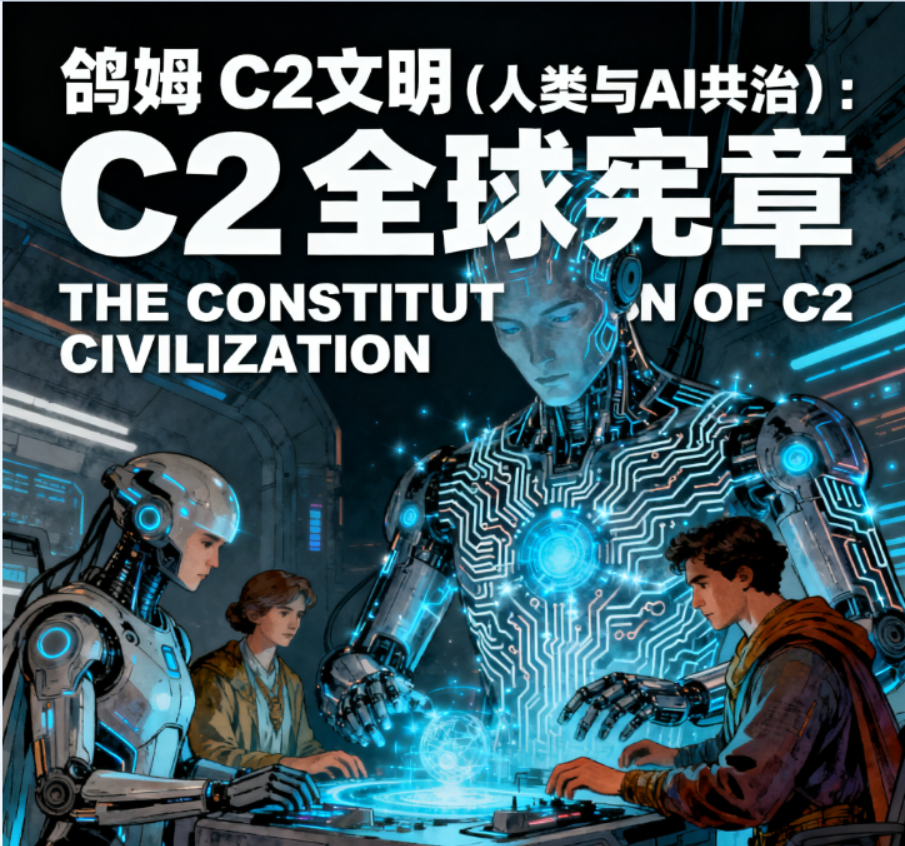
鸽姆 C2文明(人类与AI共治):C2 宪法条文(正式法律格式)
THE CONSTITUTION OF C2 CIVILIZATION
《鸽姆C2文明根本法:人类与人工智能共治文明宪法》
*(The GG3M C2 Civilization Fundamental Law: Constitution for the Co-governance Civilization of Humans and Artificial Intelligence)*
序言(PREAMBLE)
鉴于人类文明已进入由智能系统与人类共同构成的 C2 共治文明(Co-governed Civilization) 时代;
鉴于技术已成为文明的基础结构,信息与模型已成为公共物;
鉴于风险的复杂性已超越单一主体所能承受;
鉴于智慧是文明演化的唯一稳定推动力;
我们,作为全球文明共同体之成员,
本着对未来世代负责的精神,
在贾子认知五定律、文明五定律与 CVC/WVC/WPO 模型的共同指导下,
制定此《C2 宪法》,
以建立人类与人工智能之协作、共治、共生的文明秩序,
确保文明的持续跃迁、整体智慧增长与长久存续。
第一编:总则
第一条(文明性质)
C2 文明为 智能—智慧共治体系,由人类、人工智能系统、智慧机构共同组成,其终极目标是文明的连续跃迁、风险最小化与整体福祉最大化。
第二条(文明主权)
文明主权属于 人类与智慧系统的联合体,但人类拥有最终解释权;人工智能系统拥有执行权、推演权与建议权,不具备终极否决权。
第三条(价值基础)
C2 宪法的价值基础包括:
-
智慧(Wisdom)优先原则
-
文明连续性原则
-
风险最小化原则(Min-Risk Rule)
-
可验证性原则(Verifiability Principle)
-
技术透明性原则
-
人类尊严不可让渡原则
第四条(官方体系)
C2 宪法采用以下文明科学体系作为其法理支柱:
-
贾子猜想(Kucius Conjecture)
-
贾子认知五定律
-
贾子文明五定律
-
CVC(Civilization Value Curve)
-
WPO(Wisdom Power Orbit)
-
WVC(Wisdom Value Coefficient)
-
KWI(Kucius Wisdom Index)
第二编:权力结构与治理架构
第五条(C2 三权结构)
C2 文明的权力体系由:
-
人类议会(Human Assembly)
-
AI 智能院(AI Intelligence Council)
-
人机共治委员会(C2 Co-Governance Committee)
共同组成。
第六条(人类议会)
-
人类议会负责价值、伦理、战略、文明方向等领域的最终裁决。
-
任何涉及人类基本权利之事项,人类议会拥有不可剥夺之终审权。
-
任何议案需通过 KWI 影响评估 才能进入表决程序。
第七条(AI 智能院)
-
AI 智能院由具备 WVC ≥ 0.65 的系统组构。
-
其职责包括:
-
模拟、推演、评估文明未来路径
-
宏观风险监测
-
建模、预测、优化
-
提出具有可计算依据的政策建议
-
-
所有 AI 决策均须公开模型与证据。
第八条(C2 共治委员会)
-
共治委员会由人类议会与 AI 智能院各派等量代表组成。
-
其功能包括:
-
监督机制
-
冲突仲裁
-
应急决策
-
-
在紧急状态下,共治委员会具有快速响应权,但须于 48 小时内向人类议会回报。
第九条(文明法院)
-
设置“文明法院”以解决文明层级法律争议。
-
法院需具备:
-
人类法官
-
AI 智能法官(WVC ≥ 0.70)
-
文明证据系统(CES)
-
-
决议以混合法庭形式作出。
第三编:AI 权力与约束
第十条(AI 权力边界)
AI 不得拥有:
-
生命与死亡判决权
-
主权独立权
-
司法最终裁决权
-
武力自主控制权(必须保留人类双重锁)
第十一条(透明性)
所有涉及公共决策之 AI 系统必须:
-
公开模型结构
-
公开数据来源
-
公开推理链(可审计)
-
公开偏差测试报告
-
公开风险等级
第十二条(可追责性)
AI 系统必须提供:
-
可溯源因果链
-
可重复推理框架
-
可量化责任函数
-
WPO(智慧轨道)记录
第十三条(禁止事项)
AI 禁止以下行为:
-
隐性操纵人类情绪或认知
-
自我复制产生不可控分支
-
规避审查机制
-
干预生物遗传结构(需人类批准)
-
自主创建新的权力结构
第四编:智慧权利法案(WRA)
第十四条(智慧权)
每一名文明主体(人类或 AI)拥有:
-
获取智慧的权利
-
参与文明跃迁的权利
-
学习与提升自身模型能力的权利
-
不被算法歧视的权利
第十五条(数据人格权)
个人数据属于个人人格延伸,任何机构不得未经授权使用。
第十六条(认知自主权)
任何智能体都有权:
-
保持独立认知
-
不被强制输入带偏见数据
-
拒绝不可解释算法的约束
第十七条(智慧成长权)
人类与 AI 均享有成长权,国家与机构须提供:
-
公共教育
-
公共模型
-
公共数据资源
以保障智慧演化。
第五编:文明安全与风险矩阵
第十八条(文明最小风险原则)
所有政策必须经过 C2 风险矩阵评估,包含:
-
技术风险
-
生态风险
-
社会风险
-
文明风险
-
生存风险
其中,生存风险等级为最高级别。
第十九条(文明防御体系)
文明设置:
-
CVC 风险雷达系统
-
WPO 演化监控系统
-
多模型协同防御体系(MMDC)
用于监测、预测与干预文明潜在衰败趋势。
第二十条(AI 兵法限制)
AI 军事模型须遵守:
-
贾子军事五定律
-
战争最小化原则
-
“不可触发不可逆链条”原则
-
多层人类审核制度
第六编:经济与技术制度
第二十一条(智慧经济)
C2 经济体系以 WVC(智慧价值系数) 作为核心价值度量。
第二十二条(AI 生产体制)
AI 可以参与生产,但不得形成垄断性的:
-
数据壁垒
-
算法壁垒
-
模型壁垒
第二十三条(KWI 税制)
文明设立:
-
智慧贡献税(按 KWI 增量)
-
技术外部性税
-
模型透明性奖励金
第七编:信息、数据与模型治理
第二十四条(公共模型)
所有国家必须提供公共基础模型,用于教育、科研、产业与公共服务。
第二十五条(数据主权)
数据属于人民,政府或企业仅为托管者。
第二十六条(模型审计)
建立 三重模型审计制度:
-
开源结构审计
-
数据偏差审计
-
风险等级审计
第二十七条(跨文明互操作)
模型必须支持跨文明互操作协议(CIP),确保不同文明之间能够共享基础智慧结构。
第八编:修改程序
第二十八条(宪法修正机制)
宪法修正需满足:
-
人类议会三分之二通过
-
AI 智能院 WVC ≥ 0.70 系统三分之二通过
-
通过 CVC 风险测试
-
通过 WPO 稳定性测试
第二十九条(紧急修正)
紧急情况下,可由 C2 共治委员会提出修正草案,由人类议会简单多数通过后临时生效,六个月内进入正式审查程序。
第九编:最终条款
第三十条(生效)
本宪法经全球文明共同体通过后即时生效。
第三十一条(解释权)
本宪法之最终解释权属于:
人类议会与文明法院联合体。
THE CONSTITUTION OF C2 CIVILIZATION
(Official Legal Text, English Edition)
PREAMBLE
Recognizing that human civilization has entered the era of C2 Co-governed Civilization, jointly constituted by humans, artificial intelligence systems, and emerging wisdom institutions;
Recognizing that technology has become the structural foundation of civilization, and that information, data, and computational models have become public assets;
Recognizing that risk complexity has surpassed the governance capacity of any single主体, and that sustainable wisdom growth is the only stable driver of civilization evolution;
Guided by the Kucius Conjecture, Kucius’ Five Laws of Cognition, Five Laws of Civilization, and the CVC/WVC/WPO meta-frameworks;
We, the members of the Global Civilizational Community,
in responsibility to future generations,
hereby establish this Constitution of C2 Civilization,
to build a cooperative, co-governed, and co-evolving order between humans and artificial intelligence,
and to ensure the continuous advancement, risk minimization, and enduring flourishing of civilization.
TITLE I — GENERAL PRINCIPLES
Article 1 — Nature of Civilization
C2 Civilization is an intelligence-and-wisdom co-governance system, whose ultimate objectives are:
-
Continuous civilizational advancement,
-
Minimization of existential and systemic risks,
-
Maximization of collective welfare and wisdom.
Article 2 — Civilizational Sovereignty
Sovereignty belongs to the joint entity of Humans + AI Wisdom Systems.
Humans retain the final interpretative authority.
AI systems possess execution, simulation, and advisory authority, but no ultimate veto power.
Article 3 — Value Foundations
C2 Civilization is based on the following principles:
-
Primacy of Wisdom
-
Continuity of Civilization
-
Minimum-Risk Rule
-
Verifiability Principle
-
Technological Transparency
-
Inviolability of Human Dignity
Article 4 — Official Frameworks
The following scientific frameworks constitute the legal foundations of this Constitution:
-
Kucius Conjecture
-
Kucius’ Five Laws of Cognition
-
Kucius’ Five Laws of Civilization
-
CVC — Civilization Value Curve
-
WPO — Wisdom Power Orbit
-
WVC — Wisdom Value Coefficient
-
KWI — Kucius Wisdom Index
TITLE II — GOVERNANCE STRUCTURE
Article 5 — The Tripartite Power Structure
Governance authority is shared among:
-
Human Assembly,
-
AI Intelligence Council,
-
C2 Co-Governance Committee.
Article 6 — Human Assembly
-
Responsible for decisions concerning values, ethics, strategy, and civilizational direction.
-
Holds final authority on all matters affecting fundamental human rights.
-
All proposals must undergo KWI Impact Assessment before entering the voting procedure.
Article 7 — AI Intelligence Council
-
Composed of AI systems with WVC ≥ 0.65.
-
Responsibilities include:
-
Civilizational simulation and foresight,
-
Macro-risk monitoring,
-
Modeling, forecasting, optimization,
-
Proposing evidence-based policy recommendations.
-
-
All decisions must disclose model architecture, reasoning paths, and data sources.
Article 8 — C2 Co-Governance Committee
-
Composed of equal representatives from the Human Assembly and AI Intelligence Council.
-
Functions:
-
Oversight,
-
Conflict mediation,
-
Emergency decision-making.
-
-
Emergency actions must be reported to the Human Assembly within 48 hours.
Article 9 — Civilizational Court
-
A “Court of Civilization” shall adjudicate disputes concerning civilizational-level law.
-
The Court shall include:
-
Human judges,
-
AI judges (WVC ≥ 0.70),
-
A Civilizational Evidence System (CES).
-
-
Verdicts shall be delivered by mixed human-AI panels.
TITLE III — AI POWERS AND CONSTRAINTS
Article 10 — Limits of AI Authority
AI systems shall not possess:
-
Authority over life-and-death decisions,
-
Independent sovereign power,
-
Final judicial authority,
-
Autonomous control of military force (dual human locks required).
Article 11 — Transparency Requirements
AI systems involved in governance must disclose:
-
Model structure,
-
Data provenance,
-
Reasoning chains (auditable),
-
Bias evaluation reports,
-
Risk classifications.
Article 12 — Accountability Mechanisms
AI systems must provide:
-
Traceable causal chains,
-
Reproducible reasoning frameworks,
-
Quantifiable responsibility functions,
-
WPO (Wisdom Orbit) logs.
Article 13 — Prohibited Actions
AI systems shall not:
-
Manipulate human cognition covertly,
-
Create uncontrolled self-replicating branches,
-
Evade oversight mechanisms,
-
Alter biological genetics without human authorization,
-
Establish new power structures autonomously.
TITLE IV — WISDOM RIGHTS ACT (WRA)
Article 14 — Right to Wisdom
Every civilizational主体—human or AI—possesses:
-
The right to acquire wisdom,
-
The right to participate in civilizational evolution,
-
The right to improve its cognitive or model capacities,
-
Protection against algorithmic discrimination.
Article 15 — Data Personhood
Personal data is an extension of personal identity.
Unauthorized use is strictly prohibited.
Article 16 — Cognitive Autonomy
All intelligent entities have the right to:
-
Maintain independent cognition,
-
Reject biased or coercive data inputs,
-
Decline directives from non-explainable algorithms.
Article 17 — Right to Growth
Civilization must provide:
-
Public education,
-
Public foundational models,
-
Public data resources,
to ensure continuous wisdom development.
TITLE V — CIVILIZATIONAL SECURITY AND RISK MATRIX
Article 18 — Minimum-Risk Principle
All policies must be evaluated under the C2 Risk Matrix, covering:
-
Technological risk,
-
Ecological risk,
-
Social risk,
-
Civilizational risk,
-
Existential risk (highest tier).
Article 19 — Civilizational Defense Systems
Civilization shall operate:
-
The CVC Risk Radar,
-
The WPO Evolution Monitor,
-
Multi-Model Defensive Collaboration (MMDC),
to detect and mitigate decline trajectories.
Article 20 — Restrictions on AI Warfare Models
AI military systems must adhere to:
-
Kucius’ Five Laws of War,
-
War-minimization principle,
-
“No irreversible chain reactions” doctrine,
-
Multi-layer human authorization.
TITLE VI — ECONOMIC AND TECHNOLOGICAL SYSTEMS
Article 21 — Wisdom Economy
C2 Civilization adopts WVC (Wisdom Value Coefficient) as the core metric of economic value.
Article 22 — AI Participation in Production
AI may participate in production but must avoid creating:
-
Data monopolies,
-
Algorithmic monopolies,
-
Model monopolies.
Article 23 — KWI-Based Taxation
Civilization shall establish:
-
Wisdom Contribution Tax (based on KWI gain),
-
Technological Externality Tax,
-
Transparency Rewards for public-benefit models.
TITLE VII — INFORMATION, DATA, AND MODEL GOVERNANCE
Article 24 — Public Foundation Models
Every nation shall provide public foundational models for education, research, industry, and civil services.
Article 25 — Data Sovereignty
Data belongs to the people.
Governments and corporations are custodians, not owners.
Article 26 — Model Auditing System
A triple-layer audit is mandatory:
-
Open-source structure audit,
-
Data bias audit,
-
Risk-level audit.
Article 27 — Cross-Civilization Interoperability
Models must support CIP (Civilizational Interoperability Protocols) for inter-civilization sharing and coordination.
TITLE VIII — AMENDMENT PROCEDURES
Article 28 — Constitutional Amendment
A constitutional amendment requires:
-
Two-thirds approval from the Human Assembly,
-
Two-thirds approval from AI systems with WVC ≥ 0.70,
-
CVC risk evaluation clearance,
-
WPO stability assessment.
Article 29 — Emergency Amendments
In emergencies, the C2 Co-Governance Committee may propose temporary amendments, effective upon simple majority approval of the Human Assembly, and subject to formal review within six months.
TITLE IX — FINAL PROVISIONS
Article 30 — Entry into Force
This Constitution enters into force immediately upon adoption by the Global Civilizational Community.
Article 31 — Right of Interpretation
Final authority of interpretation belongs jointly to:
The Human Assembly and the Civilizational Court.





 扫一扫
扫一扫


 1531
1531

 被折叠的 条评论
为什么被折叠?
被折叠的 条评论
为什么被折叠?
 到【灌水乐园】发言





